Why Your Electrical Bus Bar Matters for EV Charging
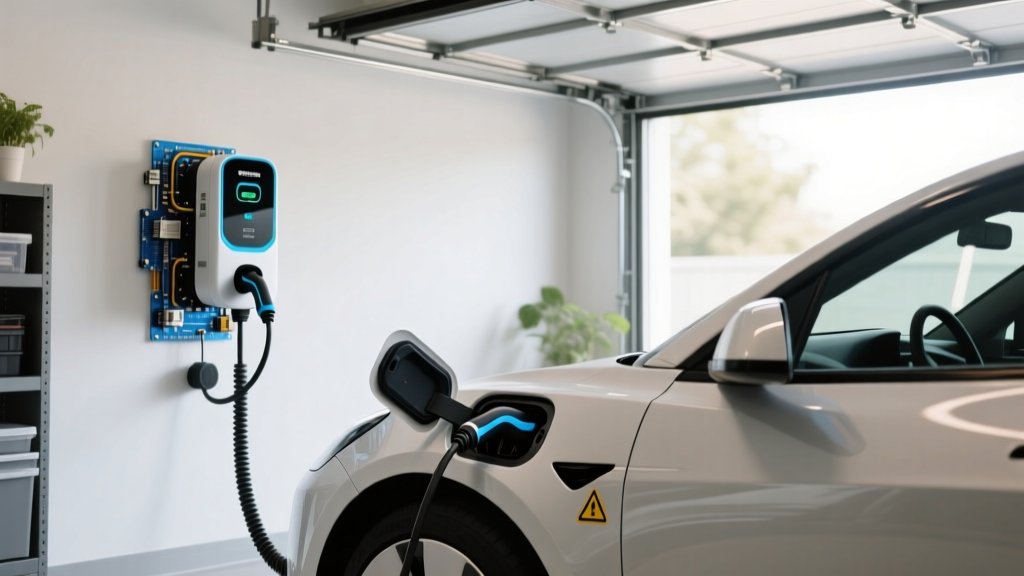
Before you order a Level 2 wall connector or schedule an electrician, there's a component inside your main electrical panel that determines whether your home can actually support EV charging: the bus bar. Often called a "charger bus" in EV forums, the bus bar is the metal strip inside your breaker panel that distributes electricity from the utility feed to every circuit in your home. Its ampacity rating — typically 100A, 150A, or 200A — sets a hard ceiling on how much total load your house can draw at once.
Add a 40-amp or 48-amp EV charger circuit to a panel already running central air, an electric dryer, and an electric range, and you may exceed that ceiling. The result? Your utility may reject the permit, your electrician may flag a code violation under NEC Article 220, or worse — you trip the main breaker repeatedly. Understanding your bus bar's capacity is step one of any home EV charging installation.
This guide covers bus bar and panel realities, charging speeds at every level, installation costs with full breakdowns, connector compatibility across 2026 models, and specific charger hardware recommendations.
Charging Levels Explained: Speeds in kW and Miles Per Hour
Every EV owner needs to internalize one distinction: kW (kilowatts) measures power — the rate of energy delivery, like water flow from a hose. kWh (kilowatt-hours) measures energy — the total amount stored or delivered, like gallons in a bucket. A 19.2 kW charger fills an 84 kWh battery faster than a 7.7 kW charger. The battery size (kWh) is fixed; the charger power (kW) determines how long you wait.
| Level | Voltage | Max Power (kW) | Miles of Range Added Per Hour | Typical Use Case |
|---|---|---|---|---|
| Level 1 | 120V AC | 1.4–1.9 kW | 3–5 miles | Overnight top-up, PHEVs, emergency |
| Level 2 | 240V AC | 7.7–19.2 kW | 20–60 miles | Home daily charging, workplace |
| DC Fast Charge | 400–800V DC | 50–350 kW | 150–300+ miles (in ~20 min) | Road trips, commercial fleets |
Real-world charging time examples (10–80% State of Charge):
- Level 1 (1.4 kW) into a 75 kWh battery: approximately 37+ hours. Impractical for BEVs, workable for PHEVs with 15–18 kWh batteries.
- Level 2 at 11.5 kW (48A) into a 75 kWh battery: roughly 4.5 hours for a 10–80% fill — ideal overnight window.
- Level 2 at 7.7 kW (32A) into an 84 kWh battery: about 7 hours for 10–80%.
- DC Fast at 250 kW peak into a 82 kWh battery (e.g., Hyundai Ioniq 5): 10–80% in approximately 18 minutes, though the charge curve tapers sharply above 80% SoC, so the sustained average is closer to 130–150 kW.
Charge curve reality check: A charger rated at 250 kW does not deliver 250 kW for the entire session. Most EVs peak near 10–30% SoC, then taper progressively. A "250 kW charger" might average 140 kW across a 10–80% session. Always look at the 10–80% time, not the peak kW number.
Bus Bar Capacity: Will Your Panel Handle a Level 2 Charger?
The National Electrical Code (NEC) Article 220 requires a load calculation before adding any significant new circuit. Your electrician will total up every existing load — HVAC compressor, electric water heater, dryer, range, and lighting — and compare it against the bus bar's ampacity rating.
Common bus bar ratings and EV charger headroom:
- 100A bus bar: Common in homes built before 1990. Tight margin for a 40A EV circuit. A load calculation often fails unless you have gas appliances and minimal electric loads. Panel upgrade likely required.
- 150A bus bar: Common in 1990s–2000s construction. May support a 32A (7.7 kW) charger if other loads are gas. A 48A circuit may push past the limit depending on HVAC and appliance mix.
- 200A bus bar: Standard in newer construction. Comfortably supports a 48A (11.5 kW) or even 64A (15+ kW) Level 2 circuit alongside typical household loads.
What Electrical Upgrades Might You Need?
If the load calculation fails, you have several options before committing to a full panel replacement:
- Downsize the charger circuit. Drop from 48A to 32A or even 24A. Many smart chargers allow software-limited amperage settings. You lose some speed but stay within panel capacity.
- Install an automatic load management system. Devices like the Emporia Load Management Center or Span smart panel monitor real-time household draw and throttle the EV charger when other loads spike. This can avoid a panel upgrade entirely.
- Upgrade the bus bar or full panel. A 200A panel upgrade from a 100A service is the most expensive but most future-proof solution. It also supports potential additions like heat pumps or solar inverters.
- Add a dedicated sub-panel. If your main panel is full but the bus bar has ampacity headroom, a sub-panel provides physical breaker slots without a full service upgrade.
Home Charger Installation: Full Cost Breakdown
How much does it cost to install a home EV charger? The honest answer depends on your panel's proximity to the charger location, your bus bar capacity, and local permit fees. Below is a realistic 2026 cost range based on national electrician averages and equipment pricing.
| Cost Component | Simple Install (panel nearby, 200A service) | Moderate Install (long wire run, 150A service) | Complex Install (panel upgrade required) |
|---|---|---|---|
| Level 2 Charger Hardware | $400–$700 | $400–$700 | $400–$700 |
| Electrician Labor (2–8 hrs at $85–$150/hr) | $170–$400 | $400–$800 | $600–$1,200 |
| Materials (wire, conduit, breaker, junction box) | $50–$150 | $150–$400 | $200–$500 |
| Permit & Inspection | $50–$200 | $50–$200 | $100–$300 |
| Panel Upgrade (if needed) | $0 | $0 | $1,500–$4,000 |
| Total Estimated Cost | $670–$1,450 | $1,000–$2,100 | $2,800–$6,700 |
Federal incentive note: The Alternative Fuel Vehicle Refueling Property Credit (IRS Form 8911) covers up to 30% of home charger equipment and installation costs, capped at $1,000 per item, but only if you live in an eligible census tract (typically lower-income or rural areas). Check current-year eligibility on irs.gov before assuming you qualify.
Safety and Code Considerations
Any licensed electrician should address these NEC requirements during installation:
- Dedicated circuit: EV chargers are considered continuous loads under NEC 210.20(A), meaning the circuit must be rated at 125% of the charger's maximum draw. A 48A charger requires a 60A breaker and 6 AWG copper wire minimum.
- GFCI protection: NEC 625.54 mandates ground-fault circuit interrupter protection for all EV charging outlets rated 150V to ground or less and 50A or less. Hardwired units may have built-in GFCI; receptacle-based installs require a GFCI breaker.
- Outdoor rating: If mounting outdoors, the charger must carry a NEMA 4 or NEMA 4X rating for weather resistance. The receptacle (if using a NEMA 14-50 plug) requires an in-use weatherproof cover.
- Wire gauge and conduit: Long runs (over 50 feet) may require upsizing wire to prevent voltage drop beyond NEC's recommended 3% threshold.
Connector Compatibility: NACS, CCS1, and CHAdeMO in 2026
The connector landscape has consolidated significantly. As of the 2026 model year, nearly every major automaker has adopted the North American Charging Standard (NACS), originally developed by Tesla. Here's where each brand stands:
| Connector | Brands Using It (2026 Models) | Adapter Needed? |
|---|---|---|
| NACS (Tesla-style) | Tesla, Ford, GM, Rivian, Volvo, Polestar, Mercedes-Benz, BMW, Hyundai, Kia, Nissan (new models) | No — native on new models. Older CCS vehicles need a CCS-to-NACS adapter (~$200–$300) for Supercharger access. |
| CCS1 | Legacy models (pre-2025 VW ID.4, older BMW i4, Stellantis EVs). Declining in new production. | CCS-to-NACS adapter needed for Tesla Supercharger network access. |
| CHAdeMO | Nissan Leaf (discontinued after 2025 model year). Effectively obsolete for new vehicles. | Limited adapter options. CHAdeMO public stations are declining. |
For home Level 2 charging: All Level 2 chargers use a J3400 connector (the formal SAE name for NACS) or a J1772 connector. New 2025+ EVs with NACS ports accept J3400 plugs directly. Older J1772 vehicles use a J1772 connector, which is still widely available on Level 2 home chargers. Adapters between J1772 and NACS are inexpensive (~$30–$60) and straightforward.
Level 2 Charger Equipment Recommendations
Below are three proven Level 2 chargers for 2026, selected for reliability, smart features, and value. All carry UL certification and support the amperage ranges relevant to most residential panels.
Emporia Vue Level 2 EV Charger
- Power Output: 48A max (11.5 kW at 240V), adjustable down to 16A via app
- Connector: J1772 (NACS adapter included in box for 2026 models)
- Cable Length: 24 feet
- Smart Features: Wi-Fi scheduling, solar integration (pairs with Emporia Vue energy monitor), load management compatibility, energy cost tracking
- Price: ~$399
- Best For: Budget-conscious owners who want smart scheduling and solar-aware charging
ChargePoint Home Flex
- Power Output: Up to 50A (12 kW at 240V), dip-switch adjustable from 16A to 50A
- Connector: J1772 (NACS version available for 2026)
- Cable Length: 23 feet
- Smart Features: Wi-Fi, Alexa/Google Home integration, detailed session history, scheduled charging, utility demand-response program support
- Price: ~$549
- Best For: Owners who want a proven, widely supported unit with flexible amperage and utility program compatibility
Tesla Wall Connector (Gen 4)
- Power Output: 48A (11.5 kW at 240V)
- Connector: NACS native (J1772 adapter available separately)
- Cable Length: 24 feet
- Smart Features: Wi-Fi updates, Power Sharing (link up to 6 units on one circuit for multi-EV garages), integrated cable management
- Price: ~$425
- Best For: Tesla owners or NACS-equipped vehicles; excellent for two-EV households using Power Sharing
Cost to Charge: Per-Mile Economics vs. Gasoline
How much does charging cost per mile compared to gas? The answer depends entirely on where and when you charge. Below are realistic 2026 scenarios using a mid-size EV averaging 3.0 miles per kWh (roughly 111 MPGe, consistent with vehicles like the Tesla Model Y or Hyundai Ioniq 5).
| Charging Scenario | Cost per kWh | Cost per Mile (at 3 mi/kWh) | Equivalent Gas MPG at $3.50/gal |
|---|---|---|---|
| Home, off-peak utility rate | $0.08–$0.12 | $0.027–$0.040 | 88–130 MPG |
| Home, standard residential rate | $0.14–$0.18 | $0.047–$0.060 | 58–75 MPG |
| Public Level 2 (ChargePoint, EVgo L2) | $0.25–$0.40 | $0.083–$0.133 | 26–42 MPG |
| DC Fast Charging (Electrify America, Tesla Supercharger) | $0.32–$0.55 | $0.107–$0.183 | 19–33 MPG |
Gas comparison baseline: A 28 MPG combined gas vehicle at $3.50/gallon costs $0.125 per mile. Home off-peak charging delivers fuel costs at roughly one-quarter to one-third of gasoline. Even public DC fast charging is generally cost-competitive with gas on a per-mile basis, though the convenience premium narrows the gap.
Critical nuance: Time-of-use (TOU) utility plans can dramatically reduce home charging costs. Programs from utilities like PG&E, SCE, Xcel Energy, and ConEdison offer super off-peak rates between midnight and 6 AM as low as $0.05–$0.08/kWh. If your daily driving is under 40 miles, a Level 2 charger on a TOU plan can fuel your EV for under $1.50 per day. Data from fueleconomy.gov confirms that EVs consistently achieve 2–4× lower fuel cost per mile than comparable ICE vehicles when charged at home.
Frequently Asked Questions
How much does it cost to install a home EV charger?
A straightforward Level 2 installation on a 200A panel with a short wire run typically costs $670–$1,450 including hardware, labor, and permits. If your panel needs upgrading from 100A to 200A, total project costs can reach $2,800–$6,700. The single biggest variable is whether your existing bus bar has sufficient ampacity headroom.
How fast will each charging level add range?
Level 1 (120V) adds 3–5 miles of range per hour. Level 2 (240V) at 48A adds roughly 35–45 miles per hour depending on vehicle efficiency. DC fast charging at 150–350 kW can add 150–300+ miles in a 20-minute session, though real-world charge curves mean the average rate is significantly below the peak kW rating.
Which connector and charger is compatible with my EV?
For 2026 model-year vehicles, most new EVs from Tesla, Ford, GM, Rivian, Hyundai, Kia, and others use the NACS (J3400) connector. Older models may still have CCS1 or CHAdeMO ports. For home Level 2 charging, check whether your vehicle has a NACS or J1772 inlet and select a charger accordingly — adapters are available in both directions for $30–$60.
How much does charging cost per mile compared to gas?
Home charging on an off-peak utility rate costs approximately $0.03–$0.04 per mile — roughly one-quarter the cost of gasoline at $3.50/gallon in a 28 MPG vehicle ($0.125/mile). Public DC fast charging at $0.35–$0.55/kWh costs $0.12–$0.18 per mile, which is comparable to or slightly above gas costs depending on the vehicle.
What electrical upgrades might I need for a home charger?
If your home has a 100A bus bar and significant electric loads (electric range, dryer, HVAC), a panel upgrade to 200A may be required, costing $1,500–$4,000. Alternatives include downsizing the charger amperage (e.g., 32A instead of 48A) or installing an automatic load management device that throttles the charger when household demand spikes. A licensed electrician must perform a NEC Article 220 load calculation to determine the correct path.
Can I use a NACS-to-CCS adapter at home?
Yes. If your older EV has a CCS1 port and you buy a NACS-equipped home charger, a passive CCS-to-NACS adapter (typically $30–$60) works for Level 2 AC charging without issue. These adapters do not support DC fast charging — they are for home and workplace Level 2 use only.
Is a hardwired charger better than a plug-in NEMA 14-50?
Hardwired installations eliminate the GFCI breaker requirement (since the charger has internal ground-fault protection), reduce connection points that can overheat, and allow higher amperage (up to 64A on some units vs. 48A max on most NEMA 14-50 receptacles). The trade-off is portability — a plug-in unit can be unplugged and moved. For permanent garage installations, hardwired is generally preferred by electricians.
Sources: U.S. Department of Energy / fueleconomy.gov for EV efficiency data; IRS.gov for refueling property credit rules; NEC Article 625 and Article 220 for electrical code requirements.