What Is the Charger Bee and Why Are EV Owners Talking About It?
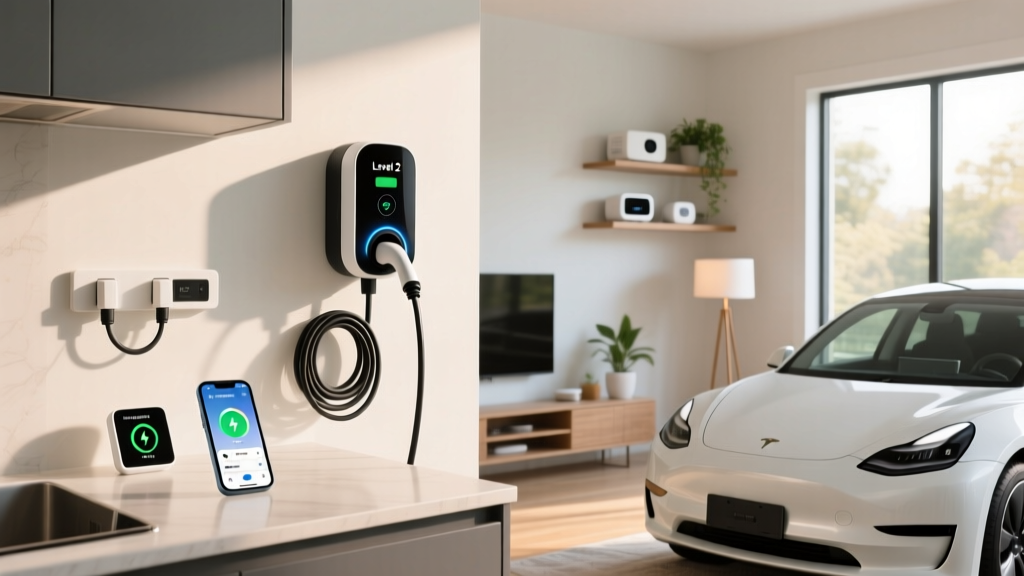
The Charger Bee has emerged as a notable option in the growing market of smart Level 2 home EV chargers. Designed for residential installation, it delivers up to 9.6 kW (40 amps on a 240V circuit) of power to your electric vehicle — enough to add roughly 30-35 miles of range per hour of charging, depending on your vehicle's onboard charger capacity and efficiency.
If you're researching home charging solutions, you've likely encountered a confusing maze of kW ratings, connector types, electrical requirements, and installation costs. This guide breaks down everything you need to know about the Charger Bee and how it fits into the broader EV charging ecosystem — with exact numbers, not marketing fluff.
Understanding EV Charging Levels: Speeds in kW and Miles Per Hour
Before evaluating any specific charger, you need to understand the three charging levels available to EV owners. The distinction between kW (kilowatts — the rate of power delivery) and kWh (kilowatt-hours — the total energy stored in your battery) is critical. Think of kW as how fast water flows from a hose, and kWh as the size of the bucket you're filling.
| Charging Level | Voltage | Power (kW) | Miles of Range Added Per Hour | Typical Use Case |
|---|---|---|---|---|
| Level 1 | 120V AC | 1.2–1.9 kW | 3–5 miles | Overnight trickle; PHEVs; emergency top-ups |
| Level 2 (Home/Public) | 240V AC | 3.3–19.2 kW | 12–75 miles | Daily home charging; workplace; shopping centers |
| DC Fast Charging | 200–900V DC | 50–350 kW | 150–1,000+ miles/hr equivalent | Road trips; rapid top-ups (10–80% in 15–40 min) |
The Charger Bee is a Level 2 charger operating at up to 9.6 kW. For context, a 75 kWh battery (like those in many mid-size crossovers) charging from 10% to 80% at a sustained 9.6 kW would take approximately 5.5 hours. In practice, the vehicle's onboard charger, thermal management, and charge curve taper near 80% will affect actual times.
Charger Bee Specifications and Equipment Details
The Charger Bee positions itself as a connected, smart-home-ready Level 2 EVSE (Electric Vehicle Supply Equipment). Here are the key specifications based on available product information:
| Specification | Detail |
|---|---|
| Max Power Output | 9.6 kW (40A / 240V) |
| Connector | J1772 (standard for non-Tesla EVs); NACS adapter available |
| Cable Length | 25 feet |
| Smart Features | Wi-Fi connectivity, app-based scheduling, energy monitoring, load balancing |
| Indoor/Outdoor Rating | NEMA 4 (suitable for outdoor installation) |
| Mounting | Wall-mounted (hardwired or NEMA 14-50 plug) |
| Estimated Equipment Price | $350–$500 |
| Warranty | 3 years |
The 25-foot cable is a practical length for most garage and driveway setups. If your parking spot is farther from the electrical panel or wall mount point, verify cable reach before purchasing — stretching an EVSE cable creates a trip hazard and can damage the connector over time.
Home Installation: Electrical Requirements, Panel Upgrades, and Costs
The single biggest variable in home EV charging setup is installation cost, which depends heavily on your home's existing electrical infrastructure. The Charger Bee requires a dedicated 240V circuit — typically a 50-amp breaker to support continuous 40-amp draw (the National Electrical Code requires circuits to be rated at 125% of continuous load, so a 40A charger needs a 50A breaker).
What Electrical Upgrades Might You Need?
Many modern homes with 200-amp electrical panels have sufficient capacity for a Level 2 charger. However, older homes with 100-amp service, or homes already running multiple high-draw appliances (electric range, dryer, HVAC, water heater), may require a panel upgrade to 200 amps — a significant added cost.
A licensed electrician will perform a load calculation to determine if your existing panel can handle the additional 40A continuous draw. Do not skip this step — overloading a panel is a fire risk and a code violation.
| Cost Component | Typical Range | Notes |
|---|---|---|
| Charger Bee Equipment | $350–$500 | Varies by retailer and promotions |
| Electrician Labor (standard install) | $500–$1,500 | Depends on run length from panel to mount point; shorter runs = lower cost |
| Permit Fees | $50–$200 | Required in most jurisdictions; varies by municipality |
| Electrical Materials (conduit, wire, breaker) | $100–$400 | 6 AWG copper wire for 50A circuit; longer runs cost more |
| Panel Upgrade (if needed) | $1,500–$3,500 | 100A → 200A upgrade; not needed in most newer homes |
| Total (no panel upgrade) | $1,000–$2,600 | Typical scenario for homes with adequate panel capacity |
| Total (with panel upgrade) | $2,500–$6,100 | Older homes or those near panel capacity |
Get at least two quotes from licensed electricians. Some utilities offer rebates for Level 2 charger installation — check with your local provider, as these can offset $200–$500 of the total cost.
Safety and Code Considerations
- Dedicated circuit: The Charger Bee must be on its own dedicated 50A breaker — never share a circuit with other appliances.
- GFCI protection: NEC 2020 and later require GFCI protection for EVSE outlets. Hardwired installations may have different requirements; your electrician will ensure code compliance.
- Outdoor rating: If mounting outdoors, confirm the unit's NEMA 4 rating covers your climate. The Charger Bee's NEMA 4 rating handles rain and splashing water but is not rated for submersion or high-pressure washdowns.
- NEMA 14-50 vs. hardwired: A NEMA 14-50 plug offers portability (take the charger if you move), but some jurisdictions now require hardwired installations for EVSE to eliminate the GFCI nuisance-tripping issue common with 14-50 receptacles. Ask your electrician what local code requires.
Connector Compatibility: Will the Charger Bee Work with Your EV?
The EV connector landscape has shifted dramatically. As of 2025–2026, the North American Charging Standard (NACS), originally developed by Tesla, has been adopted by Ford, GM, Rivian, Volvo, Polestar, Mercedes-Benz, BMW, Hyundai, Kia, and others. The legacy CCS1 connector remains on many vehicles already on the road, while CHAdeMO is effectively discontinued for new vehicles (Nissan Leaf being the last notable holdout).
| Connector Type | Vehicles Using It (2025–2026 Models) | Charger Bee Compatibility |
|---|---|---|
| J1772 (Level 1/2 standard) | All non-Tesla EVs for AC charging; Tesla vehicles via Mobile Connector adapter | Native — Charger Bee ships with J1772 |
| NACS (Tesla / adopted standard) | Tesla (all models), Ford F-150 Lightning/Mach-E (2025+), GM Ultium vehicles (2025+), Rivian, Hyundai/Kia (2025+) | Requires J1772-to-NACS adapter (~$100–$200) or future NACS-native Charger Bee variant |
| CCS1 | Older (pre-2025) non-Tesla EVs: VW ID.4, older Mustang Mach-E, Bolt EV/EUV, Ioniq 5 (pre-NACS) | Native — CCS1 uses J1772 for Level 2 AC portion |
| CHAdeMO | Nissan Leaf (legacy); no new vehicles adopting | Native for Level 2 AC (J1772 portion) |
Key takeaway: For Level 2 home charging, J1772 is the universal AC connector across all EVs sold in North America. Even NACS-equipped vehicles accept J1772 via an adapter (typically included with the vehicle). The Charger Bee's J1772 connector will work with virtually every EV on the road for home AC charging. For DC fast charging on road trips, connector type matters more — but that's separate from your home setup.
Cost to Charge: Home vs. Public vs. Gas Per Mile
One of the strongest economic arguments for home Level 2 charging is the per-mile fuel cost advantage. Here's a realistic breakdown using 2025–2026 electricity and fuel prices:
| Scenario | Rate | Cost for 300 Miles (avg EV at 3 mi/kWh) | Cost Per Mile |
|---|---|---|---|
| Home charging (national avg residential) | $0.16/kWh | $16.00 | $0.053 |
| Home charging (off-peak TOU rate) | $0.08/kWh | $8.00 | $0.027 |
| Public Level 2 (network charging) | $0.30–$0.45/kWh | $30.00–$45.00 | $0.10–$0.15 |
| DC Fast Charging (public) | $0.35–$0.55/kWh | $35.00–$55.00 | $0.12–$0.18 |
| Gasoline vehicle (25 MPG combined) | $3.30/gallon | $39.60 | $0.132 |
At off-peak residential rates, home charging costs roughly 80% less per mile than gasoline. Even at public DC fast charging rates, EV fueling is often comparable to or cheaper than gas — though the advantage narrows significantly. The lesson: home charging is where the economics work best, and a Level 2 charger like the Charger Bee makes daily home charging practical.
For a concrete example: if you drive 12,000 miles per year in an EV averaging 3 miles per kWh (like a Tesla Model Y), your annual electricity cost at home off-peak rates is approximately $320 — compared to roughly $1,584 in gasoline for a 25 MPG vehicle. That's over $1,200 in annual fuel savings.
Charging Time Examples: What to Expect with 9.6 kW
Charge times depend on your battery size (measured in kWh — the total energy capacity) and the charger's power output (measured in kW — the rate of delivery). Here are realistic 10–80% charge times at a sustained 9.6 kW:
| Vehicle Example | Usable Battery (kWh) | Energy Needed (10–80%) | Estimated Time at 9.6 kW |
|---|---|---|---|
| Chevrolet Equinox EV | 85 kWh | ~59.5 kWh | ~6.2 hours |
| Hyundai Ioniq 5 (Standard Range) | 58 kWh | ~40.6 kWh | ~4.2 hours |
| Ford Mustang Mach-E (Extended Range) | 91 kWh | ~63.7 kWh | ~6.6 hours |
| Toyota bZ4X | 64 kWh | ~44.8 kWh | ~4.7 hours |
| BMW iX xDrive50 | 105 kWh | ~73.5 kWh | ~7.7 hours |
For most daily driving (30–50 miles), you'll only need 1–2 hours of Level 2 charging to replenish what you used. Full 10–80% charges are typically weekend or overnight affairs. The Charger Bee's 9.6 kW output is well-matched to overnight replenishment for all of these vehicles.
How the Charger Bee Compares to Other Level 2 Chargers
The home Level 2 charger market is competitive. Here's how the Charger Bee stacks up against established alternatives:
Charger Bee
- Power: 9.6 kW (40A)
- Cable: 25 ft
- Smart Features: Wi-Fi, app scheduling, energy monitoring, load balancing
- Connector: J1772
- Price: $350–$500
- Warranty: 3 years
ChargePoint Home Flex
- Power: Up to 12 kW (50A) — configurable
- Cable: 23 ft
- Smart Features: Wi-Fi, app, Alexa integration, flexible amperage
- Connector: J1772 or NACS
- Price: $550–$700
- Warranty: 3 years
Emporia Vue EV Charger
- Power: 11.5 kW (48A)
- Cable: 24 ft
- Smart Features: Wi-Fi, detailed energy tracking, solar integration
- Connector: J1772
- Price: $400–$500
- Warranty: 3 years
Tesla Wall Connector
- Power: 11.5 kW (48A)
- Cable: 24 ft
- Smart Features: Wi-Fi, power sharing with multiple units, OTA updates
- Connector: NACS (J1772 adapter included)
- Price: $450–$500
- Warranty: 4 years
The Charger Bee's value proposition centers on its competitive price point and smart features at the lower end of the market. If you need more than 40A (for vehicles with larger onboard chargers that can accept 48A or 50A), the ChargePoint Home Flex or Tesla Wall Connector offer higher output — but only if your electrical panel and circuit can support the higher amperage.
Federal and Utility Incentives for Home Charger Installation
Under the IRS §30C Alternative Fuel Vehicle Refueling Property Credit, homeowners may be eligible for a tax credit covering 30% of the cost of home EV charger equipment and installation, up to a maximum of $1,000. This credit applies to both the charger hardware and electrician labor.
Key eligibility requirements:
- The charger must be installed at your primary residence
- The property must be located in an eligible census tract (designated as low-income or non-urban under IRA provisions)
- The credit is non-refundable — it reduces your tax liability but won't generate a refund beyond what you owe
- Equipment must be new and placed in service during the tax year
Additionally, many utilities offer their own rebates — typically $200–$500 for Level 2 charger purchase and installation. Check with your local utility before buying, as some require pre-approval or specific charger models to qualify.
Frequently Asked Questions
How much does it cost to install a home EV charger like the Charger Bee?
Expect to pay $1,000–$2,600 total (equipment + electrician + permit + materials) for a standard installation in a home with adequate electrical panel capacity. If your home needs a panel upgrade from 100A to 200A, add $1,500–$3,500 to that total. Always get a load calculation from a licensed electrician before committing.
How fast will each charging level add range to my EV?
Level 1 (120V standard outlet) adds 3–5 miles per hour. Level 2 at 9.6 kW (like the Charger Bee) adds approximately 30–35 miles per hour. DC fast charging at 150 kW+ can add 150–400+ miles per hour equivalent, though charge rates taper significantly above 80% state of charge. Actual miles per hour depend on your vehicle's efficiency (miles per kWh).
Which connector is compatible with my EV for home charging?
For Level 2 AC home charging, J1772 is the universal standard in North America. Every EV sold in the US — including Teslas — can accept a J1772 connector (Tesla vehicles use an included adapter). The Charger Bee ships with J1772, making it compatible with all current EVs for home use. For DC fast charging on road trips, check whether your vehicle uses NACS, CCS1, or CHAdeMO.
How much does EV charging cost per mile compared to gasoline?
Home charging at off-peak rates (~$0.08/kWh) costs roughly $0.03 per mile for an average EV. Home charging at standard residential rates (~$0.16/kWh) costs about $0.05 per mile. Gasoline at $3.30/gallon in a 25 MPG vehicle costs $0.13 per mile. Public DC fast charging ($0.35–$0.55/kWh) ranges from $0.12–$0.18 per mile — comparable to or slightly above gasoline.
What electrical upgrades might I need for a Level 2 charger?
The most common upgrade is running a new dedicated 240V/50A circuit from your panel to the charger location. If your panel is maxed out (common in older homes with 100A service), you may need a panel upgrade to 200A, costing $1,500–$3,500. Some homes also need conduit runs through walls or underground for detached garages. A licensed electrician's load calculation will identify exactly what's required.
Is the Charger Bee ENERGY STAR certified?
Check current product listings for ENERGY STAR certification status. ENERGY STAR–certified EVSE must meet standby power consumption limits (drawing minimal power when not actively charging). This certification can also be a requirement for certain utility rebate programs.
Can I use a NEMA 14-50 outlet instead of hardwiring?
Yes, the Charger Bee supports NEMA 14-50 plug connection. However, some local electrical codes now require hardwired EVSE installations due to GFCI breaker nuisance tripping on 14-50 receptacles. A hardwired connection also eliminates one potential failure point (the receptacle itself). Discuss with your electrician which method meets local code and suits your needs.