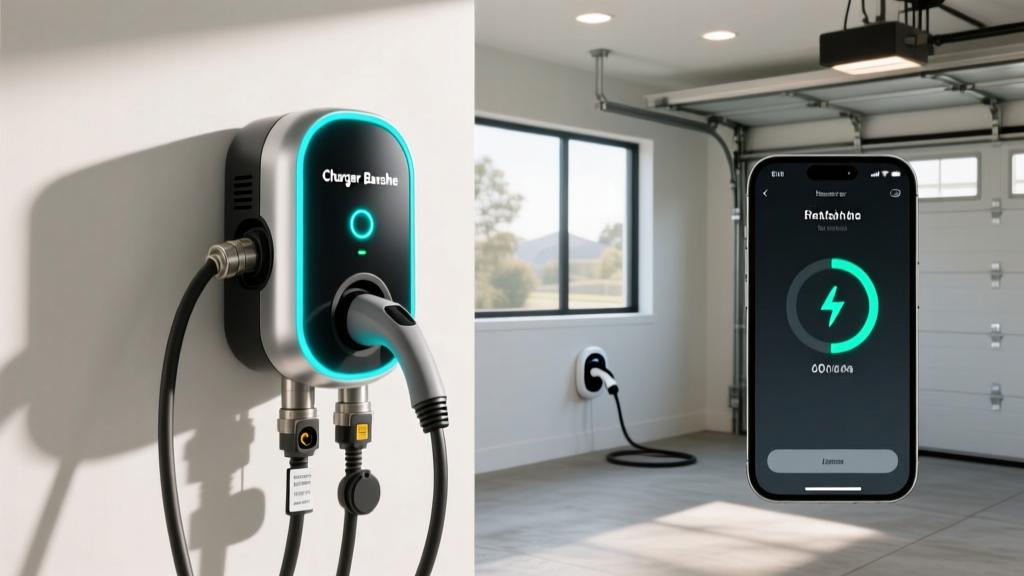
If you've been searching for a high-output Level 2 home charger that won't require a $3,000 electrical panel overhaul, the Charger Banshee has likely crossed your radar. Rated at 48 amps and delivering up to 11.5 kW of continuous power on a 240V/60A dedicated circuit, the Banshee sits in the upper tier of residential EV charging equipment — fast enough to replenish most EV batteries overnight, yet compatible with the electrical infrastructure in many modern homes.
This guide breaks down exactly what the Charger Banshee delivers, what your home's electrical system needs to support it, what you'll actually pay for installation, and how its per-mile charging cost compares to gasoline. We'll also cover connector compatibility (NACS, CCS1, and CHAdeMO), real-world charging times for popular 2026 EV models, and the safety codes your electrician will follow.
What Is the Charger Banshee and Where Does It Fit?
The Charger Banshee is a hardwired Level 2 EV charging station designed for residential and light-commercial use. Its headline spec is a 48-amp maximum output, which on a standard 240V circuit translates to 11.5 kW of charging power. That's roughly 35–45 miles of range added per hour of charging for a typical mid-size EV like the Tesla Model Y or Hyundai Ioniq 5.
For context, most EVs accept between 7.2 kW and 11.5 kW on Level 2 AC charging. The Banshee's 48A output means it can max out the onboard chargers of vehicles like the Ford F-150 Lightning (extended range, 11.3 kW onboard), Rivian R1S/R1T (11.5 kW), and Lucid Air (up to 19.2 kW with dual chargers). For vehicles with smaller onboard chargers — say, a Chevrolet Equinox EV at 11.5 kW or a Nissan Leaf at 6.6 kW — the Banshee will charge them at their maximum accepted rate without wasting capacity.
Key Banshee specifications:
- Max output: 48A / 11.5 kW (240V)
- Circuit requirement: 60A dedicated breaker (NEC 80% rule: continuous loads capped at 80% of breaker rating)
- Connector: NACS (native Tesla plug), with CCS1 adapter included in 2026 packages
- Cable length: 24 feet (standard), 30 feet (optional)
- Smart features: Wi-Fi connected, load balancing, scheduled charging, energy monitoring via app
- Enclosure: NEMA 4 rated (indoor/outdoor), operating temp -22°F to 122°F
- Price: $599 (standard 24 ft cable) / $649 (30 ft cable)
Charging Levels Explained: How Fast Will Each Level Add Range?
Before sizing your home setup, it's critical to understand the three EV charging levels and how they differ in power delivery. The distinction between kW (power — the rate of energy flow) and kWh (energy — the total capacity of your battery) matters here. Think of kW as how wide the pipe is; kWh is how big the tank is.
| Level | Voltage | Power (kW) | Miles of Range/Hour | Typical Use |
|---|---|---|---|---|
| Level 1 | 120V AC | 1.0–1.4 kW | 3–5 mi/hr | Emergency / overnight top-off |
| Level 2 (standard) | 240V AC | 7.2–9.6 kW | 22–35 mi/hr | Daily home charging (32A–40A circuit) |
| Level 2 (high-output) | 240V AC | 11.5–19.2 kW | 35–60 mi/hr | Large-battery EVs, fast overnight fills |
| DC Fast Charging | 400–800V DC | 50–350 kW | 150–1,000+ mi/hr | Road trips, public stations |
The Charger Banshee falls into the high-output Level 2 category. For a vehicle with an 80 kWh battery (like the Hyundai Ioniq 5 or Kia EV6), a full 10–80% charge on the Banshee takes approximately 5.5 to 6 hours — assuming the vehicle's onboard charger can accept the full 11.5 kW. That means plugging in at 10 PM gives you a full daily-driving charge by 5 AM.
Real-World Charging Times: 10–80% on the Banshee (11.5 kW)
| Vehicle (2026 Model Year) | Battery (kWh usable) | Onboard Charger (kW) | 10–80% Time | EPA Range |
|---|---|---|---|---|
| Tesla Model Y Long Range | 75 kWh | 11.5 | ~4.5 hours | 330 mi |
| Hyundai Ioniq 5 (LR AWD) | 77.4 kWh | 10.9 | ~5.0 hours | 290 mi |
| Ford F-150 Lightning (Ext.) | 131 kWh | 11.3 | ~8.5 hours | 320 mi |
| Chevrolet Equinox EV 3RS | 85 kWh | 11.5 | ~5.5 hours | 319 mi |
| BMW iX xDrive50 | 105.2 kWh | 11.0 | ~7.0 hours | 324 mi |
Note: These times assume consistent 11.5 kW delivery. In practice, charging may taper slightly in the final minutes above 75% SoC as the vehicle's battery management system balances cells. Cold-weather charging (below 32°F) without battery preconditioning can add 15–30% to these times.
Home Installation: Electrical Requirements and Real Costs
This is where most EV buyers get surprised. The Charger Banshee's $599 equipment price is just the starting point. Professional installation — which is mandatory for hardwired 48A units and strongly recommended for safety and code compliance — adds significant cost depending on your home's existing electrical infrastructure.
What the Banshee Requires Electrically
- Circuit: Dedicated 60-amp, 240V breaker in your main panel
- Wire: 6 AWG copper (THHN in conduit) or 4 AWG aluminum for runs over 50 feet
- Disconnect: Some jurisdictions require a local disconnect switch within sight of the charger
- GFCI: NEC 2023 (Article 625.54) requires GFCI protection for EV receptacles; hardwired units like the Banshee may be exempt depending on local AHJ (Authority Having Jurisdiction) interpretation
- Permit: Required in virtually all US jurisdictions for new 240V circuits
Panel Capacity: The Hidden Cost Driver
The single biggest variable in your installation cost is whether your electrical panel has room for a new 60A breaker and sufficient total capacity. Here's the reality:
- 200A panel with spare slots: Most straightforward install. If your panel's calculated load allows a new 60A circuit, the electrician runs conduit and wire from the panel to the charger location. Typical cost: $850–$1,500 total (equipment + labor + permit).
- 200A panel, no spare capacity: Your electrician may need to perform a load calculation. If the panel is near capacity, options include adding a sub-panel ($500–$1,200 additional) or using a load-management device that throttles the charger when household demand is high.
- 100A panel (common in older homes): Very likely needs a panel upgrade to 200A, which typically costs $1,800–$3,500 including the new panel, utility coordination, and permit. This is the scenario that pushes total project costs above $3,000.
| Component | Simple Install (200A panel, short run) | Complex Install (sub-panel or long run) | Panel Upgrade Required |
|---|---|---|---|
| Banshee charger unit | $599 | $599 | $599 |
| 60A breaker + wire + conduit | $150–$300 | $300–$600 | $200–$400 |
| Electrician labor (2–6 hrs) | $200–$500 | $500–$1,000 | $400–$800 |
| Permit fee | $50–$150 | $50–$150 | $100–$250 |
| Panel upgrade (if needed) | — | — | $1,800–$3,500 |
| Total estimated cost | $850–$1,550 | $1,450–$2,350 | $3,100–$5,550 |
The National Electrical Code (NEC), published by the NFPA, governs EV charging installations. Your licensed electrician will pull permits and schedule inspection — skip this step and you risk voiding homeowner's insurance coverage for electrical fires.
Connector Compatibility: NACS, CCS1, and CHAdeMO
The EV charging connector landscape has consolidated significantly since 2024, when Ford, GM, Rivian, and most major automakers adopted the North American Charging Standard (NACS) — originally Tesla's proprietary plug. As of 2026, NACS is the dominant connector on new EVs sold in the US.
| Connector | Brands Using It (Native) | Adapter Needed for Banshee? |
|---|---|---|
| NACS (J3400) | Tesla, Ford, GM, Rivian, Hyundai/Kia (2025+), Volvo, Polestar, Fisker, Lucid | No — Banshee ships with NACS |
| CCS1 | VW ID.4 (pre-2026), BMW (some models), older Hyundai/Kia | NACS-to-CCS adapter (included with Banshee) |
| CHAdeMO | Nissan Leaf (discontinued after 2025), Mitsubishi Outlander PHEV | Separate CHAdeMO adapter required (not included) |
If you drive a CCS1-equipped vehicle (common for 2022–2024 model year EVs), the Banshee's included NACS-to-CCS adapter handles Level 2 AC charging without issue. For CHAdeMO vehicles — increasingly rare as Nissan retired the Leaf — you'd need a third-party adapter, which adds $100–$200 and introduces some power-loss overhead.
For public DC fast charging, the connector situation is separate from your home setup. Tesla Superchargers now serve NACS-equipped non-Tesla vehicles. Electrify America and EVgo stations increasingly offer NACS cables alongside CCS1. According to the Alternative Fuels Data Center, over 70% of new DC fast charger installations in 2025–2026 include NACS connectors.
Cost to Charge: Home vs. Public vs. Gasoline
One of the strongest arguments for home Level 2 charging is cost. The Banshee's smart scheduling feature lets you charge during off-peak utility hours (typically 10 PM–6 AM), when electricity rates are lowest.
| Scenario | Avg. $/kWh | Cost to Add 200 mi (80 kWh EV at 3.5 mi/kWh) | Cost Per Mile |
|---|---|---|---|
| Home off-peak (utility TOU rate) | $0.08–$0.12 | $4.57–$6.86 | $0.023–$0.034 |
| Home standard rate (national avg.) | $0.16 | $9.14 | $0.046 |
| Public Level 2 (ChargePoint, etc.) | $0.25–$0.40 | $14.29–$22.86 | $0.071–$0.114 |
| DC Fast Charging (Electrify America, EVgo) | $0.35–$0.55 | $20.00–$31.43 | $0.100–$0.157 |
| Gasoline (25 MPG combined, $3.40/gal) | — | $27.20 | $0.136 |
At off-peak home rates, charging a typical EV with the Banshee costs roughly $0.03 per mile — about one-quarter the per-mile cost of a 25 MPG gas car at current fuel prices. Even at standard residential rates ($0.16/kWh), you're paying under $0.05 per mile. The savings are substantial: a driver covering 12,000 miles annually saves approximately $1,200–$1,600 per year charging at home versus fueling a comparable gas vehicle.
The Banshee's app includes energy-cost tracking and can integrate with time-of-use (TOU) utility plans to automatically charge when rates dip. If your utility offers an EV-specific rate plan (many do — check energy.gov for resources), pairing it with the Banshee's scheduling feature maximizes savings.
Safety, Code, and Installation Best Practices
A 48-amp continuous load on a 60-amp circuit is a serious piece of electrical infrastructure. Here's what code compliance and safe installation look like:
NEC and Local Code Requirements
- Dedicated circuit: The Banshee must have its own 60A breaker — it cannot share a circuit with other appliances (NEC Article 625.40).
- Wire gauge: 6 AWG copper minimum for runs under 50 feet. Longer runs may require 4 AWG to limit voltage drop below 3%.
- Conduit: Required for all exposed wiring. EMT (metal) or PVC schedule 80 are standard. Underground runs to a detached garage need direct-burial rated cable or conduit at 18–24 inches depth.
- GFCI protection: NEC 2023 requires GFCI for EV receptacles (14-50 outlets). Hardwired installations like the Banshee may not require GFCI in all jurisdictions, but many inspectors now mandate it regardless. A 60A GFCI breaker adds $80–$150 to material costs.
- Outdoor rating: The Banshee's NEMA 4 enclosure handles rain, dust, and hose-directed water. If mounted outdoors, the conduit entry point must be sealed, and the unit should be positioned to avoid direct sprinkler spray.
- Load management: If your panel is near capacity, the Banshee supports dynamic load balancing via an optional CT (current transformer) clamp installed on your main service conductors. This reduces charging amperage when household demand spikes — a code-compliant alternative to a panel upgrade in some jurisdictions.
What to Ask Your Electrician
Before hiring, confirm:
- Are you licensed and insured for EV charger installations in this jurisdiction?
- Will you perform a load calculation per NEC Article 220?
- Does the quote include permit and inspection?
- Will you provide a detailed wiring diagram and as-built documentation?
- Do you offer a warranty on labor (1–2 years is standard)?
Get at least three quotes. Prices vary dramatically — a simple 15-foot surface-mount run in a garage might be $850, while the same charger mounted on an exterior wall with a 60-foot underground conduit run to a detached garage could exceed $2,200.
How Does the Banshee Compare to Other Level 2 Chargers?
The Banshee competes in the premium residential charger segment. Here's how it stacks up against common alternatives:
Charger Banshee (48A)
- Output: 11.5 kW / 48A
- Connector: NACS (CCS adapter included)
- Cable: 24 ft (30 ft option)
- Smart features: Wi-Fi, scheduling, load balancing, energy tracking
- Price: $599
- Best for: Large-battery EVs, homes with 200A panels
ChargePoint Home Flex (up to 50A)
- Output: Up to 12 kW / 50A (adjustable)
- Connector: NACS or J1772 (configurable)
- Cable: 23 ft
- Smart features: Wi-Fi, Alexa, scheduling
- Price: $699
- Best for: Flexible amperage adjustment
Tesla Wall Connector (48A)
- Output: 11.5 kW / 48A
- Connector: NACS native
- Cable: 24 ft
- Smart features: Wi-Fi, power sharing, OTA updates
- Price: $475
- Best for: Tesla-only households
The Banshee's advantage over the Tesla Wall Connector is the included CCS1 adapter and more granular load-balancing controls. Against the ChargePoint Home Flex, it's $100 cheaper but offers 2 fewer amps (negligible in real-world charging time — roughly 10 minutes difference on a full 10–80% cycle for a 77 kWh battery).
Is the Charger Banshee Right for Your Setup?
Choose the Charger Banshee if:
- You drive a large-battery EV (80+ kWh) and want full overnight replenishment
- Your home has a 200A panel with spare capacity
- You want NACS native with CCS adapter flexibility
- You value load balancing to avoid a panel upgrade
- You charge on a TOU rate plan and want scheduling automation
Consider alternatives if:
- You have a 100A panel and can't justify a $2,000+ upgrade — a 32A/7.7 kW charger on a 40A circuit may suffice
- You only drive a PHEV with a small battery (15–25 kWh) — even Level 1 (1.4 kW) fully charges most PHEVs overnight
- Your charger will be 80+ feet from the panel — voltage drop at 48A over long runs requires expensive 4 AWG wire or a sub-panel
Frequently Asked Questions
How much does it cost to install a home EV charger like the Charger Banshee?
Expect $850–$1,550 for a straightforward installation in a home with a 200A panel and a short wire run. If your panel needs a sub-panel or you have a long conduit run, costs rise to $1,450–$2,350. Homes with 100A panels often need a full panel upgrade ($1,800–$3,500 additional), pushing total project cost to $3,100–$5,550. Always get a load calculation from a licensed electrician before committing.
How fast will each charging level add range to my EV?
Level 1 (120V) adds 3–5 miles per hour. Standard Level 2 (240V, 32A–40A) adds 22–35 miles per hour. The Charger Banshee at 48A/11.5 kW adds 35–45 miles per hour depending on your vehicle's efficiency. DC fast charging (50–350 kW) can add 150–1,000+ miles per hour, but is used for road trips, not daily charging.
Which connector is compatible with my EV?
If your EV is a 2025 or newer model from Tesla, Ford, GM, Rivian, Hyundai, Kia, Volvo, or most other major brands, it uses NACS — which is the Banshee's native connector. If you have a 2022–2024 CCS1-equipped EV, the included adapter works for Level 2. CHAdeMO vehicles (mostly older Nissan Leafs) require a separate adapter.
How much does home charging cost per mile compared to gasoline?
At off-peak residential rates ($0.08–$0.12/kWh), home EV charging costs approximately $0.023–$0.034 per mile. A comparable 25 MPG gas car at $3.40/gallon costs $0.136 per mile. That's a savings of roughly $0.10 per mile, or $1,200+ annually for a 12,000-mile driver.
What electrical upgrades might I need for a 48A charger?
The most common upgrade is ensuring your panel has capacity for a new 60A breaker. Homes with 200A service usually accommodate this without issue. Homes with 100A service typically need a panel upgrade to 200A ($1,800–$3,500). In some cases, the Banshee's dynamic load-balancing feature can avoid a panel upgrade entirely by throttling charge rate during peak household demand.
Is the Charger Banshee eligible for any tax credits or rebates?
The federal Alternative Fuel Vehicle Refueling Property Credit (IRS Form 8911) covers up to 30% of home charger equipment and installation costs, capped at $1,000. However, eligibility depends on your census tract meeting certain income or rural criteria under current IRS rules. Many utilities also offer $250–$500 rebates for Level 2 charger installations — check with your local provider. Always consult a tax professional for credit eligibility.