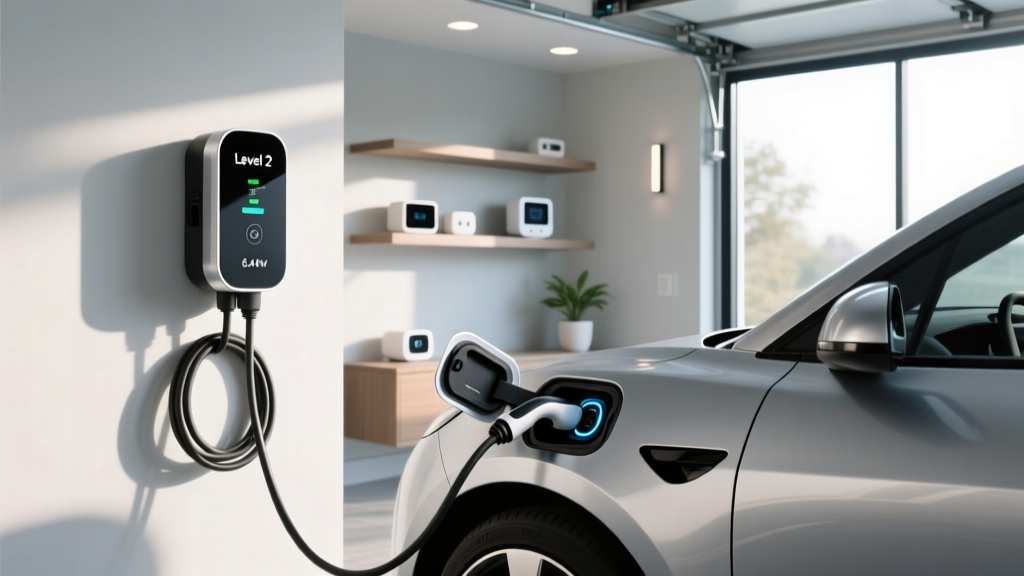
If you've been shopping for a home EV charger and seen the term charger 6.4 kW pop up on spec sheets, you're looking at one of the most common Level 2 configurations on the market. A 6.4 kW charger delivers roughly 25 to 30 miles of range per hour of charging — enough to fully replenish most EV batteries overnight while drawing power from a standard 240-volt, 30-amp circuit.
But understanding that number requires clarity on a distinction that trips up many first-time EV buyers: kW (kilowatts) measures power — the rate at which energy flows into your car — while kWh (kilowatt-hours) measures energy — the total capacity of your battery. Think of kW as the width of the pipe and kWh as the size of the tank. A 6.4 kW charger filling an 80 kWh battery from empty would take roughly 12.5 hours; a 19.2 kW charger would cut that to about 4 hours. That difference matters enormously when you're sizing equipment to your daily driving needs.
This guide covers everything you need to evaluate a 6.4 kW home charger: what it delivers in real-world range, what your electrical panel needs to support it, what installation actually costs, which connector your car requires, and how the per-mile cost compares to gasoline.
Charging Levels Explained: Where 6.4 kW Fits
EV charging falls into three tiers, each defined by voltage, power output, and typical use case. Understanding these tiers is essential before you commit to hardware.
| Level | Voltage | Max Power (kW) | Miles of Range Added per Hour | Typical Use |
|---|---|---|---|---|
| Level 1 | 120V AC | 1.4–1.9 kW | 3–5 mi/hr | Overnight top-ups, low-mileage drivers, PHEVs |
| Level 2 | 240V AC | 3.3–19.2 kW | 12–75 mi/hr | Home daily charging, workplace, public destinations |
| DC Fast (Level 3) | 400–800V DC | 50–350 kW | 150–1,000+ mi/hr | Road trips, highway corridors, fleet depots |
A 6.4 kW charger sits in the lower-middle of the Level 2 range. It's typically delivered through a 240V circuit at either 26.7 amps or 30 amps (depending on whether the unit is hardwired or plugs into a NEMA 14-30 outlet). For context, here's what a 6.4 kW session looks like with common EV battery sizes:
- Tesla Model 3 Standard Range (57.5 kWh usable, LFP): 0–100% in approximately 9 hours
- Hyundai Ioniq 5 (77.4 kWh usable, NMC): 10–80% in approximately 8 hours
- Ford F-150 Lightning Extended Range (131 kWh usable, NMC): 10–80% in approximately 15 hours
- Chevrolet Equinox EV (85 kWh usable, NMC): 10–80% in approximately 10 hours
For most commuters driving 30–50 miles per day, a 6.4 kW charger replenishes a full day's driving in 1.5 to 2 hours. That's the practical sweet spot: you plug in when you get home, and by bedtime, you're topped off for tomorrow. You don't need 11.5 kW or 19.2 kW unless you're regularly driving 150+ miles daily or operating a large-battery truck that needs faster turnaround.
Home Electrical Requirements for a 6.4 kW Charger
Installing a 6.4 kW Level 2 charger requires a dedicated 240-volt circuit. The two most common configurations are:
- 30-amp circuit (NEMA 14-30 outlet): Delivers up to 24 amps continuous (7.2 kW max, but a 6.4 kW charger draws ~26.7A continuous, so this circuit must be rated for at least 35 amps to comply with the NEC 80% continuous-load rule). In practice, a 6.4 kW charger is most safely paired with a 40-amp circuit.
- 40-amp circuit (NEMA 14-50 outlet or hardwired): Delivers up to 32 amps continuous — a comfortable match for a 6.4 kW unit and the most common residential Level 2 configuration.
The National Electrical Code (NEC) requires that continuous loads — which EV charging qualifies as — not exceed 80% of a circuit breaker's rated capacity. So a charger drawing 26.7 amps continuously needs a breaker rated for at least 33.4 amps, rounded up to the next standard size: 40 amps.
Do You Need a Panel Upgrade?
This is the question that separates a $600 installation from a $3,500 one. Most homes built after 1990 have a 200-amp main electrical panel, which typically has enough spare capacity to add a 40-amp EV circuit without an upgrade. Homes built before 1980, or those with 100-amp panels, often need either:
- A panel upgrade to 200 amps ($1,500–$3,000), or
- A load-management device ($200–$500 plus installation) that throttles charger power when the house is drawing heavily on other circuits
A licensed electrician will perform a load calculation (per NEC Article 220) to determine whether your panel can handle the added draw. Don't skip this step — an overloaded panel is a fire risk and will fail inspection.
How Much Does It Cost to Install a Home EV Charger?
Installation costs vary widely based on your home's electrical infrastructure, the distance from your panel to the charging location, and local labor rates. Here's a realistic breakdown for a 6.4 kW Level 2 charger installation in 2026:
| Component | Low Estimate | High Estimate | Notes |
|---|---|---|---|
| Level 2 charger unit (6.4–7.7 kW) | $300 | $700 | Brands: Emporia, ChargePoint, Wallbox, Tesla |
| Electrician labor (40A circuit run) | $400 | $1,500 | Depends on panel-to-outlet distance, wall type |
| Electrical materials (wire, conduit, breaker) | $100 | $400 | Longer runs = more copper = higher cost |
| Permit and inspection | $50 | $300 | Varies by municipality; some jurisdictions waive EV permits |
| Panel upgrade (if needed) | $1,500 | $3,000 | Only for homes with 100A or maxed-out 200A panels |
| Total (no panel upgrade) | $850 | $2,900 | Average: ~$1,400–$1,800 |
| Total (with panel upgrade) | $2,350 | $5,900 | Panel upgrade is a one-time home improvement |
Connector Compatibility: NACS, CCS1, and CHAdeMO
As of 2026, the North American EV charging connector landscape has consolidated significantly, but you still need to verify what your vehicle uses before buying a charger.
| Connector | Brands Using It (2026) | Adapter Availability |
|---|---|---|
| NACS (Tesla / J3400) | Tesla, Ford, GM, Rivian, Volvo, Polestar, Mercedes-Benz, Hyundai/Kia (new models), Subaru, BMW (new models) | CCS-to-NACS adapters available from Tesla and third parties ($150–$250) |
| CCS1 (Combined Charging System) | Volkswagen ID.4 (carryover), Stellantis, some Hyundai/Kia (2024–2025 models still in circulation) | NACS-to-CCS adapters available; many CCS vehicles now ship with adapter |
| CHAdeMO | Nissan Leaf (legacy only — no new models since 2025) | Limited adapter options; CHAdeMO DC infrastructure declining |
The practical takeaway: If you're buying a new EV in 2026, it almost certainly uses NACS. Buy a NACS-equipped home charger (or a Tesla Wall Connector, which is NACS-native). If you're charging a CCS-equipped vehicle from 2024–2025, purchase a CCS charger or use a NACS-to-CCS adapter. CHAdeMO owners should plan for eventual adapter reliance as public infrastructure shifts to NACS/CCS.
Cost to Charge: Per-Mile Economics vs. Gasoline
The financial case for home EV charging rests on one powerful advantage: residential electricity is dramatically cheaper per mile than gasoline. But the savings depend on your local rates and whether you charge at home, at public Level 2 stations, or at DC fast chargers.
| Scenario | Rate ($/kWh) | Vehicle Efficiency | Cost per Mile |
|---|---|---|---|
| Home (national avg. residential) | $0.17/kWh | 3.5 mi/kWh | $0.049 |
| Home (off-peak TOU rate) | $0.09/kWh | 3.5 mi/kWh | $0.026 |
| Public Level 2 (network pricing) | $0.35/kWh | 3.5 mi/kWh | $0.100 |
| DC Fast Charging (Electrify America, etc.) | $0.48/kWh | 3.5 mi/kWh | $0.137 |
| Gasoline ($3.40/gal, 28 MPG combined) | — | 28 mi/gal | $0.121 |
At national average residential rates, a 6.4 kW home charger delivers fuel at roughly $0.05 per mile — less than half the cost of a 28 MPG gas car at $3.40/gallon. If your utility offers time-of-use (TOU) pricing and you schedule charging for off-peak hours (typically 10 PM–6 AM), that cost drops to under $0.03 per mile.
However, DC fast charging at public stations can cost more per mile than gasoline. This is why home charging isn't just a convenience — it's the economic foundation of EV ownership. According to fueleconomy.gov, the average EV driver who charges primarily at home saves $800–$1,200 annually on fuel compared to a comparable gas vehicle.
Best 6.4 kW Home EV Chargers for 2026
Here are four Level 2 chargers that operate at or near 6.4 kW and represent strong value for home installations. Each is compared on power output, connector type, cable length, smart features, and price.
Emporia Level 2 EV Charger
- Power: 6.4 kW (26.7A @ 240V) / up to 11.5 kW on 48A circuit
- Connector: NACS (J3400) native; CCS adapter included
- Cable length: 24 ft
- Smart features: Wi-Fi, Emporia app scheduling, solar integration, energy monitoring
- Price: ~$349
- Best for: Budget-conscious buyers who want app control and energy tracking
Tesla Wall Connector (Gen 4)
- Power: Up to 11.5 kW (48A); configurable down to 6.4 kW for 30A/40A circuits
- Connector: NACS native
- Cable length: 24 ft
- Smart features: Wi-Fi, Tesla app, load sharing (pair up to 6 units on one circuit), OTA updates
- Price: ~$475
- Best for: Tesla owners and multi-EV households
ChargePoint Home Flex
- Power: Configurable 6.4–12 kW (26.7A–50A)
- Connector: NACS or CCS1 (select at purchase)
- Cable length: 23 ft
- Smart features: Wi-Fi, ChargePoint app, Alexa integration, flexible amperage DIP switch
- Price: ~$549
- Best for: Flexibility — adjust amperage to match your circuit without buying a new unit
Wallbox Pulsar Plus
- Power: Up to 9.6 kW (40A); configurable for lower circuits
- Connector: NACS or CCS1
- Cable length: 25 ft
- Smart features: Wi-Fi + Bluetooth, Wallbox app, Eco-Smart solar mode, Power Sharing
- Price: ~$499
- Best for: Compact form factor and solar-panel integration
For a dedicated 40-amp circuit delivering 6.4 kW, any of these units will work reliably. The Emporia offers the best price-to-feature ratio; the Tesla Wall Connector is the natural choice for Tesla and NACS-equipped Ford/GM owners; the ChargePoint Home Flex provides the most circuit-flexibility if you might upgrade your electrical service later.
Safety, Code, and Installation Best Practices
EV charging is a continuous high-draw electrical load — your charger will run at near-maximum output for 4 to 12 hours at a stretch. That makes proper installation non-negotiable. Here's what the NEC and best practices require:
- Dedicated circuit: Your EV charger must be on its own dedicated breaker — it cannot share a circuit with your dryer, oven, or HVAC. This prevents overloads and nuisance trips.
- GFCI protection: The 2023 NEC (Article 625.54) requires ground-fault circuit interrupter protection for all EV charging outlets rated 150V to ground or less and 60A or less. Your electrician should install a GFCI breaker or use a charger with built-in GFCI. Note: some early GFCI breakers had nuisance-trip issues with EV chargers — confirm your electrician uses an EV-compatible GFCI breaker (e.g., Eaton EVGF20).
- Outdoor rating: If your charger is installed outdoors (carport, driveway, exterior wall), the unit must carry a NEMA 4 or NEMA 4X rating for weather resistance. All four chargers recommended above meet this standard.
- Wire gauge: A 40-amp circuit requires minimum 8 AWG copper wire (THHN in conduit or NM-B for indoor runs). Longer runs may require 6 AWG to minimize voltage drop.
- Permit and inspection: Nearly all jurisdictions require a permit for new 240V circuits. The inspection verifies wire gauge, breaker sizing, grounding, and GFCI compliance. Do not skip this — unpermitted work can void home insurance claims.
When 6.4 kW Isn't Enough: Upgrading to Higher Power
A 6.4 kW charger handles most daily needs, but certain scenarios justify a higher-power installation:
- Large-battery trucks: The Ford F-150 Lightning (131 kWh) or Chevrolet Silverado EV (200+ kWh) can take 20+ hours at 6.4 kW from 10–80%. An 11.5 kW or 19.2 kW charger cuts that to 11 or 7 hours, respectively.
- High-mileage commuters: If you drive 100+ miles daily and need full replenishment in under 6 hours, you'll need at least 11.5 kW (48A circuit).
- Multi-EV households: Two EVs sharing overnight hours may require a 60-amp circuit with a dual-port charger or load-sharing setup.
Upgrading later is possible but means re-running wire and potentially replacing the breaker — so if your panel has capacity for a 60A circuit today, consider installing it even if you start with a 6.4 kW charger. The marginal wire cost during initial installation is far less than a second electrician visit.
Frequently Asked Questions
How much does it cost to install a home EV charger?
For a 6.4 kW Level 2 charger on a new 40-amp, 240-volt circuit, expect to pay $850 to $2,900 total (equipment, labor, materials, and permit) in a home with an adequate electrical panel. If your panel needs upgrading from 100A to 200A, add $1,500–$3,000. The IRS §30C credit may cover up to $1,000 (30%) of the cost if you meet census-tract eligibility.
How fast will each charging level add range?
Level 1 (120V) adds 3–5 miles per hour. Level 2 at 6.4 kW adds roughly 22–25 miles per hour. DC fast charging at 150 kW can add 200+ miles in 20 minutes, though charge speed tapers significantly above 80% State of Charge to protect battery health.
Which connector/charger is compatible with my EV?
Check your vehicle's charge port. Nearly all 2025–2026 EVs from Tesla, Ford, GM, Rivian, Hyundai, Kia, and Volvo use NACS (J3400). Older CCS1 vehicles (2022–2024 VW, some Hyundai/Kia) can use a NACS-to-CCS adapter. The Nissan Leaf (discontinued) uses CHAdeMO. Buy a charger matching your vehicle's native connector for the most reliable connection.
How much does charging cost per mile vs gas?
At the national average residential electricity rate of $0.17/kWh and an EV efficiency of 3.5 mi/kWh, home charging costs about $0.049 per mile. A comparable gas car at 28 MPG and $3.40/gallon costs $0.121 per mile. Off-peak home charging can drop to under $0.03/mile — roughly 75% cheaper than gas. Public DC fast charging, however, can exceed gas costs at $0.48+/kWh.
What electrical upgrades might I need?
The most common upgrade is a panel capacity increase (100A to 200A) for older homes. You may also need a new breaker slot if your panel is full (a sub-panel or tandem breakers can solve this). Homes with long wire runs from the panel to the garage may require thicker-gauge wire (6 AWG instead of 8 AWG) to prevent voltage drop. A licensed electrician's load calculation will identify all requirements before work begins.