Setting up home EV charging in a 2-door garage presents unique challenges. Limited wall space, tight turning radii, and the need to share circuits with other appliances mean you can't just mount any charger anywhere. This guide breaks down exactly what's required to install a Level 2 charger in a compact 2-door garage, what it costs, and which equipment works best when space is at a premium.
Charging Levels Explained: What Speeds Are We Talking?
Before choosing equipment, you need to understand the three charging tiers available to EV owners. The distinction between kW (power, or charge rate) and kWh (energy, or battery capacity) is critical — kW tells you how fast you're filling the battery, kWh tells you how big the tank is.
| Level | Voltage | Power (kW) | Miles Added/Hour | Typical Use Case |
|---|---|---|---|---|
| Level 1 | 120V | 1.2-1.8 kW | 3-5 mi/hr | Overnight top-ups, PHEVs |
| Level 2 | 240V | 3.3-19.2 kW | 12-75 mi/hr | Home/workplace daily charging |
| DC Fast | 400-800V | 50-350 kW | 150-1000+ mi/hr | Road trips, public stations |
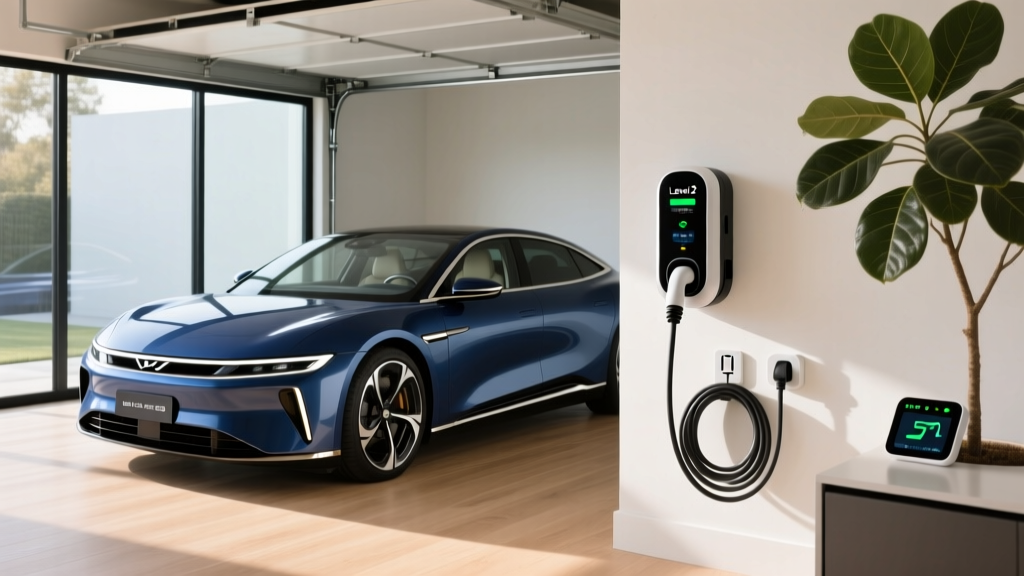
For a 2-door garage setup, Level 2 is your target. A 40-amp circuit delivering 9.6 kW adds roughly 35 miles of range per hour — enough to fully replenish a 75 kWh battery (think Tesla Model Y or Ford Mustang Mach-E) in about 8 hours overnight. Level 1 is too slow for most BEVs unless you drive under 30 miles daily. DC fast charging is for road trips, not home use.
Electrical Requirements: What Your 2-Door Garage Needs
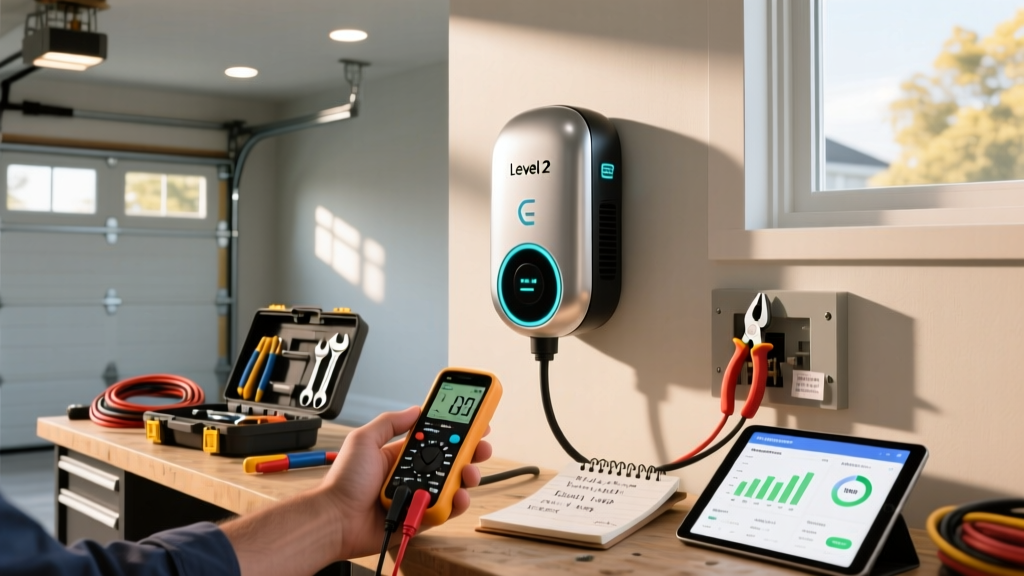
Most 2-door garages in homes built before 2000 have 100-amp or 150-amp main panels, and the garage itself may only have one or two 15-amp 120V outlets on a shared circuit. Installing a Level 2 charger requires a dedicated 240V circuit, typically 40-60 amps, run directly from your main panel.
Typical Level 2 Circuit Requirements
- 40-amp circuit: Delivers 9.6 kW (32 amps continuous, per NEC 80% rule). Requires 8 AWG copper wire. Suitable for most daily driving needs.
- 50-amp circuit: Delivers 12 kW (40 amps continuous). Requires 6 AWG copper wire. Faster fills, but overkill for overnight charging.
- 60-amp circuit: Delivers 14.4 kW (48 amps continuous). Requires 6 AWG copper wire. Needed only for large batteries (100+ kWh) or if you want maximum future-proofing.
Panel Upgrade: The Hidden Cost
If your main panel is already near capacity (common in older homes with electric ranges, dryers, and HVAC), adding a 40-60 amp EV circuit may require a panel upgrade from 100A to 200A. This is the single biggest variable in installation cost. Signs you might need an upgrade:
- Main breaker is 100A or 125A
- No open slots in the panel
- Electrician's load calculation shows you're above 80% capacity
- Panel is a recalled Federal Pacific or Zinsco brand (common in 1960s-80s homes)
Per the National Electrical Code, your electrician must perform a load calculation before installing any EV circuit. Don't skip this — an overloaded panel is a fire hazard.
Installation Cost Breakdown: What You'll Actually Pay
Installation costs vary wildly based on panel condition, wire run distance, and local permit fees. Here's a realistic breakdown for a 2-door garage Level 2 install in 2026:
| Component | Simple Install (panel in garage, short run) | Complex Install (panel upgrade, long run) |
|---|---|---|
| Level 2 charger unit | $400-$700 | $400-$700 |
| Electrical permit | $50-$150 | $50-$150 |
| Electrician labor (40A circuit, 20-30 ft run) | $500-$1,200 | $800-$1,800 |
| Panel upgrade (if needed) | N/A | $1,500-$3,000 |
| Conduit/wire materials | $100-$250 | $200-$500 |
| Total | $1,050-$2,300 | $2,950-$5,650 |
The wide range reflects real-world variability. A newer home with a 200A panel and the breaker box in the garage might cost under $1,500 all-in. A 1970s home needing a panel upgrade and a 60-foot wire run through a finished basement could push past $5,000. Get at least three quotes from licensed electricians — and verify they have EV charger installation experience.
Connector Compatibility: Will It Fit Your EV?
The connector landscape shifted dramatically in 2024-2025 when most automakers adopted the North American Charging Standard (NACS), originally Tesla's proprietary design. As of 2026, here's what you're likely to encounter:
| Connector | Brands Using It (2026) | Adapter Needed? |
|---|---|---|
| NACS (Tesla-style) | Tesla, Ford, GM, Rivian, Volvo, Polestar, Mercedes, Nissan (2025+) | None for these brands |
| CCS1 | Hyundai, Kia, BMW, VW, Stellantis (some), legacy models | CCS-to-NACS adapter ($150-$250) |
| CHAdeMO | Nissan Leaf (pre-2025), Mitsubishi Outlander PHEV | Limited public support; consider replacement |
If you own a 2026 model-year EV from Ford, GM, Rivian, or Tesla, buy a NACS charger. If you drive a Hyundai Ioniq 5, Kia EV6, or BMW i4, you'll need a CCS1 charger or a NACS charger with a CCS adapter. Most quality Level 2 chargers now ship with NACS connectors and include CCS adapters in the box — but confirm before purchasing.
Adapter Considerations for Tight Garages
In a 2-door garage, cable management matters. A CCS-to-NACS adapter adds bulk at the connector end and can make the cable stiffer and harder to coil. If your EV uses CCS1, consider a native CCS1 charger to avoid the adapter entirely. ChargePoint and Emporia offer both connector options.
Charging Cost: Home vs. Public vs. Gas
One of the biggest EV ownership advantages is fuel cost savings — but only if you charge at home. Public DC fast charging can approach or exceed gas prices per mile.
| Scenario | Cost per kWh | Cost per Mile (3.5 mi/kWh efficiency) | Annual Cost (12,000 mi) |
|---|---|---|---|
| Home Level 2 (off-peak rate) | $0.12/kWh | $0.034/mi | $408 |
| Home Level 2 (standard rate) | $0.18/kWh | $0.051/mi | $612 |
| Public Level 2 (ChargePoint, EVgo) | $0.35/kWh | $0.10/mi | $1,200 |
| DC Fast (Electrify America, Tesla) | $0.48/kWh | $0.137/mi | $1,644 |
| Gas car (28 MPG, $3.40/gal) | — | $0.121/mi | $1,452 |
At home off-peak rates, an EV costs roughly one-quarter what a gas car costs per mile. But if you rely exclusively on DC fast charging, your costs can exceed gasoline. This is why a 2-door garage Level 2 install pays for itself within 2-3 years for most drivers.
According to fueleconomy.gov, the average 2026 EV achieves 3.0-4.0 miles per kWh. Efficiency drops 15-30% in cold weather (below 40°F) due to battery heating demands and cabin climate use. Plan accordingly if you live in northern climates.
Equipment Picks: Best Level 2 Chargers for 2-Door Garages
When space is tight, you need a charger with a compact wall footprint, manageable cable length (25 feet is usually sufficient), and smart features like scheduling and load management. Here are three proven options for 2026:
Emporia Vue Level 2 (Budget Pick)
- Power: 48 amps / 11.5 kW (requires 60A circuit)
- Connector: NACS (CCS adapter included)
- Cable: 24 feet
- Smart features: Wi-Fi, app scheduling, energy monitoring, solar integration
- Price: $399
- Best for: Budget-conscious buyers who want smart features without a subscription
ChargePoint Home Flex (Versatile Pick)
- Power: Adjustable 16-50 amps / 3.8-12 kW (set via dip switches)
- Connector: NACS or CCS1 (select at purchase)
- Cable: 23 feet
- Smart features: Wi-Fi, app scheduling, Alexa integration, load sharing with second unit
- Price: $549-$649
- Best for: Garages with limited panel capacity (dial down amps to match circuit)
Tesla Wall Connector (Premium Pick)
- Power: 48 amps / 11.5 kW (requires 60A circuit)
- Connector: NACS native (CCS adapter sold separately)
- Cable: 24 feet
- Smart features: Wi-Fi, OTA updates, power sharing between two units, Tesla app integration
- Price: $475
- Best for: Tesla owners or households with multiple NACS-equipped EVs
All three units are NEMA 4-rated for outdoor use if your 2-door garage is detached or unheated. For indoor-only installations, NEMA 3R is sufficient. Ensure your electrician installs a GFCI breaker as required by NEC 2023 and later — this is non-negotiable for safety.
Safety and Code: What Not to Cut Corners On
A 2-door garage often doubles as storage for tools, bikes, and lawn equipment. That means your charger installation must account for physical protection and electrical safety:
- Dedicated circuit: Your Level 2 charger must be on its own breaker — no sharing with garage outlets or lighting.
- GFCI protection: NEC 625.54 requires ground-fault protection for all EV charging equipment. Your electrician should install a GFCI breaker or a charger with built-in GFCI.
- Mounting height: Install the charger 18-48 inches above the floor to avoid damage from stored items and to comply with ADA-adjacent best practices.
- Cable management: Use a wall-mounted cable organizer or retractable reel to prevent tripping hazards and connector damage.
- Outdoor rating: If your garage is unconditioned (no insulation/heat), choose a NEMA 4-rated unit to handle condensation and temperature swings.
Never use an extension cord with a Level 2 charger. The continuous high-amperage draw can overheat undersized cords and cause fires. If the charger's cable won't reach your EV's charge port, move the charger or buy a unit with a longer cable — don't improvise.
Charging Time Examples: What to Expect Overnight
Here's how long common 2026 EV models take to charge from 10% to 80% on a 9.6 kW (40-amp) Level 2 circuit — the most common home setup:
- Tesla Model Y (75 kWh battery): ~5.5 hours
- Ford Mustang Mach-E Extended Range (91 kWh usable): ~6.5 hours
- Hyundai Ioniq 5 (77.4 kWh): ~5.5 hours
- Chevrolet Equinox EV (85 kWh): ~6 hours
- BMW i4 eDrive40 (81.5 kWh): ~6 hours
All of these fit comfortably within an overnight window. If you arrive home at 7 PM with 10% battery, you'll have 80% by 1 AM — more than enough for the next day's driving. The 10-80% recommendation isn't arbitrary: charging above 80% slows dramatically as the battery management system reduces current to protect cell longevity. For daily use, 80% is the sweet spot.
FAQ: Common 2-Door Garage Charging Questions
Can I install a Level 2 charger myself?
No. A 240V, 40-60 amp circuit requires a licensed electrician and a permit. DIY electrical work at this amperage is a fire and electrocution risk, and your homeowner's insurance may deny claims if unpermitted work causes damage.
What if my 2-door garage has no 240V outlet?
That's normal — most garages don't. Your electrician will run a new 240V circuit from your main panel. If the panel is in the garage, the wire run is short and inexpensive. If it's in the basement or on the other side of the house, costs increase.
Will a Level 2 charger work with my EV's charge port location?
Check your EV's charge port position (front fender, rear quarter panel, or rear center) and measure the distance to where you plan to mount the charger. A 24-foot cable reaches most configurations in a 2-door garage, but if your port is on the opposite side from the charger, you may need a 25-foot cable or strategic mounting.
Do I need a smart charger, or is a dumb one fine?
A "dumb" charger (no Wi-Fi, no app) works perfectly for charging. Smart features let you schedule charging during off-peak hours, monitor energy use, and receive firmware updates. If your utility offers time-of-use rates, a smart charger pays for itself by avoiding peak-rate charging.
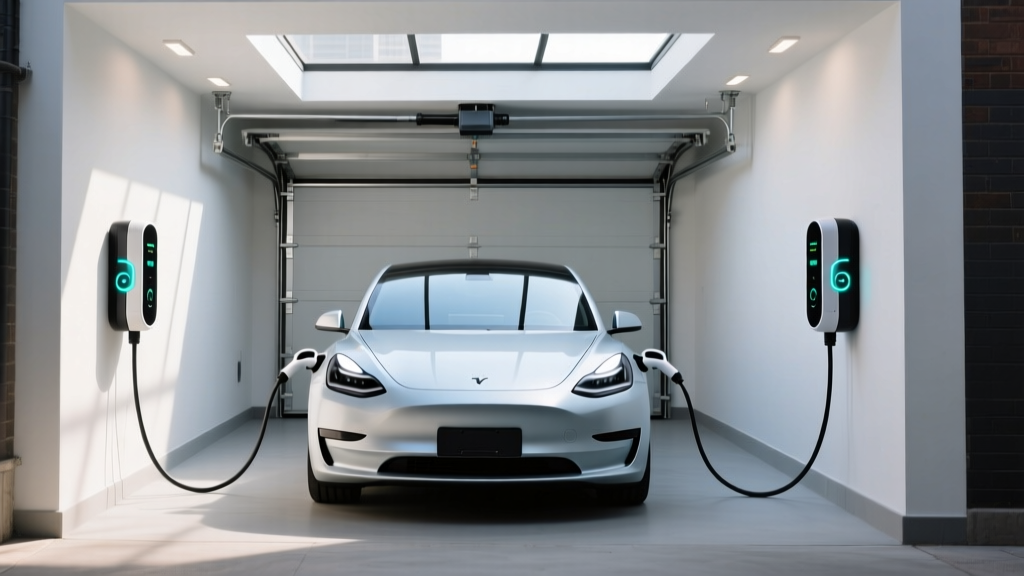
Can I charge two EVs in a 2-door garage on one circuit?
Yes, with load-sharing chargers like the Tesla Wall Connector or ChargePoint Home Flex. These units communicate with each other and split available amperage dynamically — if one car unplugs, the other gets full power. This requires a single 60A circuit rather than two separate 40A circuits, saving panel space.