If you're shopping for an EV or planning your first home charging setup, the phrase "charger 0-60" can mean two very different things: how fast the car accelerates, or how fast the charger replenishes your battery from empty to full. This guide focuses on the second meaning — a practical, numbers-first breakdown of how quickly each charging level adds range, what it costs to install at home, which connectors you need, and what you'll actually pay per mile compared to gasoline.
Before we get into the data, one critical distinction every EV owner must internalize: kW (kilowatts) measures power — the rate at which energy flows into your battery, like water pressure from a hose. kWh (kilowatt-hours) measures energy — the total capacity of your battery, like the size of the tank. A charger rated at 11.5 kW delivers energy faster than one rated at 7.2 kW, but the total energy your battery holds is measured in kWh (e.g., 75 kWh usable). Mixing these up is the single most common mistake new EV owners make.
The Three Charging Levels: Speed, Power, and Real-World Range Added
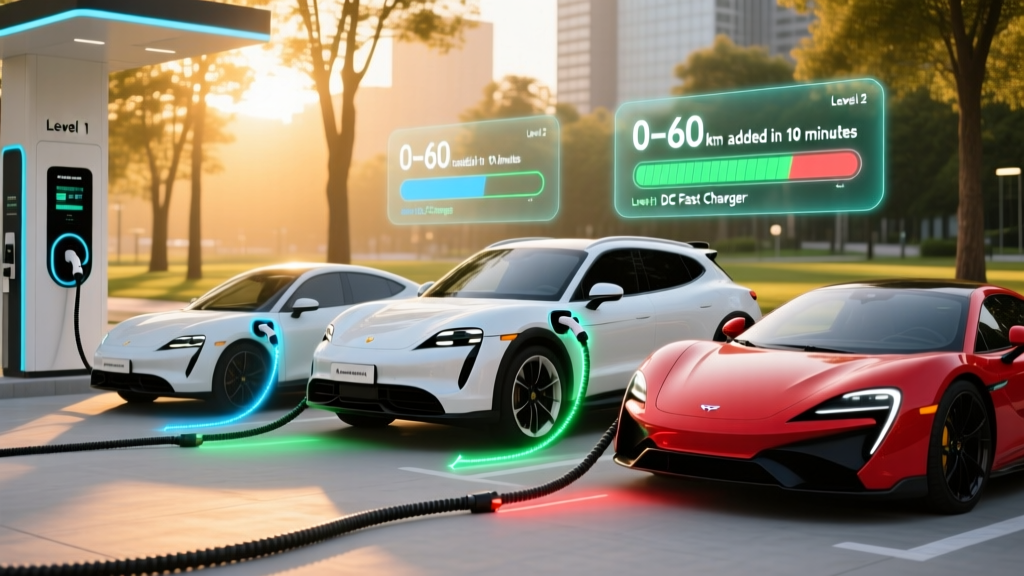
Every EV sold in the US charges via one of three tiers. The table below maps each level to its typical power output (kW), the voltage and amperage required, and — most importantly for trip planning — how many miles of range you gain per hour of charging.
| Level | Voltage / Amperage | Max Power (kW) | Miles of Range per Hour | Typical Use Case |
|---|---|---|---|---|
| Level 1 | 120V / 12A | 1.4 kW | 3–5 mi/hr | Overnight top-off, PHEVs, emergencies |
| Level 2 | 240V / 32A–48A | 7.7–11.5 kW | 25–44 mi/hr | Daily home charging, workplace, hotels |
| DC Fast Charge | 400V–800V DC | 50–350 kW | 150–1,200+ mi/hr (peak) | Road trips, highway corridors, quick top-ups |
A few real-world nuances matter here. Level 1 charging from a standard household outlet is essentially a trickle — adequate for plug-in hybrids with 25–40 miles of electric range (like the Toyota RAV4 Prime), but painfully slow for a full BEV with an 80+ kWh battery. Level 2 is the backbone of daily EV ownership: plug in when you get home, wake up to a full battery every morning. DC fast charging is designed for road trips and quick stops; it's not meant for daily use because sustained high-power charging accelerates battery degradation over time.
The "miles per hour" figures above assume an average vehicle efficiency of roughly 3–4 miles per kWh (about 100–120 MPGe combined). A more efficient vehicle like the Lucid Air (4.5 mi/kWh) will gain more miles per hour at the same charger than a heavier, less aerodynamic SUV like the GMC Hummer EV (roughly 2 mi/kWh).
DC Fast Charging: 10–80% Times for Common Battery Sizes
When automakers advertise "charges from 10% to 80% in 18 minutes," they're referring to DC fast charging under ideal conditions — battery preconditioned to optimal temperature, connected to a charger that can sustain the vehicle's peak charge rate, and ambient temps between 60°F and 85°F. Here's what that looks like for popular 2025–2026 EVs with varying battery capacities:
| Vehicle | Battery (kWh usable) | Peak DC Rate (kW) | 10–80% Time (min) | Notes |
|---|---|---|---|---|
| Hyundai Ioniq 5 (Long Range) | 77.4 kWh (NMC) | 240 kW (800V) | ~18 min | Sustains high rate well; precondition via nav |
| Tesla Model Y (Long Range) | 75 kWh (NMC) | 250 kW | ~22 min | V4 Superchargers; taper above 60% |
| Ford F-150 Lightning (Extended) | 131 kWh (NMC) | 150 kW | ~41 min | Large battery = longer fill even at high kW |
| Chevrolet Equinox EV (3RS) | 85 kWh (NMC) | 150 kW | ~30 min | GM's Ultium platform; CCS1/NACS adapter |
| Tesla Model 3 (RWD, LFP) | 57.5 kWh (LFP) | 170 kW | ~25 min | LFP chemistry tolerates frequent 100% SoC |
Home Charger Installation: Electrical Requirements, Costs, and Panel Upgrades
Installing a Level 2 home charger is the single most impactful upgrade an EV owner can make. It transforms your garage or driveway into a personal fueling station, eliminating dependence on public charging for daily driving. But costs vary enormously depending on your home's electrical infrastructure.
Electrical Requirements for Level 2 Charging
A Level 2 charger requires a 240-volt dedicated circuit, similar to what powers an electric dryer or oven. The most common configurations are:
- 32-amp circuit (40A breaker): Delivers up to 7.7 kW — sufficient for most overnight charging needs. Requires 8 AWG copper wire.
- 40-amp circuit (50A breaker): Delivers up to 9.6 kW — the sweet spot for most homes. Requires 6 AWG copper wire.
- 48-amp circuit (60A breaker): Delivers up to 11.5 kW — maximum Level 2 speed for most EVs. Requires 4 AWG copper wire and a panel with adequate spare capacity.
National Electrical Code (NEC) requires that continuous loads (including EV chargers) not exceed 80% of a circuit's rated capacity. That's why a 40A breaker supports a 32A continuous charge, and a 50A breaker supports a 40A continuous charge.
Installation Cost Breakdown
| Component | Simple Install (panel nearby) | Complex Install (long run / panel upgrade) |
|---|---|---|
| Level 2 Charger Equipment | $350–$650 | $350–$650 |
| Electrician Labor | $300–$800 | $1,000–$2,500 |
| Materials (wire, conduit, breaker) | $50–$200 | $200–$600 |
| Permit & Inspection | $50–$200 | $100–$300 |
| Electrical Panel Upgrade (if needed) | $0 (not needed) | $1,500–$3,500 |
| Total Estimated Cost | $750–$1,850 | $3,150–$7,550 |
The "simple install" scenario assumes your electrical panel is close to the charger location (same wall or adjacent), has a spare double-pole breaker slot, and has sufficient amperage headroom (typically a 200A service panel with less than 80% existing load). The "complex install" applies when you need a long wire run through walls or underground conduit, or when your existing 100A panel is already near capacity — common in homes built before 2000.
Safety and Code Considerations
Every Level 2 installation must meet these NEC and local code requirements:
- Dedicated circuit: The EV charger must have its own double-pole breaker — no sharing with other outlets or appliances.
- GFCI protection: NEC 2020 and later requires Ground Fault Circuit Interrupter protection for all EV charging outlets (NEC 625.54). Many modern hardwired chargers have built-in GFCI; if you're installing a NEMA 14-50 receptacle, your breaker must be GFCI-rated.
- Outdoor rating: If your charger is mounted outside, the unit must carry a NEMA 4 (weatherproof) rating, and any receptacle must be in a weatherproof "in-use" cover box.
- Permit and inspection: Most jurisdictions require an electrical permit for EV charger installation. The inspection ensures the work meets code and protects your homeowner's insurance coverage.
Connector Compatibility: NACS, CCS1, and CHAdeMO in 2026
The North American charging connector landscape has shifted dramatically. Tesla's North American Charging Standard (NACS) has been adopted by nearly every major automaker starting with 2025 model-year vehicles, but millions of CCS1-equipped EVs remain on the road. Here's where each connector stands:
| Connector | Brands Using It (2026 MY) | DC Fast Network Access | Adapter Needed? |
|---|---|---|---|
| NACS (native) | Tesla, Ford, GM, Rivian, Volvo, Polestar, Mercedes, Nissan (Ariana), Honda, Fisker, Lucid, BMW (new models) | Tesla Supercharger + growing NACS public networks | None for Superchargers; CCS adapter may be needed at legacy stations |
| CCS1 | Hyundai, Kia, VW, Audi, Porsche (Taycan), Stellantis, older BMW, older Ford/GM | Electrify America, EVgo, ChargePoint, Ionity | NACS-to-CCS adapter (~$200–$250) for Tesla Supercharger access |
| CHAdeMO | Nissan Leaf (legacy only — discontinued) | Declining; some EA and EVgo stations retain connectors | No widely available adapter; network is shrinking |
For home Level 2 charging, all vehicles use the J1772 connector (or NACS, which includes J1772 Level 2 pins). If you buy a NACS-equipped home charger, it will natively plug into Teslas and new NACS-adopting vehicles. For CCS1 vehicles, you'll need a J1772-to-vehicle adapter (usually included with the car) or a charger with a J1772 plug. Most third-party Level 2 chargers ship with J1772 connectors, which work universally for AC charging.
Cost to Charge: Per-Mile Economics vs. Gasoline
The economic case for EV charging hinges on where you charge. Home charging on an off-peak utility rate is dramatically cheaper than gasoline, while DC fast charging on a road trip can approach or even exceed gas costs per mile. Here's the math for a vehicle averaging 3.5 miles per kWh (roughly 117 MPGe):
| Scenario | Cost per kWh | Cost per Mile | Equivalent Gas MPG at $3.50/gal |
|---|---|---|---|
| Home (off-peak utility rate) | $0.08–$0.14 | $0.023–$0.040 | 88–152 MPG |
| Home (standard residential rate) | $0.14–$0.20 | $0.040–$0.057 | 61–88 MPG |
| Public Level 2 (workplace, retail) | $0.20–$0.35 | $0.057–$0.100 | 35–61 MPG |
| DC Fast Charge (Electrify America, EVgo) | $0.35–$0.55 | $0.100–$0.157 | 22–35 MPG |
| Tesla Supercharger (average 2026) | $0.28–$0.40 | $0.080–$0.114 | 31–44 MPG |
| Gasoline vehicle (25 MPG combined) | — | $0.140 | 25 MPG (baseline) |
The takeaway: if you can charge at home on a reasonable utility rate (and most US residential rates fall in the $0.12–$0.18/kWh range), your per-mile fuel cost is roughly one-third to one-half that of a 25 MPG gasoline vehicle. Even at the national average residential rate of ~$0.16/kWh (per EIA data), you're paying the equivalent of driving a 60+ MPG car.
However, if you rely exclusively on DC fast charging — living in an apartment without home charging access, for instance — your costs can rival or exceed gasoline. This is why home charging access remains the single biggest predictor of EV ownership satisfaction.
Recommended Home Level 2 Chargers: Power, Features, and Price
Based on reliability data, real-world charging performance, and feature sets, these are the top Level 2 home chargers for 2026. All figures reflect current retail pricing and manufacturer specifications.
ChargePoint Home Flex
- Power Output: Up to 11.5 kW (48A) on a 60A circuit; configurable down to 16A
- Connector: J1772 (works with all EVs for AC charging); NACS version available
- Cable Length: 23 feet
- Smart Features: Wi-Fi, app scheduling, Alexa integration, energy tracking, utility demand-response
- Price: ~$599 (J1772) / ~$649 (NACS)
- Best For: Flexible amperage configuration if your panel has limited capacity
Tesla Wall Connector
- Power Output: Up to 11.5 kW (48A) on a 60A circuit
- Connector: NACS native; includes J1772 adapter for non-Tesla EVs
- Cable Length: 24 feet
- Smart Features: Wi-Fi, over-the-air updates, load sharing (pair two units on one circuit), Tesla app integration
- Price: ~$475
- Best For: Tesla owners or households with NACS-equipped vehicles seeking best value
Emporia Vue Level 2 Charger
- Power Output: Up to 11.5 kW (48A)
- Connector: J1772
- Cable Length: 24 feet
- Smart Features: Wi-Fi, real-time energy monitoring, integration with Emporia home energy panel, solar-aware scheduling
- Price: ~$399
- Best For: Budget-conscious buyers who want energy monitoring without a premium price
Grizzl-E Smart
- Power Output: Up to 10 kW (40A) on a 50A circuit
- Connector: J1772
- Cable Length: 24 feet
- Smart Features: Wi-Fi, OCPP compatibility, adjustable amperage (16A–40A), extreme cold rating (-40°F)
- Price: ~$449
- Best For: Cold-climate owners; rugged outdoor installations; Canadian-built durability
Frequently Asked Questions
How much does it cost to install a home EV charger?
A straightforward Level 2 installation (panel nearby, adequate capacity) typically runs $750–$1,850 including equipment, electrician labor, materials, and permit. If your home needs a panel upgrade from 100A to 200A service, total costs can reach $3,150–$7,550. Always get a load calculation from a licensed electrician before committing. Some utilities and states offer rebates of $250–$1,000 that offset these costs — check AFDC's state incentive database for current programs.
How fast will each charging level add range?
Level 1 (120V) adds 3–5 miles per hour — adequate for PHEVs but impractical for full BEVs. Level 2 (240V, 32A–48A) adds 25–44 miles per hour, fully recharging most EVs overnight in 6–10 hours. DC fast charging adds 150–1,200+ miles per hour at peak rates, with typical 10–80% sessions taking 18–41 minutes depending on battery size and charger power. See the charging levels table above for exact figures.
Which connector/charger is compatible with my EV?
For 2026 model-year vehicles: if you drive a Tesla, Ford, GM, Rivian, Volvo, or most new-brand EVs, your vehicle uses NACS. If you drive a Hyundai, Kia, VW, or most pre-2025 non-Tesla EVs, your vehicle uses CCS1. For home Level 2 charging, J1772 connectors are universal for AC charging across all EVs. For DC fast charging, check your vehicle's port — and if you have CCS1 and want Tesla Supercharger access, you'll need a manufacturer-approved NACS adapter (~$200–$250).
How much does charging cost per mile vs. gas?
At the US average residential electricity rate (~$0.16/kWh), an EV averaging 3.5 mi/kWh costs roughly $0.046 per mile — equivalent to driving a 76 MPG car at $3.50/gallon gas. Home off-peak charging can drop this to $0.023–$0.040/mile (88–152 MPG equivalent). DC fast charging on road trips costs $0.08–$0.16/mile, comparable to a 22–44 MPG gas vehicle. See the cost table above for detailed scenarios.
What electrical upgrades might I need?
The most common upgrade is a panel capacity increase. Homes with 100A service panels that are already heavily loaded may need an upgrade to 200A ($1,500–$3,500). Other potential upgrades include: replacing a Federal Pacific or Zinsco panel (known fire hazards, $2,000–$4,000 replacement), adding a sub-panel near the charger location for long wire runs, or installing a smart load-management device (e.g., Emporia Smart Panel) that dynamically limits charger amperage when other household loads spike — this can avoid a panel upgrade entirely in some cases.
Is DC fast charging bad for my battery?
Occasional DC fast charging on road trips has minimal impact on battery health. However, daily DC fast charging — especially at rates above 100 kW — accelerates degradation by generating sustained heat and stress in the battery cells. According to the DOE, most modern EV thermal management systems mitigate this substantially, but the physics remain: slower charging is gentler on lithium-ion cells. For daily use, Level 2 home charging is the optimal balance of speed and battery longevity.
Can I charge my EV from a regular household outlet?
Yes — that's Level 1 charging (120V, 1.4 kW). It adds roughly 3–5 miles of range per hour, meaning a full charge of a 75 kWh battery would take 50+ hours. Level 1 is practical only for PHEVs with small batteries (15–20 kWh, charging overnight is sufficient) or as an emergency backup for BEVs. If you must rely on Level 1 for a BEV, expect to gain only 35–50 miles of range from a 10-hour overnight session.