Why the ChargePoint NACS Cable Matters in 2026
With nearly every major automaker — Ford, GM, Rivian, Hyundai, Kia, BMW, and others — having adopted the North American Charging Standard (NACS) for their electric vehicles, the charging landscape has consolidated fast. If you're shopping for a home Level 2 charger and your EV uses a NACS port (or will, via adapter), the ChargePoint Home Flex with a NACS cable is one of the most widely recommended units on the market. But buying the charger is only half the equation. The real questions are: what does installation actually cost, what electrical work is required, and how fast will it charge your specific EV?
This guide breaks down the ChargePoint NACS cable ecosystem, home installation requirements with real cost ranges, connector compatibility across brands, and what you'll actually pay per mile compared to gasoline.
Charging Levels Explained: kW Speeds and Range Added Per Hour
Before evaluating any charger, you need to understand the three charging levels and how they differ in power delivery. Power is measured in kW (kilowatts) — the rate of energy flow — while your battery stores energy measured in kWh (kilowatt-hours). Think of kW as how fast water flows through a hose, and kWh as the total volume of the tank you're filling.
| Level | Voltage | Power (kW) | Miles of Range Added Per Hour | Typical Use Case |
|---|---|---|---|---|
| Level 1 | 120V AC | 1.0–1.4 kW | 3–5 mi/hr | Overnight top-ups, PHEVs, emergency |
| Level 2 | 240V AC | 3.3–19.2 kW | 12–75 mi/hr | Home daily charging, workplace |
| DC Fast Charging | 400–800V DC | 50–350 kW | 150–1,200+ mi/hr | Road trips, public stations |
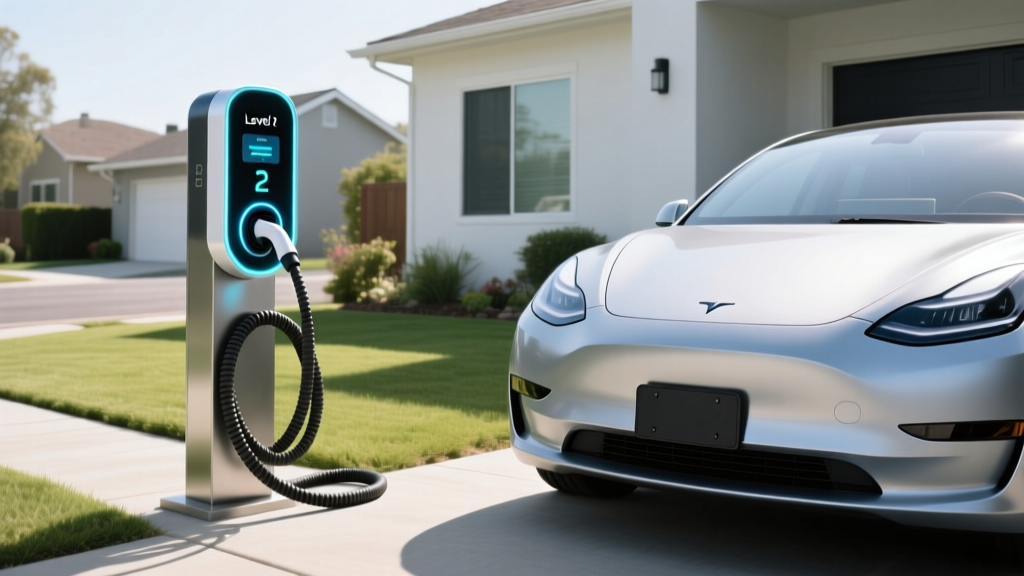
The ChargePoint Home Flex is a Level 2 charger. Configured on a 60-amp circuit, it delivers up to 11.5 kW (48 amps continuous, as the National Electrical Code requires a 20% derating on circuits — a 60A breaker supports 48A continuous draw). On a 50-amp circuit, it delivers up to 9.6 kW (40A continuous). At 11.5 kW, most EVs will gain roughly 35–45 miles of range per hour of charging, depending on the vehicle's efficiency rating.
ChargePoint Home Flex NACS: Equipment Specs and Pricing
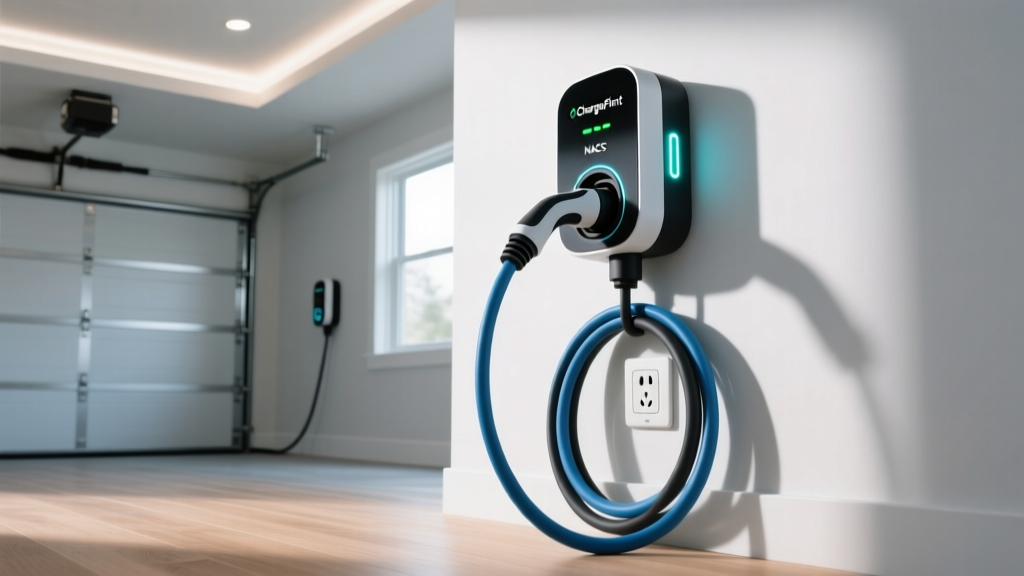
The ChargePoint Home Flex is a hardwired or plug-in (NEMA 14-50) Level 2 charger that ChargePoint now ships with either a J1772 or NACS connector cable. Here's what you need to know about the NACS cable version:
ChargePoint Home Flex (NACS Cable) — Key Specifications
- Max Power Output: 11.5 kW (on 60A circuit) / 9.6 kW (on 50A circuit)
- Cable Length: 23 feet (standard)
- Connector: NACS (native Tesla-style plug)
- Wi-Fi Connected: Yes — app scheduling, energy tracking, Alexa integration
- Indoor/Outdoor Rated: Yes (NEMA 4 rating)
- Energy Star Certified: Yes
- Equipment Price: Approximately $549–$599 (NACS version, as of early 2026)
- Warranty: 3 years
The NACS cable version eliminates the need for a J1772-to-NACS adapter if your EV has a native NACS charge port (all Tesla vehicles, plus 2025–2026 model-year Ford, GM, Rivian, Hyundai, Kia, and BMW EVs). If you drive an older EV with a CCS1 port, you'll need a NACS-to-CCS1 adapter — more on that below.
How It Compares to Other NACS Home Chargers
| Charger | Max Power | Cable Length | Smart Features | Price (approx.) |
|---|---|---|---|---|
| ChargePoint Home Flex (NACS) | 11.5 kW | 23 ft | App, Wi-Fi, scheduling, Alexa | $549–$599 |
| Tesla Wall Connector | 11.5 kW | 24 ft | App, Wi-Fi, load sharing, Powerwall integration | $475 |
| Grizzl-E Smart (NACS) | 10 kW | 24 ft | App, Wi-Fi, OCPP | $449–$499 |
| Emporia Level 2 (NACS) | 11.5 kW | 24 ft | App, Wi-Fi, solar integration | $399–$449 |
The ChargePoint Home Flex holds its own on power output and cable length. The Tesla Wall Connector is slightly cheaper and offers Powerwall integration, but lacks the broader third-party app ecosystem. The Emporia is a strong value pick if you have solar panels and want energy management. The Grizzl-E is rugged and well-suited to extreme cold climates.
Home Installation: Electrical Requirements and Real Costs
The single biggest variable in home EV charging setup isn't the charger itself — it's the electrical work. Here's what a licensed electrician will evaluate:
Electrical Requirements for the ChargePoint Home Flex
- Voltage: 240V (standard for Level 2 — same as a dryer or oven circuit)
- Amperage: 50A breaker (for 9.6 kW / 40A continuous) or 60A breaker (for 11.5 kW / 48A continuous)
- Wiring: 6 AWG copper for 50A; 4 AWG copper or 6 AWG copper (depending on insulation type and run length) for 60A
- Circuit: Dedicated — no sharing with other appliances
- Connection type: Hardwired (recommended for 60A) or NEMA 14-50 receptacle (plug-in, limited to 50A / 40A continuous by code)
Installation Cost Breakdown
| Component | Simple Install (panel nearby, no upgrade) | Complex Install (long run, panel upgrade) |
|---|---|---|
| ChargePoint Home Flex (equipment) | $549–$599 | $549–$599 |
| Electrician labor (2–4 hrs simple / 6–12 hrs complex) | $300–$800 | $1,200–$3,000 |
| Materials (wire, conduit, breaker, junction box) | $100–$300 | $300–$700 |
| Permit and inspection | $50–$200 | $50–$200 |
| Panel upgrade (if needed) | $0 | $1,500–$3,500 |
| Total Estimated Cost | $1,000–$1,900 | $3,600–$8,000 |
According to data from the U.S. Department of Energy, most straightforward Level 2 home installations fall between $1,000 and $2,500 total (equipment included). Costs spike when the panel is far from the charge location (long wire runs through walls or underground conduit) or when a service upgrade is required.
Safety and Code Considerations
- GFCI protection: NEC 2020 and later require GFCI protection for all EV charging outlets. Hardwired installations may be exempt in some jurisdictions — confirm with your local inspector.
- Outdoor rating: The ChargePoint Home Flex carries a NEMA 4 rating, meaning it handles rain, dust, and hose-directed water. If mounting outdoors, ensure the conduit and junction boxes are also rated for wet locations.
- Dedicated circuit: Never share the EV circuit with other loads. This is both a code requirement and a practical necessity to avoid tripped breakers.
- Permit: Nearly all jurisdictions require an electrical permit for new 240V circuits. The permit ensures an inspection verifies the work — this protects your home insurance coverage.
Connector Compatibility: Does the ChargePoint NACS Cable Fit Your EV?
The NACS connector (SAE J3400) has become the dominant light-duty EV charging connector in North America. Here's how compatibility breaks down by brand:
| EV Brand | Native Connector (2025–2026 Models) | Works with ChargePoint NACS? | Adapter Needed? |
|---|---|---|---|
| Tesla (all models) | NACS | Yes — direct plug | None |
| Ford (F-150 Lightning, Mustang Mach-E) | NACS (2025+) | Yes — direct plug | None for 2025+; CCS adapter for 2022–2024 |
| GM (Chevy Equinox EV, Blazer EV, Silverado EV, Cadillac Lyriq) | NACS (2025+) | Yes — direct plug | None for 2025+ |
| Rivian (R1T, R1S) | NACS (2025+) | Yes — direct plug | None for 2025+ |
| Hyundai (Ioniq 5, Ioniq 6) | NACS (2026+) | Yes — direct plug | CCS-to-NACS adapter for 2022–2025 |
| Kia (EV6, EV9) | NACS (2026+) | Yes — direct plug | CCS-to-NACS adapter for 2023–2025 |
| BMW (iX, i4, i5) | NACS (2025+) | Yes — direct plug | None for 2025+ |
| Older CCS1 EVs (VW ID.4 pre-2025, etc.) | CCS1 | Yes — with adapter | NACS-to-CCS1 adapter required |
| Nissan Leaf (CHAdeMO) | CHAdeMO | No | No standard adapter exists |
If you currently own a CCS1-equipped EV but plan to upgrade to a NACS vehicle in the next few years, buying the NACS cable version of the Home Flex now is a reasonable forward-looking choice. A NACS-to-CCS1 adapter (typically $100–$200 from manufacturers like Lectron or A2Z) bridges the gap for your current vehicle.
Cost to Charge: Home vs. Public vs. Gasoline
One of the strongest arguments for home Level 2 charging is cost. Here's how per-mile energy expenses compare across scenarios, based on an EV averaging 3.0 miles per kWh (a typical mid-size crossover efficiency, roughly equivalent to 112 MPGe per EPA data at fueleconomy.gov):
| Scenario | Rate | Cost Per kWh | Cost Per Mile (at 3 mi/kWh) |
|---|---|---|---|
| Home — off-peak utility rate | $0.09–$0.14/kWh | $0.12 avg | $0.04 |
| Home — standard residential rate | $0.14–$0.22/kWh | $0.18 avg | $0.06 |
| Public Level 2 (ChargePoint, EVgo, etc.) | $0.25–$0.49/kWh | $0.35 avg | $0.12 |
| DC Fast Charging (Electrify America, Tesla Supercharger) | $0.32–$0.56/kWh | $0.44 avg | $0.15 |
| Gasoline vehicle (28 MPG combined, $3.40/gal) | — | — | $0.12 |
The takeaway: home charging at off-peak rates is roughly one-third the per-mile cost of gasoline. Even at standard residential rates, you're saving 40–50% per mile. Public DC fast charging narrows the gap considerably — and in some regions with high utility rates, it can briefly exceed gasoline costs. This is why home charging access is the single most important factor in EV ownership economics.
Charging Time Examples for Common Battery Sizes
How long does the ChargePoint Home Flex actually take to charge popular EVs? Here are 10–80% estimates (the range most drivers use for daily charging, since charging slows significantly above 80% to protect battery health):
- Tesla Model Y (75 kWh usable, NMC): ~4.5 hours at 11.5 kW (10–80%)
- Ford F-150 Lightning Extended Range (131 kWh usable, NMC): ~8 hours at 11.5 kW (10–80%)
- Hyundai Ioniq 5 (77.4 kWh usable, NMC): ~4.7 hours at 11.5 kW (10–80%)
- Chevy Equinox EV (85 kWh usable, NMC): ~5.2 hours at 11.5 kW (10–80%)
- BMW iX xDrive50 (105.2 kWh usable, NMC): ~6.4 hours at 11.5 kW (10–80%)
All of these fit comfortably within an overnight charging window. For most drivers who plug in at 70% remaining SoC, a full replenish to 80% takes only 2–3 hours.
Federal Tax Credit for Home Charger Installation
The IRS Alternative Fuel Vehicle Refueling Property Credit (IRC §30C) can offset up to 30% of the cost of home EV charger equipment and installation, capped at $1,000. Key eligibility points:
- The charger must be installed at your primary residence.
- The property must be located in an eligible census tract (designated as low-income or non-urban — check the IRS census tract locator).
- The credit covers both equipment and labor.
- It is non-refundable — you must have sufficient tax liability to claim it.
For a $1,500 total installation, the credit could return $450. For a $3,000 complex install, you'd hit the $1,000 cap. Consult a tax professional to confirm eligibility, as census tract designations and IRS guidance may update.
Frequently Asked Questions
How much does it cost to install a ChargePoint NACS home charger?
Total installed cost ranges from roughly $1,000 to $1,900 for a straightforward setup (panel nearby, no upgrade needed), and $3,600 to $8,000 if a panel upgrade or long wire run is required. The ChargePoint Home Flex NACS unit itself costs approximately $549–$599.
How fast will the ChargePoint Home Flex add range?
At its maximum 11.5 kW output (on a 60-amp circuit), expect roughly 35–45 miles of range per hour for a typical EV crossover. On a 50-amp circuit at 9.6 kW, expect about 28–37 miles per hour. Exact figures depend on your vehicle's efficiency (miles per kWh).
Will the ChargePoint NACS cable work with my non-Tesla EV?
If your EV has a native NACS port (2025+ Ford, GM, Rivian, BMW; 2026+ Hyundai, Kia), yes — it plugs in directly. If your EV has a CCS1 port, you'll need a NACS-to-CCS1 adapter. The ChargePoint NACS cable does not work with CHAdeMO vehicles like the Nissan Leaf.
How much does charging cost per mile compared to gas?
Home charging at off-peak rates costs approximately $0.04 per mile, versus $0.12 per mile for a 28 MPG gasoline vehicle at $3.40/gallon — a savings of roughly 65%. Standard residential rates bring EV cost to about $0.06/mile, still half the cost of gas.
What electrical upgrades might I need?
At minimum, you need a dedicated 240V circuit (50A or 60A breaker). If your electrical panel lacks capacity — common with 100-amp service in older homes — a panel upgrade to 200 amps may be required, adding $1,500–$3,500. Your electrician will perform an NEC Article 220 load calculation to determine this before any work begins.
Should I hardwire the ChargePoint Home Flex or use a NEMA 14-50 plug?
Hardwiring is recommended for 60-amp installations (delivering the full 11.5 kW) and avoids the GFCI breaker requirement that applies to receptacle circuits under NEC 2020+. A NEMA 14-50 plug offers portability — you can take the charger when you move — but limits you to 50 amps (9.6 kW) and may require a costly GFCI breaker ($100–$200). For most permanent installations, hardwiring is the cleaner path.