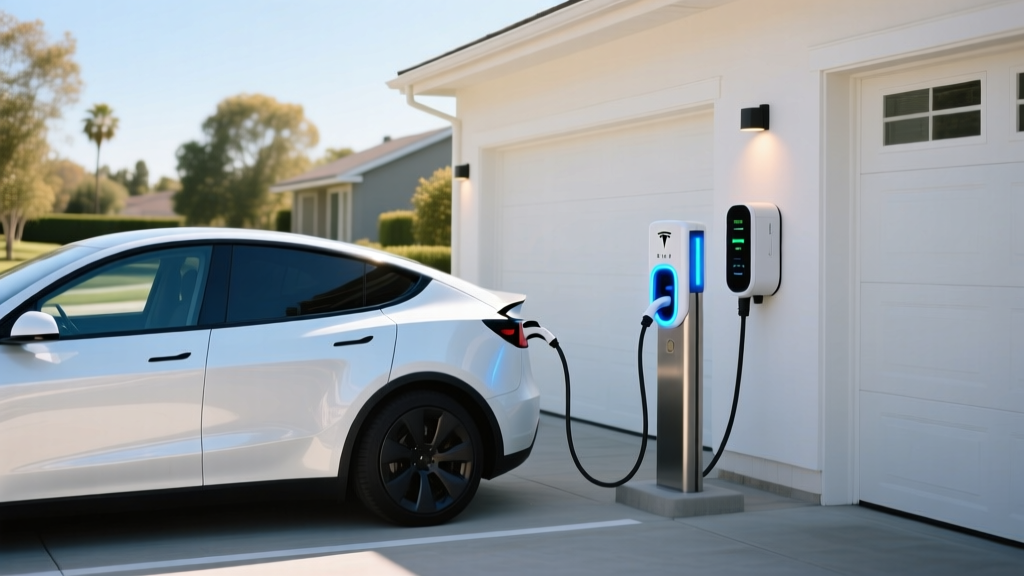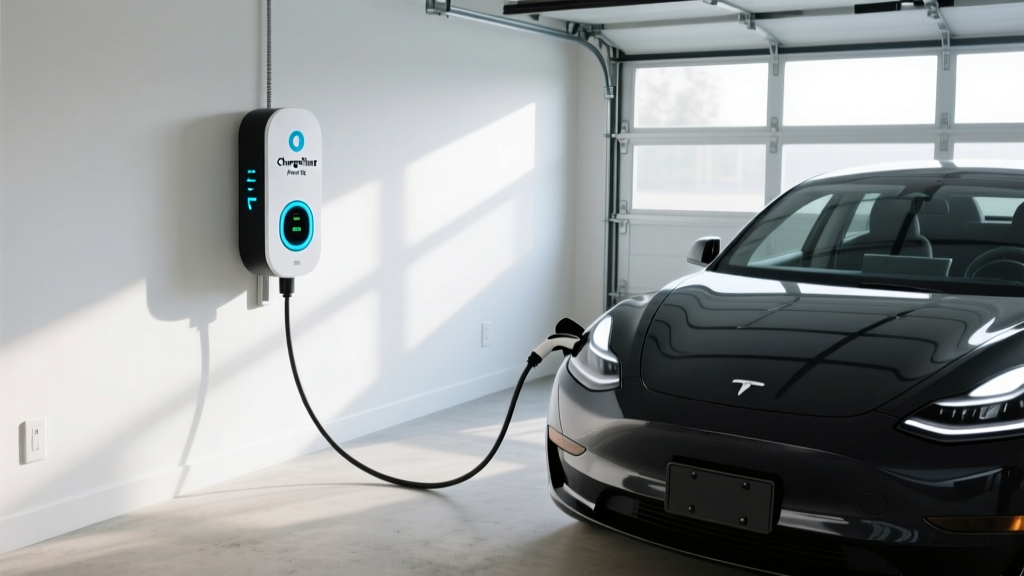
If you have narrowed your home Level 2 options down to the ChargePoint Home Flex charging station, you are looking at one of the most configurable wall boxes on the market. The Home Flex is a hardwired or plug-in Level 2 charger rated for up to 50 amps (12 kW on a 240V circuit), with a swappable connector pigtail that lets you choose NACS (Tesla) or J1772/CCS1 at the time of install. Below, we break down the electrical requirements, real-world charging speeds, total installation cost, and whether the Home Flex is the right pick for your specific EV and home panel in 2026.
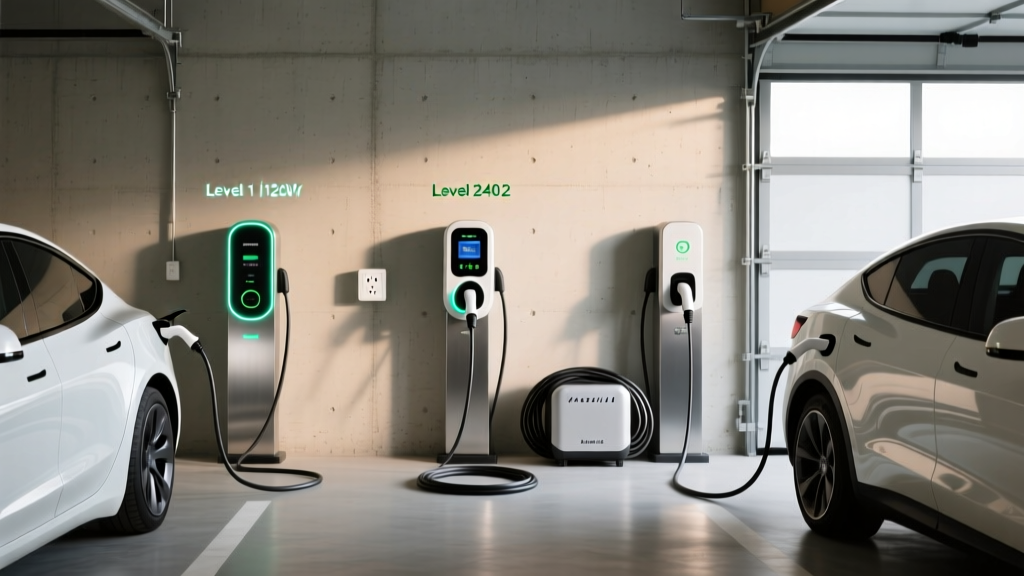
Charging Levels Explained: kW, Miles Per Hour, and What the Home Flex Delivers
Before we get into the hardware, a mandatory distinction: kW (kilowatts) measures power — the rate at which energy flows into your car. kWh (kilowatt-hours) measures energy — the total capacity of your battery. Think of kW as the width of the hose and kWh as the size of the bucket. The ChargePoint Home Flex maxes out at 12 kW (50 amps × 240 volts), which sits at the top end of residential Level 2.
| Level | Voltage | Max kW | Miles of Range Added Per Hour | Typical Use |
|---|---|---|---|---|
| Level 1 | 120V (standard outlet) | 1.2–1.9 kW | 3–5 mi/hr | Overnight top-up; PHEV-friendly |
| Level 2 | 240V (dryer/EV circuit) | 3.3–19.2 kW | 12–75 mi/hr | Primary home charging |
| DC Fast | 400–800V DC | 50–350 kW | 150–1,000+ mi/hr (peak) | Road trips; 10–80% in 15–40 min |
At 12 kW, the ChargePoint Home Flex adds roughly 30–44 miles of range per hour depending on your vehicle's efficiency. A highly efficient sedan like the Hyundai Ioniq 6 (4.0 mi/kWh per fueleconomy.gov) will gain about 44 miles per hour of charging. A heavier, less efficient SUV like the Ford F-150 Lightning (~2.0 mi/kWh) will add closer to 24 miles per hour at the same 12 kW rate.
ChargePoint Home Flex: Hardware Specs, Connector Options, and Smart Features
The Home Flex is not a one-size-fits-all unit. Its defining feature is an adjustable amperage output — you can configure it for any circuit from 16A to 50A via DIP switches inside the unit, which means it can work with older 20-amp circuits or max out a new 60-amp dedicated line. Here is the full spec breakdown:
| Spec | Detail |
|---|---|
| Max Output | 12 kW (50A / 240V) |
| Adjustable Amperage | 16A, 24A, 32A, 40A, 48A, or 50A |
| Connector Options | NACS (Tesla) or J1772 (CCS1 compatible) |
| Cable Length | 23 feet |
| Installation | Hardwired (recommended) or NEMA 14-50 plug |
| Wi-Fi / Smart Features | Yes — scheduling, energy tracking, Alexa/Google Home |
| Outdoor Rating | NEMA 4 (weather-resistant) |
| UL Listed | Yes (UL 2594) |
| Warranty | 3 years |
| Equipment Price (2026) | ~$549–$599 MSRP |
Home Installation: Electrical Requirements, Panel Upgrades, and Total Cost
This is where most EV charger budgets get blown up. The ChargePoint Home Flex itself runs about $549–$599, but the installation cost depends entirely on your home's electrical panel, the distance from the panel to your garage or driveway, and whether you need a panel upgrade.
Electrical Requirements for a 50-Amp Install
To run the Home Flex at its full 12 kW / 50A output, you need a dedicated 60-amp breaker on a 240V circuit (the National Electrical Code requires the breaker to be rated at 125% of the continuous load, so 50A continuous = 60A breaker). You will need 6 AWG copper wire for runs up to about 50 feet; longer runs may require 4 AWG to prevent voltage drop.
If your home has a 100-amp main panel — common in homes built before the 1990s — adding a 60-amp EV circuit may exceed your panel's capacity, especially if you already have electric range, dryer, and HVAC loads. A licensed electrician will perform a load calculation per NEC Article 220 to determine if a panel upgrade to 200 amps is necessary.
| Component | Simple Install (Same Wall as Panel) | Standard Install (20–50 ft Run) | Complex Install (Panel Upgrade + Long Run) |
|---|---|---|---|
| ChargePoint Home Flex Unit | $549–$599 | $549–$599 | $549–$599 |
| Electrical Permit | $50–$150 | $50–$150 | $100–$250 |
| Electrician Labor (Licensed) | $300–$600 | $600–$1,500 | $1,500–$3,000 |
| Wire, Conduit, Breaker | $50–$150 | $150–$400 | $300–$800 |
| Panel Upgrade (100A → 200A) | — | — | $1,500–$3,500 |
| Total Estimated Cost | $949–$1,499 | $1,349–$2,649 | $3,949–$8,149 |
Federal tax credit note: The Alternative Fuel Vehicle Refueling Property Credit (IRS Form 8911) covers up to 30% of home charger equipment and installation costs, capped at $1,000. Eligibility depends on your census tract meeting certain criteria, and the credit is non-refundable. Always confirm current-year rules with a tax professional before budgeting around this incentive.
Charging Time Examples: How Long to Charge Common EV Batteries
The 12 kW output of the Home Flex is excellent for overnight charging. Here is how long it takes to charge several popular EVs from 10% to 80% state of charge at the full 12 kW rate. Note that Level 2 charging is relatively linear — unlike DC fast charging, there is no dramatic taper until above 90–95% SoC.
| Vehicle | Usable Battery (kWh) | Onboard Charger Limit | Est. 10–80% Time |
|---|---|---|---|
| Tesla Model 3 Long Range (2026) | 75 kWh | 11.5 kW (48A) | ~7.3 hours |
| Hyundai Ioniq 5 (84 kWh pack) | 77.4 kWh | 10.9 kW (48A) | ~7.5 hours |
| Ford F-150 Lightning Ext. Range | 131 kWh | 19.2 kW (80A) | ~11.0 hours |
| Chevrolet Equinox EV (2026) | 85 kWh | 11.5 kW (48A) | ~8.2 hours |
| Toyota RAV4 Prime (PHEV) | 14.9 kWh | 6.6 kW (32A) | ~1.7 hours |
A key detail: if your EV's onboard charger is limited to 11.5 kW (48A), the Home Flex at 50A will not charge any faster — the car is the bottleneck, not the charger. However, setting the Home Flex to 50A gives you headroom for future EVs with higher onboard charger limits.
Cost to Charge: Home vs. Public vs. Gas — The Per-Mile Math
One of the strongest arguments for home Level 2 charging is cost. Here is how the per-mile cost compares across scenarios, using a vehicle with average efficiency of 3.5 miles per kWh (roughly the EV fleet average):
| Scenario | Rate | Cost Per kWh | Cost Per Mile (at 3.5 mi/kWh) |
|---|---|---|---|
| Home — Off-Peak TOU Rate | Utility time-of-use | $0.08–$0.14 | $0.023–$0.040 |
| Home — Standard Flat Rate | National avg. residential | $0.16–$0.20 | $0.046–$0.057 |
| Public Level 2 (ChargePoint network) | Commercial | $0.25–$0.49 | $0.071–$0.140 |
| DC Fast Charging (EA / EVgo) | Per-kWh pricing | $0.35–$0.55 | $0.100–$0.157 |
| Gasoline (30 MPG @ $3.40/gal) | — | — | $0.113 |
At off-peak home rates, the Home Flex delivers fueling at roughly one-quarter to one-third the per-mile cost of gasoline. Even at standard residential rates, you are saving meaningfully. The break-even point against gas is roughly $0.40/kWh — above that, public DC fast charging becomes comparable to or more expensive than gasoline on a per-mile basis, which is why home charging is the economic backbone of EV ownership.
Equipment Comparison: ChargePoint Home Flex vs. Alternatives
The Home Flex is excellent, but it is not the only strong Level 2 option. Here is how it stacks up against the other top picks for 2026:
ChargePoint Home Flex
- Power: Up to 12 kW (50A)
- Connector: NACS or J1772 (swappable)
- Cable: 23 ft
- Smart: Wi-Fi, scheduling, energy reports
- Price: ~$549–$599
- Best for: Maximum configurability, future-proofing
Tesla Wall Connector (Gen 4)
- Power: Up to 11.5 kW (48A)
- Connector: NACS native
- Cable: 24 ft
- Smart: Wi-Fi, OTA updates, power sharing
- Price: ~$425–$475
- Best for: Tesla-only households
Emporia Level 2 Smart Charger
- Power: Up to 11.5 kW (48A)
- Connector: J1772
- Cable: 24 ft
- Smart: Wi-Fi, solar integration, load mgmt
- Price: ~$349–$399
- Best for: Budget-conscious, solar homes
If you drive a NACS-equipped vehicle (any Tesla, or the growing list of 2025–2026 models from Ford, GM, Rivian, Hyundai, and others), the Home Flex in NACS configuration or the Tesla Wall Connector are the cleanest options. If you drive a CCS1 vehicle and want to avoid adapters, the Home Flex in J1772 config or the Emporia are better fits.
Safety, Code, and Installation Best Practices
A few non-negotiable safety and code items for any Home Flex install:
- Dedicated circuit: The Home Flex must be on its own dedicated 240V breaker — never shared with other appliances.
- Hardwired vs. plug-in: Hardwired is strongly preferred for 48A and 50A installs. A NEMA 14-50 receptacle is rated for 50A but is only code-compliant for continuous loads up to 40A. If you plug in and set the Home Flex to 50A on a 14-50 outlet, you are violating NEC continuous-load rules. Hardwire it and use a 60A breaker for the full 50A output.
- GFCI protection: NEC 2020 and later require GFCI protection for outdoor receptacles. A hardwired install avoids the nuisance-tripping issues that GFCI breakers sometimes cause with EV chargers.
- Outdoor rating: The Home Flex carries a NEMA 4 rating, meaning it is suitable for outdoor installation and can handle rain, snow, and hose-directed water. However, mounting it under a carport or garage eave extends its lifespan.
- Permit and inspection: Most jurisdictions require an electrical permit for a new 240V circuit. Skipping the permit risks insurance denial in the event of an electrical fire and can flag during a home sale inspection.
Frequently Asked Questions
How much does it cost to install a ChargePoint Home Flex charging station?
Expect $949–$2,649 for a straightforward install (equipment + electrician + permit) if your panel has capacity. If you need a panel upgrade from 100A to 200A, total costs can reach $4,000–$8,000+. The federal Alternative Fuel Vehicle Refueling Property Credit can offset up to $1,000 (30% of equipment and install) if you meet census-tract eligibility — check IRS Form 8911 and consult a tax professional.
How fast will the ChargePoint Home Flex add range to my EV?
At its maximum 12 kW (50A) output, the Home Flex adds roughly 30–44 miles of range per hour, depending on your EV's efficiency. An efficient sedan (4 mi/kWh) gains about 44 miles per hour; a heavy truck or SUV (2 mi/kWh) gains about 24 miles per hour. For most owners, an overnight charge of 8–10 hours fully replenishes the battery.
Which connector should I choose — NACS or J1772?
If you own a Tesla or a 2025–2026 EV with a native NACS port (Ford F-150 Lightning, GM Ultium vehicles, Rivian, new Hyundai/Kia models), choose the NACS connector. If your EV has a CCS1/J1772 port (most pre-2025 non-Tesla EVs), choose J1772. Adapters are available in both directions for $50–$200 but add a point of failure and slight efficiency loss.
How much does home charging cost per mile compared to gasoline?
At the national average residential electricity rate of ~$0.17/kWh and an average EV efficiency of 3.5 mi/kWh, home charging costs roughly $0.049/mile. Gasoline at $3.40/gallon in a 30 MPG vehicle costs $0.113/mile. With off-peak time-of-use rates as low as $0.08–$0.10/kWh, home EV charging can cost under $0.03/mile — roughly one-quarter the cost of gas.
What electrical upgrades might I need for a 50-amp charger?
You need a dedicated 60-amp breaker on a 240V circuit with 6 AWG copper wire. If your home has a 100-amp main panel, you may need a panel upgrade to 200 amps ($1,500–$3,500) to safely accommodate the EV charger alongside existing loads. An electrician will perform a NEC Article 220 load calculation to determine this. Homes with 200-amp panels typically have enough headroom for a 50A EV circuit without an upgrade.
Can I install the ChargePoint Home Flex myself?
No. A 240V/50A hardwired circuit involves working inside your main electrical panel with lethal voltage. Most jurisdictions require a licensed electrician for this work, and a DIY install will void the ChargePoint warranty, may violate your homeowner's insurance terms, and will fail inspection if your jurisdiction requires a permit. Budget for professional installation from the start.