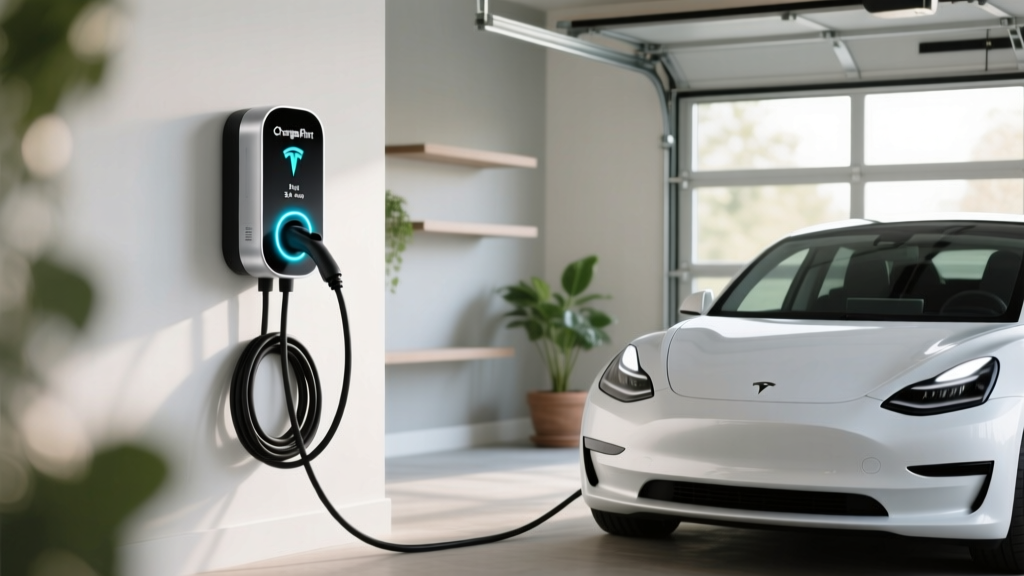
If you've narrowed your home Level 2 charger search down to the ChargePoint Home Flex electric vehicle charger, you're looking at one of the most widely recommended wall units on the market — and for good reason. With up to 50 amps of output, a 25-foot cable, and a NEMA 4-rated enclosure suitable for outdoor mounting, the Home Flex covers the needs of most EV owners, from daily commuters with a 60 kWh battery to long-range drivers with 100+ kWh packs. But is it the right charger for your garage, your electrical panel, and your specific EV?
This guide breaks down the ChargePoint Home Flex's real-world performance, installation requirements, connector compatibility across NACS, CCS1, and CHAdeMO vehicles, total installed cost, and how it compares to the competition. We'll also cover the electrical fundamentals every EV owner needs to understand before calling an electrician.
What the ChargePoint Home Flex Actually Delivers
The ChargePoint Home Flex is a Level 2, 240-volt AC charger available in two amperage configurations: 50 amps (delivering up to 12 kW of power) and 48 amps (delivering up to 11.5 kW). The unit itself supports up to 50A, but your actual output depends on your home's electrical circuit. Per the National Electrical Code (NEC), a continuous load like EV charging can only use 80% of a circuit's rated capacity — so a 50A charger requires a 60-amp dedicated circuit, while a 48A configuration needs a 60A circuit as well (48 ÷ 0.8 = 60).
At its maximum 12 kW output, the Home Flex adds roughly 35 to 44 miles of range per hour of charging, depending on your vehicle's efficiency. A highly efficient sedan like the Hyundai Ioniq 6 (rated at roughly 27 kWh/100 mi) will gain range faster than a heavier, less aerodynamic SUV like the Rivian R1S.
| Level | Voltage | Power (kW) | Miles of Range/Hour | Best For |
|---|---|---|---|---|
| Level 1 (120V) | 120V | 1.0–1.4 kW | 3–5 mi/hr | Overnight top-offs, PHEVs |
| Level 2 (240V) | 240V | 3.3–19.2 kW | 12–65 mi/hr | Daily home charging |
| DC Fast Charging | 400–800V DC | 50–350 kW | 150–1,000+ mi/hr | Road trips, rapid top-ups |
The Home Flex sits at the upper tier of residential Level 2 charging. Most homes can support a 48A or 50A circuit without a panel upgrade, but older homes with 100-amp service may need to consider a lower-amperage configuration or a panel upgrade (more on that below).
Real-World Charging Times: What to Expect
Manufacturer-stated charging speeds assume ideal conditions. In practice, charging rate depends on your vehicle's onboard charger capacity, battery temperature, and state of charge. Here's what 10–80% charging looks like with the ChargePoint Home Flex at its 12 kW maximum for several popular 2025–2026 EVs:
| Vehicle | Usable Battery (kWh) | Energy for 10–80% (kWh) | Estimated Time |
|---|---|---|---|
| Tesla Model 3 (Long Range) | 75 kWh | ~52.5 kWh | ~4.5 hours |
| Hyundai Ioniq 5 (Long Range) | 77.4 kWh | ~54.2 kWh | ~4.7 hours |
| Ford F-150 Lightning (Extended) | 131 kWh | ~91.7 kWh | ~8 hours |
| Chevrolet Equinox EV (3RS) | 85 kWh | ~59.5 kWh | ~5.2 hours |
| BMW i4 eDrive40 | 81.5 kWh | ~57 kWh | ~5 hours |
All of these times fit comfortably within an overnight charging window. The key insight: for daily driving of 30–50 miles, you'll rarely need a full 10–80% session. A typical commute replenishes in 1–3 hours on the Home Flex, meaning most owners plug in at night and wake up with a full battery every morning.
Installation Costs: The Full Breakdown
The ChargePoint Home Flex unit itself retails for approximately $549–$649 depending on plug type and retailer, but the total installed cost depends heavily on your home's electrical infrastructure. Here's a realistic breakdown based on 2025–2026 national averages from licensed electricians:
| Component | Simple Install (Near Panel) | Complex Install (Long Run / Upgrade) |
|---|---|---|
| ChargePoint Home Flex unit | $549–$649 | $549–$649 |
| 60A breaker + wiring (6 AWG copper) | $150–$300 | $400–$900 |
| Electrician labor (2–6 hours) | $300–$600 | $800–$2,000 |
| Permit and inspection | $50–$200 | $50–$200 |
| Panel upgrade (if needed: 100A → 200A) | N/A | $1,500–$3,500 |
| Total Estimated Cost | $1,050–$1,750 | $3,300–$7,250 |
The panel upgrade question is critical. Homes built before 1990 frequently have 100-amp main panels. Adding a 60-amp dedicated circuit to a panel already running electric heat, a dryer, and an electric range can exceed the panel's safe capacity. A licensed electrician will perform a load calculation per NEC Article 220 to determine if your panel can handle the additional draw. If it can't, a panel upgrade to 200 amps adds significant cost but also future-proofs your home for additional electrification (heat pumps, solar, etc.).
For homes where a 60A circuit isn't feasible, the Home Flex can be configured via its internal DIP switch to operate at 40A (requiring a 50A circuit) or even 32A (requiring a 40A circuit). This flexibility is one of the unit's strongest selling points — you don't need to buy a different charger if your electrical panel has limited headroom.
The IRS §30D clean vehicle credit does not cover home charger equipment for 2026. However, the separate §30C Alternative Fuel Vehicle Refueling Property Credit may provide up to $1,000 for residential charger installation if you live in a qualifying census tract. Consult a tax professional for eligibility specifics.
Connector Compatibility: NACS, CCS1, and Adapters
The ChargePoint Home Flex ships with a J1772 connector, the North American standard for Level 2 AC charging. This is the connector used by virtually every non-Tesla EV sold in the US through 2024, and it remains compatible with the broader Level 2 charging ecosystem.
However, the connector landscape has shifted dramatically. Tesla's NACS (North American Charging Standard) has been adopted by Ford, GM, Rivian, Hyundai, Kia, BMW, and most other major automakers starting with 2025–2026 model-year vehicles. Here's how compatibility breaks down:
| Connector | Vehicles Using It | Home Flex Compatibility |
|---|---|---|
| J1772 | Most 2024 and earlier non-Tesla EVs; some 2025–2026 PHEVs | Native — plug directly in |
| NACS (Tesla standard) | All Teslas; 2025+ Ford, GM, Rivian, Hyundai, Kia, BMW, etc. | Requires NACS-to-J1772 adapter (~$100–$200) |
| CCS1 (Combined Charging System) | 2024 and earlier non-Tesla EVs (DC fast charging portion) | J1772 portion is compatible; CCS DC pins not used at home |
| CHAdeMO | Nissan Leaf (legacy) | J1772 portion is compatible for Level 2 |
Key point: For home Level 2 charging, every EV in North America uses either J1772 or NACS. The Home Flex's J1772 plug works natively with older vehicles, and a simple adapter solves NACS compatibility for newer Ford, GM, and Hyundai EVs. ChargePoint also offers a NACS-terminated version of the Home Flex for buyers who exclusively drive Tesla or newer NACS-equipped vehicles.
CHAdeMO and CCS1 are primarily DC fast-charging connector standards. The Level 2 AC portion of a CCS1 vehicle uses the J1772 connector, so there's no compatibility issue for home charging.
Charging Cost: Home vs. Public vs. Gas
One of the strongest arguments for installing a home charger like the ChargePoint Home Flex is the dramatic per-mile cost savings compared to both public charging and gasoline. Here's a realistic comparison using 2025–2026 average energy prices:
| Scenario | Price | Cost/Mile (at 3.0 mi/kWh) |
|---|---|---|
| Home (national avg. $0.17/kWh) | $0.17/kWh | $0.057 |
| Home (off-peak TOU rate, $0.09/kWh) | $0.09/kWh | $0.030 |
| Public Level 2 (avg. $0.30/kWh) | $0.30/kWh | $0.100 |
| DC Fast Charging (avg. $0.48/kWh) | $0.48/kWh | $0.160 |
| Gasoline car (28 MPG, $3.40/gal) | $3.40/gal | $0.121 |
At off-peak residential rates, home charging on the Home Flex costs roughly 3 cents per mile — a quarter of what you'd pay at a DC fast charger and less than a quarter of gasoline. Even at standard residential rates, you're paying under 6 cents per mile. According to fueleconomy.gov, the average EV achieves roughly 3–4 miles per kWh, making the math straightforward.
The ChargePoint app supports scheduled charging, allowing you to set charging windows during off-peak hours automatically. If your utility offers time-of-use (TOU) rates, this feature alone can cut your charging costs by 40–50%.
How the Home Flex Compares: Equipment Roundup
The ChargePoint Home Flex is excellent, but it's not the only strong option. Here's how it stacks up against other popular Level 2 home chargers available in 2025–2026:
ChargePoint Home Flex
- Max Output: 12 kW (50A)
- Connector: J1772 or NACS
- Cable Length: 25 ft
- Smart Features: Wi-Fi, app scheduling, Alexa, energy tracking
- Outdoor Rating: NEMA 4
- Price: ~$549–$649
Best for: Flexibility across amperages; strong app ecosystem
Tesla Wall Connector
- Max Output: 11.5 kW (48A)
- Connector: NACS (native), J1772 adapter available
- Cable Length: 24 ft
- Smart Features: Wi-Fi, OTA updates, power sharing between units
- Outdoor Rating: NEMA 3R
- Price: ~$425–$475
Best for: Tesla-only households; best value at 48A
Emporia Vue Level 2 Charger
- Max Output: 11.5 kW (48A)
- Connector: J1772
- Cable Length: 24 ft
- Smart Features: Wi-Fi, app scheduling, integrates with Emporia energy monitor
- Outdoor Rating: NEMA 4
- Price: ~$399
Best for: Budget-conscious buyers wanting smart features
Grizzl-E Smart
- Max Output: 10 kW (40A)
- Connector: J1772
- Cable Length: 24 ft
- Smart Features: Wi-Fi, OCPP support, adjustable amperage
- Outdoor Rating: NEMA 4
- Price: ~$449–$499
Best for: Extreme cold climates (tested to -40°F); Canadian-made
The Home Flex's main advantages are its adjustable amperage (configurable from 16A to 50A via internal DIP switches) and its mature app platform. If you're uncertain about your panel's capacity, the ability to dial down the amperage without buying a new unit is genuinely valuable. The Tesla Wall Connector offers the best price-to-performance ratio for Tesla owners, while the Emporia Vue is the budget pick for non-Tesla households.
Safety, Electrical Code, and Installation Best Practices
EV charging is a high-draw, continuous electrical load — the kind of application where cutting corners creates fire risk. Here's what proper installation looks like:
- Dedicated circuit: The Home Flex requires its own dedicated 60-amp circuit (for 50A output) with a double-pole breaker. It should never share a circuit with other appliances.
- Wire gauge: 6 AWG copper wire (THHN in conduit or NM-B/Romex for indoor runs) is standard for a 60A circuit. Longer runs (over 50 feet) may require 4 AWG to prevent voltage drop.
- GFCI protection: NEC 2020 and later require GFCI protection for outdoor receptacles used for EV charging. If you opt for a hardwired installation (recommended for the Home Flex), GFCI requirements may vary by jurisdiction — your electrician will confirm local code.
- Outdoor rating: The Home Flex carries a NEMA 4 rating, meaning it's protected against splashing water and ice formation. It's rated for outdoor installation in all US climates.
- Permit and inspection: Virtually all jurisdictions require an electrical permit for a new 60A circuit. The inspection ensures proper wire sizing, breaker rating, grounding, and bonding. Do not skip this step — unpermitted work can void your homeowner's insurance in the event of an electrical fire.
- Hardwired vs. plug-in: The Home Flex is available in both hardwired and NEMA 14-50 plug-in configurations. Hardwired is generally preferred for reliability (no plug to loosen over time) and may not require GFCI in some jurisdictions. The plug-in version offers portability if you move.
Smart Features and the ChargePoint App
The ChargePoint Home Flex connects to your home Wi-Fi and integrates with the ChargePoint app, which provides:
- Scheduled charging: Set charging windows to align with off-peak utility rates or solar production hours.
- Energy tracking: Monitor kWh consumed per session and monthly cost estimates.
- Reminders and notifications: Get alerts when charging completes or if the unit detects a fault.
- Alexa integration: Voice control for starting/stopping sessions (limited utility, but available).
- Multi-vehicle support: Track charging for different vehicles if your household has multiple EVs.
The app is well-reviewed compared to competitors — ChargePoint operates the largest public charging network in North America, so their software infrastructure is mature. One limitation: the Home Flex does not support load management or power sharing between multiple units natively. If you need two chargers on a single circuit, the Tesla Wall Connector's power-sharing feature is a better fit.
Frequently Asked Questions
How much does it cost to install a ChargePoint Home Flex?
Expect $1,050–$1,750 for a straightforward installation (panel is nearby, no upgrade needed). Complex installs with long wire runs or a panel upgrade can reach $3,300–$7,250. Always get a detailed quote from a licensed electrician that breaks down equipment, labor, and permit costs separately.
Can the ChargePoint Home Flex charge a Tesla?
Yes. If you buy the NACS-terminated version, it plugs directly into any Tesla. If you buy the J1772 version, you'll need a J1772-to-NACS adapter (approximately $100–$200) for Tesla vehicles. Both work identically for Level 2 AC charging.
Is 50 amps enough for my EV?
For virtually all EVs on the market, yes. At 12 kW, the Home Flex adds 35–44 miles of range per hour. Even large-battery vehicles like the F-150 Lightning (131 kWh) will charge from 10–80% overnight in about 8 hours. The only scenario where you might want more is if you need to charge two large-battery EVs sequentially on a tight schedule — in that case, consider two 48A units on separate circuits.
What's the difference between hardwired and plug-in installation?
Hardwired means the unit is permanently connected to your electrical panel via a junction box — no plug. Plug-in uses a NEMA 14-50 receptacle (similar to a dryer outlet). Hardwired is more reliable and may avoid GFCI requirements in some jurisdictions. Plug-in offers portability if you move homes. Both are safe when installed correctly.
Does the Home Flex work in extreme cold?
The Home Flex is rated to operate in temperatures from -40°F to 122°F (-40°C to 50°C). The NEMA 4 enclosure protects against ice and snow. In extreme cold, your EV's battery will charge more slowly until it warms up — this is a battery chemistry limitation, not a charger limitation. Preconditioning your battery (a feature in most modern EVs) before a charging session helps mitigate this.
How does charging cost compare to gas?
At the national average residential electricity rate of ~$0.17/kWh, home charging costs roughly 5–6 cents per mile in a typical EV. A comparable gas car at 28 MPG and $3.40/gallon costs about 12 cents per mile. With off-peak TOU rates, home charging drops to about 3 cents per mile — making the Home Flex one of the cheapest "fuel sources" available for daily driving.