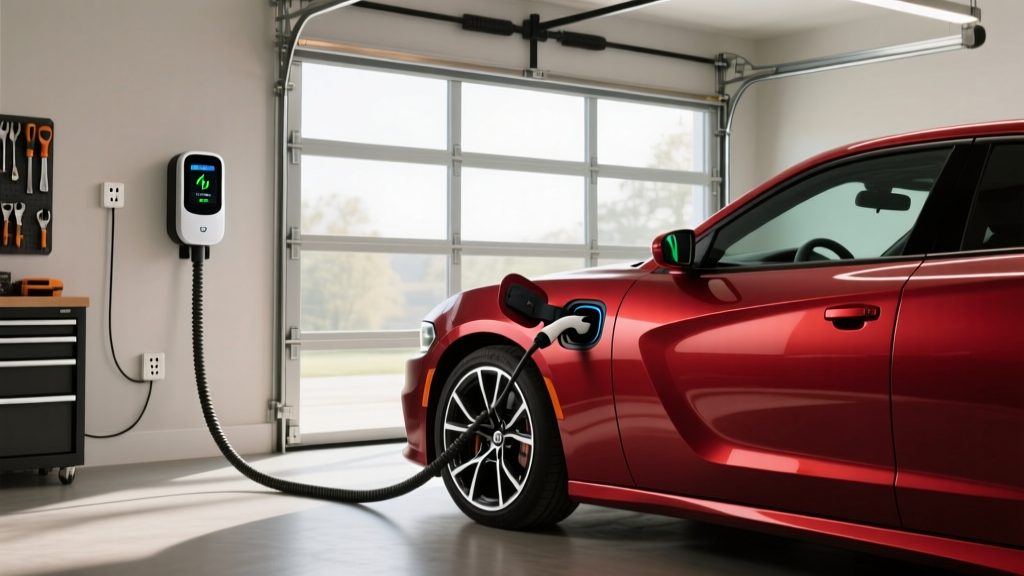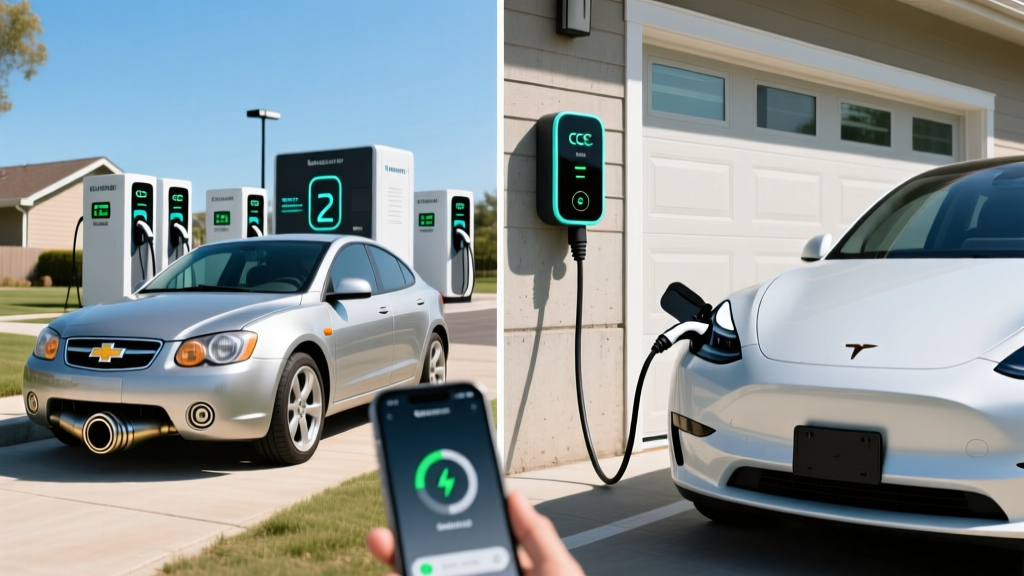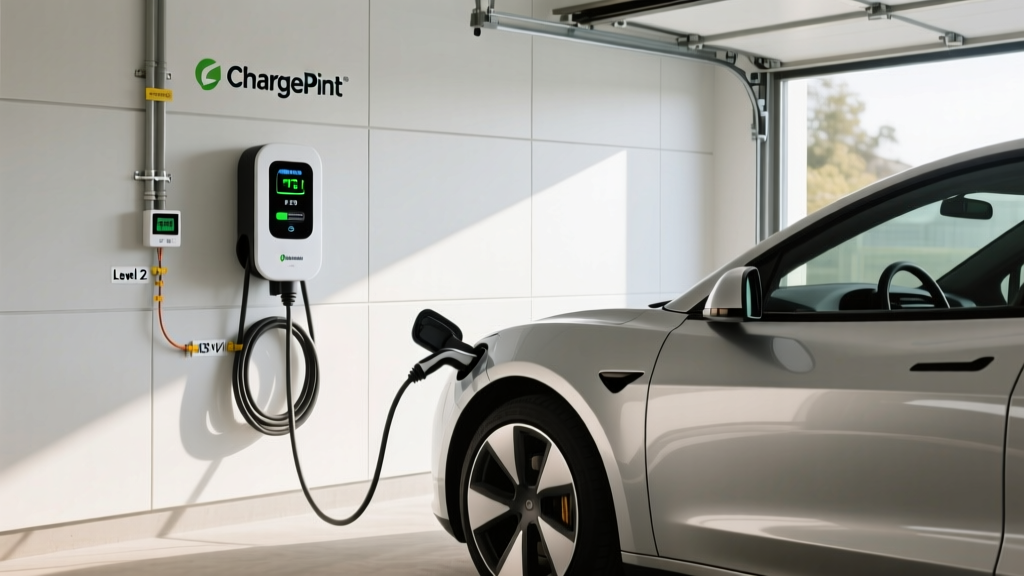
If you've ordered an EV or plug-in hybrid, the single most impactful upgrade you can make is installing a Level 2 home charger. Among the most-searched options is ChargePoint home charging hardware — specifically the ChargePoint Home Flex, which has become a default recommendation for its adjustable amperage, NACS/CCS compatibility, and smart-app features. But buying the unit is only half the equation. The real questions buyers ask us are: what will installation actually cost, does my electrical panel need an upgrade, and how fast will it charge my specific EV?
This guide walks through every number you need — from circuit requirements and permit costs to real charging times for common 2026 battery packs — so you can budget accurately before calling an electrician.
How Fast Does Each Charging Level Actually Add Range?
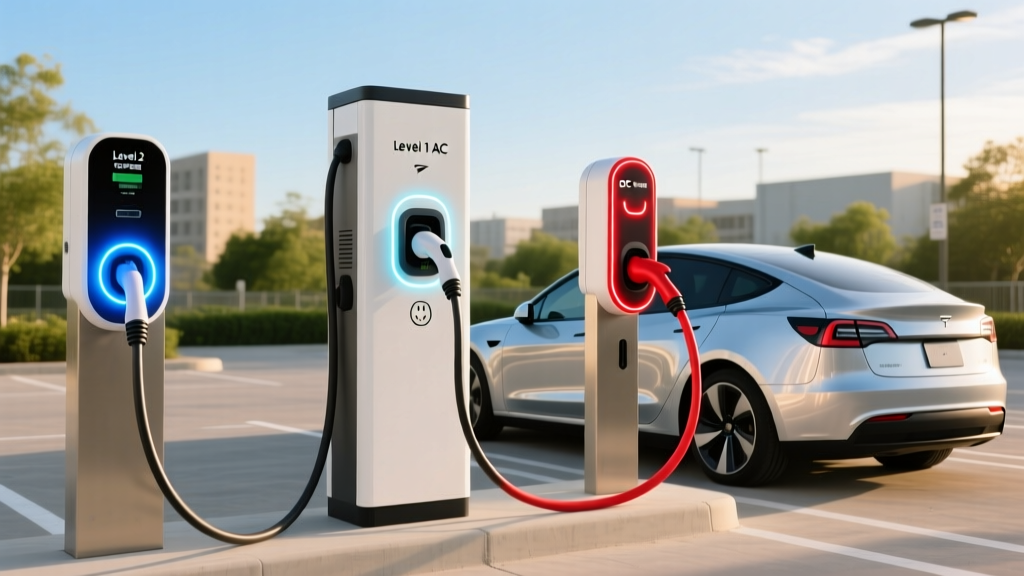
Before evaluating any home charger, understand the three charging tiers and what they deliver in practical miles-per-hour. The critical distinction: kW (kilowatts) measures power flow rate — how fast energy moves into your car. kWh (kilowatt-hours) measures total energy stored — your battery's tank size. A 48-amp Level 2 charger delivers up to 11.5 kW of power; your 75 kWh battery holds 75 kWh of energy.
| Level | Voltage | Max Power (kW) | Miles of Range Added/Hour | Best For |
|---|---|---|---|---|
| Level 1 | 120V (standard outlet) | 1.2–1.9 kW | 3–5 mi/hr | PHEVs, overnight top-ups, emergency |
| Level 2 | 240V (dryer-style outlet or hardwired) | 3.3–19.2 kW | 12–75 mi/hr | Daily home charging, most BEVs |
| DC Fast Charge | 400–800V DC | 50–350+ kW | 150–1,200+ mi/hr | Road trips, highway corridors |
For a typical 2026 BEV with a 75–100 kWh battery, Level 2 at 11.5 kW (48 amps) adds roughly 35–45 miles of range per hour of charging. That means an overnight session from 10 PM to 7 AM replenishes 300+ miles — more than enough for any daily commute. Level 1 at 1.4 kW would take 3–4 days for the same refill, which is why most BEV owners consider Level 2 non-negotiable.
ChargePoint Home Flex: Specs, Power Output, and Connector Options
The ChargePoint Home Flex remains ChargePoint's flagship residential unit in 2026. Here's why it consistently appears in our recommendations:
ChargePoint Home Flex (2026 Model)
- Adjustable amperage: 16A / 24A / 32A / 40A / 48A (configurable at install to match your circuit)
- Max power output: 11.5 kW (at 48A / 240V hardwired)
- Connector options: J1772 (standard for CCS vehicles) or NACS (Tesla native); adapters available for cross-compatibility
- Cable length: 23 feet (longer than most competitors' 18-ft cables)
- Smart features: Wi-Fi connected, ChargePoint app scheduling, Alexa integration, energy-use tracking, off-peak optimization
- Indoor/outdoor rated: NEMA 4 rated for outdoor installation
- Price: ~$699 (J1772 version) / ~$699 (NACS version) — frequently on sale for $599
- Warranty: 3 years
The adjustable amperage is the Home Flex's defining feature. If your panel can only spare a 30A circuit, you set the unit to 24A continuous (80% rule) for 5.8 kW. If you have headroom for a 60A circuit, you run 48A continuous for the full 11.5 kW. This flexibility avoids the common mistake of buying a fixed-48A charger and discovering your panel can't support it.
Home Installation Costs: Equipment, Electrician, Permits, and Panel Upgrades
This is where most buyers get surprised. The charger unit is often the cheapest line item. Total installed cost depends on four variables: panel capacity, distance from panel to charger location, local permit fees, and whether you choose hardwired or plug-in (NEMA 14-50 outlet).
| Line Item | Simple Install Range | Complex Install Range |
|---|---|---|
| ChargePoint Home Flex unit | $599–$699 | $599–$699 |
| Electrician labor (2–4 hrs simple / 6–12 hrs complex) | $400–$800 | $1,200–$3,000 |
| Materials (conduit, wire, breaker, mounting) | $100–$300 | $300–$800 |
| Electrical permit | $50–$150 | $50–$200 |
| Panel upgrade (if needed: 100A → 200A service) | N/A | $2,000–$5,000 |
| Total estimated cost | $1,150–$1,950 | $4,150–$9,700 |
When Do You Need a Panel Upgrade?
Homes built before 1990 often have 100-amp electrical service. Adding a 48A continuous EV load (which draws 60A of breaker capacity under the NEC 80% continuous-load rule) may exceed your panel's spare capacity. A licensed electrician will perform a load calculation — adding up your existing circuits (HVAC, dryer, range, water heater) to determine remaining headroom.
If your calculation shows insufficient capacity, you have three options:
- Downsize the charger circuit: Run the Home Flex at 24A or 32A on a smaller breaker. You lose peak speed but avoid the panel upgrade.
- Install a smart load-management device: Products like the Span smart panel or Emporia load manager dynamically throttle EV charging when other high-draw appliances activate.
- Upgrade to 200A service: The permanent fix, but adds $2,000–$5,000 and may require utility coordination.
The federal Residential Clean Energy Credit does not cover EV chargers in 2026 (the previous §30C alternative fuel infrastructure credit expired for most residential installations). However, many utilities and local municipalities offer rebates of $250–$750 for Level 2 installation — check your utility's EV program page before scheduling work.
Connector Compatibility: Will the ChargePoint Home Flex Fit Your EV?
The North American charging connector landscape consolidated significantly between 2023 and 2026. Here's where each brand stands:
| Connector Type | Brands Using It Natively | ChargePoint Home Flex Option |
|---|---|---|
| NACS (Tesla standard, now SAE J3400) | Tesla, Ford, GM, Rivian, Volvo, Polestar, Hyundai/Kia (2025+), most new 2026 BEVs | Order NACS version, or use J1772-to-NACS adapter |
| CCS1 (J1772 + DC pins) | Legacy models: pre-2025 VW ID.4, BMW i4, some Stellantis | Order J1772 version (Level 2 uses only J1772 upper portion) |
| CHAdeMO | Nissan Leaf (discontinued after 2025); no new vehicles | J1772 version works for Level 2 (CHAdeMO is DC-only) |
Key 2026 reality: NACS is now the dominant connector. If you're buying a new EV in 2026, it almost certainly has a NACS port. Order the ChargePoint Home Flex with the NACS connector to avoid adapter clutter. If you own a pre-2025 CCS vehicle, the J1772 version works perfectly — Level 2 AC charging uses only the J1772 upper pins regardless of whether your car also has CCS DC pins below.
Real Charging Times: 10% to 80% on ChargePoint Home Flex
Charging speed depends on your vehicle's onboard charger capacity (which limits AC intake) and your Home Flex amperage setting. Most 2026 EVs accept 11.5 kW AC, but some cap at 7.7 kW or 9.6 kW.
| Vehicle (2026) | Battery (kWh usable) | Onboard Charger Limit | 10–80% Time (approx.) |
|---|---|---|---|
| Tesla Model Y Long Range | 75 kWh | 11.5 kW | ~4 hr 30 min |
| Hyundai Ioniq 5 (Long Range) | 77.4 kWh | 10.9 kW | ~4 hr 45 min |
| Ford F-150 Lightning (Extended) | 131 kWh | 19.2 kW (Pro Power) | ~4 hr 50 min (at 11.5 kW circuit) |
| Chevrolet Equinox EV | 85 kWh | 11.5 kW | ~5 hr 15 min |
| Toyota RAV4 Plug-in Hybrid | 18.1 kWh | 6.6 kW | ~1 hr 50 min |
Why 10–80%? Lithium-ion batteries charge fastest between 10% and 80% State of Charge. Above 80%, the battery management system tapers current to protect cell longevity — this applies to both Level 2 and DC fast charging. For daily driving, charging to 80% is recommended for NMC batteries; LFP batteries (found in some Tesla Model 3/Y Standard Range trims) tolerate regular 100% sessions without significant degradation.
Cost Per Mile: Home Charging vs. Public Charging vs. Gas
The economic case for home charging is overwhelming — if you have access to off-peak electricity rates.
| Scenario | Rate / Cost | Vehicle Efficiency | Cost Per Mile |
|---|---|---|---|
| Home Level 2 (off-peak TOU rate) | $0.09/kWh | 3.0 mi/kWh (100 MPGe) | $0.03/mi |
| Home Level 2 (national avg residential) | $0.17/kWh | 3.0 mi/kWh | $0.057/mi |
| Public Level 2 (ChargePoint network, typical) | $0.30–$0.49/kWh | 3.0 mi/kWh | $0.10–$0.16/mi |
| DC Fast Charge (Electrify America, Tesla Supercharger) | $0.35–$0.55/kWh | 3.0 mi/kWh | $0.12–$0.18/mi |
| Gasoline vehicle (28 MPG combined) | $3.40/gal | 28 MPG | $0.12/mi |
| Gasoline vehicle (22 MPG combined, truck/SUV) | $3.40/gal | 22 MPG | $0.155/mi |
At off-peak residential rates, home-charged EVs cost roughly $0.03 per mile — one-quarter the fuel cost of a 28 MPG gas car. Even at national average electricity rates, you're saving 50%+ per mile. However, exclusive reliance on public DC fast charging erases most of the cost advantage. This is why home Level 2 access is the single biggest predictor of EV ownership satisfaction.
Most utilities offer Time-of-Use (TOU) plans that drop rates to $0.07–$0.11/kWh between 10 PM and 6 AM. The ChargePoint app lets you schedule charging windows to automatically capture these rates — plug in at 6 PM, and the car waits until 10 PM to begin drawing power.
Equipment Alternatives: How ChargePoint Compares
Emporia Level 2 Smart Charger
- Power: Up to 48A / 11.5 kW (adjustable)
- Connector: J1772 (NACS adapter included in 2026 package)
- Price: ~$399 (lowest-cost smart charger with full app)
- Best for: Budget-conscious buyers who want solar-integration features
Tesla Wall Connector
- Power: Up to 48A / 11.5 kW
- Connector: NACS native (J1772 adapter available separately)
- Price: ~$450
- Best for: Tesla-only households (no app required, Plug-and-charge seamless)
Grizzl-E Smart
- Power: Up to 40A / 9.6 kW
- Connector: J1772 or NACS options
- Price: ~$449
- Best for: Extreme cold climates (rated to -40°F, ruggedized build)
The ChargePoint Home Flex commands a ~$100–$250 premium over competitors, justified by its longer 23-foot cable, polished app experience, and broad utility-rebate eligibility. If cable reach isn't an issue and you want the lowest price, the Emporia delivers comparable performance at $300 less.
Safety, Electrical Code, and Installation Best Practices
EV charging draws sustained high current for hours — more like a furnace than a typical appliance. The National Electrical Code (NEC) treats it as a continuous load, which triggers specific requirements:
- Dedicated circuit: Your EV charger must have its own breaker — no sharing with other outlets or appliances.
- 80% rule: A 60A breaker supports 48A continuous draw. A 50A breaker supports 40A continuous. Never size the breaker to the exact load.
- GFCI protection: NEC 2020+ requires GFCI breakers for outdoor receptacles (NEMA 14-50). Hardwired installations may exempt you from GFCI in some jurisdictions — confirm with your local inspector.
- Wire gauge: 6 AWG copper for 48A circuits over short runs; 4 AWG for longer runs (>50 feet from panel) to minimize voltage drop.
- Outdoor rating: If mounting outside, ensure the unit carries a NEMA 4 (splash-resistant) or NEMA 4X (corrosion-resistant) rating. The ChargePoint Home Flex is NEMA 4 rated.
- Permit and inspection: Virtually all jurisdictions require an electrical permit for new 240V circuits. The inspection ensures code compliance and protects your homeowner's insurance coverage. Skipping the permit risks claim denial in the event of an electrical fire.
Hardwired vs. plug-in (NEMA 14-50): Hardwired installation eliminates the outlet, reducing failure points and satisfying GFCI requirements more cleanly. A NEMA 14-50 outlet offers portability — you can unplug and take the charger if you move — but requires a GFCI breaker ($80–$150 extra) and some jurisdictions now require outlet-inspection after installation due to documented 14-50 receptacle failures under sustained EV loads. We recommend hardwired for permanent installations.
Frequently Asked Questions
How much does it cost to install a ChargePoint home charger?
Expect $1,150–$1,950 total for a straightforward installation (short wire run, adequate panel capacity, no upgrade needed). Complex installations requiring long conduit runs, sub-panel additions, or a full 200A service upgrade can reach $4,000–$9,700. Always get 2–3 electrician quotes and confirm they include permit fees.
Can I install the ChargePoint Home Flex myself?
Only if you are a licensed electrician. 240V circuits at 48A continuous can cause fatal arc flashes and electrical fires if improperly terminated. DIY installation also voids the ChargePoint warranty, violates electrical code in most jurisdictions, and may invalidate your homeowner's insurance. Hire a licensed, insured electrician.
Does the ChargePoint Home Flex work with non-Tesla EVs?
Yes. Order the J1772 connector version for CCS-equipped vehicles (pre-2025 VW, BMW, Stellantis). Order the NACS version for Tesla and all 2025+ Ford, GM, Hyundai, Kia, Rivian, and Volvo models. The J1772 version also works with CHAdeMO vehicles (Nissan Leaf) for Level 2 AC charging — CHAdeMO is only relevant for DC fast charging.
Will a ChargePoint Home Flex charge my EV overnight?
Yes, for virtually every 2026 EV. At 48A/11.5 kW, you'll add 35–45 miles of range per hour. An 8-hour overnight session replenishes 280–360 miles — covering the full battery of most EVs from near-empty. Even the Ford F-150 Lightning Extended Range (131 kWh) refills from 10–80% in under 5 hours at this rate.
What if my home only has 100-amp electrical service?
You can still install a Level 2 charger — just at reduced amperage. Set the Home Flex to 24A continuous on a 30A breaker for 5.8 kW, which still adds ~20 miles per hour and refills most EVs overnight. If you want full 48A speed, budget $2,000–$5,000 for a 200A panel upgrade, or explore smart load-management devices that share capacity between your EV and other appliances.
Is there a federal tax credit for home charger installation in 2026?
The §30C Alternative Fuel Infrastructure Tax Credit expired for most residential installations after 2021, and as of 2026, residential EV charger installations do not qualify for a federal tax credit. However, the vehicle itself may qualify for the §30D New Clean Vehicle Credit (up to $7,500) or the Used Clean Vehicle Credit (up to $4,000) — subject to MSRP caps, income limits, and battery-sourcing requirements. Many state utilities and municipalities offer $250–$750 rebates specifically for Level 2 charger installation; check your utility's EV program or fueleconomy.gov for current incentives.