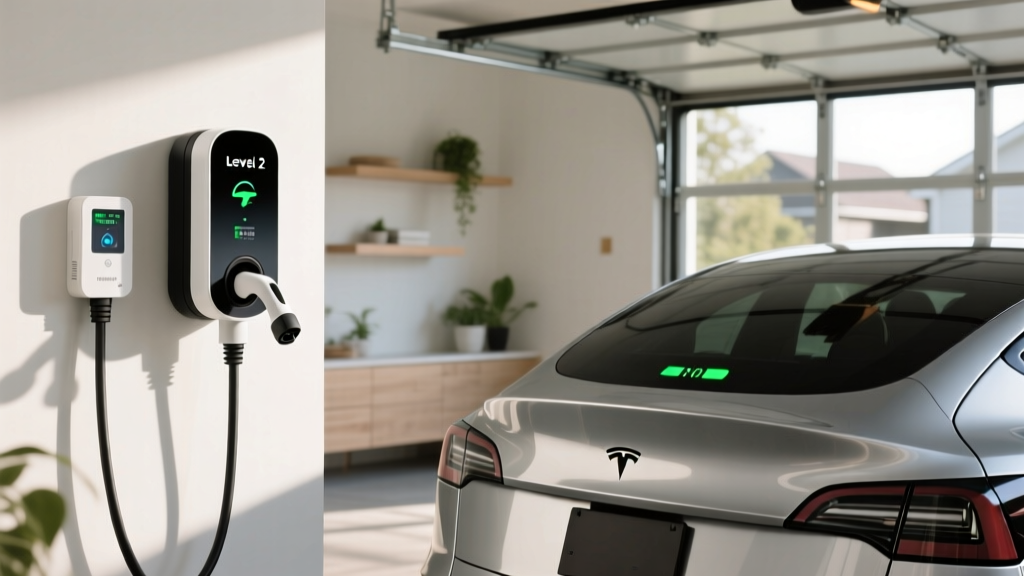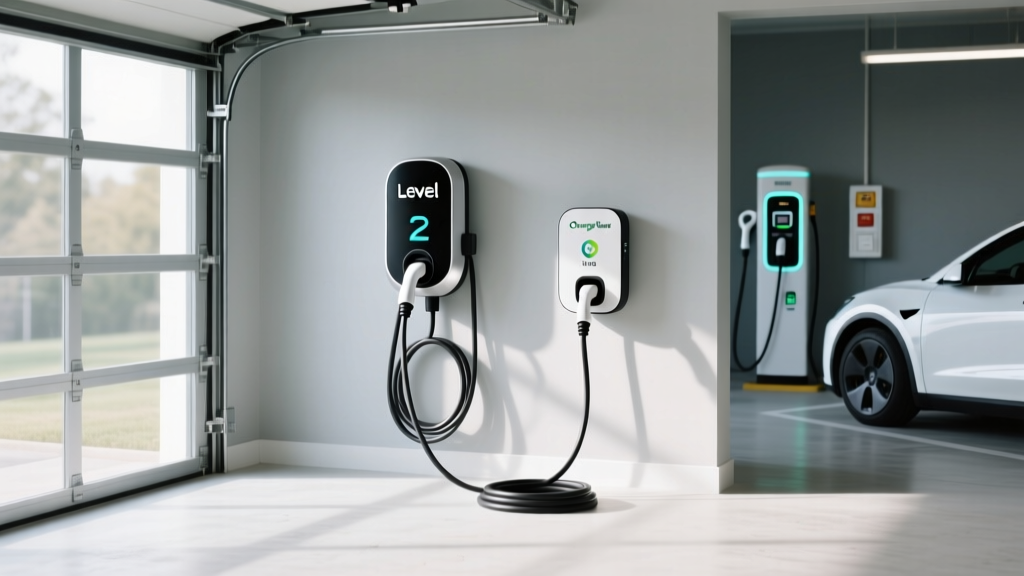
Choosing the right Level 2 home charger for your EV comes down to three things: power output, connector compatibility, and what your home's electrical panel can actually support. Two of the most popular units on the market — the ChargePoint Home Flex and the Emporia Vue 2 (EV charger variant) — cover most buyer needs, but they serve different budgets and installation scenarios. This guide breaks down the exact numbers so you can pick the right charger and budget for a proper installation.
Understanding EV Charging Levels: What Speeds Are We Talking About?
Before comparing specific units, you need to know what each charging level delivers. The most common EV mistake is confusing kW (kilowatts — the rate of power delivery, like water pressure) with kWh (kilowatt-hours — the total energy stored in your battery, like gallons in a tank). A charger rated at 11.5 kW delivers energy at that rate; your battery stores energy measured in kWh.
| Charging Level | Voltage / Amps | Max Power (kW) | Miles of Range Added Per Hour | Typical Use Case |
|---|---|---|---|---|
| Level 1 | 120V / 12–16A | 1.4–1.9 kW | 3–5 miles/hr | Overnight top-up for PHEVs or low-mileage drivers |
| Level 2 | 240V / 32–48A | 7.7–11.5 kW | 25–44 miles/hr | Daily home charging for BEVs |
| DC Fast Charge | 400–800V DC | 50–350 kW | 150–1,000+ miles/hr (peak) | Road trips; 10–80% in 18–45 min depending on vehicle |
For context, a Tesla Model Y with a 75 kWh (usable) battery charging from 10% to 80% on an 11.5 kW Level 2 charger takes roughly 5 hours. That same 10–80% session on a 250 kW DC fast charger takes about 20–25 minutes, though real-world charge curves taper significantly above 80% SoC, which is why most EV owners rarely charge past 80% on DC fast chargers.
ChargePoint Home Flex vs Emporia: Head-to-Head Specs
ChargePoint Home Flex (NACS)
- Power Output: Up to 11.5 kW (240V / 48A) — adjustable down to 16A
- Connector: NACS (Tesla-standard); J1772 adapter included for legacy EVs
- Cable Length: 23 feet
- Smart Features: Wi-Fi, ChargePoint app scheduling, Alexa integration, energy tracking
- Indoor/Outdoor: NEMA 4 rated (outdoor-safe)
- Price: ~$599 (charger only)
- Warranty: 3 years
Emporia EV Charger
- Power Output: Up to 11.5 kW (240V / 48A) — adjustable via app
- Connector: J1772 (NACS adapter available separately, ~$50–100)
- Cable Length: 24 feet
- Smart Features: Wi-Fi, Emporia app, solar integration, time-of-use scheduling, energy monitoring per circuit
- Indoor/Outdoor: NEMA 4 rated (outdoor-safe)
- Price: ~$399 (charger only)
- Warranty: 3 years
Both chargers max out at 11.5 kW on a 48A / 60A dedicated circuit. The primary differences are connector type out of the box, smart ecosystem integration, and price. If you drive a Tesla or any post-2025 EV with a native NACS port (Ford, GM, Rivian, Volvo, and others now ship NACS), the ChargePoint Home Flex is ready to plug in immediately. If you drive a vehicle with a CCS1 port — most non-Tesla EVs built before 2025 — the Emporia's J1772 connector works natively, and you'd use a J1772-to-NACS adapter only if your car is NACS-equipped.
Connector Compatibility: Which Plug Does Your EV Need?
The connector landscape has consolidated significantly since 2024, when Ford and GM began adopting the North American Charging Standard (NACS). Here's what you need to know based on your vehicle:
| Connector Standard | Vehicles That Use It | Adapter Needed? |
|---|---|---|
| NACS (Tesla-style) | All Tesla models; 2025+ Ford, GM, Rivian, Volvo, Polestar, Mercedes, BMW, Hyundai/Kia (select models) | None if charger is NACS; J1772-to-NACS adapter (~$50–150) if charger is J1772 |
| J1772 (Level 2 standard) | Most pre-2025 non-Tesla EVs (Chevy Bolt, VW ID.4, older Hyundai/Kia, Nissan Leaf) | None if charger is J1772; NACS-to-J1772 adapter needed if charger is NACS |
| CCS1 (DC fast, legacy) | Pre-2025 non-Tesla EVs for DC fast charging | Tesla Supercharger networks now offer CCS1 adapters; public CCS1 stations are native |
| CHAdeMO | Nissan Leaf (older), Mitsubishi Outlander PHEV | Rarely available on new chargers; public CHAdeMO stations are declining |
Key buying advice: Buy the charger that matches your EV's native port. Adapters add cost, bulk, and a potential failure point. If you plan to switch to a NACS-equipped vehicle within a few years, the ChargePoint Home Flex (NACS) is the more future-proof buy in 2026.
Home Installation Costs: The Full Breakdown
The charger itself is usually the cheapest part of the equation. Installation costs vary dramatically based on your home's electrical panel capacity and the distance from your panel to the charger location. Here's a realistic breakdown based on 2026 national averages:
| Cost Component | Simple Install (panel near garage, spare capacity) | Moderate Install (50–80 ft run, no panel upgrade) | Complex Install (panel upgrade needed, long run) |
|---|---|---|---|
| Charger unit | $399–$599 | $399–$599 | $399–$599 |
| Electrician labor (licensed) | $300–$600 | $600–$1,200 | $1,200–$2,500 |
| Electrical permit | $50–$150 | $50–$150 | $50–$200 |
| Panel upgrade (100A → 200A) | $0 | $0 | $1,500–$3,500 |
| Conduit, wiring, connectors | $50–$150 | $200–$500 | $300–$800 |
| Total Estimated Cost | $800–$1,500 | $1,250–$2,450 | $3,450–$7,600 |
What electrical upgrades might you need? Both the ChargePoint Home Flex and Emporia charger require a dedicated 240V circuit. At 48A continuous draw, the National Electrical Code (NEC) requires a 60A breaker (continuous loads cannot exceed 80% of breaker rating). If your panel is a 100A service — common in homes built before the 1990s — adding a 60A dedicated circuit may push you past safe capacity, requiring a panel upgrade to 200A. This is the single biggest cost variable and the reason you should have a licensed electrician do a load calculation before buying a charger.
If your panel can't support 60A, both chargers can be configured (via DIP switches or app) to run at 32A on a 40A breaker, delivering 7.7 kW instead of 11.5 kW. That's still 25–30 miles of range per hour — enough for most daily driving needs.
Charging Cost Per Mile: Home vs Public vs Gas
One of the strongest ownership arguments for an EV is the fuel cost savings — but only if you charge at home at residential electricity rates. Public DC fast charging has gotten expensive enough in some markets to rival gasoline on a per-mile basis.
| Charging Scenario | Rate ($/kWh) | Cost Per Mile (at 3.5 mi/kWh efficiency) | Full 75 kWh Battery Cost (10–80%) |
|---|---|---|---|
| Home — off-peak TOU rate | $0.08–$0.12 | $0.023–$0.034 | $3.15–$4.70 |
| Home — standard flat rate | $0.14–$0.18 | $0.040–$0.051 | $5.50–$7.10 |
| Public Level 2 (ChargePoint, EVgo) | $0.25–$0.49 | $0.071–$0.140 | $9.75–$19.10 |
| DC Fast Charge (Electrify America, Tesla) | $0.35–$0.55 | $0.100–$0.157 | $13.65–$21.45 |
| Gasoline (30 MPG combined, $3.40/gal) | — | $0.113 | ~$24.80 (equivalent energy) |
At home on off-peak rates, you're paying roughly $0.03 per mile — about one-quarter the cost of gasoline. Even on a flat residential rate of $0.16/kWh, you're still well under gas per mile. However, relying exclusively on public DC fast charging at $0.45–$0.55/kWh can push your per-mile cost to near-gasoline levels. This is why home Level 2 charging is the economic backbone of EV ownership.
Charging Time Examples for Popular EVs
Here's how long a 10–80% session takes on each charger for common 2026 EV battery sizes. Note that Level 2 charging is relatively linear, so these estimates hold well — unlike DC fast charging, where the charge curve tapers dramatically above 80% SoC.
- Tesla Model Y (~75 kWh usable): 10–80% in ~4.5 hours at 11.5 kW; ~6.8 hours at 7.7 kW
- Ford Mustang Mach-E Extended Range (~91 kWh usable): 10–80% in ~5.5 hours at 11.5 kW; ~8.2 hours at 7.7 kW
- Hyundai Ioniq 5 (~77.4 kWh usable): 10–80% in ~4.7 hours at 11.5 kW; ~7.0 hours at 7.7 kW
- Chevrolet Equinox EV (~85 kWh usable): 10–80% in ~5.2 hours at 11.5 kW; ~7.7 hours at 7.7 kW
- Toyota RAV4 Prime (PHEV) (~14.9 kWh usable): 10–80% in ~0.9 hours at 11.5 kW — PHEVs charge quickly due to small batteries
For most BEV owners, an overnight charge window of 8–10 hours on Level 2 is more than sufficient to go from 20% back to 80%+ every night. You rarely need the full 11.5 kW unless you drive 60+ miles daily or have a very large battery.
Safety, Code, and Installation Best Practices
A Level 2 charger is a major continuous electrical load. Cutting corners on installation creates fire risk and may void your homeowner's insurance. Here's what the NEC and best practices require:
- Dedicated circuit: Your charger must have its own breaker — no sharing with other appliances. A 48A charger requires a 60A breaker; a 32A charger requires a 40A breaker.
- GFCI protection: NEC 2023 (and most 2026 local adoptions) requires GFCI protection for all EV charging outlets. Hardwired installations may exempt you from the GFCI breaker requirement depending on your local AHJ (Authority Having Jurisdiction), which is one reason hardwired installs are often preferred.
- Hardwired vs plug: The ChargePoint Home Flex and Emporia both come in hardwired and NEMA 14-50 plug-in versions. Hardwired is more reliable (no plug overheating risk), allows higher amperage in some panels, and avoids the NEC GFCI breaker issue. Plug-in offers portability if you move.
- Outdoor rating: Both units carry a NEMA 4 rating, meaning they're safe for outdoor installation and can withstand rain, dust, and hose-directed water. If you're installing in an exposed carport or driveway, this rating is essential.
- Permit and inspection: Nearly all jurisdictions require an electrical permit for EV charger installation. The inspection ensures your wiring gauge, breaker sizing, and grounding meet code. Skipping the permit risks insurance denial in the event of an electrical fire. Check your local building department for specific requirements.
- Wire gauge: A 60A circuit typically requires 6 AWG copper wire (or 4 AWG aluminum). Your electrician will size this based on run length — longer runs may need thicker wire to prevent voltage drop.
Which Charger Should You Buy?
Choose the ChargePoint Home Flex if:
- You drive a Tesla or any 2025+ NACS-equipped EV and want native plug compatibility
- You value a polished app experience with robust scheduling and energy reporting
- You want a widely supported brand with strong utility rebate compatibility
Choose the Emporia EV Charger if:
- You want to save ~$200 on the charger unit
- You have solar panels and want integrated solar-aware charging (charge only when solar is producing)
- Your EV uses a J1772 connector (most pre-2025 non-Tesla EVs)
- You want detailed circuit-level energy monitoring through Emporia's whole-home energy system
Frequently Asked Questions
How much does it cost to install a home EV charger?
Total installed cost ranges from roughly $800 for a simple install near your panel to $7,600+ if you need a 200A panel upgrade and a long conduit run. The charger itself costs $399–$599; electrician labor is $300–$2,500 depending on complexity; permits run $50–$200. Always get a load calculation from a licensed electrician before purchasing.
How fast will each charging level add range?
Level 1 (120V) adds 3–5 miles per hour — adequate only for PHEVs or very low daily mileage. Level 2 (240V) adds 25–44 miles per hour depending on amperage (32A vs 48A) and your vehicle's onboard charger acceptance rate. DC fast charging adds 150–1,000+ miles per hour at peak, but sessions are typically limited to 10–80% in 18–45 minutes due to charge-curve tapering.
Which connector/charger is compatible with my EV?
Check your vehicle's charge port. If it's a NACS port (all Teslas, plus 2025+ Ford, GM, Rivian, and others), buy a NACS charger like the ChargePoint Home Flex. If it's a J1772/CCS1 port (most pre-2025 non-Tesla EVs), buy a J1772 charger like the Emporia. CHAdeMO (older Nissan Leaf) is a legacy standard with declining public infrastructure.
How much does charging cost per mile vs gas?
Home charging on off-peak rates costs roughly $0.03 per mile — about 75% less than gasoline at $3.40/gal and 30 MPG. Even on a standard flat rate of $0.16/kWh, you're at about $0.05/mile. Public DC fast charging at $0.45–$0.55/kWh can approach gasoline costs, which is why home charging is essential for maximum savings.
What electrical upgrades might I need?
Both chargers need a dedicated 240V circuit at 40A or 60A. If your home has a 100A electrical panel (common in older homes), adding a 60A circuit may require a panel upgrade to 200A — a $1,500–$3,500 job. A licensed electrician can perform a load calculation to determine if your existing panel has sufficient spare capacity. You can also configure either charger to run at 32A on a 40A breaker, which reduces the panel load while still providing 25+ miles of range per hour.
Can I claim a tax credit for a home EV charger?
The federal §30C Alternative Fuel Vehicle Refueling Property Credit offers up to $1,000 (30% of cost) for home charger installation, but eligibility depends on whether your census tract qualifies as a low-income or non-urban area per current IRS rules. Many utilities also offer rebates of $250–$500 for Level 2 charger purchases — check with your local provider. Consult a tax professional for your specific situation.
For EPA range and efficiency data on specific EV models, refer to fueleconomy.gov. For electrical code questions, consult a licensed electrician in your jurisdiction — local amendments to the NEC vary significantly by state and municipality.