The Short Answer: Rivians Can Now Use Tesla Superchargers Natively
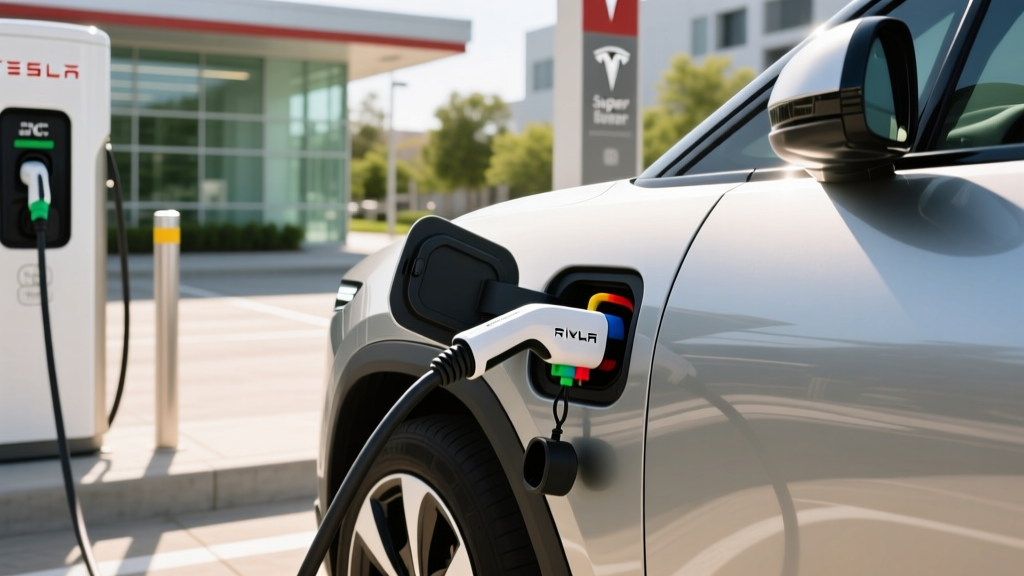
If you own a Rivian R1T or R1S from the 2025 model year onward, your truck rolls off the factory line with a native NACS (North American Charging Standard) charge port — the same connector Tesla uses. That means you can pull into any V3 or V4 Tesla Supercharger, plug in directly, and start charging without an adapter. For owners of 2022–2024 Rivians that shipped with a CCS1 port, Rivian provides a NACS-to-CCS adapter that unlocks the Supercharger network.
This guide breaks down exactly how the process works, what speeds to expect, what it costs compared to gas, and how to set up a full home charging ecosystem alongside public DC fast-charging access.
Understanding Charging Levels: What Each Adds to Your Rivian
Before we get into Supercharger specifics, it's essential to understand the three charging levels and how they translate to real range added per hour. Remember: kW (kilowatts) measures power — the rate of energy flow — while kWh (kilowatt-hours) measures energy, the total capacity of your battery. Think of kW as the width of a hose and kWh as the size of the bucket.
| Level | Voltage / Amps | Power (kW) | Miles of Range Added per Hour | Typical Use Case |
|---|---|---|---|---|
| Level 1 (120V) | 120V / 12A | ~1.4 kW | ~3–4 mi/hr | Emergency / overnight trickle |
| Level 2 (240V) | 240V / 40–48A | 9.6–11.5 kW | ~25–31 mi/hr | Daily home charging |
| DC Fast (V3 Supercharger) | 400V DC | Up to 200 kW peak | ~140 mi in 20 min (Rivian est.) | Road trips, rapid top-ups |
| DC Fast (V4 Supercharger) | 400V+ DC | Up to 250 kW peak | ~160 mi in 20 min (est.) | Latest-gen highway corridors |
Rivian's Standard Battery pack holds roughly 106 kWh of usable capacity (LFP chemistry on newer models), while the Max Battery pack stores approximately 141 kWh (NMC). The larger pack accepts higher peak DC charge rates, but both taper significantly above 80% State of Charge — a characteristic of lithium-ion charging curves, not a hardware limitation.
How to Charge a Rivian at a Tesla Supercharger: Step by Step
The physical process is straightforward, but there are a few setup steps to handle before your first session.
For 2025+ Rivians with Native NACS
- Open the Rivian app and navigate to Settings → Charging → Networks.
- Link your Tesla account or enable NACS network roaming (Rivian partnered with Tesla to enable plug-and-charge authentication).
- Drive to any open Supercharger stall. The Rivian's navigation will route you to available stalls and precondition the battery for optimal charge speed.
- Plug the NACS connector directly into your charge port. Charging begins automatically — no app tap required at most V3/V4 stalls.
- Monitor progress in the Rivian app or on the vehicle's center display.
For 2022–2024 Rivians (CCS1 Port, Adapter Required)
- Confirm you have the Rivian-provided NACS adapter (shipped to registered owners starting mid-2024; replacement units available through Rivian's gear shop for ~$200).
- Enable Tesla Supercharger access in the Rivian app under Settings → Charging → Networks.
- At the Supercharger stall, attach the adapter to the Tesla NACS cable first, then plug the adapter into your CCS1 port.
- Initiate charging via the Rivian app if plug-and-charge doesn't authenticate automatically.
DC Fast Charging Speeds: What to Actually Expect
Tesla's V3 Superchargers peak at 250 kW, but your Rivian won't sustain that rate for the full session. Here's how the charge curve actually looks in practice:
- 10–30% SoC: Peak rate of ~190–200 kW (Max Battery) or ~170 kW (Standard). This is the fastest portion.
- 30–60% SoC: Rate tapers to ~130–150 kW as cell temperature and voltage rise.
- 60–80% SoC: Further taper to ~75–100 kW.
- 80–100% SoC: Drops below 40 kW. Avoid charging past 80% on road trips unless necessary — the last 20% can take as long as the first 60%.
| Battery Pack | Usable Capacity | Peak kW | 10–80% Time | Miles Added (EPA Basis) |
|---|---|---|---|---|
| Standard (LFP) | ~106 kWh | ~170 kW | ~35–40 minutes | ~190 miles |
| Max (NMC) | ~141 kWh | ~200 kW | ~40–45 minutes | ~250 miles |
These figures assume a preconditioned battery (Rivian's nav automatically warms or cools the pack when a Supercharger is set as your destination) and an ambient temperature between 60–85°F. In sub-freezing conditions without preconditioning, add 10–15 minutes to these estimates.
Cost to Charge: Rivian at Supercharger vs. Gas Truck
Electricity pricing varies dramatically between home charging and public DC fast charging. Here's a realistic breakdown using national averages as of 2026.
| Charging/Fueling Scenario | Rate | Cost per Mile (Rivian R1T, ~2.5 mi/kWh) | Cost per Mile (Gas Truck, 19 MPG Combined) |
|---|---|---|---|
| Home Level 2 (off-peak utility rate) | $0.12/kWh | $0.048 | $0.184 (at $3.50/gal) |
| Home Level 2 (standard residential) | $0.18/kWh | $0.072 | $0.184 |
| Tesla Supercharger (national avg.) | $0.35/kWh | $0.14 | $0.184 |
| Electrify America / 3rd-party DCFC | $0.48/kWh | $0.192 | $0.184 |
The takeaway: home charging makes the Rivian roughly 3–4× cheaper per mile than a gas truck. Even at Supercharger rates, you're still saving 20–25% per mile over gasoline. But if you rely exclusively on expensive public DC fast chargers, the cost advantage narrows — another reason to invest in a quality Level 2 home setup.
Home Level 2 Charging Setup: Electrical Requirements and Costs
Most Rivian owners do 85–95% of their charging at home on a 240V Level 2 circuit. Here's what that installation actually involves and what it costs.
Electrical Requirements
- Circuit: Dedicated 60-amp breaker (for a 48-amp continuous charger) or 50-amp breaker (for a 40-amp charger). The National Electrical Code requires circuits to be rated 125% above the continuous load.
- Wire: 6 AWG copper (for 60A) or 8 AWG copper (for 50A), run in conduit if exposed.
- Outlet vs. hardwired: A NEMA 14-60 outlet offers portability; hardwired installations are slightly cheaper and eliminate one failure point.
- Panel capacity: Your electrical panel needs at least 60 amps of available headroom. Homes with a 100-amp main panel often need a panel upgrade to 200 amps — a significant added cost.
- GFCI protection: Required for outdoor outlets in most jurisdictions per NEC 2020+.
- Permit: Required in virtually all US jurisdictions. Typical cost: $50–$200.
| Component | Simple Install (panel nearby, no upgrade) | Complex Install (long run, panel upgrade) |
|---|---|---|
| Level 2 charger unit | $400–$700 | $400–$700 |
| Electrician labor (2–4 hrs simple; 6–12 hrs complex) | $600–$1,200 | $1,800–$4,000 |
| Electrical panel upgrade (if needed) | $0 | $1,500–$3,500 |
| Permit and inspection | $50–$200 | $100–$300 |
| Total estimated cost | $1,050–$2,100 | $3,800–$8,500 |
Recommended Level 2 Chargers for Rivian (NACS, 2026)
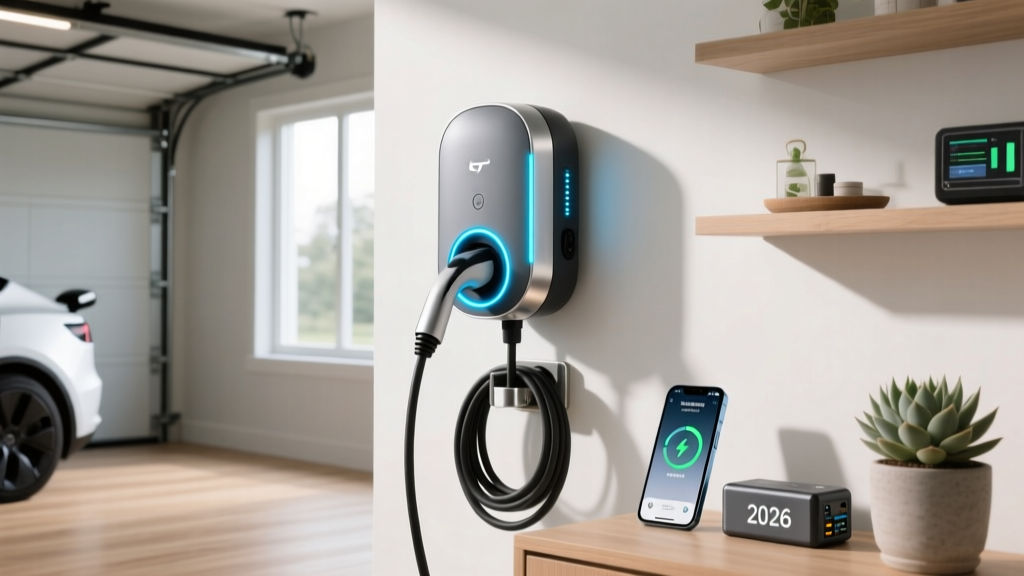
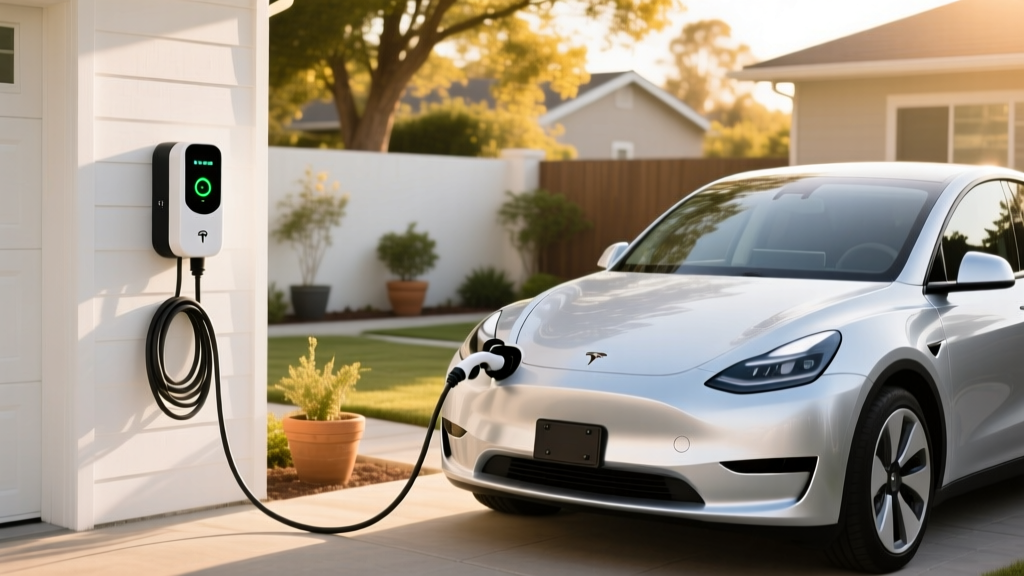
Tesla Wall Connector (NACS)
- Power: Up to 11.5 kW (48A on 60A circuit)
- Connector: Native NACS — no adapter needed for 2025+ Rivians
- Cable length: 24 ft
- Smart features: Wi-Fi, OTA updates, power sharing between two units
- Price: ~$475
ChargePoint Home Flex (NACS version)
- Power: Up to 12 kW (50A on 60A circuit, adjustable)
- Connector: NACS (2025+ models) or J1772 with adapter
- Cable length: 23 ft
- Smart features: App scheduling, utility demand-response, Alexa integration
- Price: ~$599
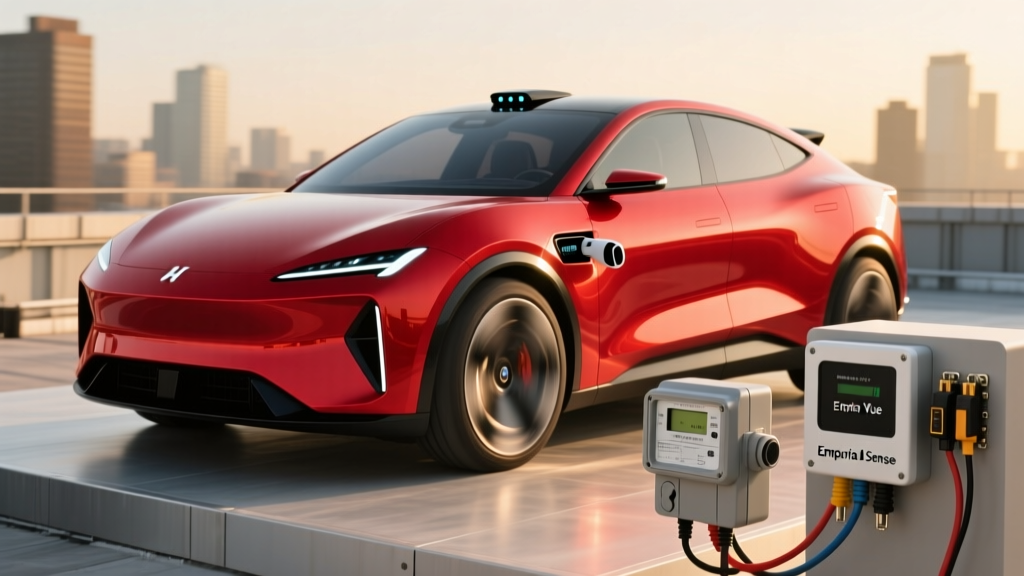
Emporia Vue Level 2 (NACS)
- Power: Up to 11.5 kW (48A)
- Connector: NACS
- Cable length: 24 ft
- Smart features: Real-time energy monitoring, solar integration, load management
- Price: ~$399
Rivian Wall Charger (NACS)
- Power: Up to 11.5 kW (48A)
- Connector: Native NACS
- Cable length: 25 ft
- Smart features: Deep Rivian app integration, scheduled charging, departure preconditioning
- Price: ~$550 (available through Rivian gear shop)
For 2022–2024 Rivian owners with a CCS1 port, any J1772 Level 2 charger will plug in natively (J1772 is the standard AC connector that CCS builds upon). If you install a NACS Wall Connector, you'll need the same NACS adapter — but note that some adapters support DC fast charging only, not AC Level 2. Verify adapter specs before purchasing.
Connector Compatibility: What Plugs Into What
| Connector Type | 2022–2024 Rivian (CCS1 Port) | 2025+ Rivian (NACS Port) |
|---|---|---|
| NACS (Tesla Supercharger) | Via Rivian NACS adapter (DC only) | Native — plug and charge |
| CCS1 (Electrify America, EVgo, etc.) | Native — plug and charge | Via NACS-to-CCS adapter (sold separately) |
| J1772 (public Level 2) | Native (J1772 is the AC portion of CCS1) | Via J1772-to-NACS adapter (included with vehicle) |
| CHAdeMO | Via third-party adapter (rare, not recommended) | Not supported |
As of 2026, the industry has decisively moved to NACS. Electrify America, EVgo, and most major networks are adding NACS cables to new and retrofitted stations. If you're buying a new Rivian today, NACS is your native standard and CCS access is the one that may require an adapter going forward.
Safety and Electrical Code Considerations
A Level 2 charger draws sustained high current for hours at a time — more like an electric oven than a phone charger. Proper installation isn't optional:
- Dedicated circuit: Your EV charger must be on its own breaker, not shared with other appliances. Double-pole, properly sized.
- GFCI protection: Required for all outdoor receptacles. Hardwired installations may be exempt in some jurisdictions, but GFCI is always good practice.
- Outdoor rating: If your charger is mounted outside (garage exterior, carport, driveway), the unit must carry a NEMA 4 or IP65 weather rating. All chargers recommended above meet this standard.
- Wire gauge and conduit: Undersized wire creates a fire hazard. Your electrician will size wire per NEC Table 310.16 and the specific run length.
- Utility notification: Some utilities require you to notify them before adding a Level 2 charger. Many also offer rebates of $250–$1,000 for installation — check with your provider.
Always hire a licensed electrician. DIY high-voltage work is dangerous, will void your homeowner's insurance in the event of a fire, and won't pass inspection.
Frequently Asked Questions
How much does it cost to install a home EV charger for my Rivian?
A straightforward Level 2 installation with an existing 200-amp panel and a short wire run typically costs $1,050–$2,100 all-in (charger, labor, permit). If your home needs a panel upgrade from 100A to 200A, expect the total to reach $3,800–$8,500. Always get at least two quotes from licensed electricians and confirm they include permit and inspection in the price.
How fast will each charging level add range to my Rivian?
Level 1 (120V) adds roughly 3–4 miles per hour — enough only for emergency top-ups. Level 2 (240V, 48A) adds about 25–31 miles per hour, which fully replenishes a Standard Battery overnight in 8–10 hours. DC fast charging at a Tesla V3 Supercharger adds up to 140 miles in about 20 minutes, with the full 10–80% session taking 35–45 minutes depending on battery size and temperature.
Which connector and charger is compatible with my Rivian?
If your Rivian is a 2025 or newer model, it has a native NACS port and plugs directly into Tesla Superchargers and NACS-equipped Level 2 chargers. For 2022–2024 models with a CCS1 port, you need Rivian's NACS adapter for Supercharger access and can use any J1772 or CCS1 public charger natively. For home Level 2, any NACS or J1772 charger works with the appropriate configuration.
How much does charging a Rivian cost per mile compared to gas?
Charging at home on an off-peak utility rate of $0.12/kWh costs roughly $0.05 per mile in a Rivian R1T. At a Tesla Supercharger averaging $0.35/kWh, it's about $0.14 per mile. A comparable gas truck at 19 MPG and $3.50/gallon costs $0.18 per mile. Over 15,000 annual miles, home charging saves approximately $1,950–$2,000 per year versus gasoline.
What electrical upgrades might I need for a home charger?
The most common upgrade is a panel upgrade from 100A to 200A service, required when your existing panel lacks the headroom for a 60-amp dedicated EV circuit. This costs $1,500–$3,500 depending on your utility's requirements and local labor rates. Other potential upgrades include running new conduit from the panel to the garage, adding a sub-panel, or upgrading your utility service drop. A licensed electrician will perform a load calculation to determine exactly what's needed.
Can I use a Tesla Destination Charger with my 2022–2024 Rivian?
It depends on the adapter. Tesla Destination Chargers (Level 2, AC) use the NACS connector. If your NACS adapter from Rivian supports AC charging (not just DC fast), you can use them. However, some adapters are rated for DC only. Check your adapter's specifications before relying on Destination Chargers during a trip. Hotels and restaurants with J1772 Level 2 chargers are universally compatible with all Rivian model years.
Does the federal tax credit cover home charger installation?
The IRS §30D and §25C credits have separate provisions for home charging equipment. As of 2026, the Alternative Fuel Vehicle Refueling Property Credit (§30C) covers up to 30% of home charger equipment and installation costs, capped at $1,000 — but only if you live in an eligible census tract (typically non-urban or low-income areas). Consult irs.gov or a tax professional to confirm eligibility, as tract designations and credit rules are subject to change.
For the latest on Rivian's EPA range ratings and efficiency data, refer to fueleconomy.gov, the official source for EPA-tested vehicle figures.