The NACS Reality: Tesla's Network Is Now (Mostly) Open
If you drive a Ford Mustang Mach-E, Hyundai Ioniq 5, Rivian R1T, or virtually any new EV sold in 2025–2026, you've likely noticed a shift: Tesla's Supercharger network — long the gold standard for DC fast charging reliability — is now accessible to non-Tesla vehicles. But the logistics aren't always straightforward. Depending on your vehicle's model year, native port, and the specific Supercharger location, you may need an adapter, a specific app, or both.
This guide walks through exactly how to charge a non-Tesla at a Tesla charging station, including the North American Charging Standard (NACS) transition timeline, adapter requirements, real-world costs per kWh, and what to expect at the stall.
Understanding Charging Levels: What You'll Encounter
Before we get to Tesla-specific logistics, it's critical to understand the three charging levels and what they deliver. Power is measured in kW (kilowatts — the rate of energy flow), while battery capacity is measured in kWh (kilowatt-hours — the total energy stored). Confusing these two is the single most common mistake new EV owners make.
| Level | Voltage / Amperage | Max Power (kW) | Miles of Range Added Per Hour | Typical Use Case |
|---|---|---|---|---|
| Level 1 | 120V / 12A | 1.4 kW | 3–5 mi/hr | Overnight trickle; emergency top-up |
| Level 2 | 240V / 32–48A | 7.7–11.5 kW | 25–44 mi/hr | Home daily charging; workplace; hotels |
| DC Fast Charge | 400–800V DC | 50–350 kW | 150–1,000+ mi/hr (peak) | Road trips; rapid top-ups on the go |
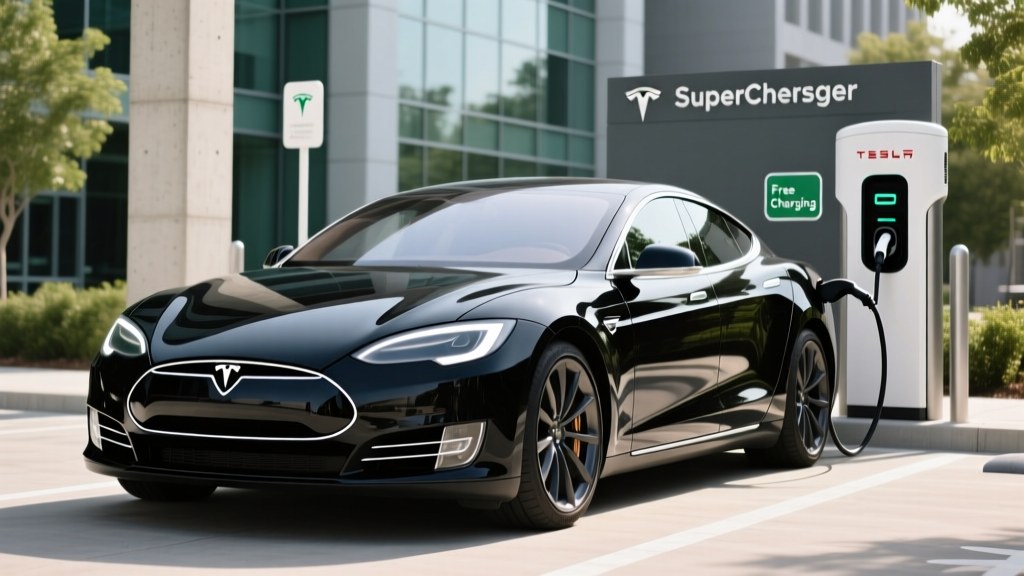
Tesla Superchargers are DC fast chargers. V3 stalls deliver up to 250 kW; V4 stalls (deployed starting 2023 and expanding through 2026) can deliver up to 350 kW to compatible vehicles. Tesla Destination Chargers are Level 2 units — typically 11.5 kW — and have been open to non-Tesla vehicles via the J1772 adapter for years at select locations.
How to Charge a Non-Tesla at a Tesla Supercharger Station
There are three pathways to use a Tesla Supercharger with a non-Tesla EV in 2026. Which one applies to you depends on your vehicle's charge port and the specific station.
Pathway 1: Native NACS Port (2025+ Models)
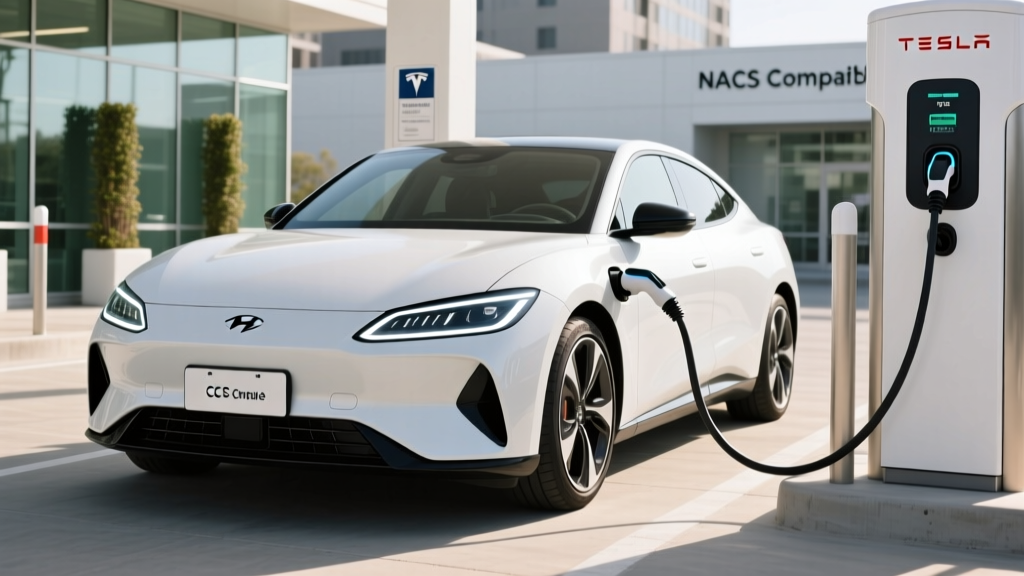
Starting with the 2025 model year, most major automakers — Ford, GM, Rivian, Volvo, Polestar, Mercedes-Benz, Nissan, Honda, Fisker, BMW, Hyundai, Kia, and others — began shipping vehicles with a native NACS charge port. If your EV has a NACS port, you can plug directly into any Tesla Supercharger stall with no adapter required. Simply use the Tesla app (or your automaker's integrated charging interface, where supported) to initiate the session.
Pathway 2: CCS-to-NACS Adapter (2022–2024 Models with CCS1)
If your EV has a CCS1 port (the combined charging system standard used by most non-Tesla EVs through 2024), you'll need a CCS-to-NACS adapter. Several manufacturers now provide these adapters free or at low cost:
- Ford: Provides a free Tesla Supercharger adapter (valued at ~$230) with its Fast Charging Adapter program for 2021–2024 Mustang Mach-E and F-150 Lightning owners via the FordPass app.
- GM: Offers a complimentary adapter for eligible 2022–2024 Bolt EV/EUV, Cadillac Lyriq, and Blazer EV owners.
- Rivian: Ships adapters with 2022–2024 R1T and R1S vehicles; replacements available through the Rivian shop.
- Aftermarket: Lectron, A2Z EV, and Tesla sell CCS-to-NACS adapters ranging from $175–$295. Look for units rated for at least 250 kW / 500A DC.
| Connector Standard | Used By (2026) | Tesla Supercharger Compatible? | Adapter Needed? |
|---|---|---|---|
| NACS (native) | Tesla (all years), Ford 2025+, GM 2025+, Rivian 2025+, Hyundai/Kia 2025+, most others 2025+ | Yes — direct plug-in | None |
| CCS1 | Most 2019–2024 non-Tesla EVs (Mach-E, Ioniq 5, ID.4, EV6, Lyriq, etc.) | Yes — with adapter | CCS-to-NACS adapter ($0–$295) |
| CHAdeMO | Nissan Leaf (legacy), Mitsubishi Outlander PHEV (legacy) | No — not supported | No reliable adapter exists |
| Tesla (proprietary, pre-NACS) | Tesla vehicles 2012–present | Yes — native | N/A |
Pathway 3: Tesla Magic Dock (Built-In CCS Adapter)
At select Supercharger locations (primarily those opened under the National Electric Vehicle Infrastructure, or NEVI, program), Tesla has installed a "Magic Dock" — a built-in CCS adapter integrated into the Supercharger cable. Non-Tesla EVs with CCS1 ports can plug in directly without carrying a separate adapter. Use the Tesla app to locate Magic Dock-equipped stations and initiate a charge session. As of early 2026, Magic Dock deployment remains limited to roughly 100–150 stations across the U.S., concentrated in urban centers and highway corridors.
Step-by-Step: Your First Supercharger Session in a Non-Tesla
- Download the Tesla app (iOS/Android) and create an account. You do not need a Tesla vehicle on your account.
- Locate a compatible station. In the app, filter for "Open to Non-Tesla EVs" — not all Supercharger locations are open yet, though the majority were by late 2025.
- Check your adapter. If your EV has a CCS1 port, confirm your adapter is in the vehicle. Native NACS vehicles can skip this step.
- Pull up to the stall. Note: Tesla Supercharger cables are relatively short (~6 feet). If your vehicle's charge port is on the front fender or the opposite side from a Tesla's rear-driver-side port, you may need to park at an angle or use an adjacent stall. Some newer V4 stalls have longer cables to accommodate this.
- Plug in and start the session via the Tesla app. You'll see real-time kW delivery and cost.
- Monitor your charge curve. Peak kW is only sustained at low state of charge (SoC). Expect the rate to taper significantly above 80% SoC — a 250 kW peak may drop to 40–60 kW by 85%. For efficient road-trip stops, charge to 80% and move on.
Real-World Charging Times: What to Expect at a Tesla Supercharger
Charging speed depends on your vehicle's onboard charge acceptance rate, battery chemistry, state of charge, and ambient temperature. Here are approximate 10–80% times at a Tesla V3 Supercharger (250 kW max) for popular non-Tesla EVs:
| Vehicle | Battery (kWh usable) | Peak DC Rate (kW) | 10–80% Time (approx.) |
|---|---|---|---|
| 2026 Ford Mustang Mach-E Extended Range | 91 kWh (NMC) | 150 kW | ~38 min |
| 2026 Hyundai Ioniq 5 (Long Range AWD) | 84 kWh (NMC) | 240 kW | ~18 min |
| 2026 Rivian R1T (Max Pack) | 141 kWh (NMC) | 200 kW | ~55 min |
| 2026 Kia EV6 GT-Line AWD | 77.4 kWh (NMC) | 240 kW | ~18 min |
| 2026 Cadillac Lyriq | 102 kWh (NMC) | 190 kW | ~34 min |
Cold-weather caveat: In sub-freezing temperatures (below 32°F / 0°C), expect 10–80% charge times to increase by 20–40% unless your vehicle has active battery preconditioning. The Hyundai Ioniq 5 and Kia EV6, for example, precondition the battery when a Supercharger is set as a navigation destination — reducing cold-weather taper. Always precondition before arriving at a DC fast charger.
How Much Does Charging at a Tesla Supercharger Cost?
Tesla Supercharger pricing for non-Tesla vehicles is typically higher than for Tesla owners. As of early 2026, expect the following ranges:
| Charging Scenario | Cost per kWh | Cost per Mile (at 3.5 mi/kWh) | Cost for 200-Mile Fill |
|---|---|---|---|
| Home Level 2 (off-peak utility rate) | $0.08–$0.14 | $0.02–$0.04 | $4.57–$8.00 |
| Home Level 2 (peak utility rate) | $0.18–$0.28 | $0.05–$0.08 | $10.29–$16.00 |
| Tesla Supercharger (Tesla owner rate) | $0.25–$0.35 | $0.07–$0.10 | $14.29–$20.00 |
| Tesla Supercharger (non-Tesla rate) | $0.33–$0.48 | $0.09–$0.14 | $18.86–$27.43 |
| Gasoline (avg. $3.40/gal, 28 MPG combined) | — | $0.12 | $24.29 |
Non-Tesla drivers pay a premium at Superchargers — often 15–40% more per kWh than Tesla owners. Tesla frames this as a "membership" differential; the workaround is Tesla's monthly subscription plan (roughly $13/month) which unlocks Tesla-owner pricing for non-Tesla vehicles. If you charge at Superchargers more than twice a month, the subscription typically pays for itself.
Even at non-Tesla rates, Supercharging remains cheaper per mile than gasoline in most U.S. markets. Home Level 2 charging on off-peak rates is the most economical option by a wide margin — roughly one-fifth the cost of gas per mile.
Home Charging Setup: Installing a Level 2 Charger
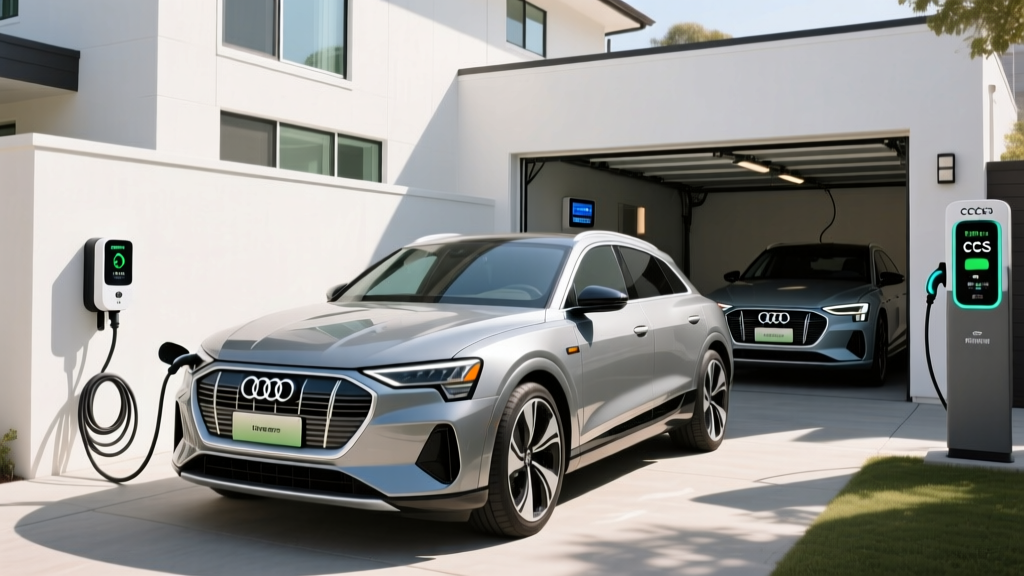
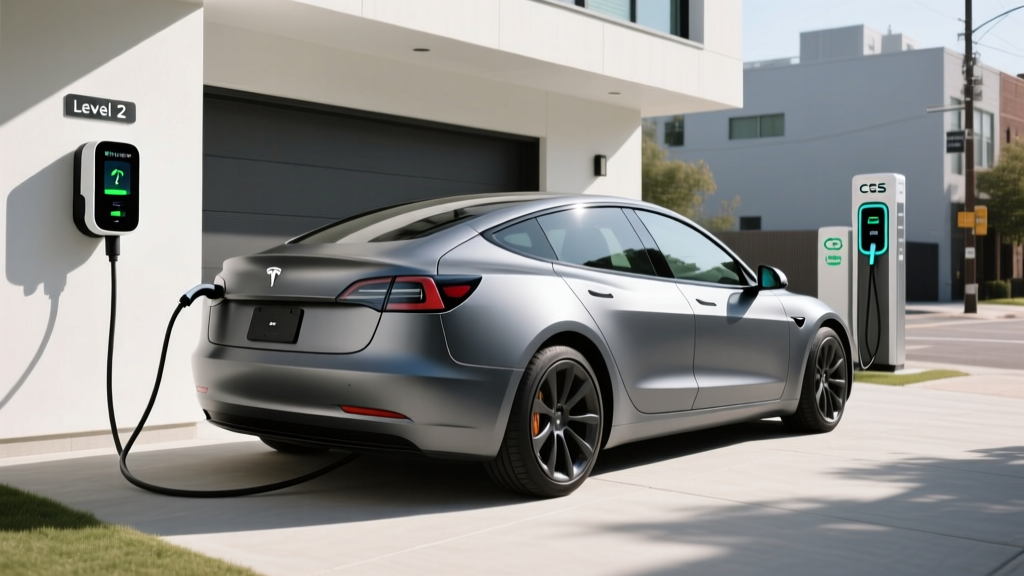
While Superchargers handle road trips, the vast majority of EV charging happens at home. A Level 2 home charger on a 240V circuit adds 25–44 miles of range per hour and can fully replenish most EVs overnight. Here's what's involved in installation.
Electrical Requirements
- Circuit: A dedicated 240V circuit — typically 40A (for a 32A charger) or 60A (for a 48A charger). The circuit breaker must be rated at 125% of the continuous load per NEC Article 625.
- Wire gauge: 6 AWG copper for 40A circuits; 4 AWG for 60A circuits (varies by run length and local code).
- Panel capacity: Your electrical panel must have sufficient spare amperage. A 200A panel is standard in most modern homes; older homes with 100A or 150A panels may need a panel upgrade — a significant added cost.
- GFCI protection: NEC 2020 and later require GFCI protection for EV charging circuits in garages. Most hardwired Level 2 chargers have built-in GFCI; plug-in units rely on the breaker.
- Outdoor rating: If installing outdoors, the charger must be NEMA 4-rated (weather-resistant). All major chargers listed below meet this standard.
Installation Cost Breakdown
| Component | Low-End Estimate | High-End Estimate | Notes |
|---|---|---|---|
| Level 2 Charger (equipment) | $300 | $700 | Varies by brand, power, cable length, smart features |
| Electrician labor (standard install) | $400 | $1,200 | Short run from panel to garage; longer runs cost more |
| Permit & inspection | $50 | $250 | Required in most jurisdictions; varies by municipality |
| Electrical panel upgrade (if needed) | $1,500 | $4,000 | 100A→200A upgrade; not needed in most newer homes |
| Total (no panel upgrade) | $750 | $2,150 | Typical scenario for homes with adequate panel capacity |
| Total (with panel upgrade) | $2,250 | $6,150 | Older homes or those adding multiple high-draw circuits |
Always hire a licensed electrician and pull a permit. Unpermitted EV charger installations can void homeowner's insurance claims and create fire risk. The U.S. Department of Energy recommends obtaining at least three quotes and verifying the electrician has EV charger installation experience.
Federal Tax Credit for Home Charging Equipment
The IRS §30C Alternative Fuel Vehicle Refueling Property Credit covers 30% of home EV charger equipment and installation costs, up to $1,000. Eligibility depends on the equipment being installed at your primary residence in a qualifying census tract (generally low-income or non-urban areas). Check the latest IRS guidance for current tract eligibility maps — these change annually.
Recommended Level 2 Home Chargers for 2026
Below are four well-regarded Level 2 chargers suitable for non-Tesla EVs. All are NACS-compatible or available with NACS connectors for 2025+ vehicles, and all can charge CCS1 vehicles with the appropriate adapter.
1. ChargePoint Home Flex (NACS or J1772)
- Power output: Up to 11.5 kW (48A) on a 60A circuit; adjustable down to 16A
- Connector: Available in NACS or J1772 (CCS adapter needed for CCS1 vehicles using J1772 variant)
- Cable length: 23 feet
- Smart features: Wi-Fi, ChargePoint app scheduling, Alexa integration, energy tracking
- Price: ~$550–$650
- Best for: Flexible amperage adjustment for homes with limited panel capacity
2. Tesla Wall Connector (NACS)
- Power output: Up to 11.5 kW (48A) on a 60A circuit
- Connector: NACS native; includes integrated J1772 adapter for non-Tesla EVs
- Cable length: 24 feet
- Smart features: Wi-Fi, over-the-air updates, load sharing (up to 6 units on one circuit), Powerwall integration
- Price: ~$475
- Best for: Mixed Tesla/non-Tesla households; best value per watt
3. Emporia Level 2 EV Charger
- Power output: Up to 11.5 kW (48A) on a 60A circuit
- Connector: J1772 (NACS adapter sold separately)
- Cable length: 24 feet
- Smart features: Wi-Fi, Emporia app, solar integration, real-time energy monitoring, time-of-use scheduling
- Price: ~$350–$400
- Best for: Budget-conscious buyers with solar panels; best smart-home energy integration
4. Grizzl-E Smart (NACS or J1772)
- Power output: Up to 10 kW (40A) on a 50A circuit
- Connector: Available in NACS or J1772
- Cable length: 24 feet
- Smart features: OCPP-compatible, app control, load balancing
- Price: ~$450–$550
- Best for: Extreme cold climates (rated to -40°F); rugged outdoor builds
Safety and Electrical Code Considerations
EV charging draws sustained high current for hours — unlike most household appliances. This makes proper installation non-negotiable:
- Dedicated circuit: Your EV charger must be on its own dedicated breaker. Sharing a circuit with other appliances risks tripped breakers or overheated wiring.
- Hardwired vs. plug-in: Hardwired installations (no plug) avoid the NEC GFCI nuisance-trip issues common with 240V receptacles. Hardwired also allows higher amperage (48A vs. 40A max for NEMA 14-50 outlets). Most electricians recommend hardwired for new installations.
- NEMA 14-50 receptacle caution: If you opt for a plug-in charger on a 14-50 outlet, ensure the receptacle is a commercial/industrial grade (e.g., Hubbell 9450A or Bryant 9450FRS). Residential-grade 14-50 receptacles have been linked to melting under sustained EV charging loads.
- Outdoor installations: Must use NEMA 4-rated equipment and weatherproof conduit. The charger should be mounted at least 18 inches above grade per NEC.
- Load management: If your panel is near capacity, consider a smart load-management system (e.g., Emporia or ChargePoint with load-sharing) that dynamically reduces charger amperage when other household loads spike.
The National Fire Protection Association's NEC Article 625 governs all EV charging installations. Your electrician should be current on the 2023 NEC (or your state's adopted version).
Frequently Asked Questions
Can any non-Tesla EV use a Tesla Supercharger?
Most can, but not all. Vehicles with a native NACS port (2025+ models from Ford, GM, Rivian, Hyundai, Kia, and others) plug in directly. Vehicles with a CCS1 port (most 2019–2024 EVs) need a CCS-to-NACS adapter. CHAdeMO-equipped vehicles like the Nissan Leaf cannot use Tesla Superchargers — no adapter exists. Check the Tesla app for station-specific compatibility.
How much does it cost to install a home EV charger?
Expect $750–$2,150 for a standard Level 2 installation (equipment + electrician + permit) if your electrical panel has sufficient capacity. If a panel upgrade is needed (common in homes with 100A service), add $1,500–$4,000. Always get multiple quotes from licensed electricians and pull a permit.
How fast will each charging level add range?
Level 1 (120V) adds roughly 3–5 miles per hour. Level 2 (240V, 32–48A) adds 25–44 miles per hour. DC fast charging (50–350 kW) can add 150–1,000+ miles per hour at peak, but sustained rates are lower due to charge-curve taper above 80% SoC. For road trips, plan around 10–80% DC fast-charge times — typically 18–55 minutes depending on your vehicle.
Which connector is compatible with my EV?
Check your vehicle's charge port. If it's NACS (smaller, 5-pin), you can use Tesla Superchargers directly. If it's CCS1 (larger, with two DC pins below), you need a CCS-to-NACS adapter for Tesla Superchargers and can use Electrify America, EVgo, and other CCS networks natively. CHAdeMO (round, with two large DC pins) is legacy and limited to older Nissan Leafs and Mitsubishi PHEVs.
How much does EV charging cost per mile vs. gas?
At home on off-peak electricity ($0.10/kWh), EV charging costs roughly $0.03/mile — about one-quarter the cost of gasoline at $3.40/gal and 28 MPG ($0.12/mile). Even at non-Tesla Supercharger rates ($0.38/kWh average), you're looking at ~$0.11/mile, still slightly cheaper than gas. The savings are largest when you charge primarily at home.
What electrical upgrades might I need for a home charger?
The most common upgrade is a panel replacement from 100A or 150A to 200A service ($1,500–$4,000). You may also need a new breaker slot, upgraded wire from the utility meter to the panel, or a smart load-management device if your panel is near capacity. A licensed electrician can perform a load calculation to determine whether your existing panel can handle a 40A or 60A EV circuit.
Do I need a Tesla account to charge at a Supercharger?
Yes. Download the Tesla app and create a free account. You'll use it to locate open stations, initiate sessions, and pay. Non-Tesla drivers pay a higher per-kWh rate unless they subscribe to Tesla's monthly membership plan (~$13/month), which unlocks Tesla-owner pricing.
Will using a CCS-to-NACS adapter void my vehicle's warranty?
No. Automakers like Ford, GM, and Rivian have officially endorsed the use of their approved CCS-to-NACS adapters for Supercharger access. Using a reputable, properly rated adapter (250 kW / 500A minimum) will not void your battery or powertrain warranty. Avoid unverified, ultra-cheap adapters from unknown brands.