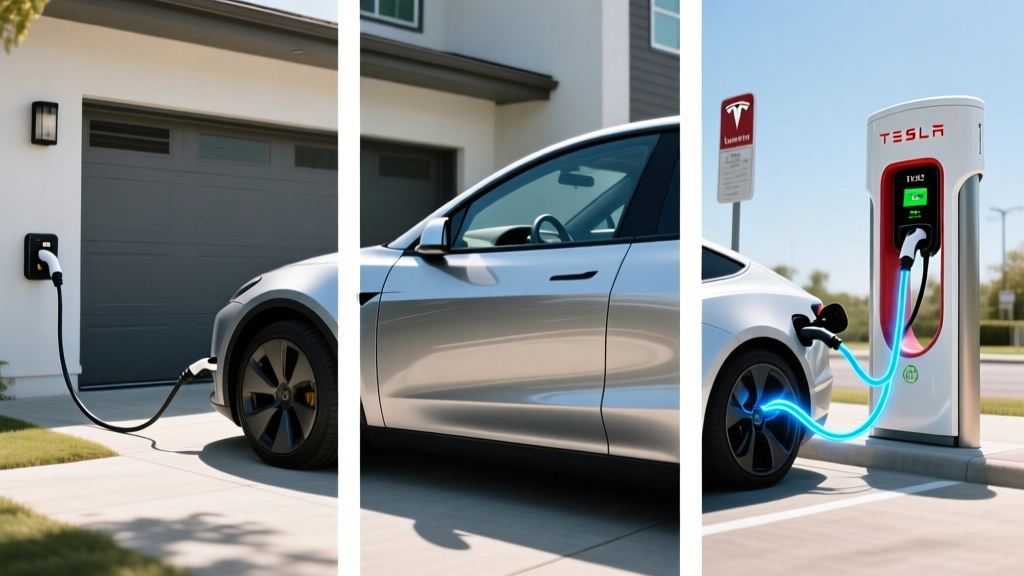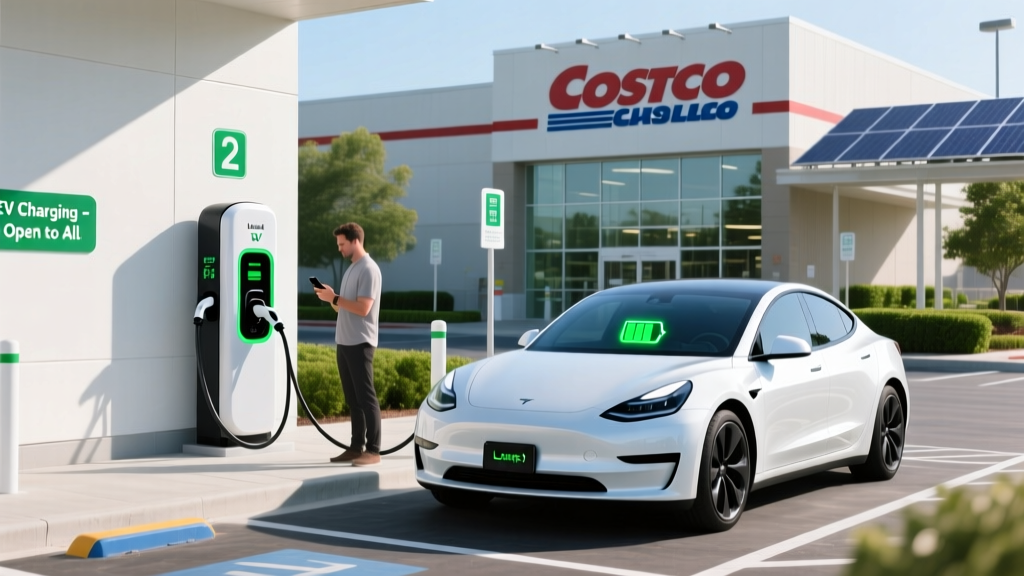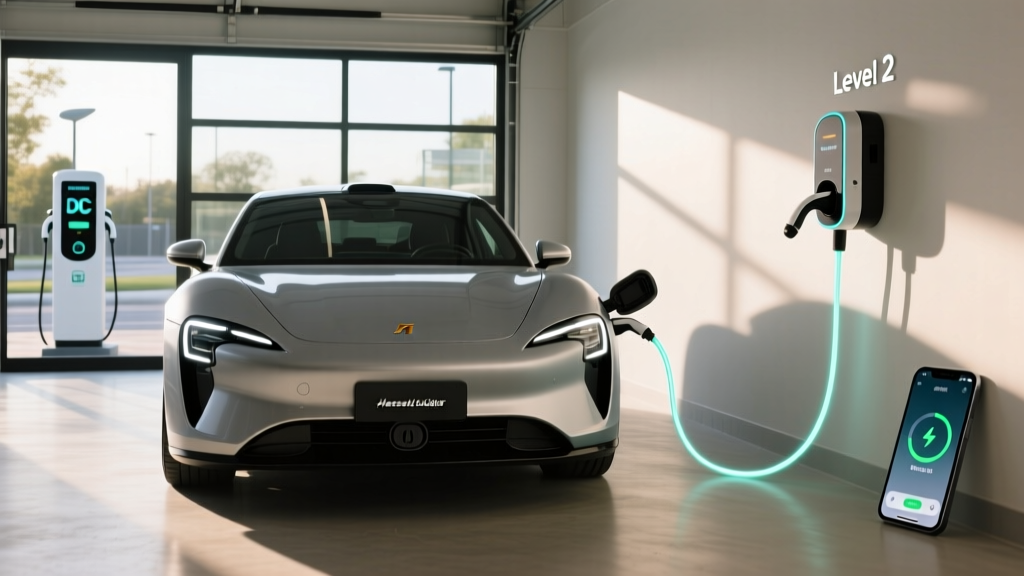
You can buy the electric car with the most range on the market — a Lucid Air Grand Touring with its EPA-estimated 512 miles or a Chevrolet Silverado EV with 440 miles — and still find yourself stranded if your charging setup doesn't match the battery size. A massive 118 kWh usable pack is an asset on the highway and a liability in the garage if you're limited to a 120V wall outlet adding 3 miles per hour.
This guide maps the full charging ecosystem — from overnight Level 2 home installs to DC fast-charging road trips — with exact numbers for the high-capacity EVs dominating the 2026 market. We'll cover what it costs, how long it takes, and which equipment actually delivers on its promises.
Charging Levels Explained: Speeds, kW, and Miles Per Hour
Before comparing chargers, you need to understand the three charging tiers and what they actually deliver to your battery. Power is measured in kW (kilowatts) — the rate of energy flow — while battery capacity is measured in kWh (kilowatt-hours) — the total energy stored. Confusing the two is the most common EV literacy mistake.
| Level | Voltage | Power (kW) | Miles of Range Added Per Hour | Best Use Case |
|---|---|---|---|---|
| Level 1 | 120V AC | 1.0–1.4 kW | 3–5 mi/hr | Emergency top-ups, PHEVs, low-mileage drivers |
| Level 2 | 240V AC | 3.3–19.2 kW | 12–75 mi/hr | Daily home charging, workplace, hotels |
| DC Fast Charge | 400–800V DC | 50–350 kW | 150–1,200+ mi/hr (peak) | Road trips, highway corridors, quick top-ups |
For context, a Lucid Air Grand Touring with its 118 kWh usable battery would take roughly 118 hours on Level 1 (0–100%), about 10–12 hours on a 48-amp Level 2 (11.5 kW), and approximately 22–28 minutes from 10–80% on a 300 kW DC fast charger thanks to its 900V+ architecture. The larger the battery, the more critical your charging infrastructure becomes.
Home Level 2 Installation: Electrical Requirements, Costs, and Gotchas
Installing a Level 2 home charger is the single highest-impact upgrade for any EV owner, but the cost varies wildly depending on your home's electrical panel, the distance from panel to charger location, and local permitting requirements.
Electrical Requirements for a Standard Level 2 Install
A typical Level 2 home charger runs on a 240V dedicated circuit, similar to a clothes dryer or electric oven. The most common configurations:
- 40-amp circuit → delivers up to 32 amps continuous (7.7 kW) — sufficient for most EVs
- 50-amp circuit → delivers up to 40 amps continuous (9.6 kW) — ideal for larger batteries
- 60-amp circuit → delivers up to 48 amps continuous (11.5 kW) — best for 100+ kWh packs like the Lucid Air or Hummer EV
- 100-amp circuit → delivers up to 80 amps continuous (19.2 kW) — requires hardwiring and a 200A+ panel; offered by chargers like the ChargePoint Home Flex or Tesla Wall Connector
Panel upgrade warning: If your home has a 100-amp main service panel (common in homes built before 1990), adding a 50-amp EV circuit may require a panel upgrade to 200 amps, which costs $1,500–$4,000 on top of the charger install. Have a licensed electrician perform a load calculation before committing to a circuit size.
| Component | Low-End Estimate | High-End Estimate | Notes |
|---|---|---|---|
| Level 2 Charger Equipment | $350 | $750 | Hardwired units cost less than NEMA 14-50 plug-in models |
| Electrician Labor (standard install) | $500 | $1,500 | Depends on distance from panel; conduit runs add cost |
| Electrical Permit | $50 | $300 | Varies by municipality; some utilities bundle this |
| Panel Upgrade (if needed) | $1,500 | $4,000 | 100A → 200A upgrade; not required for most modern homes |
| Total (no panel upgrade) | $900 | $2,550 | Typical range for most homeowners |
| Total (with panel upgrade) | $2,400 | $6,550 | Older homes with 100A service |
Some utilities offer rebates of $250–$1,000 for Level 2 installations, and the federal Residential Clean Energy Credit may cover 30% of equipment and installation costs up to $1,000 through 2032 (IRS §25E). Check with your local utility and a tax professional for eligibility.
Connector Compatibility: NACS, CCS, and CHAdeMO in 2026
The connector landscape has consolidated significantly since Ford, GM, Rivian, Volvo, and others adopted the North American Charging Standard (NACS) — originally Tesla's proprietary connector — starting in 2024–2025. Here's where things stand for 2026 model-year vehicles:
| Connector | Brands Using It Natively | Adapter Needed For |
|---|---|---|
| NACS (Tesla) | Tesla, Ford, GM, Rivian, Volvo, Polestar, Mercedes-Benz (new), Hyundai/Kia (new), Lucid, Fisker | CCS public chargers (adapter included by most automakers) |
| CCS1 | VW, BMW, Stellantis (some), legacy models from Ford/GM/Hyundai/Kia (pre-2025) | Tesla Superchargers (Magic Dock or third-party adapter) |
| CHAdeMO | Nissan Leaf (legacy only — discontinued) | Effectively orphaned; no new vehicles use it |
Practical advice: If you're buying a new EV in 2026, it almost certainly has a NACS port. You'll get native access to the Tesla Supercharger network — over 25,000 stalls in North America — and can use a CCS adapter (usually included) for Electrify America, EVgo, and other CCS networks. Keep the adapter in your frunk.
Charging Time Examples: How Long to Charge High-Range EVs
Let's put real numbers to the EVs with the largest batteries on the market. These times assume starting at 10% SoC and charging to 80% — the practical fast-charging window, since charging slows dramatically above 80% to protect battery health.
| Vehicle | Battery (kWh usable) | Level 2 at 11.5 kW (48A) | DC Fast (peak kW) | DC Fast 10–80% Time |
|---|---|---|---|---|
| Lucid Air Grand Touring | 118 kWh (NMC) | ~10.3 hrs | 300 kW (900V arch) | ~22 min |
| Chevy Silverado EV 4WT | 200+ kWh (NMC) | ~17+ hrs | 350 kW (Ultium) | ~40 min |
| Tesla Model S Long Range | 95 kWh (NMC) | ~8.3 hrs | 250 kW (V3 Supercharger) | ~27 min |
| Rivian R1T Dual Max | 141 kWh (NMC) | ~12.3 hrs | 220 kW | ~42 min |
| Hyundai Ioniq 5 Long Range | 84 kWh (NMC) | ~7.3 hrs | 240 kW (800V arch) | ~18 min |
Cost to Charge: Home vs. Public vs. Gas Comparison
The economics of EV charging depend entirely on where you charge. Home charging on a residential electric rate is dramatically cheaper than public DC fast charging, and both are generally cheaper than gasoline on a per-mile basis.
| Scenario | Rate | Cost Per kWh | Cost Per Mile (3 mi/kWh avg) | Annual Cost (12,000 mi) |
|---|---|---|---|---|
| Home (off-peak utility rate) | $0.10–$0.15/kWh | $0.13 avg | $0.043 | $516 |
| Home (standard rate, no TOU) | $0.16–$0.22/kWh | $0.19 avg | $0.063 | $756 |
| Public Level 2 (ChargePoint, etc.) | $0.25–$0.49/kWh | $0.37 avg | $0.123 | $1,476 |
| DC Fast Charging (EA, EVgo, Tesla) | $0.35–$0.65/kWh | $0.48 avg | $0.160 | $1,920 |
| Gasoline (25 MPG avg, $3.50/gal) | — | — | $0.140 | $1,680 |
Key takeaway: If you charge primarily at home on an off-peak rate, your fuel cost is roughly one-quarter the cost of gasoline. But if you rely entirely on DC fast charging, your per-mile cost can actually exceed gasoline. This is why a home Level 2 install is essentially non-negotiable for EV economics — especially with a large battery that would cost $50–$90 to fill at a public DC fast charger.
For the Lucid Air Grand Touring (118 kWh usable), a full home charge at $0.13/kWh costs roughly $15.34 for 512 miles of range. The same charge at a $0.48/kWh DC fast charger: $56.64. Plan accordingly.
Equipment Recommendations: Best Level 2 Chargers for High-Capacity EVs
Not all Level 2 chargers are equal. For vehicles with 100+ kWh batteries, you want at least 48 amps (11.5 kW) to achieve a full overnight charge. Here are top picks available in 2026:
Tesla Wall Connector (Gen 4)
- Power Output: Up to 48 amps (11.5 kW) on a 60A circuit
- Connector: NACS native; J1772 adapter included
- Cable Length: 24 feet
- Smart Features: Wi-Fi, OTA updates, power sharing (pair two units on one circuit), access control
- Price: ~$450
- Best For: Tesla owners and any NACS-equipped EV; cleanest integration with Tesla vehicles
ChargePoint Home Flex
- Power Output: Adjustable 16–50 amps (up to 12 kW on a 60A circuit)
- Connector: NACS (2025+ model) or J1772 with adapter; CCS adapter support
- Cable Length: 23 feet
- Smart Features: Wi-Fi, app scheduling, Alexa integration, utility demand-response programs
- Price: ~$550–$650
- Best For: Non-Tesla EV owners who want flexible amperage tuning to match their panel capacity
Grizzl-E Smart (United Chargers)
- Power Output: Up to 40 amps (9.6 kW) on a 50A circuit
- Connector: NACS or J1772 options
- Cable Length: 24 feet
- Smart Features: OCPP-compatible, works with multiple apps, extreme cold rated (-40°C)
- Price: ~$400–$500
- Best For: Cold-climate owners; built in Canada and tested to -40°F; rugged outdoor installation
FLO Home X5
- Power Output: Up to 48 amps (11.5 kW) on a 60A circuit
- Connector: NACS (2025+ model) or J1772
- Cable Length: 25 feet
- Smart Features: Wi-Fi, load management, FLO network integration
- Price: ~$600–$700
- Best For: Buyers wanting commercial-grade build quality with utility demand-response support
For vehicles with very large batteries (Silverado EV, Hummer EV, Rivian Max pack), prioritize a charger that supports 48 amps or higher. Anything below 40 amps will result in 14+ hour charge times that may not complete overnight.
Safety, Electrical Code, and Installation Best Practices
EV charging involves sustained high-current draw for hours at a time — far more demanding than intermittent appliance use. Proper installation is critical for safety and insurance compliance.
- Dedicated circuit: Your EV charger must be on its own dedicated breaker — never shared with other appliances. A 50-amp charger needs a 50-amp breaker with 6 AWG copper wire (or 4 AWG aluminum).
- GFCI protection: The 2023 NEC (National Electrical Code) requires GFCI protection for all EV charging outlets (NEMA 14-50 or similar). Hardwired chargers are exempt from this GFCI requirement, which is one reason many electricians now recommend hardwiring.
- Outdoor rating: If mounting outdoors, ensure the charger carries a NEMA 4 rating (weatherproof). Most major chargers — Tesla Wall Connector, ChargePoint Home Flex, Grizzl-E — are rated for outdoor use.
- Permit and inspection: Nearly all jurisdictions require an electrical permit for EV charger installation. The inspection ensures correct wire gauge, breaker sizing, grounding, and GFCI compliance. Skipping the permit risks insurance denial in the event of an electrical fire.
- NEMA 14-50 vs. hardwired: A 14-50 outlet gives you portability (take the charger when you move), but hardwired installs eliminate the GFCI requirement, reduce connection points (fewer failure modes), and often cost less in labor. Discuss both options with your electrician.
Always hire a licensed electrician experienced with EV installations. According to the National Fire Protection Association, improper EV charging installations have been linked to residential electrical fires — almost always traceable to undersized wiring, missing permits, or DIY shortcuts.
Frequently Asked Questions
How much does it cost to install a home EV charger?
A typical Level 2 home installation costs $900–$2,550 including equipment ($350–$750), electrician labor ($500–$1,500), and permitting ($50–$300). If your home needs a panel upgrade from 100A to 200A service, add $1,500–$4,000. Utility rebates and the federal §25E credit (30% up to $1,000) can offset a significant portion.
How fast will each charging level add range?
Level 1 (120V) adds 3–5 miles per hour. Level 2 (240V) adds 12–75 miles per hour depending on amperage. DC fast charging adds 150–1,200+ miles per hour at peak rates, but sustained speeds taper as the battery fills — always check 10–80% times rather than peak kW ratings.
Which connector/charger is compatible with my EV?
For 2026 model-year vehicles, NACS is the dominant standard — used by Tesla, Ford, GM, Rivian, Hyundai/Kia, and most others. CCS1 is found on older models and VW/BMW vehicles. CHAdeMO is effectively discontinued. Check your vehicle's charge port or consult the manufacturer spec sheet. Most new EVs include a CCS-to-NACS adapter in the box.
How much does charging cost per mile vs gas?
Home charging at off-peak rates averages $0.04–$0.06 per mile — roughly one-third to one-quarter the cost of gasoline at $3.50/gal and 25 MPG ($0.14/mile). Public DC fast charging averages $0.16/mile, which can exceed gasoline costs. Home charging is essential for EV economics.
What electrical upgrades might I need?
The most common upgrade is a panel capacity increase from 100A to 200A ($1,500–$4,000) if your existing panel doesn't have capacity for a new 50–60 amp circuit. Your electrician will perform a NEC Article 220 load calculation to determine if an upgrade is needed. Homes built after 2000 typically have 200A service and won't need this.
Does the electric car with the most range need a bigger charger?
Not necessarily bigger, but it benefits more from higher-amperage Level 2 charging. A Lucid Air (118 kWh) or Silverado EV (200+ kWh) needs a 48-amp or higher Level 2 charger to complete a full charge overnight. On a 32-amp (7.7 kW) charger, these vehicles may require 15–26 hours for a full charge — impractical for daily use.
For authoritative range and efficiency data, consult fueleconomy.gov for EPA-verified figures, and always pair EPA estimates with real-world expectations: highway driving at 75+ mph typically reduces range 10–15%, and cold weather (below 30°F) can reduce it 20–35% depending on whether the vehicle uses a heat pump for cabin heating.