If you own or are considering a used Nissan Leaf, Mitsubishi Outlander PHEV, or older Kia Soul EV, you have likely encountered the CHAdeMO connector — the DC fast-charging standard developed by a consortium of Japanese automakers and Tokyo Electric Power Company (TEPCO). Once the dominant fast-charging format in the United States, CHAdeMO now faces a shrinking public network as CCS1 and NACS (Tesla's North American Charging Standard) claim the vast majority of new infrastructure. Understanding what CHAdeMO can and cannot do in 2026 — and how to keep your vehicle charged efficiently — is essential for current owners and used-EV shoppers alike.
- Max DC fast-charge power: 50 kW (typical), up to 62.5 kW on CHAdeMO 1.0; CHAdeMO 2.0 supports up to 400 kW but is virtually nonexistent in the US
- Primary compatible vehicles sold in the US: Nissan Leaf (2011–2025 model years), Mitsubishi Outlander PHEV (DC port), Kia Soul EV (2015–2019)
- No new US-market EVs launched after 2021 use CHAdeMO as their DC standard
- Public CHAdeMO stalls: declining — many Electrify America and EVgo stations have removed or deprioritized CHAdeMO cables
CHAdeMO Connector Explained: What It Is and How It Works
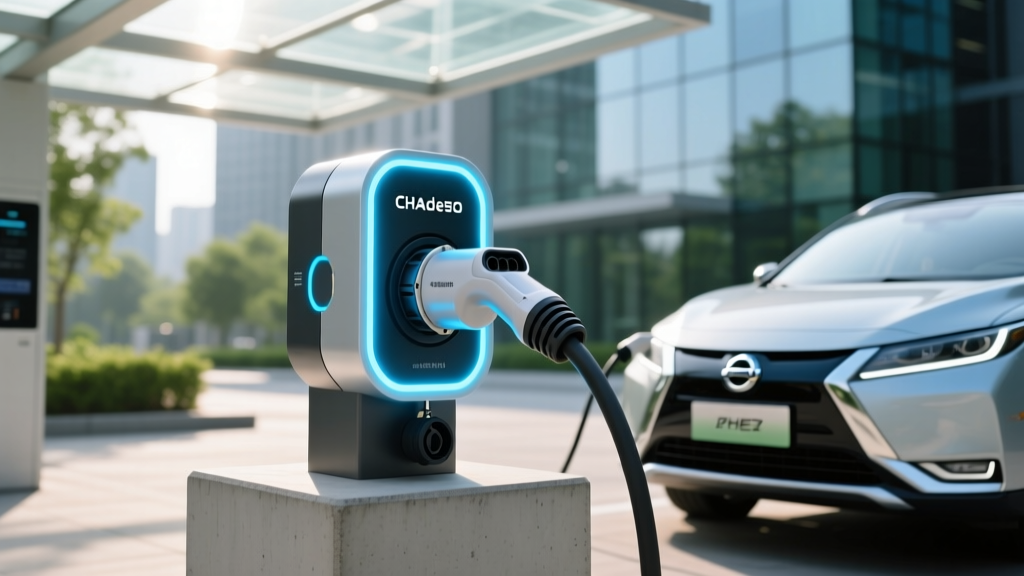
CHAdeMO (Charge de Move) is a DC fast-charging protocol that delivers high-voltage direct current directly to an EV's battery, bypassing the vehicle's onboard charger. The connector itself is a large, round, multi-pin plug — distinctly different from the smaller CCS1 or NACS connectors. A CHAdeMO port on the vehicle is a separate inlet from the J1772 AC port used for Level 1 and Level 2 charging; most CHAdeMO-equipped vehicles have two charge ports side by side or stacked.
The protocol communicates charge state, battery temperature, and voltage limits between the station and the vehicle via CAN bus. When you plug in, the station negotiates maximum current with the car's battery management system (BMS), then ramps power up or down accordingly. Peak power on most US CHAdeMO stations is 50 kW, which translates to roughly 150–200 miles of range added per hour of charging on a compact EV like the Leaf — though real-world sustained rates are often lower due to charge-curve tapering above 80% state of charge (SoC).
Charging Levels and Speeds: Where CHAdeMO Fits
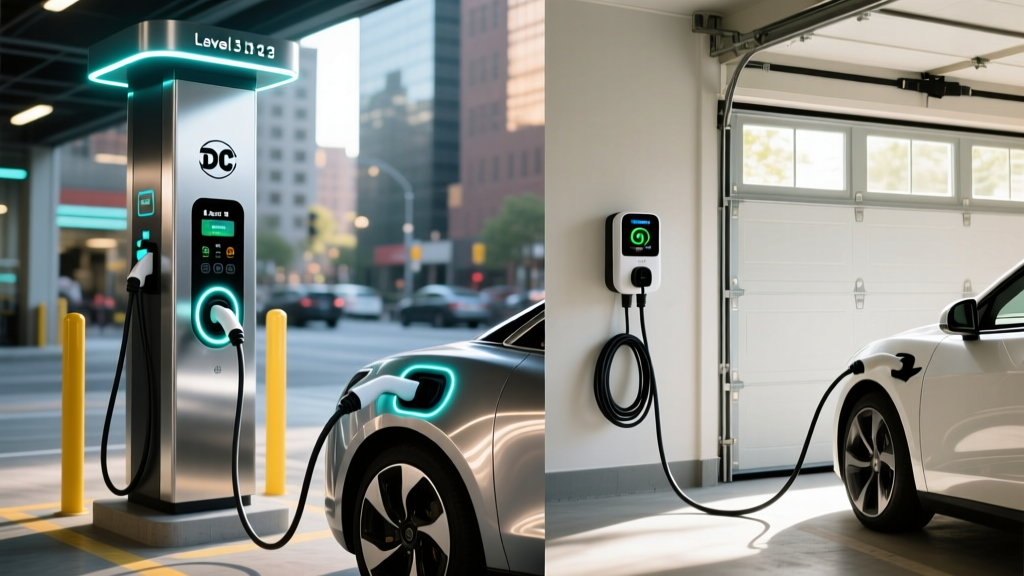
CHAdeMO is exclusively a DC fast-charging (Level 3) connector. It is not used for home or destination AC charging. Every CHAdeMO vehicle also has a J1772 inlet for Level 1 and Level 2 charging. Here is how the three levels compare in practical terms:
| Level | Power (kW) | Voltage | Miles of Range Added per Hour | Typical Use Case | Connector |
|---|---|---|---|---|---|
| Level 1 | 1.2–1.9 kW | 120V AC | 3–5 mi/hr | Overnight trickle; emergency top-up | J1772 (standard 120V outlet) |
| Level 2 | 3.3–19.2 kW | 240V AC | 12–60 mi/hr | Home daily charging; workplace; destination | J1772 (or NACS on Tesla/newer EVs) |
| DC Fast (CHAdeMO) | 24–50 kW (typical US) | 200–500V DC | 80–180 mi/hr | Road trips; quick top-ups | CHAdeMO |
| DC Fast (CCS1) | 50–350 kW | 200–920V DC | 150–1,200+ mi/hr | Road trips; highway corridor charging | CCS1 |
| DC Fast (NACS) | 150–350+ kW | 200–920V DC | 200–1,300+ mi/hr | Tesla Supercharger & expanding open network | NACS |
For a 40 kWh Nissan Leaf (EPA range ~149 miles), a 50 kW CHAdeMO session from 10–80% SoC typically takes 40–50 minutes in moderate temperatures. In cold weather (below 32°F / 0°C), that same session can stretch to 60+ minutes because the BMS limits charge current to protect the battery until it warms up — and the Leaf lacks active battery thermal preconditioning, a significant real-world limitation.
The larger 62 kWh Leaf Plus (EPA range ~212–226 miles, depending on model year) can accept up to ~100 kW peak on CHAdeMO 1.0 at compatible high-power stations, though very few US stations deliver above 50 kW on CHAdeMO. Expect a 10–80% session in roughly 45–60 minutes at a 50 kW stall.
Connector Compatibility: CHAdeMO vs CCS1 vs NACS
One of the most common questions from used-EV buyers is whether they can use CCS1 or NACS stations with a CHAdeMO vehicle. The short answer: CHAdeMO is not adapter-compatible with CCS1 or NACS at DC fast-charging speeds. The protocols, pin configurations, and communication standards are fundamentally different. No commercially available, safety-certified CHAdeMO-to-CCS or CHAdeMO-to-NACS adapter exists for DC fast charging as of 2026.
| Connector | Compatible EV Brands (2026 Models) | Adapter Available? |
|---|---|---|
| CHAdeMO | Nissan Leaf (all years), Mitsubishi Outlander PHEV (DC port), Kia Soul EV (2015–2019) | No DC adapter to CCS1/NACS exists |
| CCS1 | VW ID.4, Hyundai Ioniq 5/6, Kia EV6/EV9, Ford F-150 Lightning, BMW iX, Chevrolet Equinox EV, Rivian R1T/R1S, and most non-Tesla EVs | NACS-to-CCS1 adapters available from Tesla, Ford, GM, and third parties |
| NACS | All Tesla vehicles; Ford, GM, Rivian, Volvo, Polestar, Mercedes-Benz, BMW, Hyundai/Kia (2025+ models transitioning) | CCS1-to-NACS adapters widely available |
What this means for CHAdeMO owners: Your AC home and destination charging uses the universal J1772 standard (or a J1772-to-NACS adapter for Tesla destination chargers), which works perfectly. But for DC fast charging on road trips, you are limited to stations with functioning CHAdeMO cables — and that network is contracting. Before purchasing a CHAdeMO vehicle, map your typical routes using PlugShare or the DOE's Alternative Fuels Data Center station locator to verify CHAdeMO availability along your corridors.
Home Charging Setup for CHAdeMO Vehicles: Installation and Cost
Since CHAdeMO is DC-only, your home charging will use the vehicle's J1772 Level 2 port — the same standard used by virtually every non-Tesla EV. A Level 2 home charger is the backbone of daily EV ownership, adding enough range overnight to cover most commutes and errands without ever touching a public station.
Electrical Requirements
A typical Level 2 home charger requires a 240V dedicated circuit, similar to what an electric dryer or oven uses. The most common configurations:
- 40-amp circuit / 32-amp continuous output (7.7 kW): Sufficient for most CHAdeMO vehicles. The Nissan Leaf's onboard charger maxes out at 6.6 kW (27.5A), so a 40A circuit captures its full AC charging capability.
- 50-amp circuit / 40-amp continuous output (9.6 kW): Recommended if you plan to upgrade to a newer EV in the future or have a second EV. Adds roughly 25% more flexibility.
- 60-amp circuit / 48-amp continuous output (11.5 kW): Future-proofs for high-capacity onboard chargers (e.g., Ford F-150 Lightning's 19.2 kW option, though that requires an 80A/100A circuit).
Your home's electrical panel must have sufficient spare capacity. A licensed electrician will perform a load calculation (per NEC Article 220) to determine whether your existing panel can handle the added circuit. Homes with 100-amp service may require a panel upgrade to 200 amps — a significant additional cost.
Installation Cost Breakdown
| Component | Simple Install (panel nearby, no upgrade) | Complex Install (long run, panel upgrade) |
|---|---|---|
| Level 2 charger (hardware) | $350–$650 | $350–$650 |
| Electrician labor (2–4 hrs basic / 6–10 hrs complex) | $400–$800 | $1,200–$2,500 |
| Electrical materials (wire, conduit, breaker) | $100–$300 | $300–$800 |
| Permit and inspection | $50–$200 | $50–$200 |
| Panel upgrade (if needed: 100A → 200A) | $0 | $1,500–$3,500 |
| Total estimated range | $900–$1,950 | $3,400–$7,650 |
Get at least three quotes from licensed electricians. Some utilities offer rebates of $250–$1,000 for Level 2 charger installation — check with your local provider. The federal §30C Alternative Fuel Vehicle Refueling Property Credit may cover up to 30% of hardware and installation costs (capped at $1,000 for residential), subject to income and census-tract eligibility. Consult a tax professional for your specific situation.
Recommended Level 2 Chargers for CHAdeMO Vehicles
Since all CHAdeMO vehicles use J1772 for AC charging, any quality J1772 Level 2 charger will work. Here are three proven options across budget tiers:
Emporia Vue Level 2 EV Charger — Budget Pick
- Power output: Up to 48A / 11.5 kW (configurable to match your circuit)
- Connector: J1772 (works with all CHAdeMO vehicles' AC port)
- Cable length: 24 ft
- Smart features: Wi-Fi, scheduling, energy monitoring via Emporia app, solar integration
- Price: ~$399
- Best for: Budget-conscious owners who want smart scheduling and energy tracking
ChargePoint Home Flex — Best Overall
- Power output: Up to 50A / 12 kW (adjustable 16A–50A via dip switch)
- Connector: J1772
- Cable length: 23 ft (available in NACS for future-proofing)
- Smart features: Wi-Fi, Alexa/Google integration, ChargePoint app scheduling, detailed session history
- Price: ~$549–$649
- Best for: Reliability, broad ecosystem, and flexible amperage configuration
Grizzl-E Smart — Rugged / Outdoor Pick
- Power output: Up to 40A / 9.6 kW
- Connector: J1772
- Cable length: 24 ft
- Smart features: OCPP-compatible, works with multiple apps, IP65 outdoor rated, -40°F operational
- Price: ~$449
- Best for: Outdoor installations, extreme cold climates, no-frills durability
The Cost to Charge: CHAdeMO at Home vs Public Stations
One of the strongest arguments for EV ownership — including CHAdeMO vehicles — is lower per-mile fuel cost. But savings depend heavily on where and when you charge.
| Charging Scenario | Average $/kWh | Cost for Full Charge (40 kWh) | Cost per Mile (est.) |
|---|---|---|---|
| Home Level 2 — off-peak utility rate | $0.08–$0.12 | $3.20–$4.80 | $0.025–$0.036 |
| Home Level 2 — standard residential rate | $0.14–$0.18 | $5.60–$7.20 | $0.044–$0.056 |
| Public Level 2 (workplace, mall) | $0.15–$0.30 | $6.00–$12.00 | $0.047–$0.094 |
| DC Fast (CHAdeMO 50 kW, Electrify America/EVgo) | $0.35–$0.55 | $14.00–$22.00 | $0.11–$0.17 |
| Gasoline comparison (30 MPG, $3.40/gal) | — | — | $0.113 |
At home off-peak rates, a Leaf costs roughly $0.03 per mile — about one-quarter the cost of a 30 MPG gas car. Even at standard residential rates, you save substantially. However, relying exclusively on DC fast charging at $0.45+/kWh erases most of the cost advantage over gasoline. This is why home Level 2 installation is the single most impactful investment for any EV owner.
Safety, Electrical Code, and Installation Best Practices
EV charger installation involves high-voltage electrical work that must comply with the National Electrical Code (NEC) Article 625 and local amendments. Key requirements:
- Dedicated circuit: Your Level 2 charger must be on its own dedicated breaker — it cannot share a circuit with other appliances.
- GFCI protection: NEC 2020 and later require ground-fault circuit interrupter (GFCI) protection for all EV charging outlets. Many modern hardwired chargers have built-in GFCI, but outlet-based installs (NEMA 14-50) require a GFCI breaker — which costs $50–$120 more than a standard breaker.
- Outdoor rating: If your charger is installed outdoors or in an unenclosed carport, it must carry at minimum an NEMA 3R or IP55 rating. Chargers like the Grizzl-E (IP65) exceed this requirement.
- Wire gauge: A 50A circuit requires 6 AWG copper wire (or 4 AWG aluminum) in most jurisdictions. Your electrician will size wire based on circuit amperage and run length to minimize voltage drop.
- Permit and inspection: Most jurisdictions require an electrical permit for EV charger installation, followed by an inspection. Skipping this step risks voiding homeowner's insurance coverage for electrical fires and may cause issues during a home sale.
The CHAdeMO Network in 2026: What Owners Need to Know
The public CHAdeMO charging network in the United States has been in decline since roughly 2020. When Electrify America launched in 2017 as part of VW's Dieselgate settlement, it included CHAdeMO cables at most stations. However, as CCS1 became the standard for nearly all non-Tesla automakers and NACS gained dominance through Tesla's Supercharger network opening to other brands, the economic case for maintaining CHAdeMO hardware has weakened.
As of 2026, CHAdeMO availability varies significantly by network:
- Electrify America: Most stations still have at least one CHAdeMO cable, but it is often the lowest-power stall (50 kW) and may be deprioritized for maintenance.
- EVgo: Retains CHAdeMO at many legacy stations, particularly in markets with high Leaf adoption (California, Pacific Northwest, Tennessee). Newer EVgo stations may omit CHAdeMO.
- ChargePoint: CHAdeMO availability depends on the site host. Many ChargePoint DC stations in commercial locations still offer CHAdeMO.
- Tesla Supercharger: No CHAdeMO support. Tesla's network is NACS-only.
For CHAdeMO owners planning road trips, pre-trip route planning is essential. Use PlugShare's filter to show only CHAdeMO-compatible stations, and check recent user reviews for cable functionality — out-of-service CHAdeMO connectors are a common complaint. Consider carrying a CHAdeMO-to-J1772 adapter (for AC charging only — this does not enable DC fast charging on CCS/NACS stations) to access destination Level 2 chargers at hotels and restaurants.
Frequently Asked Questions
How much does it cost to install a home EV charger for my CHAdeMO vehicle?
Home Level 2 charger installation for any CHAdeMO vehicle (which uses J1772 for AC charging) typically costs $900–$1,950 for a straightforward install near the electrical panel, or $3,400–$7,650 if a panel upgrade, long wire run, or trenching is required. The charger hardware itself runs $350–$650. Always get a load calculation from a licensed electrician before committing.
How fast will each charging level add range to my Nissan Leaf?
Level 1 (120V): approximately 3–5 miles of range per hour. Level 2 (240V, 6.6 kW — the Leaf's onboard charger max): approximately 22–25 miles per hour, or a full charge in ~6 hours for the 40 kWh battery. DC fast charging via CHAdeMO at 50 kW: approximately 150–180 miles per hour peak, though a realistic 10–80% session takes 40–50 minutes.
Can I use a CCS1 or NACS (Tesla) DC fast charger with my CHAdeMO car?
No. There is no commercially available, safety-certified adapter to convert a CHAdeMO vehicle to CCS1 or NACS for DC fast charging. The communication protocols and physical connectors are incompatible. You are limited to CHAdeMO-equipped DC stations for fast charging. For Level 2 AC charging, your J1772 port works at all J1772 stations and at NACS AC destinations with a simple J1772-to-NACS adapter ($30–$60).
How much does charging cost per mile compared to gasoline?
At home off-peak rates ($0.10/kWh), a Nissan Leaf costs roughly $0.03 per mile — about 75% cheaper than a 30 MPG gas car at $3.40/gallon ($0.11/mile). At public DC fast-charging rates ($0.45/kWh), the Leaf costs ~$0.14/mile, which is more than gasoline. Maximizing home charging is the key to EV cost savings.
What electrical upgrades might my home need for a Level 2 charger?
If your home has a 200-amp panel with spare breaker slots and capacity, you likely need only a new dedicated 40–50A breaker and a wire run to your garage or parking spot. If your panel is 100 amps or near capacity, you may need a panel upgrade to 200 amps ($1,500–$3,500), or an alternative solution like a smart load-management device (e.g., Emporia Smart Load Center) that dynamically shares capacity between the EV charger and other circuits. Your electrician's load calculation will determine the path forward.
Should I buy a CHAdeMO vehicle in 2026?
A used Nissan Leaf or Mitsubishi Outlander PHEV with CHAdeMO can be an excellent value — particularly the Leaf, which is often available for $10,000–$18,000 on the used market and may qualify for the §25E used clean vehicle credit (up to $4,000, subject to income and vehicle-price caps). However, the shrinking CHAdeMO public network makes road trips more challenging. If your driving is primarily local and you can install a Level 2 home charger, a CHAdeMO vehicle remains practical. For frequent highway travel, a CCS1 or NACS vehicle offers far better fast-charging infrastructure access.
Sources: U.S. DOE Alternative Fuels Data Center; EPA Fuel Economy (fueleconomy.gov); IRS §30C Refueling Property Credit.