Why Go Overhead? The Case for a Ceiling Mounted EV Charger
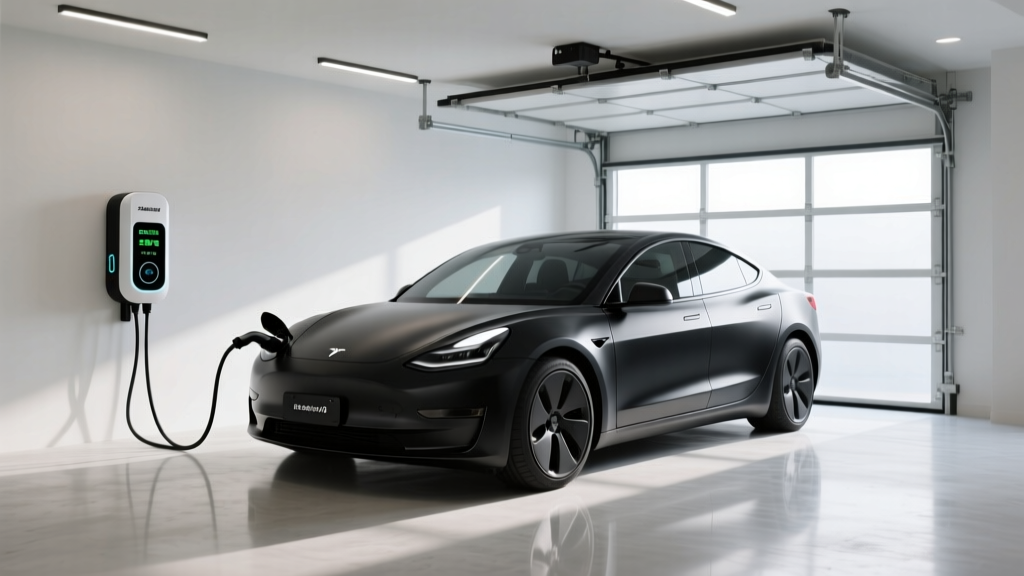
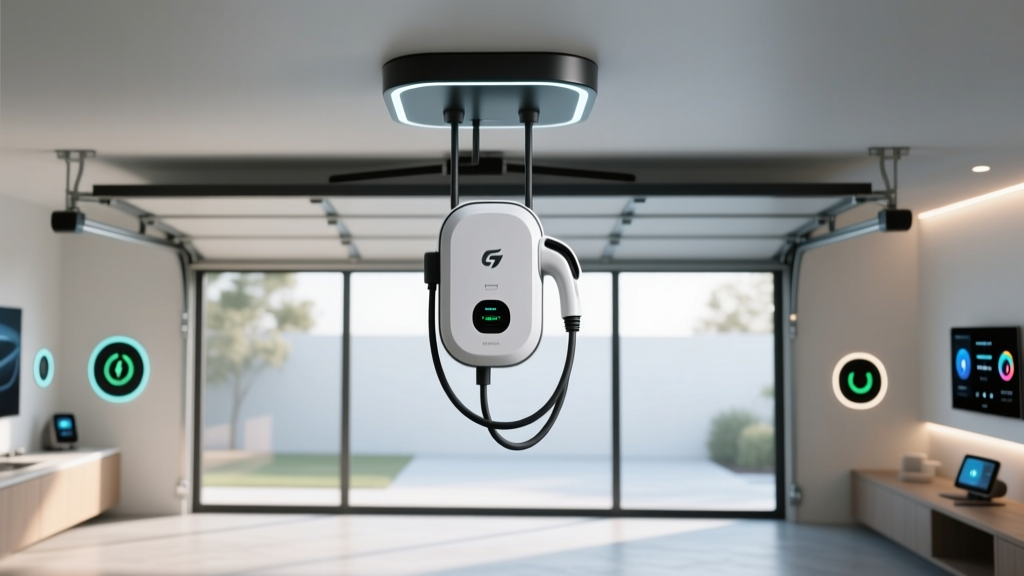
Most home EV charging setups involve a wall-mounted unit near where the car parks. But garages with tight floor plans, shared walls, multiple vehicles, or finished drywall where running conduit is impractical present a different challenge. A ceiling mounted EV charger solves these problems by routing the charging cable from above, keeping the garage floor completely clear and allowing a single unit to serve two adjacent parking spots.
Overhead mounting is particularly popular in two-car garages where one charger on a centered ceiling joist can reach either vehicle, in garages with finished walls where retrofitting a 240V wall outlet would require extensive drywall work, and in commercial fleet depots where floor space is at a premium. The electrical and safety requirements are largely the same as wall-mounted Level 2 chargers — the difference is physical routing, cable management, and structural mounting.
This guide covers the electrical fundamentals, real installation costs, equipment picks, connector compatibility, and per-mile charging economics you need before committing to an overhead setup.
Charging Levels Explained: kW Speeds and Miles Added Per Hour
Before selecting any charger, you need to understand the three charging tiers available to EV owners. The critical distinction: kW (kilowatts) measures power — the rate at which energy flows into your battery. kWh (kilowatt-hours) measures energy — the total capacity of your battery. Think of kW as how fast water flows from a hose, and kWh as the size of the bucket you're filling.
| Level | Voltage | Power (kW) | Miles of Range Added Per Hour | Typical Use Case |
|---|---|---|---|---|
| Level 1 | 120V AC | 1.0–1.4 kW | 3–5 mi/hr | Emergency / overnight trickle (PHEVs) |
| Level 2 | 240V AC | 3.3–19.2 kW | 12–75 mi/hr | Home, workplace, destination charging |
| DC Fast Charge | 400–900V DC | 50–350 kW | 150–1,000+ mi/hr (peak) | Highway road trips, commercial fleets |
For home installations — including ceiling mounted setups — Level 2 is the standard. A 48-amp (11.5 kW) Level 2 charger on a 60-amp dedicated circuit will add roughly 35–45 miles of range per hour for a typical midsize EV like the Tesla Model Y or Hyundai Ioniq 5. That means an overnight session of 8 hours can replenish 280–360 miles, more than enough for any daily driving cycle.
DC fast charging is not available for residential installation. Those 150–350 kW chargers require three-phase commercial power and dedicated utility infrastructure — you'll find them along highways and at Electrify America, EVgo, and Tesla Supercharger stations.
Electrical Requirements for a Ceiling Mounted Level 2 Charger
A ceiling mounted EV charger draws the same current as a wall-mounted unit, so the electrical requirements are identical. The physical mounting changes the conduit routing and junction box placement, not the circuit specification.
Voltage, Amperage, and Circuit Sizing
Most residential Level 2 chargers operate on a 240-volt, single-phase circuit. The National Electrical Code (NEC) requires that continuous loads (defined as operating for 3+ hours, which EV charging always qualifies as) be limited to 80% of the circuit breaker rating. This means:
- 40-amp charger → requires a 50-amp breaker and 6 AWG copper wire
- 48-amp charger → requires a 60-amp breaker and 4 AWG copper wire
- 80-amp charger → requires a 100-amp breaker and 1 AWG copper wire (for high-power setups like the Tesla Wall Connector at max config)
Most homeowners choose 48-amp chargers on 60-amp circuits, balancing charge speed with electrical panel headroom.
Panel Capacity and Upgrade Reality
Before any installation, your electrician will calculate your panel's available capacity. A typical modern home has a 200-amp main panel. Adding a 60-amp EV circuit consumes a significant chunk — and if your panel is already loaded with HVAC, electric range, dryer, and water heater circuits, you may not have room.
If your panel lacks capacity, you have three options:
- Panel upgrade — replacing a 100A or 150A panel with a 200A or 400A service. Cost: $1,500–$4,500 depending on your utility and local requirements.
- Load management device — a smart panel-level system (like the Emporia Load Management or Span smart panel) that dynamically reduces charger amperage when other high-draw appliances are running. Cost: $300–$800 for the device plus installation.
- Lower-amperage charger — dropping to a 32-amp or 24-amp charger that fits within existing panel headroom. Slower charging, but avoids a panel upgrade entirely.
Conduit Routing for Ceiling Mounts
The unique electrical consideration for ceiling mounted EV chargers is conduit routing. Your electrician will typically run conduit from the panel up a wall to the ceiling, then across ceiling joists to the mounting point. In unfinished garages with exposed joists, this is straightforward. In finished garages with drywall ceilings, expect additional labor for cutting access points, running conduit through attic spaces, and patching — adding $300–$800 to the labor cost.
How Much Does It Cost to Install a Ceiling Mounted EV Charger?
Installation costs vary dramatically based on your home's electrical infrastructure. Here's a realistic breakdown for a ceiling mounted Level 2 charger in 2026:
| Component | Simple Install (Panel Nearby, Unfinished Garage) | Complex Install (Panel Far, Finished Ceiling, Upgrade Needed) |
|---|---|---|
| Level 2 Charger Equipment | $400–$700 | $500–$800 |
| Electrical Permit | $50–$200 | $100–$350 |
| Electrician Labor (2–4 hrs simple / 6–12 hrs complex) | $300–$700 | $900–$2,400 |
| Wire, Conduit, Junction Box, Mounting Hardware | $100–$300 | $300–$800 |
| Panel Upgrade (if needed) | $0 | $1,500–$4,500 |
| Drywall Repair / Patching (finished ceilings) | $0 | $200–$600 |
| Total | $850–$1,900 | $3,500–$9,450 |
The median cost for a straightforward ceiling mount in an unfinished two-car garage with a 200A panel and nearby breaker space is approximately $1,200–$2,200 all-in (equipment + labor + permit + materials). Homes needing panel upgrades or extensive finished-ceiling work should budget $4,000–$7,000.
Some utilities offer rebates of $200–$500 for Level 2 charger installations, and certain states provide additional incentives. Check with your local utility and the Alternative Fuels Data Center for current programs in your area.
Connector Compatibility: NACS, CCS1, and CHAdeMO
As of 2026, the North American EV market has largely standardized on the NACS (North American Charging Standard) connector, originally developed by Tesla and now adopted by Ford, GM, Hyundai/Kia, Rivian, Volvo, BMW, and most major automakers. CCS1 is being phased out on new vehicles, and CHAdeMO remains only on legacy Nissan Leaf and Mitsubishi models.
| Connector | Compatible Brands | Adapter Needed? |
|---|---|---|
| NACS (native) | Tesla (all), Ford (2025+), GM (2025+), Hyundai/Kia (2026+), Rivian (2025+), Volvo, BMW, Mercedes (2026+) | None — plug directly into NACS chargers and Tesla Superchargers |
| CCS1 (legacy) | Older Ford Mustang Mach-E (2021–2024), VW ID.4 (2021–2025), older BMW i4/iX, Hyundai Ioniq 5 (2022–2025) | CCS-to-NACS adapter ($100–$250) for use with NACS chargers |
| CHAdeMO | Nissan Leaf (all years), Mitsubishi Outlander PHEV (older) | Limited adapter options; CHAdeMO public stations declining |
For a ceiling mounted home charger in 2026: Buy a NACS-connector charger if your EV has a native NACS port (or will within the next few years). If you currently drive a CCS1 vehicle, you can either buy a CCS1 charger now or buy a NACS charger with a CCS-to-NACS adapter for future-proofing. Most new Level 2 chargers sold in 2026 ship with NACS connectors as standard.
Equipment Picks: Top Ceiling Mountable Level 2 Chargers
Not every Level 2 charger is well-suited to ceiling mounting. Key factors include cable length (you need enough reach from ceiling to charge port — typically 18–25 feet for overhead installs), cable management systems (retractors or reels to prevent the cable from dragging on the floor), and mounting bracket flexibility. Here are four strong options available in 2026:
ChargePoint Home Flex (NACS)
- Power Output: Up to 12 kW (50 amps) on a 60A circuit; configurable down to 16A for panel-limited homes
- Connector: NACS (2025+ models); CCS1 adapter available
- Cable Length: 23 feet — sufficient for most ceiling-to-vehicle runs
- Smart Features: Wi-Fi, app scheduling, utility demand-response integration, Alexa/Google Home, energy tracking
- Weight: 14 lbs (manageable for joist mounting)
- Price: ~$549 (charger only; mounting hardware sold separately)
- Ceiling Mount Notes: Requires a third-party ceiling bracket or custom joist mount plate. ChargePoint does not sell a dedicated ceiling kit, but the unit's compact form factor and bottom-exit cable make it workable with standard Unistrut or angle-iron brackets.
Tesla Wall Connector (Gen 4, NACS)
- Power Output: Up to 11.5 kW (48 amps) on a 60A circuit
- Connector: NACS native; J1772 adapter included for non-Tesla EVs
- Cable Length: 24 feet
- Smart Features: Wi-Fi, OTA firmware updates, Power-Share (two units sharing one circuit), Tesla app integration
- Weight: 12 lbs
- Price: ~$450
- Ceiling Mount Notes: The Wall Connector's slim profile and lightweight design make it one of the easiest units to mount overhead. Tesla's mounting plate allows orientation in multiple directions. A ceiling-mounted plate adapter from a third-party vendor (e.g., EVSE Adapters) simplifies joist attachment.
FLO Home X8 (NACS)
- Power Output: Up to 19.2 kW (80 amps) on a 100A circuit — the highest-output residential Level 2 charger widely available
- Connector: NACS (2025+ models)
- Cable Length: 25 feet — ideal for ceiling installations with higher clearance
- Smart Features: Wi-Fi, FLO app, load balancing, scheduled charging, utility program compatibility
- Weight: 18 lbs (heavier — requires solid joist anchoring with lag bolts)
- Price: ~$899
- Ceiling Mount Notes: The X8's 80-amp output is overkill for most EVs (the majority accept 11.5–19.2 kW onboard), but it future-proofs for high-capacity trucks like the Ford F-150 Lightning Extended Range or Rivian R1T Dual-Motor with larger packs. FLO offers a commercial-grade ceiling mount bracket for fleet applications that works in residential settings.
Emporia Vue Level 2 Charger (NACS)
- Power Output: Up to 11.5 kW (48 amps) on a 60A circuit; software-configurable down to 6A
- Connector: NACS
- Cable Length: 24 feet
- Smart Features: Integrated with Emporia Vue whole-home energy monitor, solar-aware charging, real-time cost tracking, demand-response
- Weight: 11 lbs (lightest in class)
- Price: ~$399 (best value in smart Level 2 chargers)
- Ceiling Mount Notes: Lightweight and compact. The Emporia ecosystem excels if you have solar panels — it can charge only when excess solar production is available, minimizing grid draw. No dedicated ceiling kit, but its light weight makes mounting to a single joist straightforward.
Charging Time Examples: What to Expect With Common EV Battery Sizes
Charge times depend on two factors: your charger's kW output and your vehicle's onboard charger capacity (the maximum AC power the car can accept). Here are real-world estimates for common EVs charging from 10% to 80% state of charge on a 48-amp (11.5 kW) ceiling mounted Level 2 charger:
| Vehicle | Battery (kWh usable) | Max AC Accept Rate | 10–80% Time |
|---|---|---|---|
| Tesla Model Y Long Range | 75 kWh | 11.5 kW | ~4.5 hours |
| Hyundai Ioniq 5 (Standard Range) | 58 kWh | 10.9 kW | ~3.5 hours |
| Ford F-150 Lightning Extended Range | 131 kWh | 19.2 kW | ~7.5 hours (on 48A); ~4.5 hours (on 80A charger) |
| Chevrolet Equinox EV | 85 kWh | 11.5 kW | ~5 hours |
| BMW i4 eDrive40 | 81 kWh | 11 kW | ~5 hours |
| Toyota bZ4X | 64 kWh | 7.2 kW | ~4.5 hours (limited by onboard charger) |
Note that the Toyota bZ4X is limited by its 7.2 kW onboard charger — even connected to an 11.5 kW charger, it will only draw 7.2 kW. Always check your vehicle's maximum AC charge acceptance rate before investing in a higher-amperage unit.
For overnight charging, even a 32-amp (7.7 kW) charger is sufficient for most drivers. If you drive 40 miles per day and charge for 8 hours at 7.7 kW, you'll add roughly 200 miles of range — far more than most daily commutes require.
Cost Per Mile: Home Charging vs. Public Charging vs. Gas
The financial advantage of home Level 2 charging is one of the strongest arguments for EV ownership. Here's how costs compare across scenarios, using a national average electricity rate and current gas prices:
| Scenario | Rate | Cost Per Mile (250 Wh/mi EV) | Annual Cost (12,000 mi/yr) |
|---|---|---|---|
| Home Level 2 — Off-Peak TOU Rate | $0.08/kWh | $0.020 | $240 |
| Home Level 2 — Standard Rate | $0.16/kWh | $0.040 | $480 |
| Home Level 2 — Peak TOU Rate | $0.30/kWh | $0.075 | $900 |
| Public Level 2 (ChargePoint, EVgo) | $0.35/kWh | $0.088 | $1,056 |
| DC Fast Charge (Electrify America) | $0.48/kWh | $0.120 | $1,440 |
| Tesla Supercharger (average) | $0.30/kWh | $0.075 | $900 |
| Gas Vehicle (28 MPG combined, $3.40/gal) | $3.40/gal | $0.121 | $1,457 |
The takeaway: home off-peak charging at $240 per year costs roughly one-sixth what a comparable gas vehicle spends on fuel. Even at standard residential rates, home EV charging is 65–70% cheaper per mile than gasoline. The economics only break down if you rely exclusively on DC fast charging at public rates — which is why a home Level 2 installation (ceiling mounted or otherwise) is the single most impactful investment an EV owner can make.
Most utilities offer Time-of-Use (TOU) plans that discount electricity during overnight hours (typically 10 PM – 6 AM). Pair a TOU plan with your charger's built-in scheduling feature to automatically charge during off-peak windows. According to fueleconomy.gov, the average EV achieves 3–4 miles per kWh, making electricity cost calculations straightforward.
Safety, Code Compliance, and Permitting
Ceiling mounted EV chargers must meet the same NEC Article 625 requirements as wall-mounted units, with a few additional considerations:
Dedicated Circuit and GFCI Protection
Your Level 2 charger must be on a dedicated circuit — it cannot share a breaker with any other outlet or appliance. NEC 2023 and later editions require GFCI (Ground Fault Circuit Interrupter) protection for all EV charging circuits, including 240V. Many modern Level 2 chargers have built-in GFCI protection; if yours does not, your electrician will install a GFCI breaker in the panel (adds $50–$120 to material cost).
Structural Mounting
A ceiling mounted charger and its cable management hardware exert a sustained load on ceiling joists. While most Level 2 units weigh only 11–18 lbs, the dynamic load of a heavy cable being pulled and released adds stress. Mount directly to structural joists using lag bolts — never to drywall anchors or furring strips. For heavier units (80A chargers at 18+ lbs with cable reels), use a Unistrut channel spanning two joists for load distribution.
Cable Management and Trip Hazards
Overhead installations should include a cable retraction system — either a spring-loaded reel or a bungee/pulley system — to keep the cable off the garage floor when not in use. A cable dragging across the floor is a trip hazard, can be damaged by vehicle tires, and may violate local building codes if it crosses a walkway. Commercial-grade retractors (like the CableOrganizer EV cable reel, ~$80–$150) are worth the investment for ceiling mounts.
Outdoor Rating and Garage Environment
If your garage is unheated or uninsulated, verify that your charger carries a NEMA 4 or IP65 rating for moisture and dust resistance. Most quality Level 2 chargers are rated for indoor/outdoor use, but condensation in unconditioned garages can be an issue in humid climates. Operating temperature range matters too — most units are rated from -22°F to 122°F (-30°C to 50°C), which covers all US residential environments.
Permit and Inspection
Virtually all jurisdictions require an electrical permit for a new 240V circuit. Your electrician typically pulls this permit, and a local inspector will visit after installation to verify code compliance. The inspection covers wire gauge, breaker sizing, grounding, GFCI protection, and mounting security. Permit fees range from $50 to $350 depending on your municipality. Skipping the permit risks voiding your homeowner's insurance coverage for any electrical fire originating from the circuit.
Frequently Asked Questions
Can any Level 2 charger be ceiling mounted?
Most can, provided you fabricate or purchase an appropriate mounting bracket. Chargers with bottom-exit cables and compact form factors (like the Tesla Wall Connector or Emporia Vue) are easiest. Avoid chargers with side-exit cables or integrated cable wraps designed for wall-only orientation. Always confirm the unit's weight and use structural joist mounting with lag bolts — never drywall anchors.
How fast will a 48-amp ceiling charger add range to my EV?
A 48-amp charger on a 240V circuit delivers 11.5 kW. For a typical EV consuming 250 Wh/mile (like the Model Y or Ioniq 5), that's approximately 46 miles of range per hour. An 8-hour overnight session adds roughly 368 miles — more than enough for virtually any daily driving pattern. Actual speed varies by vehicle efficiency; larger, less efficient vehicles like the F-150 Lightning (roughly 450 Wh/mile) will add closer to 25 miles per hour at the same 11.5 kW.
Do I need a panel upgrade for a ceiling mounted EV charger?
Not necessarily — it depends on your existing panel's available capacity. A 200-amp panel with gas appliances (gas range, gas dryer, gas water heater) usually has enough headroom for a 60-amp EV circuit. An all-electric home with a 100-amp or 150-amp panel likely needs an upgrade. Your electrician will perform a load calculation per NEC Article 220 to determine this. Budget $1,500–$4,500 if an upgrade is required.
Is a ceiling mounted charger safe in an earthquake zone?
In seismic zones (California, Pacific Northwest, Alaska), overhead-mounted equipment requires additional bracing. Use a Unistrut or angle-iron frame bolted to two or more joists, and add seismic bracing straps. Consult your local building department — some jurisdictions in high-seismic areas have specific fastening requirements for suspended equipment. The charger itself is not a significant hazard (12–18 lbs), but the mounting must resist lateral movement.
Can I use a ceiling mounted charger with solar panels?
Yes — and it's an excellent pairing. Smart chargers like the Emporia Vue or ChargePoint Home Flex can integrate with your solar inverter or home energy monitor to charge only when excess solar production is available, effectively giving you free fuel. This requires a compatible energy management system and does not change the physical installation requirements.
Will a ceiling mount void my charger's warranty?
Most manufacturers' warranties do not explicitly prohibit ceiling mounting, but some specify "wall mount only" in their installation manuals. Before mounting overhead, check the manufacturer's installation guide. If it specifies wall-only, contact the manufacturer's support team for written approval — otherwise a warranty claim could be denied. The Tesla Wall Connector and ChargePoint Home Flex installation guides do not restrict mounting orientation.