The North American Charging Standard (NACS) has won the connector war. As of 2026, virtually every major automaker — Ford, GM, Rivian, Hyundai, Kia, BMW, and others — ships new EVs with the NACS charge port. But millions of CCS1-equipped EVs are still on the road, and their owners need a clear path to the fastest-growing DC fast-charging network: Tesla Superchargers. If you're navigating the shift from CCS1 to NACS, this guide covers every adapter, compatibility edge case, charging speed delta, and home charger swap you'll need to know about.
Why the Industry Shifted from CCS1 to NACS
When Ford and GM announced in mid-2023 that they would adopt Tesla's charging connector for their North American EVs, the dominoes fell quickly. By early 2024, nearly every major OEM had committed to NACS. The reasons were practical: Tesla's Supercharger network had over 25,000 stalls in North America with industry-leading uptime (~97%), while the CCS1-based networks (Electrify America, EVgo, ChargePoint) struggled with reliability rates often below 80%.
For 2025 and 2026 model-year vehicles, NACS is now the native port on most new EVs. But if you own a 2021–2025 Hyundai Ioniq 5, Ford Mustang Mach-E (pre-2025), VW ID.4, Kia EV6, or any other CCS1-equipped model, you're not stranded. Adapter solutions exist, and they're getting better and cheaper.
Connector Compatibility: Which Plug Does Your EV Use?
Before buying an adapter, confirm your vehicle's native charge port. Here's the current landscape:
| Connector | Brands Using It (Native) | Adapter Needed for Superchargers? |
|---|---|---|
| NACS (Tesla) | Tesla (all), Ford (2025+), GM (2025+), Rivian (2025+), Hyundai (2026+), Kia (2026+), BMW, Mercedes, Lucid, Polestar (2025+), Volvo (2025+) | No — plug directly into Superchargers |
| CCS1 | Hyundai (2022–2025), Kia (2022–2025), VW, Ford (2021–2024), GM (2022–2024), BMW (pre-2025), Rivian (pre-2025) | Yes — CCS1-to-NACS adapter required |
| CHAdeMO | Nissan Leaf (all years), Mitsubishi Outlander PHEV (older) | Yes — CHAdeMO-to-NACS adapter (limited availability, high cost) |
Key distinction: CCS1 and NACS are physically incompatible — you cannot plug a CCS1 cable into a NACS port or vice versa without an adapter. CHAdeMO is an entirely different standard used primarily by the Nissan Leaf and requires its own adapter ecosystem.
CCS1 to NACS Adapters: What's Available and What They Cost
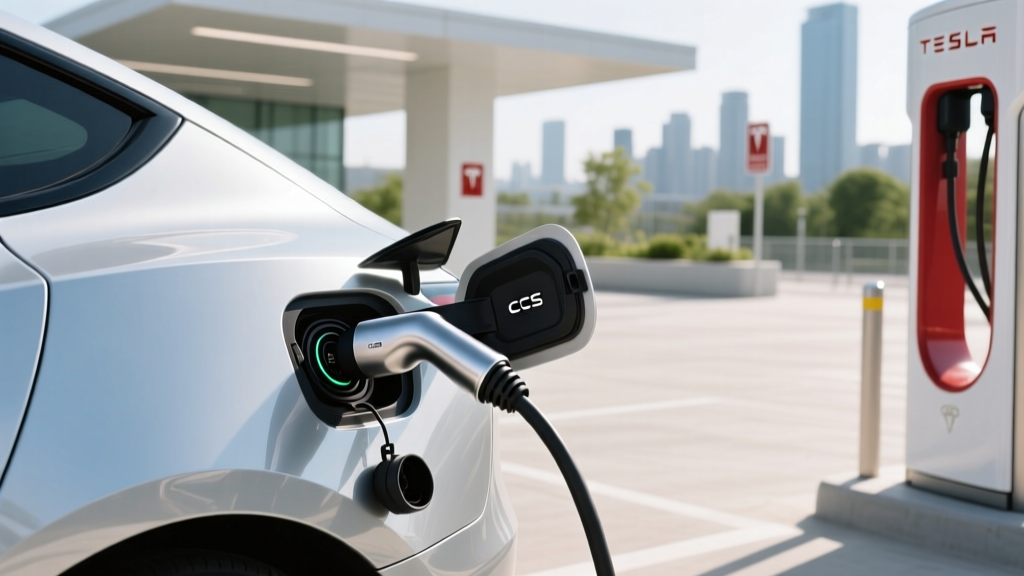
Several CCS1-to-NACS adapters have hit the market since 2024. Here are the proven options as of 2026:
Tesla CCS Adapter (Official)
Price: ~$175 (sold via Tesla Shop)
Direction: Lets a CCS1-equipped vehicle plug into a CCS1 cable at non-Tesla stations — but does NOT let a CCS1 car use a NACS Supercharger.
Max rate: 250 kW DC
Note: This adapter is designed for Tesla vehicles to use CCS1 stations, not the reverse. Many buyers confuse this.
Lectron Vortex / A2Z Typhoon (CCS1 Vehicle → NACS Charger)
Price: $199–$299
Direction: Allows a CCS1-equipped EV to plug into a NACS (Tesla Supercharger) cable.
Max rate: 150–250 kW DC (varies by model)
Note: Third-party adapters. Check UL/ETL certification. Lectron's Vortex adapter supports up to 250 kW and has been widely tested with Hyundai/Kia/Ford vehicles.
OEM-Supplied Adapters (Ford, GM, Rivian, Hyundai)
Price: Often free or discounted for existing owners during transition period
Direction: CCS1 vehicle → NACS Supercharger
Max rate: 150–250 kW DC
Note: Ford provided free adapters to Mach-E and F-150 Lightning owners. GM offered them for Bolt EUV and Cadillac Lyriq owners. Check your brand's owner portal — some programs have ended or have limited stock.
Not all NACS Superchargers will authenticate a non-Tesla vehicle, even with an adapter. Tesla opened select Supercharger locations to non-Tesla EVs through the "Charge Your EV" pilot, but as of 2026, only a subset of Supercharger stalls (typically marked in the Tesla app) support non-Tesla vehicles. Plan routes using the Tesla app or PlugShare, filtering for "Open to non-Tesla EVs."
Charging Levels Explained: Speeds, kW, and Miles Per Hour
Understanding charging speed requires separating kW (kilowatts) — the rate of power delivery — from kWh (kilowatt-hours) — the total energy stored in your battery. Think of kW as the flow rate of a hose, and kWh as the size of the bucket.
| Level | Voltage | Power (kW) | Miles of Range Added Per Hour | Typical Use Case |
|---|---|---|---|---|
| Level 1 | 120V AC | 1.0–1.4 kW | 3–5 miles/hr | Emergency/overnight trickle; PHEVs with small batteries |
| Level 2 | 240V AC | 3.3–19.2 kW | 12–75 miles/hr | Home charging, workplace, shopping centers |
| DC Fast Charging | 400–800V DC | 50–350 kW | 150–1,000+ miles/hr (peak) | Road trips, highway corridors, 10–80% top-ups |
Real-world DC fast charging context: A 2025 Hyundai Ioniq 5 (84 kWh battery, 800V architecture) can accept up to 240 kW at a 350 kW charger, adding 10–80% in approximately 18 minutes. A 2024 VW ID.4 (82 kWh, 400V architecture) peaks at about 170 kW, taking roughly 28 minutes for 10–80%. Peak kW is not sustained — charge curves taper significantly above 80% State of Charge (SoC) to protect battery health.
Home Charger Installation: Electrical Requirements and Costs
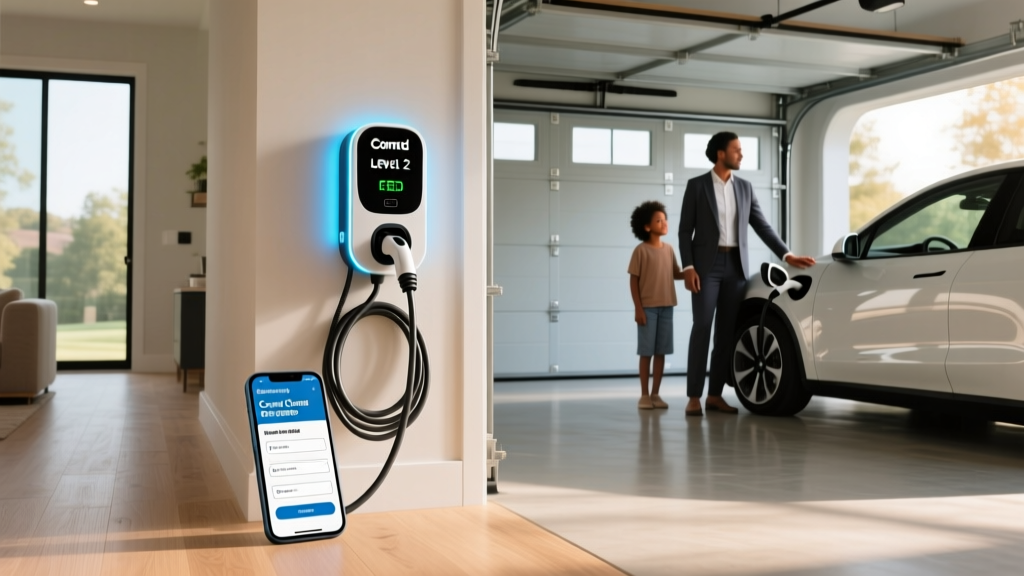
Switching to a NACS-compatible home charger (or keeping your CCS1 Level 2 unit) involves electrical considerations that go beyond the charger itself. Here's what a proper installation requires:
Electrical Requirements
- Circuit: A dedicated 240V circuit — typically 40A, 50A, or 60A depending on charger amperage
- Breaker sizing: EV chargers are "continuous loads" per NEC Article 625, meaning the circuit must be rated at 125% of the charger's max draw. A 40A charger requires a 50A breaker; a 48A charger requires a 60A breaker
- Wire gauge: 6 AWG copper for 50A circuits; 4 AWG for 60A (varies by run length and local code)
- Panel capacity: Your main service panel must have sufficient spare amperage. A 200A panel with significant existing loads may need a load calculation or upgrade to 400A
- GFCI protection: NEC 2020+ requires GFCI protection for EV charging outlets in garages — some hardwired chargers have built-in GFCI, while plug-in units via NEMA 14-50 outlets need a GFCI breaker (~$50–$80 extra)
| Component | Low-End | High-End | Notes |
|---|---|---|---|
| Level 2 Charger (hardware) | $350 | $750 | Varies by power output and smart features |
| Electrician labor | $500 | $2,000 | Depends on panel proximity and conduit run length |
| Electrical permit | $50 | $250 | Required in most jurisdictions |
| Panel upgrade (if needed) | $1,500 | $4,500 | 200A → 400A service upgrade for older homes |
| GFCI breaker (if plug-in) | $50 | $80 | Required for NEMA 14-50 outlets per NEC |
| Total (no panel upgrade) | $950 | $3,080 | Most homes with 200A service fall in $1,200–$2,000 |
| Total (with panel upgrade) | $2,450 | $7,580 | Common in homes built before 2000 with 100A–150A service |
Home Charger Equipment Picks: NACS vs. Universal Options
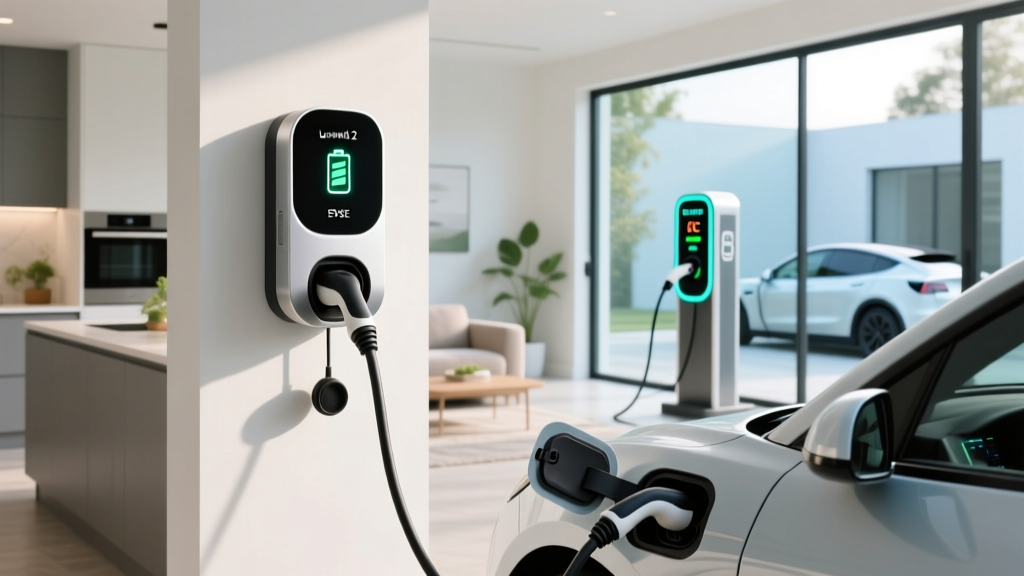
If you're buying a new home Level 2 charger in the NACS era, you have two paths: buy a native NACS charger (which won't work with a CCS1 vehicle without a NACS-to-CCS1 adapter — the reverse direction) or buy a universal charger with interchangeable pigtails.
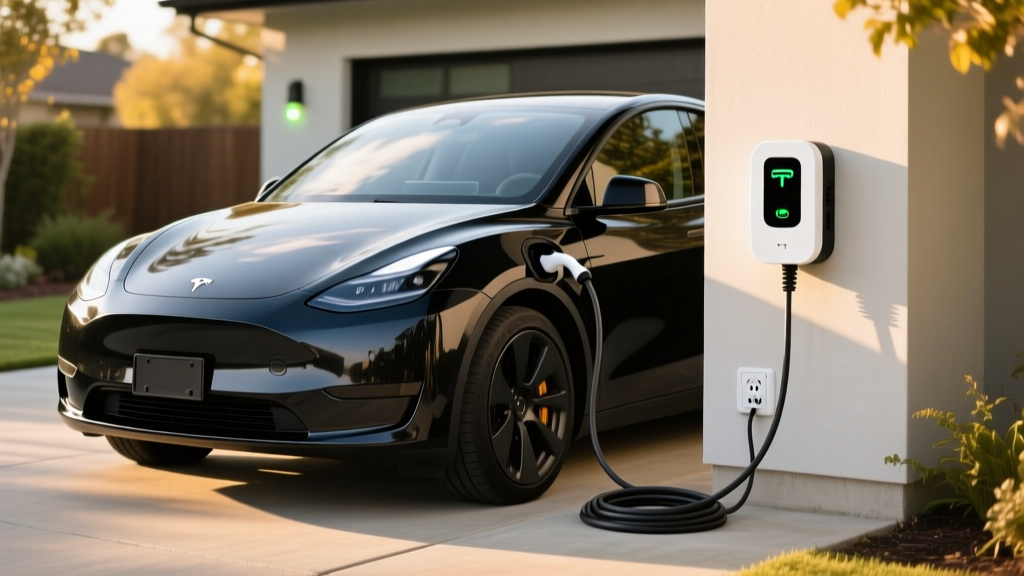
Tesla Wall Connector (NACS native)
Max output: 11.5 kW (48A on a 60A circuit)
Connector: NACS
Cable length: 24 ft
Smart features: Wi-Fi, OTA updates, power sharing with second unit, load management
Price: ~$450
Best for: NACS-native EVs (Tesla, 2025+ Ford/GM/Rivian). CCS1 vehicles need a NACS-to-CCS1 adapter (~$150–$250) to use this unit.
ChargePoint Home Flex
Max output: 12 kW (50A, configurable down to 16A)
Connector: J1772 (standard) — works with all EVs via adapter; NACS vehicles use the included NACS-to-J1772 adapter or Tesla's J1772 adapter
Cable length: 23 ft
Smart features: Wi-Fi, ChargePoint app scheduling, Alexa integration
Price: ~$550–$650
Best for: Mixed-EV households (one CCS1 car, one NACS car). The universal J1772 plug plus adapters covers everything.
Emporia Level 2 EV Charger
Max output: 11.5 kW (48A)
Connector: J1772 (standard)
Cable length: 24 ft
Smart features: Wi-Fi, real-time energy monitoring via Emporia app, solar integration, load management
Price: ~$350–$400
Best for: Budget-conscious buyers who want energy monitoring. Great value with solid app support.
Grizzl-E Smart (United Chargers)
Max output: 10 kW (40A)
Connector: J1772 or NACS (configurable at purchase)
Cable length: 24 ft
Smart features: OCPP-compatible, adjustable amperage (16A–40A), built in Canada for extreme cold
Price: ~$450–$550
Best for: Cold-climate owners who need rugged, outdoor-rated hardware. IP67 rated.
Charging Cost Per Mile: Home vs. Public vs. Gas
The economics of EV charging depend heavily on where you plug in. Home charging on a time-of-use (TOU) plan is dramatically cheaper than DC fast charging on the road.
| Scenario | Cost per kWh | Vehicle Efficiency | Cost Per Mile |
|---|---|---|---|
| Home Level 2 (off-peak TOU rate) | $0.08–$0.12/kWh | 3.0 mi/kWh (105 MPGe avg) | $0.027–$0.040 |
| Home Level 2 (standard rate) | $0.14–$0.18/kWh | 3.0 mi/kWh | $0.047–$0.060 |
| Public Level 2 (ChargePoint, etc.) | $0.20–$0.35/kWh | 3.0 mi/kWh | $0.067–$0.117 |
| DC Fast Charging (Electrify America) | $0.35–$0.55/kWh | 3.0 mi/kWh | $0.117–$0.183 |
| Tesla Supercharger (member rate) | $0.25–$0.40/kWh | 3.0 mi/kWh | $0.083–$0.133 |
| Gasoline (28 MPG avg, $3.40/gal) | — | 28 MPG | $0.121 |
The takeaway: Home off-peak charging delivers fuel costs roughly 70–75% lower than a comparable gas car. Even DC fast charging on road trips is competitive with gasoline, especially with subscription plans (EA's Pass+ at $7/month for reduced rates, Tesla's membership pricing). The cost advantage of EVs shrinks significantly if you rely exclusively on public DC fast charging — making home charger installation a priority for long-term savings.
Real-World Charging Times: 10–80% for Common Battery Sizes
Charging time depends on three variables: battery size (kWh), the vehicle's maximum charge acceptance rate (kW), and the charger's output. Here are real-world estimates for popular EVs using DC fast charging:
- 2026 Hyundai Ioniq 5 (84 kWh, NMC, 800V): 10–80% in ~18 min at a 350 kW charger (peaks at 240 kW, tapers above 80%)
- 2025 Tesla Model Y Long Range (75 kWh, LFP/NMC, 400V): 10–80% in ~25 min at a 250 kW Supercharger (peaks at ~200 kW)
- 2025 Ford F-150 Lightning Extended Range (131 kWh, NMC, 400V): 10–80% in ~41 min at a 150 kW charger (peaks at ~130 kW due to large battery)
- 2026 Chevrolet Equinox EV (85 kWh, NMC, 400V): 10–80% in ~30 min at a 150 kW charger (peaks at ~150 kW)
- 2025 Nissan Leaf (62 kWh, NMC, CHAdeMO): 10–80% in ~45 min at a 50 kW CHAdeMO charger (peaks at ~50 kW, air-cooled battery limits sustained rate)
Safety, Code, and Installation Best Practices
EV charging involves sustained high-amperage electrical loads — far more demanding than a dryer or oven. Cutting corners here is a fire risk.
Non-Negotiable Safety Requirements
- Dedicated circuit: Your EV charger must be on its own dedicated breaker — never share a circuit with other appliances
- Licensed electrician: Always use a licensed, insured electrician. DIY 240V work is dangerous and may void insurance coverage in the event of a fire
- Permit and inspection: Most municipalities require an electrical permit and post-installation inspection. This protects you legally and ensures code compliance
- Outdoor rating: If installing outdoors, the charger must be rated for outdoor use (IP55 minimum, IP67 preferred). The Tesla Wall Connector and Grizzl-E are outdoor-rated; verify before purchasing
- NEMA 14-50 vs. hardwired: A NEMA 14-50 outlet offers portability (take the charger when you move) but requires a GFCI breaker per NEC 2020+. Hardwired installations eliminate the GFCI requirement and reduce points of failure — preferred for permanent installations
- Load management: If your panel is near capacity, consider a charger with built-in load management (e.g., Tesla Power Sharing, Emporia load balancing) that dynamically adjusts charge rate based on household demand
Frequently Asked Questions
How much does it cost to install a home EV charger?
A typical Level 2 home charger installation costs between $1,200 and $2,000 when no panel upgrade is needed. This includes the charger ($350–$750), electrician labor ($500–$2,000), and permit fees ($50–$250). If your home's electrical panel needs an upgrade from 100A or 150A to 200A+, add $1,500–$4,500. The IRS Alternative Fuel Vehicle Refueling Property Credit can offset up to 30% of costs (max $1,000).
How fast will each charging level add range?
Level 1 (120V) adds 3–5 miles per hour — suitable only for PHEVs or emergency top-ups. Level 2 (240V) adds 12–75 miles per hour depending on amperage and vehicle acceptance rate — this is the primary home charging method. DC fast charging adds 150–1,000+ miles per hour at peak rates, making 10–80% top-ups possible in 18–45 minutes depending on the vehicle.
Which connector and charger is compatible with my EV?
Check your vehicle's charge port: NACS vehicles (Tesla, 2025+ Ford/GM/Rivian/Hyundai) plug directly into Superchargers and NACS home chargers. CCS1 vehicles (2022–2025 Hyundai, Kia, VW, older Ford/GM) need a CCS1-to-NACS adapter ($200–$300) for Superchargers. For home Level 2, a J1772 charger with adapters covers all vehicles. CHAdeMO vehicles (Nissan Leaf) require specific CHAdeMO adapters.
How much does charging cost per mile compared to gas?
Home off-peak charging costs roughly $0.03–$0.04 per mile — about 70% less than gasoline at $3.40/gallon in a 28 MPG vehicle ($0.12/mile). Public DC fast charging costs $0.08–$0.18 per mile, still competitive with gas. The savings advantage of EV ownership is maximized with consistent home charging.
What electrical upgrades might I need for a home charger?
The most common upgrade is a panel capacity increase. Homes built before 2000 often have 100A or 150A service, which may not support a 40A–50A EV circuit alongside existing loads (HVAC, electric range, dryer). A licensed electrician will perform a load calculation per NEC Article 220. If an upgrade to 200A or 400A is needed, expect $1,500–$4,500. Some utilities offer rebates for panel upgrades tied to EV adoption — check with your local provider.
Can I use a CCS1-to-NACS adapter at every Tesla Supercharger?
Not yet. As of 2026, Tesla has opened select Supercharger stalls to non-Tesla EVs, but coverage is not universal. Use the Tesla app or PlugShare to verify which specific stalls support non-Tesla vehicles. The number of open stalls is growing, and universal access is expected as OEM transition agreements mature. Some adapters also require the vehicle to be registered in the Tesla app for payment authentication.
Will using an adapter reduce my charging speed?
High-quality CCS1-to-NACS adapters rated for 250 kW introduce negligible speed loss — typically 1–3% due to additional connection resistance. However, cheaper or uncertified adapters may not support the full amperage, throttling your charge rate. Always buy adapters with UL or ETL certification and verify the rated maximum kW matches your vehicle's charge acceptance capability.