What Is a CCS Charger and Why Does It Matter?
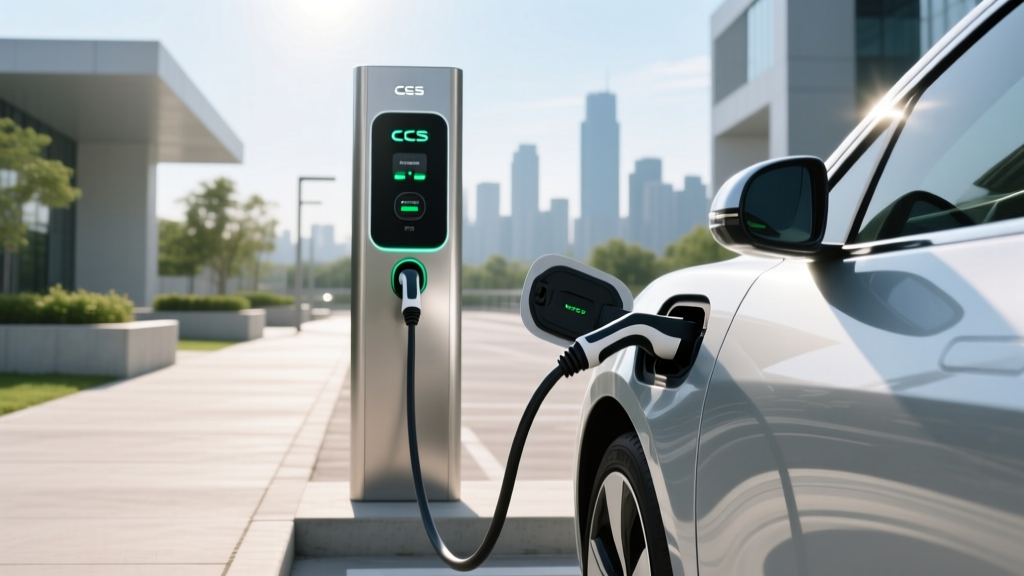
CCS — Combined Charging System — is the dominant DC fast-charging connector standard for non-Tesla electric vehicles in North America. Officially known as CCS1 (or CCS Combo 1), it combines the standard J1772 AC charging pins with two additional DC pins below, enabling a single port on your vehicle to handle both slow overnight AC charging and rapid DC fast charging at public stations.
If you own a Hyundai Ioniq 5, Ford Mustang Mach-E, Volkswagen ID.4, BMW iX, or virtually any non-Tesla EV sold in the US between 2018 and 2025, your vehicle has a CCS1 port. Understanding how CCS chargers work — at home and on the road — is essential to maximizing your EV ownership experience and avoiding costly surprises at installation time.
One critical distinction to internalize before going further: kW (kilowatts) measures power — the rate at which electricity flows into your battery. kWh (kilowatt-hours) measures energy — the total capacity stored in your battery. A 77 kWh battery charged at 150 kW fills faster than one charged at 50 kW. Never confuse these units; they are not interchangeable.
Charging Levels Explained: Speed, Power, and Range Added Per Hour
EV charging is categorized into three levels. Here is how each translates to real-world charging speed:
| Level | Voltage / Amps | Power (kW) | Miles of Range Added Per Hour | Typical Use Case |
|---|---|---|---|---|
| Level 1 | 120V / 12A | 1.4 kW | 3–5 mi/hr | Overnight trickle, PHEVs, emergencies |
| Level 2 (Home/Public AC) | 240V / 32–48A | 7.7–11.5 kW | 25–44 mi/hr | Daily home charging, workplace, retail |
| DC Fast Charging (CCS) | 400–800V DC | 50–350 kW | 150–1,200+ mi/hr (peak) | Road trips, highway corridor charging |
For daily driving, Level 2 is the workhorse. A 48-amp Level 2 charger delivers up to 11.5 kW, which adds roughly 40–44 miles of range per hour for an efficient EV like the Hyundai Ioniq 6 (EPA 361 mi, ~3.8 mi/kWh). That means a full overnight charge easily covers any daily commute.
DC fast charging via CCS is for road trips. A 350 kW Electrify America or EVgo station can add 150+ miles of range in roughly 15 minutes — but only if your vehicle supports that peak rate and the battery is preconditioned and at a low state of charge (SoC). Charging speed tapers significantly above 80% SoC, which is why most road-trip charging strategies target the 10–80% window.
Which Connector and CCS Charger Is Compatible with My EV?
The connector landscape has shifted dramatically. Here is the current compatibility picture for 2025–2026 model-year EVs:
| Connector | Brands Using It (Factory Port) | Notes |
|---|---|---|
| NACS (Tesla / SAE J3400) | Tesla (all), Ford (2025+), GM (2025+), Rivian (2025+), Volvo/Polestar (2025+), Hyundai/Kia (2026+) | Now the dominant North American standard; native Tesla Supercharger access |
| CCS1 (Combo 1) | VW, BMW, Mercedes, Stellantis, Honda, Toyota (bZ4X), pre-2025 Ford/GM/Hyundai/Kia/Rivian | Still widely deployed on public DC networks; adapters available for NACS stations |
| CHAdeMO | Nissan Leaf (all years), Mitsubishi Outlander PHEV | Legacy standard; being phased out at most networks |
If your EV has a CCS1 port and you want to charge at a Tesla Supercharger (which now uses NACS/J3400), you will need a CCS-to-NACS adapter. Tesla sells one for approximately $250, and third-party options from brands like Lectron and A2Z are available for $150–$200. Conversely, if you own a newer NACS-equipped vehicle and encounter a CCS-only public station, you will need a NACS-to-CCS adapter.
For home Level 2 charging, all EVs use the J1772 connector (or NACS, which integrates J1772 signaling). Tesla Wall Connectors now ship with NACS, so CCS-ported vehicles will need a NACS-to-J1772 adapter for home use with a Tesla charger — or simply choose a J1772-native charger like the ChargePoint Home Flex or Emporia Vue.
Home EV Charger Installation: Electrical Requirements, Costs, and Panel Upgrades
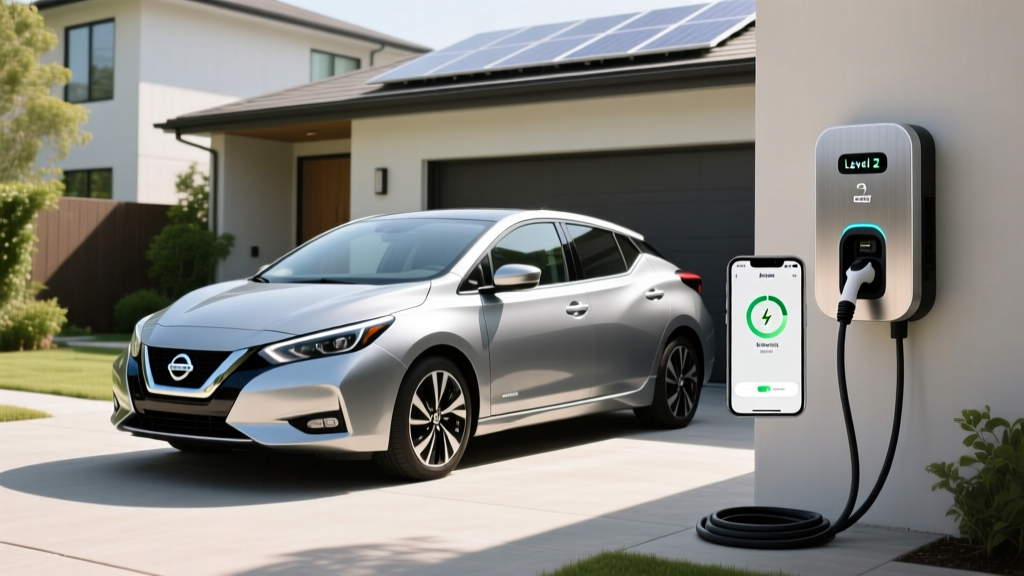
Installing a dedicated Level 2 home charger is the single highest-impact upgrade for EV ownership. Here is what the installation involves and what it costs.
Electrical Requirements
A typical Level 2 home charger requires:
- 240V dedicated circuit (like an electric dryer or oven)
- 40-amp or 60-amp breaker — a 48A charger requires a 60A breaker (NEC code mandates the circuit be rated at 125% of the continuous load)
- NEMA 14-50 outlet (for plug-in chargers) or hardwired connection (for permanent installations — often preferred for 48A+ chargers and may be required by local code)
- GFCI protection — required by NEC 2020 and later for EV outlets in garages; some chargers have built-in GFCI, but your breaker may also need to be GFCI-type
Panel Upgrade: The Hidden Cost
Many older homes have 100-amp electrical panels that lack capacity for a 60-amp EV circuit. A panel upgrade to 200 amps typically costs $1,500–$3,000 before permits. Some utility companies offer rebates that offset this cost. If your home already has a 200A panel with spare breaker slots, you likely will not need an upgrade.
A licensed electrician can perform a load calculation to determine whether your existing panel can handle the additional circuit. Do not skip this step — overloading a panel is a fire hazard and will fail inspection.
Installation Cost Breakdown
| Item | Typical Cost Range |
|---|---|
| Level 2 charger equipment (40A–48A) | $350–$700 |
| Electrician labor (2–4 hours, standard install) | $500–$1,500 |
| Electrical permit | $50–$200 |
| Panel upgrade (if needed: 100A → 200A) | $1,500–$3,000 |
| Conduit, wiring, and misc. materials | $100–$400 |
| Total (no panel upgrade) | $1,000–$2,800 |
| Total (with panel upgrade) | $2,500–$5,800 |
According to the U.S. Department of Energy, the national average for a standard Level 2 home installation is approximately $1,200–$2,000 when no panel upgrade is required. Costs increase significantly for long wire runs (e.g., a detached garage 100+ feet from the panel).
Charging Cost Per Mile: CCS Fast Charging vs. Home Level 2 vs. Gas
One of the strongest arguments for EV ownership is lower per-mile fuel cost — but the savings depend heavily on where you charge. Here is a realistic cost comparison for a midsize EV averaging 3.5 miles per kWh (e.g., Hyundai Ioniq 5, Tesla Model Y):
| Charging Scenario | Cost per kWh | Cost per Mile | Annual Cost (12,000 mi) |
|---|---|---|---|
| Home Level 2 (off-peak utility rate) | $0.08–$0.14 | $0.023–$0.040 | $275–$480 |
| Home Level 2 (standard residential rate) | $0.15–$0.22 | $0.043–$0.063 | $515–$755 |
| Public Level 2 (ChargePoint, etc.) | $0.25–$0.49 | $0.071–$0.140 | $855–$1,680 |
| DC Fast Charging (CCS, Electrify America/EVgo) | $0.35–$0.56 | $0.100–$0.160 | $1,200–$1,920 |
| Gasoline (30 MPG combined, $3.40/gal) | — | $0.113 | $1,360 |
Key takeaway: Home charging on off-peak rates is 3–5x cheaper per mile than gasoline. Even standard residential rates save 40–60% over gas. However, exclusive reliance on public DC fast charging can cost as much as — or more than — gasoline. This is why home Level 2 access is the single most important factor in EV economics.
How Fast Will a CCS Charger Fill Your Battery? Real-World Charge Times
DC fast charging speed depends on three variables: the station's maximum power output, your vehicle's maximum charge acceptance rate, and the battery's state of charge (SoC) and temperature. Here are representative 10–80% charge times for common EVs at a CCS DC fast charger:
| Vehicle (Model Year) | Battery (kWh usable) | Peak DC Charge Rate (kW) | 10–80% Time (min) |
|---|---|---|---|
| Hyundai Ioniq 5 (2025) | 77.4 (NMC) | 240 kW (800V architecture) | ~18 min |
| Volkswagen ID.4 (2025) | 77.0 (NMC) | 170 kW | ~28 min |
| Ford Mustang Mach-E Extended Range (2025) | 88.0 (NMC) | 150 kW | ~36 min |
| BMW iX xDrive50 (2025) | 105.2 (NMC) | 200 kW | ~31 min |
| Chevrolet Equinox EV (2025) | 85.0 (NMC) | 150 kW | ~34 min |
Real-world caveat: These times assume a preconditioned battery (preheated to optimal temperature), a station capable of delivering the vehicle's peak rate, and starting at 10% SoC. In cold weather (below 32°F / 0°C), an un-preconditioned battery may accept only 30–50% of its peak rate until it warms up, adding 10–15 minutes to a session. Always precondition your battery before a fast-charging stop if your vehicle supports it.
Additionally, peak kW is not sustained kW. A vehicle rated at 240 kW peak will typically sustain that rate only between roughly 10–45% SoC, then taper progressively. The 10–80% time is a more honest metric than peak kW alone.
Recommended CCS-Compatible Home Chargers (2025–2026)
These Level 2 home chargers are compatible with all CCS-ported vehicles via the standard J1772 connector. Each is UL-listed or ETL-listed for safety.
ChargePoint Home Flex (J1772)
- Power output: Up to 50A (12 kW) — adjustable via DIP switch or app to match your circuit (24A–50A)
- Connector: J1772 (fits all CCS-ported EVs natively)
- Cable length: 23 feet
- Smart features: Wi-Fi, scheduling, energy tracking, Alexa integration
- Installation: NEMA 14-50 plug or hardwired
- Price: ~$550–$650 (equipment only)
- Best for: Flexibility — adjustable amperage means it works on 30A to 60A circuits
Emporia Vue Level 2 EV Charger
- Power output: Up to 48A (11.5 kW)
- Connector: J1772
- Cable length: 24 feet
- Smart features: Wi-Fi, load management (pairs with Emporia energy monitor to avoid panel overload), solar integration, scheduling
- Installation: Hardwired or NEMA 14-50
- Price: ~$350–$400
- Best for: Budget-conscious buyers and solar-optimized homes
Grizzl-E Smart (United Chargers)
- Power output: Up to 40A (9.6 kW)
- Connector: J1772
- Cable length: 24 feet
- Smart features: Wi-Fi, OCPP protocol support, scheduling, usage logs
- Installation: NEMA 14-50 or hardwired; NEMA 4 outdoor-rated enclosure
- Price: ~$450–$550
- Best for: Outdoor installations and extreme climates (rated to -40°F)
Tesla Wall Connector (J1772 version)
- Power output: Up to 48A (11.5 kW)
- Connector: Now available in J1772 (in addition to NACS) — fits CCS-ported EVs
- Cable length: 24 feet
- Smart features: Wi-Fi, OTA updates, power sharing (link multiple units on one circuit)
- Installation: Hardwired only
- Price: ~$475
- Best for: Multi-EV households (power sharing) and Tesla + non-Tesla mixed garages
Safety, Code, and Inspection: What You Must Know Before Installing
EV charger installation is not a DIY project. The National Electrical Code (NEC) and most local jurisdictions require:
- Dedicated circuit: Your EV charger must be on its own breaker — not shared with other appliances.
- GFCI protection: NEC 625.54 (2020 edition and later) requires ground-fault circuit-interrupter protection for EV charging outlets in garages. Some modern chargers have internal GFCI, which may satisfy the requirement, but verify with your inspector.
- Permit and inspection: Most municipalities require an electrical permit ($50–$200) and a post-installation inspection. Skipping this can void your homeowner's insurance coverage in the event of a fire.
- Outdoor rating: If installing outside, the charger must be rated NEMA 4 (or higher) for weather resistance. Indoor-only units in outdoor enclosures are a code violation.
- Wire gauge: A 60A circuit requires 6 AWG copper wire (or 4 AWG aluminum). Undersized wire is a fire risk. Your electrician will size wire based on run length and ampacity requirements.
Always hire a licensed electrician familiar with EV charger installations. The Department of Energy's home charging guide provides a useful checklist for evaluating contractor quotes.
The CCS-to-NACS Transition: What It Means for CCS Charger Owners
With Ford, GM, Rivian, Hyundai, Kia, and Volvo now adopting NACS (SAE J3400) for their 2025–2026 vehicles, the long-term trajectory favors NACS as the dominant North American connector. However, CCS1 infrastructure will remain widely available for years. The Electrify America network, EVgo, and ChargePoint all continue to deploy CCS-equipped stations alongside NACS.
If you currently own a CCS-ported EV:
- Your existing CCS chargers at home and public stations will continue to work.
- A CCS-to-NACS adapter ($150–$250) unlocks Tesla Supercharger access — over 25,000 stations in North America.
- When you eventually upgrade to a NACS-ported vehicle, your J1772 home charger will still work with a simple adapter.
The transition does not make CCS equipment obsolete — it simply adds adapter requirements for cross-network access.
Frequently Asked Questions About CCS Chargers
How much does it cost to install a home EV charger?
A standard Level 2 home charger installation costs $1,000–$2,800 including equipment, electrician labor, and permit. If your home requires a panel upgrade from 100A to 200A, add $1,500–$3,000. The total with a panel upgrade typically falls between $2,500 and $5,800.
How fast will each charging level add range?
Level 1 (120V) adds 3–5 miles of range per hour. Level 2 (240V, 40–48A) adds 25–44 miles per hour depending on vehicle efficiency. DC fast charging via CCS adds 150–1,200+ miles per hour at peak rates, though real-world sessions target 10–80% in 18–36 minutes.
Which connector and charger is compatible with my EV?
If your EV was built between 2018 and 2024 and is not a Tesla, it almost certainly has a CCS1 port. For home Level 2 charging, any J1772 charger will work natively. For DC fast charging, CCS1 stations work directly. To use Tesla Superchargers, you need a CCS-to-NACS adapter.
How much does charging cost per mile vs. gas?
Home Level 2 charging costs $0.03–$0.06 per mile for most EVs — roughly 50–70% less than gasoline at $3.40/gal in a 30 MPG vehicle ($0.11/mile). Public DC fast charging at $0.40–$0.56/kWh costs $0.11–$0.16 per mile, which is comparable to or slightly more than gasoline.
What electrical upgrades might I need?
You will need a dedicated 240V circuit with a 40A or 60A breaker. If your electrical panel is 100A and near capacity, a panel upgrade to 200A may be necessary. Your electrician will perform a load calculation to determine this. Long wire runs (over 50 feet) may also require heavier-gauge wire, increasing material costs.
Can I use a CCS charger with a NACS-equipped vehicle?
Yes, with a NACS-to-CCS adapter. As of 2025–2026, most automakers transitioning to NACS include or sell adapters for legacy CCS infrastructure. Check your vehicle manufacturer's accessory catalog for the approved adapter.