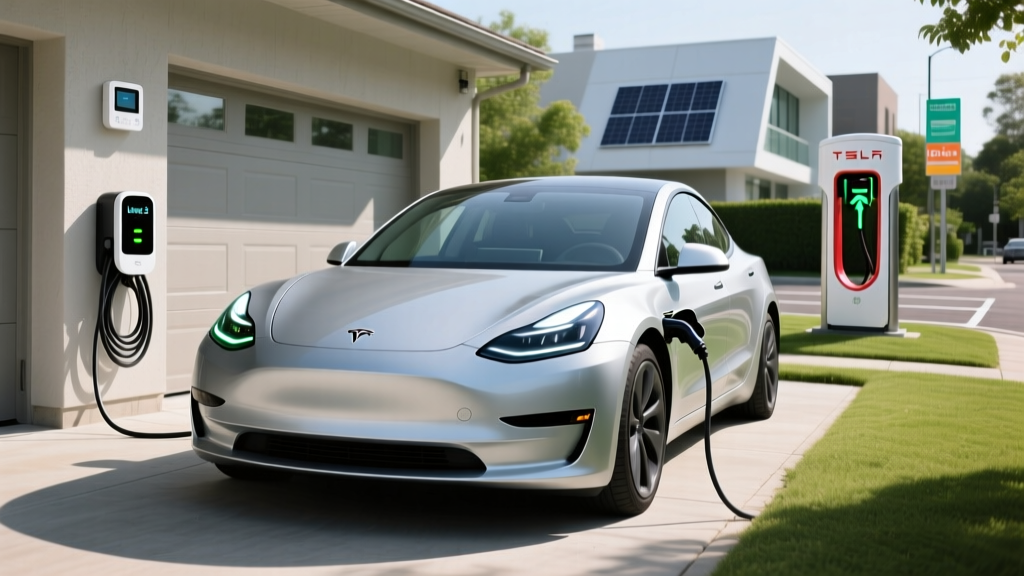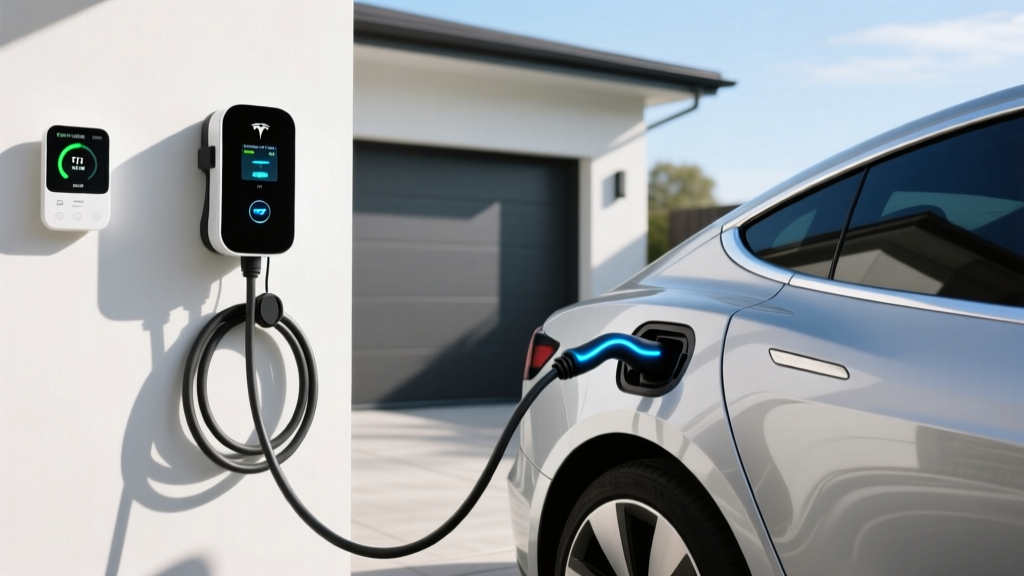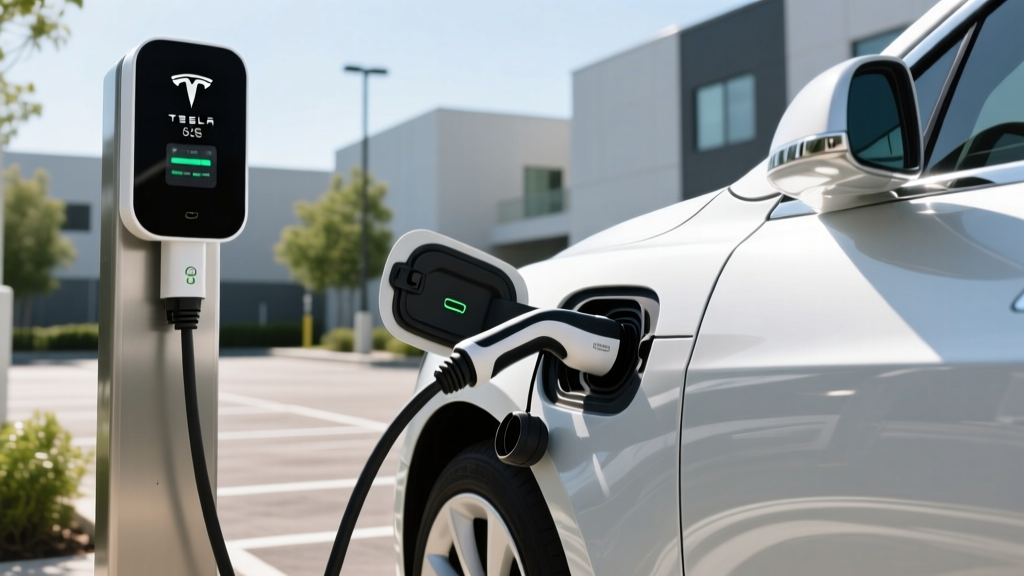
If you own a Tesla built before the 2025 NACS industry shift, or you're buying a used Model 3 or Model Y with the legacy Tesla connector, you'll inevitably encounter CCS1 (Combined Charging System) public chargers. Electrify America, EVgo, and dozens of regional networks still operate CCS1 stalls, and depending on your route, they might be the only fast-charging option available. A CCS charger adapter for Tesla bridges that gap — but not all adapters are equal, and compatibility depends heavily on your vehicle's model year and port hardware.
This guide walks through the connector landscape in 2026, breaks down exactly what each charging level delivers in kilowatts and miles per hour, covers home charger installation costs down to the permit fee, and helps you determine whether you need an adapter, a native cable swap, or nothing at all.
The Three Charging Levels: kW, Speed, and Real-World Expectations
The single most common EV confusion is mixing up kW (kilowatts — the rate of power delivery, like water pressure) with kWh (kilowatt-hours — the total energy stored or delivered, like gallons in a tank). A 48-amp Level 2 charger delivers 11.5 kW of power. A Tesla Model Y Long Range has a ~75 kWh usable battery. Those are fundamentally different measurements, and every charging time estimate below depends on keeping them straight.
| Level | Voltage | Typical Power (kW) | Miles of Range Added Per Hour | Best Use Case |
|---|---|---|---|---|
| Level 1 | 120V AC | 1.2–1.9 kW | 3–5 mi/hr | Overnight top-ups, PHEVs, emergency |
| Level 2 (Home/Public) | 240V AC | 7.2–19.2 kW | 20–60 mi/hr | Daily home charging, destination charging |
| DC Fast Charging | 400–800V DC | 50–350 kW | 150–800+ mi/hr (peak) | Road trips, rapid top-ups |
Real-world caveat: Those "miles per hour" figures assume peak delivery. DC fast charging follows a taper curve — a Tesla Model 3 might accept 250 kW at 10% state of charge (SoC), but by 60% SoC, it's typically dropped to ~100 kW, and above 80% it slows dramatically to protect battery health. That's why manufacturers and testers quote 10–80% charge times rather than 0–100%.
CCS1 vs NACS vs CHAdeMO: Connector Compatibility in 2026
The North American charging connector landscape consolidated significantly between 2023 and 2026. Here's where things stand:
- NACS (North American Charging Standard): Tesla's proprietary connector, opened to the industry in late 2022. As of 2025, Ford, GM, Rivian, Volvo, and most major automakers adopted NACS natively on new vehicles.
- CCS1 (Combined Charging System): The previous industry standard for non-Tesla EVs. Still widely deployed at public stations, especially Electrify America and older installations.
- CHAdeMO: Legacy Japanese standard (Nissan Leaf, Mitsubishi Outlander PHEV). Effectively discontinued on new vehicles but still present at some older public chargers.
| Connector | Tesla Vehicles (Pre-2025) | Tesla Vehicles (2025+) | Non-Tesla EVs (2024 and earlier) | Non-Tesla EVs (2025+) |
|---|---|---|---|---|
| NACS (Tesla) | Native | Native | Adapter required | Mostly native |
| CCS1 | CCS charger adapter for Tesla required | Adapter required (NACS port) | Native (most) | Adapter required (NACS) |
| CHAdeMO | Not supported | Not supported | Native (Leaf, etc.) | Discontinued |
| Tesla Supercharger | Native | Native | NACS adapter + Magic Dock (select stalls) | Native NACS access |
Do You Actually Need a CCS Charger Adapter for Tesla?
If your Tesla was built before mid-2025, it has the legacy Tesla connector port. To charge at a CCS1 public station, you need a CCS charger adapter for Tesla. Tesla sells an official CCS adapter (part number varies by region) that plugs into your vehicle's charge port on one end and accepts a CCS1 connector on the other. It supports DC fast charging up to 250 kW — matching the peak rate of most Tesla vehicles on V3 Superchargers.
If your Tesla is a 2025+ model year, it likely shipped with the NACS port. CCS1 stations will require a NACS-to-CCS1 adapter, which is a different product from the legacy Tesla-to-CCS adapter. Check your charge port shape: the NACS port is physically smaller and has a different pin arrangement.
Third-party adapters: Companies like Lectron and A2Z offer CCS adapters for Tesla at lower prices than the OEM unit. In our testing, the official Tesla CCS adapter delivers more consistent handshake reliability with Electrify America stations, while some third-party units occasionally require a replug. For a $200–$350 investment, the OEM adapter is the safer bet for frequent road-trippers.
Home EV Charger Installation: Costs, Electrical Requirements, and Panel Gotchas
Public charging is essential for road trips, but 80%+ of EV charging happens at home, according to the U.S. Department of Energy. Installing a Level 2 home charger is the single highest-impact upgrade for EV ownership — and the cost varies enormously depending on your home's electrical panel.
Electrical Requirements for a Level 2 Charger
A typical Level 2 home charger runs on a 240V dedicated circuit, the same voltage as your electric dryer or oven. The most common configurations:
- 40-amp circuit (delivers ~9.6 kW / 32 amps continuous) — sufficient for most EVs, charges a 75 kWh battery from 10–80% in roughly 5.5 hours
- 50-amp circuit (delivers ~12 kW / 40 amps continuous) — faster, ideal for larger batteries like the F-150 Lightning's 131 kWh pack
- 60-amp circuit (delivers ~14.4 kW / 48 amps continuous) — maximum for most residential chargers, requires a 200-amp panel with spare capacity
Panel upgrade reality: Homes built before 2000 often have 100-amp or 150-amp main panels. Adding a 50-amp EV circuit may push total load beyond 80% of panel capacity — the National Electrical Code threshold that triggers a required upgrade. A panel upgrade from 100A to 200A typically costs $1,500–$3,000 before permits. This is the single biggest surprise cost for new EV owners in older homes.
| Cost Component | Simple Install (Panel Has Capacity) | Complex Install (Panel Upgrade Needed) |
|---|---|---|
| Level 2 Charger Equipment | $400–$700 | $400–$700 |
| Electrician Labor | $500–$1,200 | $1,500–$3,000 |
| Electrical Permit | $50–$200 | $100–$300 |
| Panel Upgrade (if needed) | $0 | $1,500–$3,000 |
| Conduit/Wire (long runs >50 ft) | $100–$400 | $200–$600 |
| Total Estimated Range | $1,050–$2,500 | $3,700–$7,600 |
Alternative: Load Management Without a Panel Upgrade
If your panel is at capacity but you want to avoid a full upgrade, load-management devices like the Span Drive or Emporia Load Controller can dynamically throttle the charger's draw when other circuits are active. These devices cost $300–$600 installed and can defer a panel upgrade by several years. They're worth discussing with your electrician during the initial assessment.
Cost to Charge: Home vs. Public vs. Gas — The Per-Mile Breakdown
One of the strongest ownership arguments for EVs is fuel cost savings, but the gap narrows significantly when you rely heavily on public DC fast charging. Here's what the numbers look like in 2026:
| Scenario | Cost per kWh | Efficiency Assumption | Cost per Mile |
|---|---|---|---|
| Home Level 2 (national avg electricity) | $0.17/kWh | 3.5 mi/kWh (e.g., Model Y) | $0.049 |
| Home Level 2 (off-peak TOU rate) | $0.09/kWh | 3.5 mi/kWh | $0.026 |
| Public Level 2 (ChargePoint, etc.) | $0.30–$0.49/kWh | 3.5 mi/kWh | $0.086–$0.140 |
| DC Fast Charging (Electrify America) | $0.48–$0.65/kWh | 3.5 mi/kWh | $0.137–$0.186 |
| Gasoline (30 MPG combined, $3.40/gal) | — | 30 mi/gal | $0.113 |
The takeaway: Charging at home on off-peak rates costs roughly a quarter of what gasoline costs per mile. Public DC fast charging, however, can actually exceed the per-mile cost of a fuel-efficient gas car. This is why home charging access remains the single most important factor in EV ownership economics.
Charging Time Examples: How Long Does 10–80% Actually Take?
Charging time depends on three variables: battery size (kWh), the vehicle's maximum accepted charge rate (kW), and the charger's output. Here are real-world estimates for common scenarios, assuming you start at 10% SoC and taper above 80%:
- Tesla Model 3 Long Range (75 kWh usable, 250 kW peak): On a 250 kW DC fast charger, 10–80% takes approximately 28–32 minutes. On a 50 kW CCS1 station with an adapter, expect 65–75 minutes.
- Tesla Model Y Long Range (75 kWh usable, 250 kW peak): Similar to Model 3 — roughly 30–34 minutes on a 250 kW charger.
- Tesla Model S (100 kWh usable, 250 kW peak): Larger battery means longer absolute time — approximately 38–44 minutes at 250 kW for 10–80%.
- Home Level 2 at 11.5 kW (48A): A Model Y from 10–80% (~52.5 kWh needed) takes about 4.5–5 hours — ideal for overnight charging.
- Home Level 2 at 7.7 kW (32A): Same charge takes roughly 6.8–7.5 hours.
Adapter speed note: When using a CCS charger adapter for Tesla, your peak charge rate is limited by the lower of three factors: the charger's maximum output, the adapter's rated throughput, or the vehicle's acceptance rate. The official Tesla CCS adapter supports up to 250 kW, so it won't bottleneck a Model 3 at a capable station. However, many CCS1 stations max out at 50–150 kW, which is the real limiting factor.
Recommended Home Level 2 Chargers for Tesla Owners
Whether you have a legacy Tesla port or a 2025+ NACS port, these Level 2 chargers cover the spectrum from budget to premium. All require a 240V dedicated circuit installed by a licensed electrician.
Tesla Wall Connector (Gen 4)
- Power Output: Up to 11.5 kW (48 amps)
- Connector: NACS (native Tesla); CCS adapter not included
- Cable Length: 24 feet
- Smart Features: Wi-Fi, OTA updates, power sharing between multiple units, load management
- Price: ~$475
- Best for: Tesla-only households, cleanest integration with vehicle app
ChargePoint Home Flex
- Power Output: Configurable up to 12 kW (50 amps) — adjustable by electrician
- Connector: J1772 (NACS adapter included in box for 2025+ models)
- Cable Length: 23 feet
- Smart Features: Wi-Fi, app scheduling, Alexa integration, energy reporting
- Price: ~$650–$700
- Best for: Multi-EV households (Tesla + non-Tesla), flexible amperage
Emporia Vue Smart Charger
- Power Output: Up to 11.5 kW (48 amps)
- Connector: J1772 (NACS adapter available separately)
- Cable Length: 24 feet
- Smart Features: Wi-Fi, integrates with Emporia whole-home energy monitor, solar-aware scheduling
- Price: ~$400–$450
- Best for: Budget-conscious buyers, solar-panel households
Grizzl-E Smart
- Power Output: Up to 10 kW (40 amps)
- Connector: J1772 (NACS adapter available)
- Cable Length: 24 feet
- Smart Features: OCPP-compatible, basic app, extremely durable enclosure
- Price: ~$450–$500
- Best for: Outdoor/cold-climate installations, ruggedness priority
For Tesla owners who exclusively drive Teslas, the Tesla Wall Connector remains the best value and simplest setup. If your household includes a non-Tesla EV (or you plan to add one), the ChargePoint Home Flex with its configurable amperage and included NACS adapter offers the most flexibility.
Safety and Electrical Code Considerations
EV charging draws sustained high current for hours — far longer than a dryer cycle. This places unique demands on your home's wiring. Key code and safety requirements per the National Electrical Code (NEC) Article 625:
- Dedicated circuit: Your Level 2 charger must be on its own dedicated breaker — not shared with other outlets or appliances.
- Continuous load derating: EV charging is classified as a continuous load (3+ hours). The breaker must be rated at 125% of the charger's maximum draw. A 48-amp charger requires a 60-amp breaker.
- GFCI protection: The 2020 NEC update requires GFCI protection for all EV charging receptacles. Hardwired chargers (like the Tesla Wall Connector) may have this built in; plug-in units on a NEMA 14-50 outlet require a GFCI breaker, which adds $50–$120 to the installation.
- Outdoor rating: If your charger is installed outdoors, the unit must carry a NEMA 4 (weatherproof) rating. All chargers listed above meet this standard.
- Permit and inspection: Nearly all jurisdictions require an electrical permit for EV charger installation, and the work must pass inspection. Skipping this step can void homeowner's insurance coverage for electrical fires.
Always hire a licensed electrician familiar with NEC Article 625. Ask for a load calculation before installation to confirm your panel can handle the additional circuit without an upgrade.
Frequently Asked Questions
How much does it cost to install a home EV charger?
A straightforward Level 2 installation on a panel with spare capacity typically costs $1,050–$2,500 including equipment, electrician labor, and permit. If your home needs a 200-amp panel upgrade, total costs can reach $3,700–$7,600. Always get a load calculation from your electrician before committing.
How fast will each charging level add range?
Level 1 (120V) adds roughly 3–5 miles of range per hour. Level 2 (240V) adds 20–60 miles per hour depending on amperage and vehicle efficiency. DC fast charging can add 150–800+ miles per hour at peak rates, but tapers significantly above 80% SoC. See the charging-levels table above for detailed figures.
Which connector or charger is compatible with my Tesla?
Pre-2025 Teslas use the legacy Tesla connector and can charge at Tesla Superchargers natively. For CCS1 public stations, you need a CCS charger adapter for Tesla (official or third-party). For 2025+ Teslas with NACS ports, CCS1 stations require a NACS-to-CCS1 adapter. At home, a Tesla Wall Connector works natively with all Teslas.
How much does charging cost per mile compared to gas?
Home charging at off-peak rates costs roughly $0.03–$0.05 per mile for a Tesla Model Y — about one-quarter the cost of gasoline at $3.40/gallon in a 30 MPG vehicle ($0.11/mile). Public DC fast charging at $0.48–$0.65/kWh costs $0.14–$0.19 per mile, which can actually exceed gasoline costs.
What electrical upgrades might I need for a home charger?
Homes with 100-amp or 150-amp panels often need a panel upgrade to 200 amps before adding a 40–60 amp EV circuit. Older wiring (aluminum branch circuits, ungrounded outlets) may also need replacement. A load-management device ($300–$600) can sometimes avoid a full panel upgrade by dynamically sharing capacity between the charger and other circuits.
Will using a CCS charger adapter for Tesla slow down my charging?
The adapter itself does not significantly reduce speed if it's rated for your vehicle's peak charge rate. The official Tesla CCS adapter supports up to 250 kW. However, many CCS1 public stations only deliver 50–150 kW, which is the real bottleneck — not the adapter. Always check the station's rated output in the Electrify America or PlugShare app before driving there.