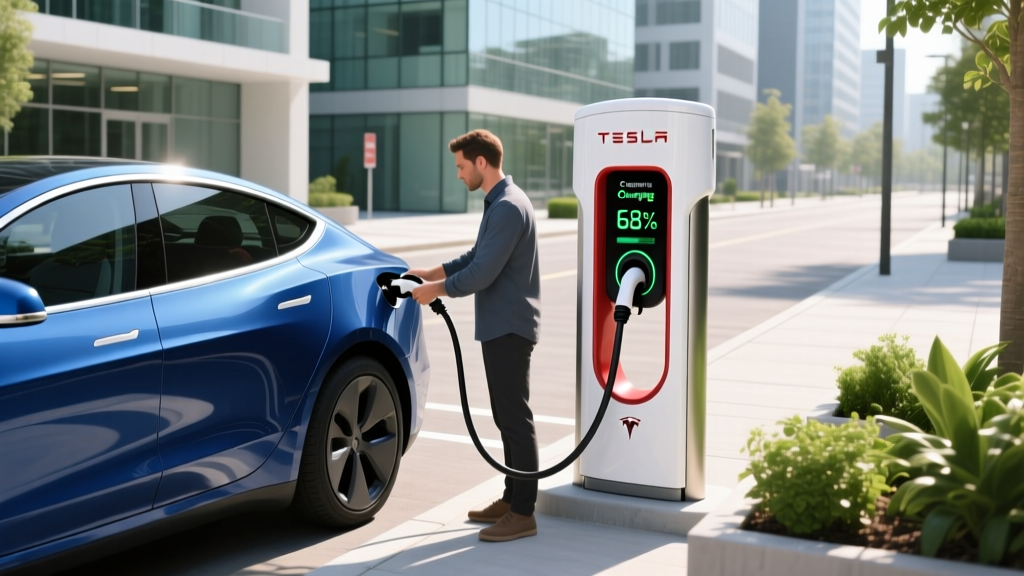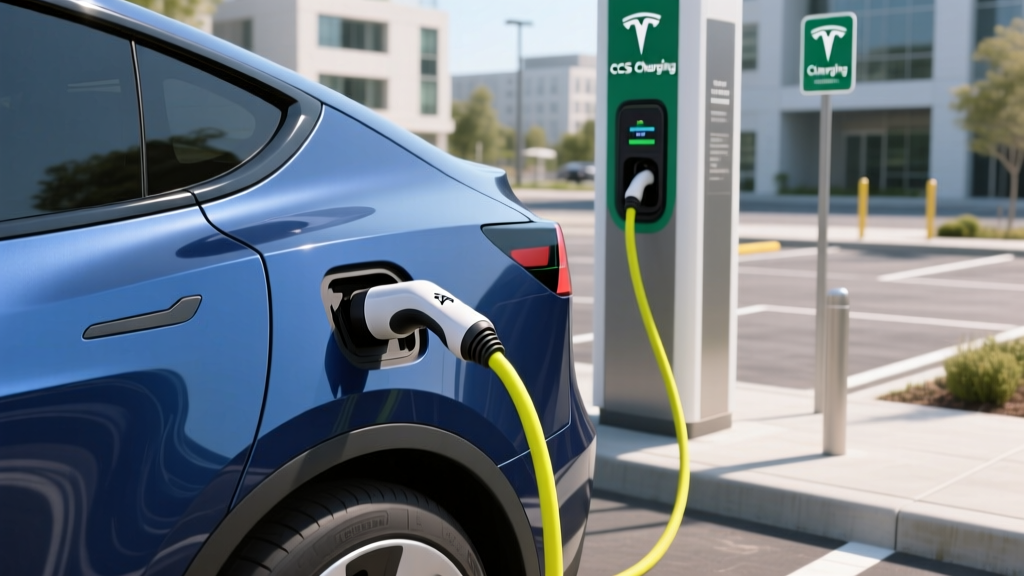
If you drive a Tesla built before late 2022, your car has a proprietary Tesla (now called NACS) charge port. But the vast majority of non-Tesla DC fast chargers across the U.S. still use the CCS1 connector. A CCS adapter for Tesla bridges that gap — letting you pull into Electrify America, EVgo, and hundreds of regional networks without being locked into the Supercharger ecosystem alone.
This guide breaks down exactly which CCS adapters work with which Tesla models, what charging speeds you can expect, how the adapter affects your charging curve, and what the broader connector landscape looks like as the industry converges on NACS through 2026.
Why Tesla Owners Still Need a CCS Adapter in 2026
Starting in late 2022, Tesla began equipping North American vehicles with a CCS-compatible charge port (the same physical NACS port, but with CCS communication protocol support). In 2025, Tesla switched all new vehicles to the standardized NACS port. However, millions of pre-2023 Teslas on the road lack native CCS protocol support at the port level — they can physically accept a NACS plug, but they can't handshake with a CCS1 DC fast charger without an adapter.
Meanwhile, the public charging network is still in transition. According to the Alternative Fuels Data Center, there are over 70,000 public charging ports in the U.S., and a significant share of DC fast chargers outside the Tesla Supercharger network still deploy CCS1 connectors. While major automakers (Ford, GM, Rivian, Volvo, BMW) have adopted NACS for new vehicles starting in 2025–2026, the existing CCS1 infrastructure won't disappear overnight.
A CCS adapter for Tesla gives you access to both worlds: Superchargers natively, plus CCS1-equipped stations via adapter.
Understanding Charging Levels: kW, kWh, and Miles Per Hour
Before selecting an adapter, it helps to ground yourself in the numbers. The most common EV confusion is between kW (kilowatts) and kWh (kilowatt-hours):
- kW = power (the rate of energy flow, like water pressure in a hose)
- kWh = energy (the total amount stored or delivered, like gallons in a tank)
A 75 kWh battery charged at 11 kW (Level 2) takes roughly 7 hours from empty. That same battery on a 150 kW DC fast charger fills much faster — but only up to a point, because charging speed tapers as the battery approaches full.
| Level | Voltage | Max Power (kW) | Miles of Range Added Per Hour | Typical Use |
|---|---|---|---|---|
| Level 1 | 120V AC | 1.2–1.9 kW | 3–5 mi/hr | Emergency/trickle (standard outlet) |
| Level 2 | 240V AC | 7.2–19.2 kW | 20–60 mi/hr | Home, workplace, destination |
| DC Fast (Level 3) | 400–800V DC | 50–350 kW | 150–1,000+ mi/hr (peak) | Road trips, highway corridors |
For a Tesla Model 3 Long Range (75 kWh usable battery, ~341 EPA miles), charging at 11.5 kW on Level 2 adds roughly 44 miles of range per hour. On a 250 kW DC fast charger, you can add 200 miles in about 15 minutes — but only during the peak portion of the charge curve, typically between 10% and 50% State of Charge (SoC).
CCS Adapter Compatibility by Tesla Model
Not every Tesla can use every CCS adapter. The determining factor is whether your vehicle has a CCS-enabled charge port ECU (electronic control unit). Here's the breakdown:
| Tesla Model | Model Year | CCS Port Support | Adapter Needed? | Max DC Charge Rate via Adapter |
|---|---|---|---|---|
| Model 3 | 2023+ | Native CCS | No (use CCS1 plug directly) | 250 kW |
| Model 3 | 2018–2022 | After retrofit or adapter | Yes — CCS adapter | ~170 kW (adapter-limited) |
| Model Y | 2023+ | Native CCS | No | 250 kW |
| Model Y | 2020–2022 | After retrofit or adapter | Yes — CCS adapter | ~170 kW |
| Model S | 2022+ (refreshed) | Native CCS | No | 250 kW |
| Model S | Pre-2022 | Adapter only | Yes — CCS adapter | ~150 kW |
| Model X | 2022+ (refreshed) | Native CCS | No | 250 kW |
| Model X | Pre-2022 | Adapter only | Yes — CCS adapter | ~150 kW |
Critical note: Tesla offers an official CCS Adapter (part number 1529865-00-A, approximately $175) for vehicles with the updated charge port ECU. If your 2018–2022 Model 3 or Y doesn't have the updated ECU, Tesla service centers can perform a retrofit (typically $250–$450 including parts and labor) that enables CCS protocol support. Without this, third-party adapters may not communicate properly with the vehicle.
Top CCS Adapters for Tesla: Specs and Comparison
The adapter market has matured considerably. Here are the most reliable options available:
Tesla Official CCS Adapter
- Price: ~$175
- Max Power: Up to 250 kW (vehicle-limited)
- Connector: CCS1 female → NACS male
- Weight: ~1.2 lbs
- Smart Features: Full vehicle integration, no app required
- Best For: Tesla owners wanting OEM reliability
Lectron Tesla to CCS Adapter
- Price: ~$140–$170
- Max Power: Up to 150 kW rated
- Connector: CCS1 female → NACS male
- Weight: ~1.5 lbs
- Smart Features: LED status indicator
- Best For: Budget-conscious backup adapter
A2Z NACS to CCS1 Adapter
- Price: ~$130–$160
- Max Power: Up to 200 kW rated
- Connector: CCS1 female → NACS male
- Weight: ~1.4 lbs
- Smart Features: IP55 weather rating
- Best For: Frequent travelers needing weather resistance
Real-world charging curve reality: Even if an adapter is rated for 250 kW, your actual peak charge rate depends on your Tesla's battery management system, battery temperature, and State of Charge. A Model 3 Long Range on a 350 kW Electrify America charger via the Tesla CCS adapter will typically peak around 170–190 kW between 15–45% SoC, then taper to ~60 kW by 70% SoC, and ~25 kW above 85% SoC. Expect a 10–80% charge in approximately 28–35 minutes depending on battery preconditioning.
Charging Costs: Home vs. Public vs. Gas
The economics of charging vary dramatically depending on where you plug in. Here's a realistic breakdown using national averages:
| Charging Scenario | Cost per kWh | Cost to Add 200 Miles* | Cost Per Mile |
|---|---|---|---|
| Home Level 2 (off-peak utility rate) | $0.08–$0.14 | $4.00–$7.00 | $0.02–$0.035 |
| Home Level 2 (standard residential) | $0.14–$0.20 | $7.00–$10.00 | $0.035–$0.05 |
| Tesla Supercharger (average) | $0.28–$0.36 | $14.00–$18.00 | $0.07–$0.09 |
| Electrify America / EVgo (CCS) | $0.32–$0.48 | $16.00–$24.00 | $0.08–$0.12 |
| Gas vehicle (28 MPG, $3.40/gal) | — | $24.29 | $0.12 |
*Based on a Tesla Model 3 Long Range consuming ~25 kWh per 100 miles (4 mi/kWh), per fueleconomy.gov efficiency data.
Home charging remains the cheapest option by a wide margin. Even at peak public DC fast charging rates, a Tesla with a CCS adapter at an Electrify America station costs roughly the same per mile as a 28 MPG gas car — and significantly less on a per-mile basis when you charge at home.
Home Charging Setup: What It Takes to Install Level 2
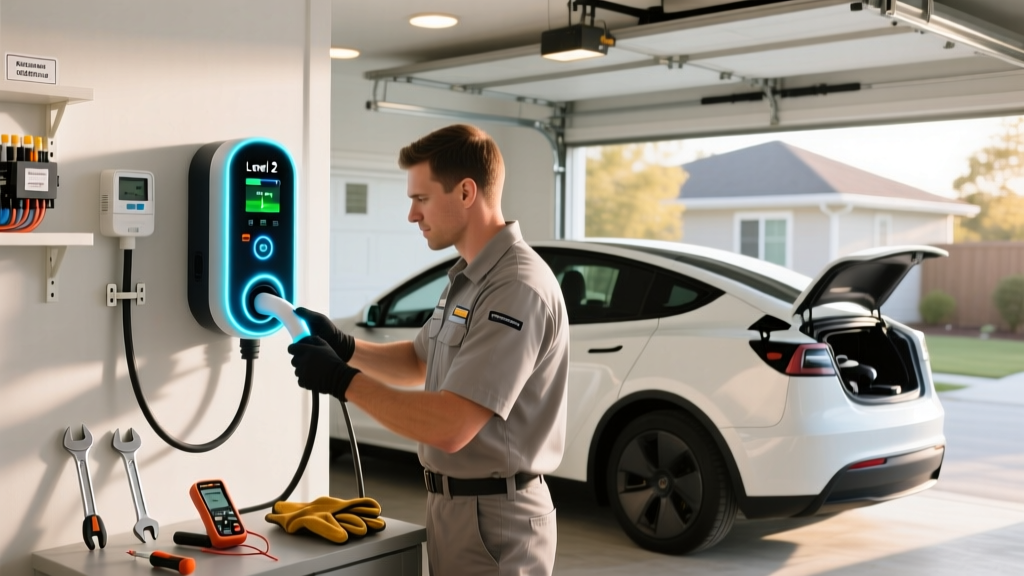
If you're buying a CCS adapter to expand your road-trip options, you still want a reliable Level 2 home charger for daily use. Here's what a proper installation involves:
Electrical requirements: A Level 2 home charger requires a dedicated 240V circuit. The most common setup is a NEMA 14-50 outlet on a 50-amp breaker, which supports chargers drawing up to 40 amps (9.6 kW). For faster charging, a 60-amp breaker with hardwired installation supports 48-amp (11.5 kW) chargers.
Panel capacity: Your home's electrical panel must have sufficient spare capacity. A typical 200-amp panel can usually accommodate a 50-amp EV circuit. Older homes with 100-amp panels may require a panel upgrade ($1,500–$3,500) before adding an EV charger. A licensed electrician should perform a load calculation per NEC Article 220.
| Component | Typical Cost Range |
|---|---|
| Level 2 charger equipment (smart, 40–48A) | $350–$700 |
| Electrician labor (240V circuit, 50–60 ft run) | $500–$1,500 |
| NEMA 14-50 outlet or hardwire junction box | $50–$150 |
| Electrical permit | $50–$200 |
| Panel upgrade (if needed, 100A → 200A) | $1,500–$3,500 |
| Total (no panel upgrade) | $950–$2,550 |
| Total (with panel upgrade) | $2,450–$6,050 |
Safety and code considerations: Per the National Electrical Code (NEC), EV chargers require a dedicated circuit — you cannot share it with other appliances. Outdoor installations should use a charger rated for weather resistance (NEMA 4 or IP65). Many jurisdictions now require GFCI protection on 240V EV circuits, though some chargers have built-in ground-fault protection that satisfies this requirement. Always pull a permit and have the work inspected — unpermitted electrical work can void home insurance and create fire risk.
Recommended Level 2 Home Chargers for Tesla
Tesla Wall Connector (Gen 3)
- Power Output: Up to 11.5 kW (48A on 60A circuit)
- Connector: NACS (native Tesla plug)
- Cable Length: 24 ft
- Smart Features: Wi-Fi, OTA updates, power sharing, access control
- Price: ~$475
ChargePoint Home Flex
- Power Output: Up to 12 kW (50A on 60A circuit, configurable)
- Connector: J1772 (NACS adapter included for Tesla)
- Cable Length: 23 ft
- Smart Features: Wi-Fi, app scheduling, Alexa, energy tracking
- Price: ~$550–$650
Emporia Vue Level 2 Charger
- Power Output: Up to 11.5 kW (48A)
- Connector: J1772 or NACS (select at purchase)
- Cable Length: 24 ft
- Smart Features: Wi-Fi, solar integration, energy monitoring, load management
- Price: ~$400–$500
Using a CCS Adapter at Public Chargers: Step-by-Step
- Pull up to a CCS1-equipped DC fast charger (Electrify America, EVgo, or regional network).
- Plug the CCS1 connector into the female end of your adapter — it locks in with the standard CCS latch.
- Insert the NACS male end into your Tesla's charge port. The vehicle should recognize the connection and begin the handshake.
- Initiate the session via the charging network's app, RFID card, or credit card terminal.
- Monitor the charge curve. Expect peak speeds between 15–50% SoC. Precondition your battery by navigating to the charger in your Tesla's navigation system — this warms the battery for optimal charge acceptance.
- Disconnect when finished. Stop the session first, then unplug the adapter from the car, then separate the CCS cable from the adapter.
Preconditioning tip: Teslas don't automatically precondition for non-Supercharger destinations. If your adapter and vehicle support it, manually enable battery preconditioning through the Tesla app or by adding the CCS station as a Supercharger waypoint in navigation (a common workaround used by experienced owners). Battery temperature is the single biggest factor in DC fast charge speed — a cold battery at 50°F may peak at only 50–70 kW, while a preconditioned battery at 95°F can hit 170+ kW.
The Connector Landscape: NACS vs. CCS1 vs. CHAdeMO
The North American charging connector landscape has shifted dramatically since Tesla opened its NACS standard in late 2022. Here's where things stand:
- NACS (North American Charging Standard): Now the dominant standard for new EVs. Ford, GM, Rivian, BMW, Hyundai, Kia, and most major automakers have adopted NACS for 2025+ models. Tesla Superchargers use NACS natively.
- CCS1 (Combined Charging System): Still the most common DC fast connector on existing public infrastructure. Being phased out on new vehicles but will remain on public chargers for years.
- CHAdeMO: Legacy Japanese standard (Nissan Leaf, Mitsubishi). Effectively discontinued for new vehicles. Adapters are available but increasingly hard to find.
For Tesla owners, the practical implication is clear: a CCS adapter for Tesla is a bridge solution that gives you maximum charging flexibility today. As CCS1 infrastructure gradually gets retrofitted with NACS cables (a process already underway at Electrify America and other networks), the adapter becomes less necessary — but it remains essential for the next 3–5 years of road-trip charging.
Frequently Asked Questions
Does using a CCS adapter void my Tesla warranty?
No. The Tesla official CCS adapter is an OEM accessory and does not affect your vehicle warranty. Third-party adapters that meet SAE and UL standards also should not void your warranty, but if an adapter causes damage to the charge port, Tesla may deny a warranty claim for that specific repair. Stick with the Tesla OEM adapter or well-reviewed, certified third-party options.
Can I use a CCS adapter for Level 2 (AC) charging?
No. CCS adapters are designed exclusively for DC fast charging. For Level 2 AC charging at non-Tesla stations, you need a J1772-to-NACS adapter (Tesla includes one with most vehicles, and third-party options like the Lectron or Taptes J1772 adapters cost $30–$60).
How fast can I actually charge through a CCS adapter?
With the Tesla OEM CCS adapter on a CCS-enabled vehicle, you can reach the vehicle's maximum DC charge rate — up to 250 kW on a Model 3 Long Range at a V3 Supercharger-class station. Real-world sustained speeds are typically 150–190 kW during the peak portion of the charge curve (15–50% SoC). Third-party adapters rated at 150 kW will cap your maximum speed accordingly.
Do I need a software update to use a CCS adapter?
For Tesla vehicles from 2021 onward, CCS adapter support is included in recent firmware versions. Older vehicles (2018–2020 Model 3) may require the charge port ECU retrofit from Tesla Service before the adapter will function. Check your vehicle's charge port settings menu — if you see a "CCS Adapter Support" toggle, you're ready to go.
Is it worth buying a CCS adapter if Tesla Superchargers are everywhere?
It depends on your travel patterns. If you primarily drive routes well-served by Superchargers, you may rarely use it. But for travel through rural areas, national parks, or regions where Electrify America or EVgo have stronger coverage than Tesla, the adapter is a $175 insurance policy against being stranded. It also future-proofs you as the broader NACS/CCS infrastructure continues to evolve.
For the latest on federal EV charging incentives, including the Alternative Fuel Vehicle Refueling Property Credit (up to $1,000 for home charger installation through 2032, subject to income and census-tract requirements), consult the IRS directly or a qualified tax professional.