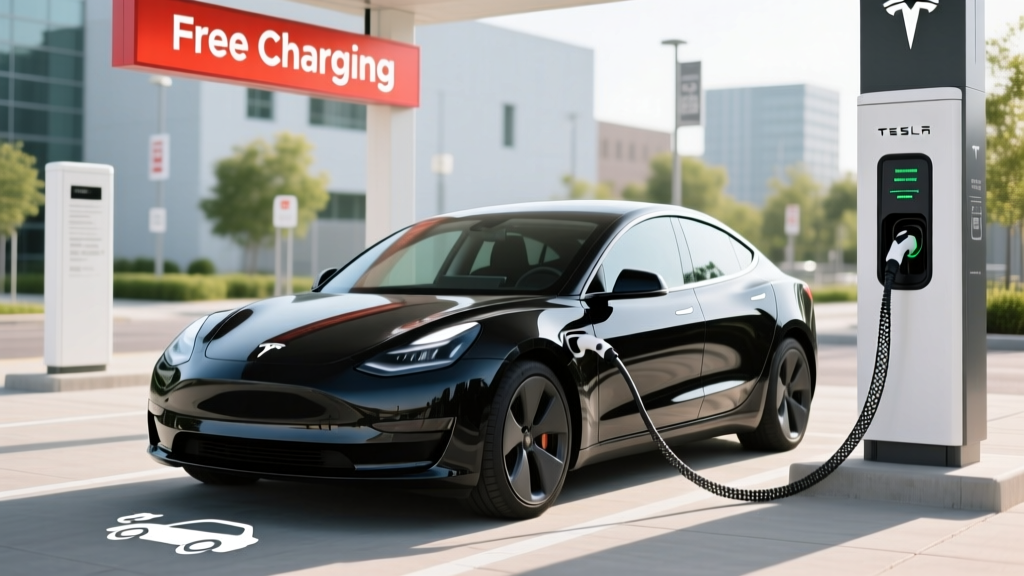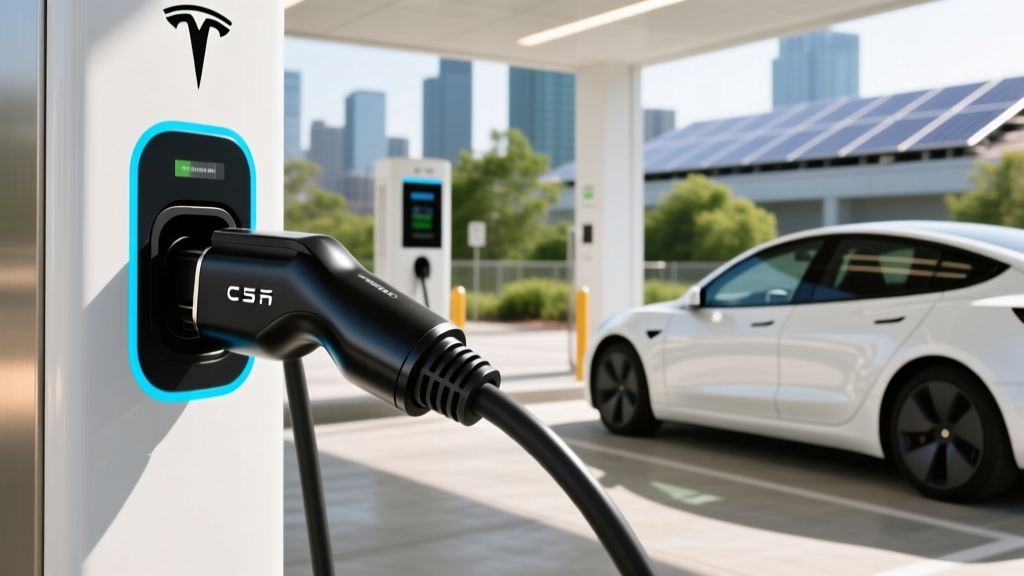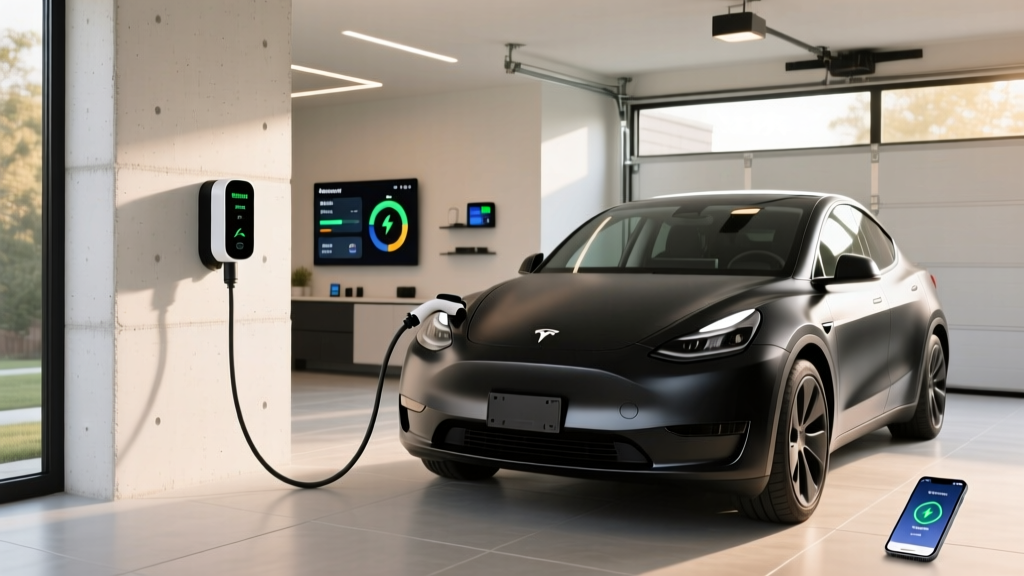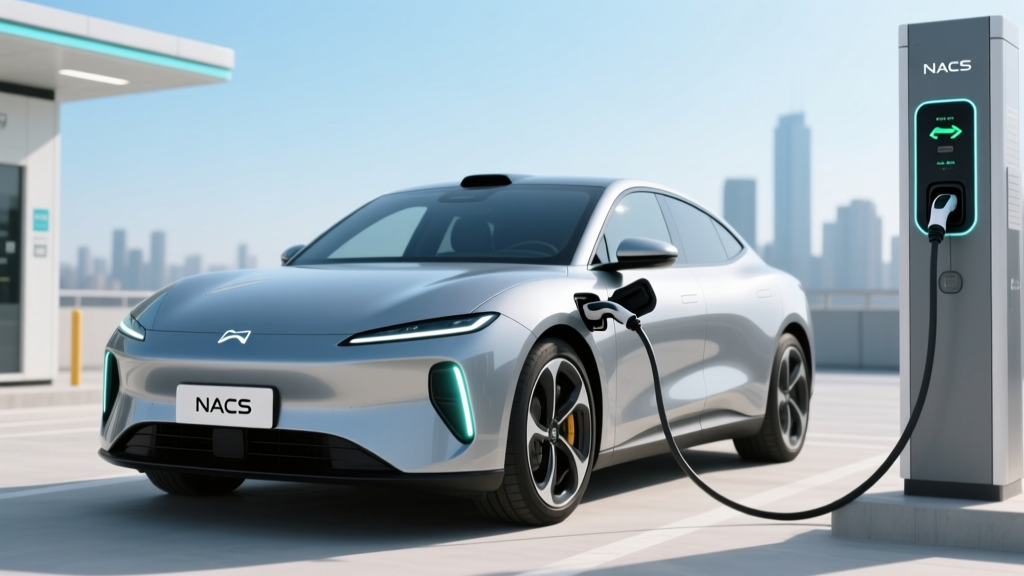
If you're shopping for an electric vehicle today, the connector on the car matters almost as much as the battery. The North American Charging Standard (NACS) — originally developed by Tesla and now adopted by nearly every major automaker — is becoming the default plug for new EVs sold in the United States. But owning a car with a NACS port raises practical questions: How fast can you charge at home? What does installation actually cost? Do you need an adapter for public stations?
This guide breaks down everything you need to know about charging vehicles equipped with a NACS port, from Level 1 trickle charging to 350 kW DC fast charging, with real numbers for equipment, installation, and cost per mile.
Which Cars Have a NACS Port?
As of the 2026 model year, the list of vehicles shipping from the factory with a native NACS charge port has grown substantially. Tesla models (Model 3, Model Y, Model S, Model X, Cybertruck) have always used NACS. Now they're joined by a wave of non-Tesla vehicles:
- Ford: F-150 Lightning, Mustang Mach-E (2025+ models)
- General Motors: Chevrolet Equinox EV, Blazer EV, Silverado EV, Cadillac Lyriq, GMC Sierra EV
- Rivian: R1S and R1T (2025+ production)
- Hyundai/Kia: Ioniq 5 (2025+ NACS variant), Ioniq 9, EV6 (select trims)
- BMW: Neue Klasse models (announced for 2026+)
- Volvo/Polestar: EX30, EX90, Polestar 3 (North American variants)
- Mercedes-Benz: Upcoming MMA-platform vehicles
Many 2024–2025 non-Tesla EVs shipped with CCS1 ports and include a NACS adapter in the box or as a dealer-installed accessory. If you're buying a used EV from this transition period, verify whether the NACS port is native or adapter-dependent — this affects Supercharger access and charging convenience.
Charging Levels Explained: Speed, Power, and Range Added
Understanding EV charging requires one critical distinction: kW (kilowatts) measures power — how fast energy flows into your battery. kWh (kilowatt-hours) measures energy — the total capacity of your battery. Think of kW as the flow rate of a hose, and kWh as the size of the bucket.
Here's how each charging level performs with a NACS-equipped vehicle:
| Level | Power (kW) | Voltage / Amps | Miles of Range Added per Hour | Typical Use Case |
|---|---|---|---|---|
| Level 1 (120V) | 1.2–1.9 kW | 120V / 12–16A | 3–5 miles | Overnight top-up, emergency |
| Level 2 (240V) | 7.2–19.2 kW | 240V / 30–80A | 20–75 miles | Daily home charging |
| DC Fast Charging | 50–350 kW | 200–800V DC | 150–1,000+ miles (in peak 10–80% window) | Road trips, quick top-ups |
Real-world context: A Ford F-150 Lightning with the extended-range 131 kWh battery charging on a 48-amp (11.5 kW) Level 2 NACS wall connector will add roughly 30–35 miles of range per hour, taking about 10–11 hours for a full 10–100% session. On a 250 kW Tesla Supercharger V3, that same truck can go from 10–80% in approximately 35–40 minutes, though peak charge rate tapers significantly above 80% to protect battery health.
Home Charger Installation: Electrical Requirements and Cost
Installing a Level 2 NACS home charger is the single most impactful upgrade for daily EV ownership. Here's what's involved electrically and financially.
Electrical Requirements
Most Level 2 NACS chargers require a 240-volt dedicated circuit, similar to what powers an electric dryer or oven. The most common configurations:
- 40-amp circuit / 32-amp continuous: Delivers 7.7 kW — adequate for most EVs with smaller batteries (e.g., Chevy Equinox EV with 85 kWh battery).
- 50-amp circuit / 40-amp continuous: Delivers 9.6 kW — the sweet spot for most homeowners, covering overnight charges for vehicles like the Hyundai Ioniq 5 or Ford Mustang Mach-E.
- 60-amp circuit / 48-amp continuous: Delivers 11.5 kW — ideal for larger batteries like the F-150 Lightning or Rivian R1T.
- 80-amp circuit / 64-amp continuous: Delivers 15.4–19.2 kW — requires a hardwired connection and a 200-amp or larger electrical panel. Best for high-capacity EVs or dual-EV households.
The National Electrical Code (NEC) requires that continuous loads (like EV charging) use no more than 80% of a circuit's rated capacity. A 50-amp breaker therefore delivers a maximum of 40 amps continuous — this is not optional, it's code.
Panel Upgrade Reality
Many homes built before 2000 have 100-amp or 150-amp electrical panels. Adding a 50- or 60-amp EV circuit may push total load beyond safe capacity, especially if you already run electric heat, an electric dryer, and an electric range. A licensed electrician will perform a load calculation to determine if your panel can handle the new circuit.
If an upgrade to a 200-amp panel is needed, expect to pay $1,500–$3,500 for the panel upgrade alone, on top of charger installation costs. In some cases, utility companies offer rebates or smart-panel devices (like the SPAN smart panel) that can avoid a full upgrade by dynamically managing circuit loads.
| Item | Typical Cost Range | Notes |
|---|---|---|
| Level 2 NACS Charger (Equipment) | $400–$750 | Smart Wi-Fi chargers from Emporia, ChargePoint, Wallbox |
| Electrician Labor (standard install) | $500–$1,500 | Varies by run length, conduit, wall type |
| Permit & Inspection | $50–$300 | Required in most jurisdictions; varies by locality |
| Electrical Panel Upgrade (if needed) | $1,500–$3,500 | 100A → 200A service upgrade |
| Total (no panel upgrade) | $950–$2,550 | Most common scenario for modern 200A-panel homes |
| Total (with panel upgrade) | $2,450–$6,050 | Older homes or high-load households |
Federal incentive note: The §30C Alternative Fuel Vehicle Refueling Property Credit, as outlined by the IRS, may cover up to 30% of home charger equipment and installation costs (maximum $1,000), but eligibility depends on census-tract qualifications and income limits. Consult a tax professional to confirm your eligibility.
Connector Compatibility: NACS, CCS1, and Adapter Requirements
The connector landscape in 2026 is consolidating around NACS, but CCS1 infrastructure still exists and CHAdeMO is effectively legacy. Here's what you need to know based on your vehicle:
| Vehicle Port | NACS Stations | CCS1 Stations | CHAdeMO Stations | Adapter Needed? |
|---|---|---|---|---|
| Native NACS (Tesla, Ford 2025+, GM 2025+, Rivian 2025+) | Direct plug | CCS1-to-NACS adapter required | CHAdeMO-to-NACS adapter (rare, expensive) | CCS1 adapter for non-Tesla DC networks |
| CCS1 with NACS adapter included (Hyundai, Kia, BMW transition models) | NACS-to-CCS1 adapter included by OEM | Direct plug | CHAdeMO-to-CCS1 adapter (rare) | NACS adapter for Tesla Supercharger access |
Tesla Supercharger access for non-Tesla NACS vehicles: Ford, GM, Rivian, and other NACS-adopting automakers now have access to Tesla's Supercharger network. However, not every Supercharger stall is enabled for non-Tesla vehicles — Tesla has been rolling out Magic Dock (built-in CCS adapter) stalls and software-gated NACS access selectively. Check your vehicle's navigation app or the Tesla app for station-level compatibility before relying on a Supercharger stop on a road trip.
For CCS1 public networks like Electrify America, EVgo, and ChargePoint, owners of native-NACS vehicles will need a CCS1-to-NACS adapter. Several third-party adapters (from brands like Lectron and A2Z) are available for $150–$300, but verify that the adapter is rated for the DC fast-charging power levels your vehicle can accept (up to 350 kW for some platforms).
Cost to Charge: Per-Mile Economics vs. Gasoline
The cost advantage of electric driving depends heavily on where and when you charge. Here's a realistic breakdown for a typical NACS-equipped EV with an efficiency of 3.0 miles/kWh (roughly 112 MPGe combined, similar to a Hyundai Ioniq 5 or Tesla Model Y):
| Scenario | Price per kWh | Cost per Mile (at 3.0 mi/kWh) | Annual Cost (12,000 mi) |
|---|---|---|---|
| Home Level 2 (off-peak utility rate) | $0.08–$0.14 | $0.027–$0.047 | $320–$560 |
| Home Level 2 (standard residential rate) | $0.14–$0.20 | $0.047–$0.067 | $560–$800 |
| Public Level 2 (network pricing) | $0.25–$0.40 | $0.083–$0.133 | $1,000–$1,600 |
| DC Fast Charging (Electrify America, EVgo) | $0.35–$0.55 | $0.117–$0.183 | $1,400–$2,200 |
| Tesla Supercharger V3/V4 | $0.28–$0.42 | $0.093–$0.140 | $1,120–$1,680 |
| Gas vehicle (28 MPG, $3.50/gal) | — | $0.125 | $1,500 |
The takeaway is clear: home charging is the economic sweet spot. Owners who charge primarily at home on off-peak rates spend roughly $400–$600 per year on "fuel" — about one-third the cost of gasoline. If you rely exclusively on DC fast charging, your per-mile cost can approach or even exceed that of a fuel-efficient gas car, which is why home Level 2 installation is so critical to the ownership equation.
Recommended NACS Home Chargers for 2026
Here are three Level 2 NACS chargers that balance price, power, cable length, and smart features for most EV owners:
Tesla Wall Connector (NACS)
- Power Output: Up to 11.5 kW (48A) on a 60A circuit
- Connector: Native NACS — no adapter needed for Tesla or non-Tesla NACS vehicles
- Cable Length: 24 feet
- Smart Features: Wi-Fi, firmware updates, power sharing between two units, access control
- Price: ~$475
- Best for: Tesla owners and native-NACS non-Tesla EVs (Ford, GM, Rivian)
Emporia Vue 2 + NACS Connector
- Power Output: Up to 11.5 kW (48A) on a 60A circuit; configurable down to 32A
- Connector: NACS (also available in J1772 with adapter)
- Cable Length: 24 feet
- Smart Features: Energy monitoring, solar integration, time-of-use scheduling, app control
- Price: ~$400
- Best for: Budget-conscious buyers who want energy data and solar pairing
ChargePoint Home Flex (NACS version)
- Power Output: Up to 12 kW (50A) on a 60A circuit; adjustable via DIP switches
- Connector: NACS (2025+ models); earlier versions use J1772
- Cable Length: 24 feet
- Smart Features: Wi-Fi, Alexa integration, scheduling, charging history, flexible amperage
- Price: ~$650
- Best for: Smart-home enthusiasts who want ecosystem integration
For hardwired installations (recommended for 48A+ chargers), your electrician will connect the charger directly to the breaker panel rather than using a NEMA 14-50 outlet. Hardwired connections are safer at higher amperages and eliminate the risk of outlet overheating — a known issue with some NEMA 14-50 receptacles under sustained EV-charging loads.
Charging Time Examples: How Long Does 10–80% Take?
DC fast charging speeds are not linear. Your vehicle's charge curve peaks at a low state of charge (typically 10–30%) and tapers progressively above 50%, slowing dramatically past 80% to protect battery longevity. Here are realistic 10–80% times for popular NACS-equipped vehicles on capable DC fast chargers:
- Tesla Model Y Long Range (75 kWh, NMC): Peak ~250 kW on V3 Supercharger; 10–80% in approximately 22–25 minutes.
- Ford F-150 Lightning Extended Range (131 kWh, NMC): Peak ~155 kW; 10–80% in approximately 38–42 minutes.
- Hyundai Ioniq 5 (84 kWh, NMC, 800V architecture): Peak ~240 kW on a 350 kW charger; 10–80% in approximately 18–20 minutes. Note: requires a CCS1-to-NACS adapter at non-Tesla stations.
- Chevrolet Equinox EV (85 kWh, NMC): Peak ~150 kW; 10–80% in approximately 30–35 minutes.
- Rivian R1T Dual-Motor (149 kWh Max Pack, NMC): Peak ~220 kW; 10–80% in approximately 35–40 minutes.
Cold-weather caveat: In temperatures below 32°F (0°C), expect 10–80% charge times to increase by 20–40% unless your vehicle preconditions the battery during navigation to the charger. Tesla's Supercharger preconditioning is among the most effective; Ford and GM have added similar features via OTA updates.
Safety and Code Considerations
EV charging places a sustained high-amperage load on your home's electrical system — far more demanding than intermittent appliances like a dryer. Key safety requirements per the NEC and best practices:
- Dedicated circuit: Your Level 2 charger must be on its own dedicated breaker — never shared with other outlets or appliances.
- GFCI protection: NEC 2020 and later require GFCI protection for all EV charging outlets. Hardwired chargers do not require a GFCI breaker (the charger typically has built-in ground-fault protection), and this avoids nuisance tripping that some GFCI breakers cause with EV loads.
- Outdoor rating: If your charger is installed outdoors, the unit must carry a NEMA 4 or IP55+ weather rating. All three chargers recommended above are rated for outdoor use.
- Wire gauge: A 60-amp circuit requires 6 AWG copper wire (or 4 AWG aluminum). Your electrician will size wire based on circuit amperage and run length; longer runs may require upsizing to prevent voltage drop.
- Permit and inspection: Most jurisdictions require an electrical permit for EV charger installation. The inspection ensures proper wire sizing, breaker rating, grounding, and code compliance. Skipping permits can void home insurance coverage in the event of an electrical fire.
Frequently Asked Questions
How much does it cost to install a home EV charger?
For a typical Level 2 NACS charger installation in a home with an adequate 200-amp electrical panel, expect to pay $950–$2,550 total (equipment, electrician labor, and permit). If your home needs a panel upgrade from 100A or 150A to 200A, add $1,500–$3,500 to that total. Always get at least two quotes from licensed electricians.
How fast will each charging level add range?
Level 1 (120V) adds roughly 3–5 miles of range per hour — adequate only for plug-in hybrids or very low daily mileage. Level 2 (240V) adds 20–75 miles per hour depending on amperage, fully recharging most EVs overnight. DC fast charging can add 150+ miles in 15–20 minutes during the peak charge window, though speed tapers significantly above 80% state of charge.
Which connector and charger is compatible with my EV?
If your vehicle has a native NACS port (Tesla, 2025+ Ford, GM, Rivian, select Hyundai/Kia), you can plug directly into any NACS charger including Tesla Superchargers and the Tesla Wall Connector. For CCS1 public stations, you'll need a CCS1-to-NACS adapter. If your vehicle has a CCS1 port with an OEM-supplied NACS adapter, the adapter enables Supercharger access while CCS1 stations work natively.
How much does charging cost per mile vs. gas?
Charging at home on off-peak rates costs roughly $0.03–$0.05 per mile for a typical EV — about one-third the $0.12–$0.15 per mile of a 28 MPG gas vehicle at $3.50/gallon. However, exclusive reliance on DC fast charging at $0.35–$0.55/kWh pushes EV costs to $0.12–$0.18 per mile, narrowing or eliminating the savings. Home charging access is the key variable.
What electrical upgrades might I need?
The most common upgrade is a panel replacement from 100-amp to 200-amp service ($1,500–$3,500), needed in older homes or those with multiple high-draw electric appliances. Some utilities offer load-management devices that allow EV charging without a panel upgrade by temporarily reducing charger power when other appliances cycle on. Your electrician's load calculation will determine which path is required for your home.