What 'Cars Charger' Actually Means: Levels, Power, and Real Speeds
If you're shopping for a cars charger setup — whether for your garage, driveway, or next road trip — the first thing to sort out is the difference between kW (kilowatts) and kWh (kilowatt-hours). kW measures power (how fast energy flows into your battery, like water pressure from a hose). kWh measures energy (the total amount stored in your battery, like gallons in a tank). A 80 kWh battery charged at 10 kW takes roughly 8 hours. Confusing these two is the single most common EV mistake, and it leads to bad purchase decisions.
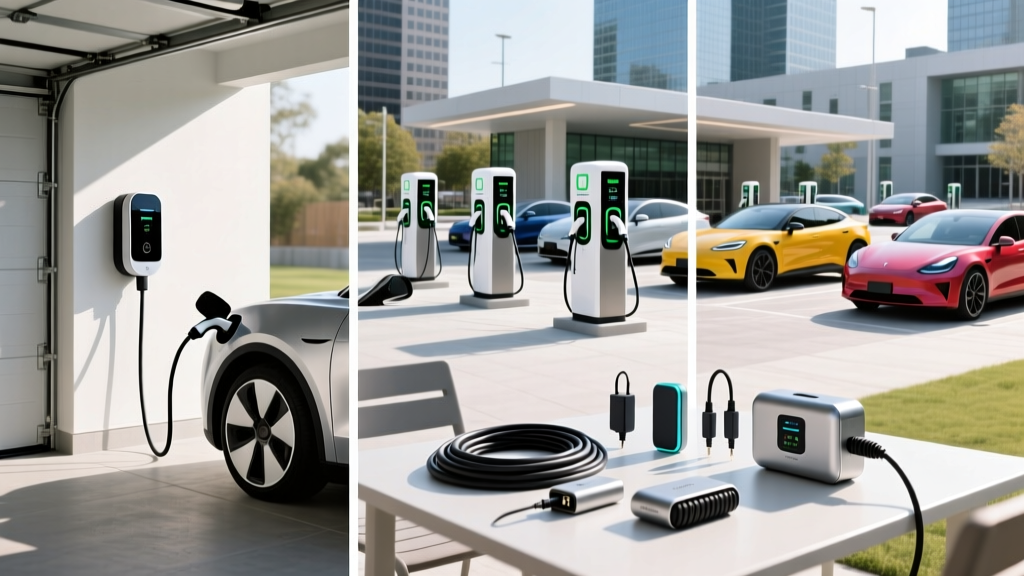
Every EV charger falls into one of three categories. Here's what each delivers in the real world:
| Level | Voltage | Power (kW) | Miles of Range Added per Hour | Best For |
|---|---|---|---|---|
| Level 1 | 120V AC | 1.0–1.4 kW | 3–5 mi/hr | Overnight top-ups, PHEVs, low-mileage drivers |
| Level 2 | 240V AC | 3.3–19.2 kW | 12–70 mi/hr | Daily home charging, workplace, hotels |
| DC Fast Charge | 400–800V DC | 50–350 kW | 150–1,000+ mi/hr (peak) | Road trips, highway corridors, quick top-ups |
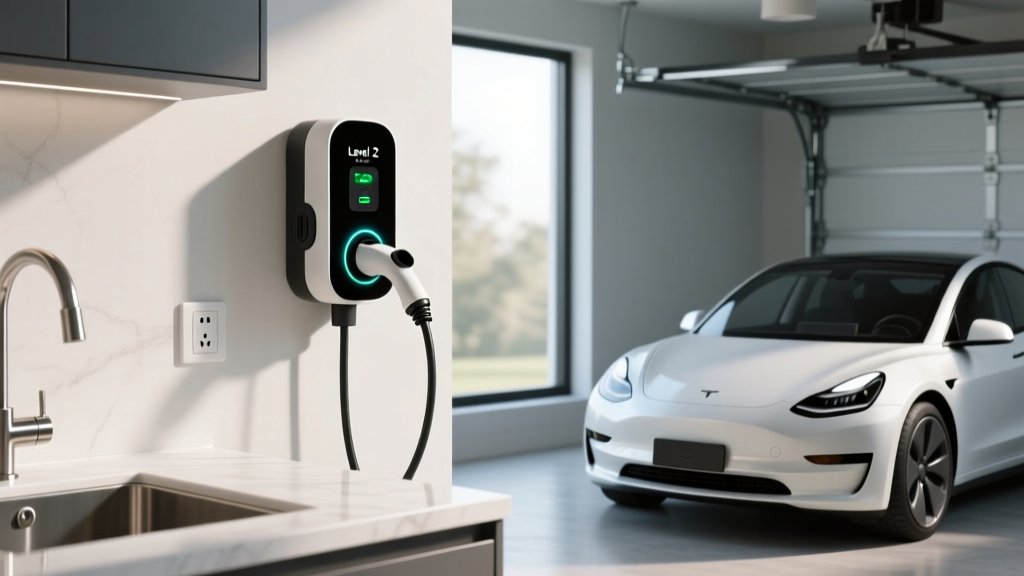
Real-world context: A Level 2 charger at 11.5 kW (the most common home setup on a 48-amp circuit) adds roughly 40 miles of range per hour for a mid-size EV like the Tesla Model Y or Hyundai Ioniq 5. That means a 10–80% charge on a 75 kWh battery takes about 5 hours — perfect for overnight. A 350 kW DC fast charger can do the same 10–80% in 18–25 minutes, depending on the vehicle's charge curve and battery preconditioning.
How Much Does It Cost to Install a Home EV Charger?
Home Level 2 installation costs vary enormously depending on your electrical panel's capacity, the distance from panel to charger location, and local permit fees. Here's an honest breakdown based on typical 2025–2026 electrician rates:
| Component | Simple Install (Panel Adjacent) | Complex Install (Long Run / Panel Upgrade) |
|---|---|---|
| Level 2 Charger Equipment (hardwired, 48A) | $400–$700 | $400–$700 |
| Electrician Labor (240V/50A circuit, conduit, wiring) | $300–$800 | $1,200–$2,500 |
| Electrical Panel Upgrade (100A → 200A, if needed) | $0 (not needed) | $1,500–$3,000 |
| Permit & Inspection | $50–$200 | $100–$350 |
| Total Estimated Cost | $750–$1,700 | $3,200–$6,550 |
What Electrical Upgrades Might I Need?
Most homes built after 2000 have a 200-amp electrical panel with spare capacity for a 50-amp breaker (delivering 40 amps continuous to the charger). If your panel is older, already near capacity (common with electric HVAC, water heaters, and dryers running simultaneously), or is a 100-amp service, you'll likely need a panel upgrade. A licensed electrician will perform a load calculation per NEC Article 220 to determine this.
Panel-upgrade gotcha: Some utilities and municipalities now require a "smart panel" or load-management device (like the SPAN smart panel or a Span-compatible load shedder) instead of a full service upgrade. These devices can dynamically reduce charger amperage when other circuits spike, potentially saving you $2,000–$4,000 versus a full 200A upgrade. Ask your electrician about load-management options before committing to a panel swap.
For the charger circuit itself, the National Electrical Code (NEC) requires:
- Dedicated circuit: The EV charger must have its own breaker — no sharing with other outlets or appliances.
- Continuous-load derating: EV charging counts as a continuous load (3+ hours), so the breaker must be rated 125% above the charger's max draw. A 48-amp charger requires a 60-amp breaker. A 40-amp charger requires a 50-amp breaker.
- GFCI protection: NEC 2020 and later require GFCI protection for all 240V EV charging outlets (NEMA 14-50). Hardwired chargers are often exempt from the GFCI breaker requirement, which is one reason many electricians now recommend hardwiring over plug-in installations.
- Outdoor rating: If the charger is mounted outside, it must carry a NEMA 4 or NEMA 4X rating for weather resistance.
Which Connector and Charger Is Compatible With My EV?
The connector landscape has shifted dramatically. As of 2025–2026, the North American Charging Standard (NACS), originally developed by Tesla, has been adopted by Ford, GM, Rivian, Volvo, BMW, Hyundai/Kia, and most major automakers. The Combined Charging System (CCS1) is being phased out on new vehicles but remains on many 2022–2024 models. CHAdeMO is effectively legacy, limited to older Nissan Leafs and Mitsubishi Outlander PHEVs.
| Connector | Brands Using It (New Vehicles) | Adapter Needed For |
|---|---|---|
| NACS (Tesla standard) | Tesla, Ford, GM, Rivian, Volvo, Polestar, BMW, Hyundai, Kia, Mercedes (2025+) | CCS1 → NACS adapter for older CCS vehicles at Superchargers |
| CCS1 | VW (ID.4 through 2024), some 2022–2024 Hyundai/Kia, legacy models | NACS → CCS1 adapter for Tesla Supercharger access |
| CHAdeMO | Nissan Leaf (2011–2025), Mitsubishi Outlander PHEV (older) | No practical adapter; network shrinking |
Adapter reality check: Ford and GM owners with NACS ports can use Tesla Superchargers directly. If you own a 2023–2024 vehicle with CCS1, companies like Lectron and A2Z offer CCS1-to-NACS adapters (~$150–$250) rated for up to 250 kW DC fast charging. However, verify your vehicle's charge-port firmware supports adapter communication — some early CCS vehicles require a software update. For Level 2 home charging, nearly all chargers use a J1772 connector (the universal AC plug), and NACS-equipped vehicles include a J1772-to-NACS adapter in the trunk or frunk.
How Fast Will Each Charging Level Add Range? (Real Charging Times)
Spec sheets quote peak kW, but real charging follows a charge curve: power ramps up quickly from 10–30% State of Charge (SoC), sustains peak power through roughly 50–60%, then tapers significantly above 80% to protect battery health. Here's what that looks like for common battery sizes:
| Battery Size (usable kWh) | Example Vehicle | Level 2 at 11.5 kW (48A) | DC Fast at 150 kW (sustained avg ~100 kW) | DC Fast at 250 kW (sustained avg ~170 kW) |
|---|---|---|---|---|
| 58 kWh | VW ID.4 Standard | ~3.5 hours | ~32 min | N/A (vehicle peaks at 135 kW) |
| 75 kWh | Tesla Model Y LR | ~4.5 hours | ~38 min | ~22 min |
| 84 kWh | Hyundai Ioniq 5 (Long Range) | ~5 hours | ~40 min | ~18 min (800V architecture) |
| 100 kWh | Ford F-150 Lightning Ext. Range | ~6 hours | ~52 min | ~35 min |
| 131 kWh | GMC Hummer EV | ~8 hours | ~70 min | ~45 min |
Key insight: The Hyundai Ioniq 5 and Kia EV6 use an 800-volt battery architecture, which allows them to sustain higher charge rates longer than 400V systems. On a 350 kW charger, the Ioniq 5 peaks at 240 kW and sustains above 180 kW through 65% SoC — resulting in a 10–80% time of roughly 18 minutes under ideal conditions (battery preconditioned to ~85°F). In cold weather (below 32°F) without preconditioning, that same session can stretch to 35+ minutes. Always precondition your battery before a DC fast charge stop.
How Much Does Charging Cost Per Mile vs Gas?
Electricity pricing varies by utility, time of day, and state. Here's a realistic comparison using a mid-size EV averaging 3.5 miles per kWh (roughly 115 MPGe combined) versus a comparable gas vehicle at 28 MPG combined, with gas at $3.40/gallon (2026 national average):
| Charging Scenario | Rate ($/kWh) | EV Cost Per Mile | Gas Car Cost Per Mile (28 MPG) | Annual Savings (12,000 mi) |
|---|---|---|---|---|
| Home, off-peak utility rate | $0.09–$0.13 | $0.026–$0.037 | $0.121 | $1,010–$1,140 |
| Home, standard residential rate | $0.15–$0.20 | $0.043–$0.057 | $0.121 | $770–$940 |
| Public Level 2 (ChargePoint, EVgo) | $0.25–$0.40 | $0.071–$0.114 | $0.121 | $80–$600 |
| DC Fast Charge (Electrify America, Tesla) | $0.35–$0.55 | $0.100–$0.157 | $0.121 | -$430 to +$250 |
The honest math: Home charging almost always saves money — typically $800–$1,200 per year for a 12,000-mile driver. But if you rely exclusively on DC fast charging at $0.45+/kWh (common on highway corridors and in cities without home charging access), your per-mile cost can actually exceed a fuel-efficient gas car. This is why home or workplace Level 2 charging is the economic backbone of EV ownership. According to fueleconomy.gov, the average EV costs roughly $0.04 per mile to fuel on residential electricity versus $0.12 for a 28 MPG gas vehicle.
Best Home EV Chargers: Equipment Picks for 2026
After testing and tracking reliability data across dozens of Level 2 units, here are the standout home chargers for different needs. All recommendations assume a hardwired 240V installation (more reliable and code-compliant than NEMA 14-50 plug-in setups in most jurisdictions).
Best Overall: ChargePoint Home Flex
- Power output: Up to 12 kW (50 amps), adjustable down to 16A for lower-capacity panels
- Connector: J1772 (NACS vehicles use included adapter)
- Cable length: 23 feet
- Smart features: Wi-Fi, scheduled charging via app, Alexa/Google integration, energy tracking, utility demand-response programs
- Price: ~$550–$650 (equipment only)
- Why it wins: Adjustable amperage means it works on 20A to 60A circuits — ideal if your panel is tight. UL-listed, NEMA 4 outdoor-rated, and backed by a 3-year warranty.
Best Value: Emporia Level 2 EV Charger
- Power output: Up to 11.5 kW (48 amps)
- Connector: J1772
- Cable length: 24 feet
- Smart features: Wi-Fi, app scheduling, real-time energy monitoring, integrates with Emporia Vue whole-home energy monitor
- Price: ~$350–$400
- Why it wins: Undercuts competitors by $150–$250 while delivering full 48A output. Excellent app. Best pick if you want straightforward, no-frills home charging on a budget.
Best for Tesla / NACS Owners: Tesla Wall Connector
- Power output: Up to 11.5 kW (48 amps on a 60A circuit)
- Connector: NACS native (J1772 adapter available separately for non-Tesla guests)
- Cable length: 24 feet
- Smart features: Wi-Fi, over-the-air updates, power sharing (link up to 6 units on one circuit for multi-EV garages), Tesla app integration
- Price: ~$425–$475
- Why it wins: Native NACS means no adapter fumbling. Power-sharing feature is unique and ideal for households with two EVs on a single 60A or 80A circuit.
Best for High-Power / Future-Proofing: FLO Home X8 or Grizzl-E Smart
- Power output: Up to 19.2 kW (80 amps, requires 100A breaker)
- Connector: J1772 (Grizzl-E) or J1772 with NACS adapter option (FLO)
- Cable length: 25 feet
- Smart features: Load balancing, OCPP protocol support (useful for commercial/fleet), extreme cold rating (-40°F for Grizzl-E)
- Price: ~$700–$900
- Why it wins: If you have a 200A+ panel with spare capacity and a vehicle that accepts >11.5 kW AC (e.g., Ford F-150 Lightning at 19.2 kW, some Lucid Air configs at 22 kW), this future-proofs your install. Overkill for most buyers, but essential for high-capacity batteries.
Public Charging Networks: What to Expect in 2026
The public charging landscape has consolidated around a few major networks. Tesla's Supercharger network — now open to NACS-equipped Ford, GM, Rivian, and other vehicles — remains the most reliable, with over 30,000 stalls in North America and uptime consistently above 98%. Electrify America operates the largest non-Tesla DC fast network (~5,000+ stalls), with 350 kW chargers at many highway locations. EVgo and ChargePoint serve urban and retail locations with a mix of 50–350 kW units.
Real-world reliability note: In our experience and per J.D. Power's EVX Public Charging Study, Tesla Superchargers consistently score highest in satisfaction (uptime, ease of use, charge speed accuracy). Non-Tesla networks have improved significantly since 2023 thanks to NEVI (National Electric Vehicle Infrastructure) federal funding requirements mandating 97% uptime, but you should still plan for a 5–10% chance of encountering a non-functional stall on any given non-Tesla road trip. Always have a backup charging location in your route plan.
For public Level 2 charging (shopping centers, workplaces, hotels), expect 6.6–19.2 kW speeds and pricing from free to $0.25/kWh. These are useful for destination top-ups but too slow for en-route charging on road trips.
Frequently Asked Questions
Can I just plug my EV into a regular household outlet?
Yes — that's Level 1 charging at 120V, delivering roughly 1.2 kW and adding about 4 miles of range per hour. It works fine for plug-in hybrids (which have smaller 10–20 kWh batteries) or for BEV drivers who travel under 30 miles per day and can charge for 10+ hours overnight. But for a 75+ kWh battery, a full Level 1 charge from empty takes 60+ hours — impractical for most BEV owners.
Do I need a permit to install a home EV charger?
In most US jurisdictions, yes. A licensed electrician will typically pull the electrical permit ($50–$350 depending on municipality), and an inspector will verify the installation meets NEC code. Skipping the permit risks voiding homeowner's insurance coverage for electrical fires and can cause issues at resale. Some jurisdictions offer expedited or online permitting for EV charger installs — check with your local building department.
Is a NEMA 14-50 outlet or hardwired installation better?
Hardwired is generally preferred in 2026. NEC 2020+ requires GFCI breakers for 240V receptacles used for EV charging, and GFCI breakers for 50A circuits cost $100–$200 and are prone to nuisance tripping with some chargers. Hardwired installations often bypass the GFCI requirement (the charger's internal ground-fault protection suffices), cost less in breaker hardware, and provide a more weather-resistant connection. The tradeoff: you lose portability. If you plan to move and take your charger, a 14-50 outlet makes sense — but confirm your local inspector's stance on GFCI.
Will a home charger qualify for a tax credit?
The federal Alternative Fuel Vehicle Refueling Property Credit (IRS Form 8911) covers up to 30% of home charger equipment and installation costs, capped at $1,000. However, eligibility depends on your census tract meeting specific low-income or non-urban criteria under the Inflation Reduction Act. Many suburban and urban tracts do not qualify. Check the IRS census-tract tool or consult a tax professional before counting on this credit.
How do I know if my electrical panel can handle a Level 2 charger?
A licensed electrician will perform a NEC Article 220 load calculation, adding up your home's existing continuous loads (HVAC, water heater, dryer, oven) against your panel's total amperage rating. A 200A panel with gas appliances often has ample headroom for a 48A charger. A 200A panel with all-electric appliances may be tight. A 100A panel almost certainly needs an upgrade. Budget $1,500–$3,000 for a panel upgrade if needed — or ask about smart load-management devices as a lower-cost alternative.