Every electric vehicle owner eventually confronts the same question: which car charging cable do I actually need, and what will it cost to set up at home? The answer depends on your daily mileage, your electrical panel's capacity, and the connector your vehicle uses. This guide breaks down the exact power levels, connector standards, installation requirements, and per-mile costs you need to make an informed decision in 2026.
Understanding Charging Levels: How Fast Does Each Cable Add Range?
EV charging is measured in kilowatts (kW), which represents power flow rate — not to be confused with kilowatt-hours (kWh), which measures total energy stored in your battery. A 80 kWh battery charged at 10 kW takes roughly 8 hours from empty to full. The three charging levels each serve distinct use cases.
| Level | Voltage | Power (kW) | Miles of Range Added Per Hour | Typical Use |
|---|---|---|---|---|
| Level 1 | 120V AC | 1.2–1.9 kW | 3–5 miles | Overnight trickle; PHEVs; low-mileage drivers |
| Level 2 | 240V AC | 3.3–19.2 kW | 12–75 miles | Home daily charging; workplace; public destinations |
| DC Fast | 400–800V DC | 50–350 kW | 150–1,000+ miles (peak) | Road trips; highway corridors; rapid top-ups |
Level 1 uses a standard household outlet and the portable car charging cable that ships with most EVs. It's adequate for plug-in hybrids with small batteries (10–20 kWh) or BEV owners who drive under 30 miles daily. For anyone regularly depleting more than 20% of a 75+ kWh battery, Level 1 becomes impractical — a full charge can take 40+ hours.
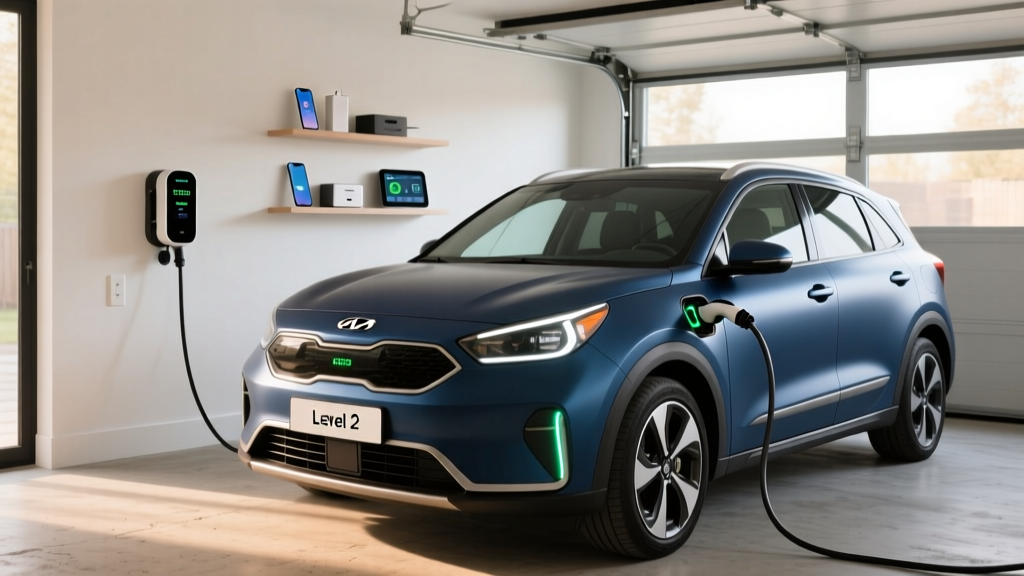
Level 2 is the home-charging standard. A 48-amp (11.5 kW) hardwired station adds roughly 40–45 miles per hour to a typical midsize EV like the Hyundai Ioniq 6 or Tesla Model 3. Most owners wake to a full battery every morning.
DC fast charging bypasses the vehicle's onboard charger entirely, delivering direct current straight to the battery. Peak speeds apply only between roughly 10–50% state of charge; above 80%, the charge curve tapers sharply to protect battery health. A vehicle advertising "250 kW peak" may sustain that rate for only 10–15 minutes before dropping to 100 kW or less.
Connector Compatibility: Which Car Charging Cable Fits Your EV?
The North American charging landscape consolidated significantly after Tesla opened its Supercharger network and the North American Charging Standard (NACS) emerged as the dominant connector. By 2026, nearly all new light-duty EVs sold in the US ship with NACS ports. Legacy CCS1 vehicles require an adapter for Tesla Superchargers and newer NACS stations.
| Connector | Also Known As | Vehicles Using It | Adapter Needed? |
|---|---|---|---|
| NACS | Tesla connector / J3400 | Tesla (all years), Ford F-150 Lightning, GM Ultium vehicles (2025+), Rivian (2025+), Hyundai/Kia (2025+), most 2026 models | No for NACS-native vehicles; CCS-to-NACS adapters available for legacy CCS cars at non-Tesla stations |
| CCS1 | Combined Charging System | Pre-2025 VW ID.4, BMW iX, older Hyundai/Kia/Stellantis EVs | NACS-to-CCS adapter required for Tesla Superchargers |
| CHAdeMO | — | Nissan Leaf (legacy); essentially discontinued on new vehicles | Limited adapter options; network support declining |
If you own a pre-2025 CCS1 vehicle, budget $200–$400 for a certified NACS-to-CCS adapter (sold by Tesla, Lectron, and others). This unlocks access to over 25,000 Supercharger stalls. CHAdeMO owners face a shrinking public network — home Level 2 charging becomes the primary strategy.
For Level 2 home charging, the J1772 connector was the prior standard. Newer NACS-equipped vehicles accept Level 2 via the same NACS port using a J1772-to-NACS adapter (typically included with the vehicle). Most 2026-model EVs now ship with a NACS inlet that handles both AC Level 2 and DC fast charging through the same port.
Home Installation: Electrical Requirements, Panel Upgrades, and Costs
Installing a Level 2 home charger is an electrical project, not a plug-and-play purchase. The total cost depends on your panel's available capacity, the distance from panel to charger location, and local permitting requirements.
Electrical Requirements by Charger Amperage
EV chargers draw continuous load, meaning the National Electrical Code (NEC) requires the circuit to be rated at 125% of the charger's maximum draw. A 48-amp charger requires a 60-amp dedicated circuit. A 32-amp charger needs a 40-amp circuit.
- 32-amp charger (7.7 kW): 40-amp breaker, 8 AWG copper wire, adds ~28–30 miles/hour
- 40-amp charger (9.6 kW): 50-amp breaker, 6 AWG copper wire, adds ~35 miles/hour
- 48-amp charger (11.5 kW): 60-amp breaker, 4 AWG copper wire, adds ~42 miles/hour
- 80-amp charger (19.2 kW): 100-amp breaker, requires substantial panel capacity, adds ~65–75 miles/hour
Panel Capacity and Upgrade Reality
Most homes built before 2000 have 100-amp or 150-amp main panels. A 200-amp panel is now standard for new construction. Before installing a 60-amp EV circuit, your electrician will perform a load calculation (NEC Article 220) to verify your panel can handle the additional continuous draw alongside HVAC, electric range, dryer, and other circuits.
If your panel is already near capacity — common in homes with electric heat, electric water heaters, and an electric range — you may need a panel upgrade to 200 amps or the installation of an automated load-management device like the Emporia Smart Load Center or Span panel, which dynamically sheds non-essential loads when the EV charger is running.
| Component | Cost Range | Notes |
|---|---|---|
| Level 2 charger hardware | $350–$750 | 40–48 amp smart charger; Wi-Fi enabled |
| Electrician labor (standard install, <50 ft run) | $500–$1,200 | Varies by region; hardwired costs more than NEMA 14-50 outlet |
| Electrical permit | $50–$250 | Required in most jurisdictions; inspection included |
| Wire and conduit materials | $100–$400 | Longer runs and underground conduit increase cost |
| Panel upgrade (if needed) | $1,500–$4,000 | 100A to 200A upgrade; not always necessary |
| Total (no panel upgrade) | $1,000–$2,600 | Typical scenario for modern 200A-panel homes |
| Total (with panel upgrade) | $2,500–$6,600 | Older homes with 100A panels and high existing loads |
Some utilities offer rebates of $250–$1,000 for Level 2 charger installation, and certain states provide additional incentives. Check your local utility's EV programs before scheduling work. The federal Alternative Fuel Vehicle Refueling Property Credit (IRC §30C) may cover up to 30% of charger and installation costs (capped at $1,000 for residential property), subject to census-tract eligibility — consult a tax professional for your specific situation.
Charging Time Examples: 10–80% for Common Battery Sizes
Real-world charging time depends on battery capacity, the charger's sustained power delivery, and the vehicle's charge-curve profile. Below are representative 10–80% times assuming the vehicle's maximum AC acceptance rate on Level 2 and typical DC fast-charge curves.
| Battery Size | Example Vehicles | Level 2 (48A / 11.5 kW) | DC Fast (150 kW peak) | DC Fast (250–350 kW peak) |
|---|---|---|---|---|
| 60 kWh | Chevy Equinox EV, base Model 3 | ~4.5 hours | ~30 min | ~18–22 min |
| 77–82 kWh | Model Y LR, VW ID.4, Ioniq 5 | ~5.5–6.5 hours | ~35–40 min | ~20–28 min |
| 100–115 kWh | F-150 Lightning Ext, Rivian R1S, Lucid Air | ~8–9.5 hours | ~50–60 min | ~30–40 min |
Note that DC fast-charge times assume battery preconditioning is active (the vehicle has navigated to the charger or you've manually enabled preconditioning). Without preconditioning, a cold battery may accept only 50–80 kW initially, adding 10–15 minutes to your stop. In winter conditions below freezing, expect 10–80% times to increase by 20–40% unless the vehicle has an active thermal management system that warms the pack en route.
Cost to Charge: Per-Mile Comparison vs. Gasoline
The economics of EV charging vary dramatically depending on where and when you plug in. Here are realistic 2026 scenarios for a midsize EV averaging 3.5 miles per kWh (roughly 285 Wh/mile, similar to a Tesla Model Y or Hyundai Ioniq 6).
| Scenario | Cost per kWh | Cost per Mile | Annual Cost (12,000 mi) |
|---|---|---|---|
| Home, off-peak utility rate | $0.08–$0.12 | $0.023–$0.034 | $275–$410 |
| Home, standard residential rate | $0.14–$0.20 | $0.040–$0.057 | $480–$685 |
| Public Level 2 (workplace/retail) | $0.20–$0.35 | $0.057–$0.100 | $685–$1,200 |
| DC Fast Charging (Electrify America, EVgo, Tesla) | $0.30–$0.55 | $0.086–$0.157 | $1,030–$1,885 |
| Gasoline equivalent (28 MPG, $3.40/gal) | — | $0.121 | $1,455 |
Home charging on an off-peak or time-of-use (TOU) rate plan delivers the strongest economics — often one-quarter the per-mile cost of gasoline. Even at standard residential rates, most EV owners save $700–$1,100 annually on fuel versus a comparable 28 MPG gas vehicle. However, if you rely exclusively on DC fast charging, your per-mile cost can equal or exceed gasoline. This is why home or workplace Level 2 access is the single most important factor in EV ownership economics.
According to fueleconomy.gov, the average 2026 EV achieves 97–130 MPGe combined, translating to 2.5–4.0 miles per kWh. Your actual efficiency varies with driving speed, temperature, terrain, and climate-control use.
Recommended Home Chargers: Equipment Picks for 2026
We evaluate home chargers on power output, connector compatibility, cable length, smart features (scheduling, load management, energy tracking), build quality, and price. Below are our top picks across common use cases.
Best Overall: ChargePoint Home Flex (NACS or J1772)
- Power: Up to 50 amps (12 kW) on a 60-amp circuit; adjustable down to 16A for lower-capacity panels
- Connector: Available with NACS or J1772 cable
- Cable length: 23 feet
- Smart features: Wi-Fi, app scheduling, Alexa/Google integration, energy reporting, flexible amperage dip-switch setting
- Price: ~$550–$650
- Best for: Most homeowners wanting reliable, app-connected Level 2 with adjustable amperage to match their panel
Best Value: Emporia Level 2 EV Charger
- Power: Up to 48 amps (11.5 kW) on a 60-amp circuit
- Connector: J1772 (NACS adapter included or available separately)
- Cable length: 24 feet
- Smart features: Wi-Fi, real-time energy monitoring, solar integration (pairs with Emporia Vue panel monitor), TOU scheduling
- Price: ~$350–$400
- Best for: Budget-conscious buyers and solar-panel owners who want detailed energy tracking
Best for Tesla/NACS Owners: Tesla Wall Connector
- Power: Up to 48 amps (11.5 kW) on a 60-amp circuit
- Connector: Native NACS (also includes J1772 adapter for non-Tesla EVs on newer units)
- Cable length: 24 feet
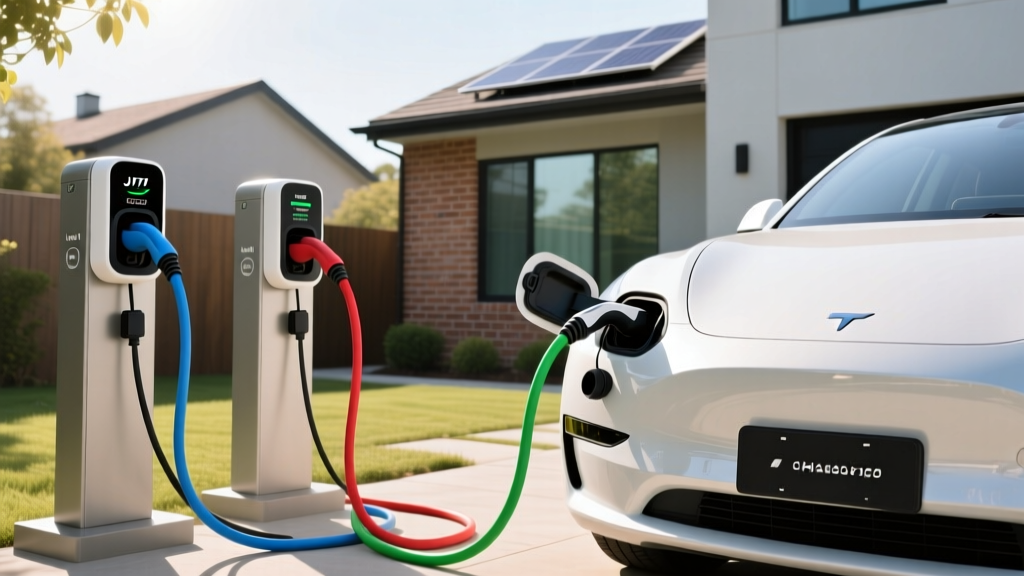
- Smart features: Wi-Fi, over-the-air updates, power sharing between two units on one circuit, access control
- Price: ~$475
- Best for: Tesla owners and households with multiple NACS vehicles
Best Portable Option: Lectron V-BOX Pro
- Power: Up to 40 amps (9.6 kW) via NEMA 14-50 plug; 16 amps (1.9 kW) on 120V
- Connector: J1772 with optional NACS adapter
- Cable length: 20 feet
- Smart features: Basic display screen, no Wi-Fi (portable trade-off)
- Price: ~$280–$350
- Best for: Renters who can't hardwire, travelers, or as a backup to a primary station
Safety, Electrical Code, and Outdoor Installation Considerations
A compliant, safe installation protects you, your home, and your vehicle. Key code and safety requirements include:
- Dedicated circuit: Your Level 2 charger must be on its own dedicated breaker — no sharing with other outlets or appliances.
- GFCI protection: NEC 2020 and later require ground-fault circuit interrupter protection for EV charging outlets. Hardwired chargers typically have built-in GFCI; receptacle-based installs require a GFCI breaker. Note: some EVs and chargers experience nuisance tripping with certain GFCI breakers — consult your electrician on compatible pairings.
- NEMA 14-50 receptacle quality: If using a plug-in charger rather than hardwiring, use a commercial-grade or industrial-grade 14-50 receptacle (Hubbell, Bryant, or Cooper — not budget residential-grade). Loose connections in cheap receptacles have caused melting and fire in high-draw EV applications.
- Outdoor rating: If mounting outdoors, the charger must carry a NEMA 4 or NEMA 4X rating for weather resistance. Most major chargers (ChargePoint, Tesla Wall Connector, Emporia) are rated for outdoor use, but verify before purchasing.
- Wire gauge: Your electrician will size wire per NEC Table 310.16. For a 60-amp circuit in typical residential NM-B (Romex), 4 AWG copper is standard. Longer runs may require upsizing to 3 AWG to limit voltage drop below 3%.
- Permit and inspection: Most jurisdictions require a permit for new 240V circuits. The inspection verifies correct wire gauge, breaker sizing, grounding, and GFCI compliance. Never skip this step — it affects insurance coverage in the event of an electrical fire.
Hardwired installations are generally preferred over receptacle-based for new construction or garage renovations. Hardwiring eliminates the failure point of a plug/receptacle connection, allows higher amperage (some 80-amp chargers require hardwiring), and avoids the GFCI nuisance-tripping issue that plagues some 14-50 installations.
Frequently Asked Questions
How much does it cost to install a home EV charger?
A standard Level 2 home charger installation with a 200-amp panel and a short wire run typically costs $1,000–$2,600 total, including the charger hardware ($350–$750), electrician labor ($500–$1,200), materials ($100–$400), and permit ($50–$250). If your home needs a panel upgrade from 100A to 200A, add $1,500–$4,000. Always get a load calculation from a licensed electrician before committing to a specific charger amperage.
How fast will each charging level add range?
Level 1 (120V) adds 3–5 miles of range per hour — adequate for PHEVs or very low daily mileage. Level 2 (240V, 48 amps) adds 35–45 miles per hour, fully replenishing most EVs overnight. DC fast charging adds 150–1,000+ miles per hour at peak power, but the charge curve tapers significantly above 80% state of charge, so practical road-trip stops take 18–40 minutes for a 10–80% fill.
Which connector and charger is compatible with my EV?
Check your vehicle's charge port. If it's a 2025+ model from Ford, GM, Rivian, Hyundai, Kia, or any Tesla, it almost certainly uses NACS. Pre-2025 non-Tesla EVs likely use CCS1. The Nissan Leaf uses CHAdeMO. For home Level 2, match your charger's connector to your car's port, or use the J1772-to-NACS adapter that ships with most new NACS vehicles. Refer to your owner's manual or the manufacturer's charging specifications page for your exact model.
How much does charging cost per mile compared to gas?
At home on off-peak rates ($0.08–$0.12/kWh), an efficient EV costs $0.02–$0.03 per mile — roughly 75–80% less than a 28 MPG gas car at $3.40/gallon ($0.12/mile). Even at standard residential rates, EV home charging saves $700–$1,100 annually over gasoline for a 12,000-mile driver. Public DC fast charging ($0.30–$0.55/kWh) narrows the gap to near parity with gasoline, which is why home charging access is essential for maximizing EV economics.
What electrical upgrades might I need before installing a charger?
If your home has a 100-amp main panel with high existing loads (electric heat, electric range, electric dryer), you may need a panel upgrade to 200 amps ($1,500–$4,000). Alternatives include installing a lower-amperage charger (32 amps instead of 48), using a smart load-management device that reduces charger power when other circuits are heavily loaded, or upgrading to a smart electrical panel (e.g., Span) that provides circuit-level control. Your electrician's NEC Article 220 load calculation will determine what's required.
The right car charging cable setup for your home comes down to three inputs: your vehicle's connector type, your daily mileage needs, and your electrical panel's spare capacity. Most EV owners find that a 40–48 amp Level 2 station on a dedicated 50–60 amp circuit delivers the ideal balance of charging speed, installation cost, and overnight convenience — waking to a full battery every morning for a fraction of what gasoline would cost.