The Three Car Charger Types Every EV Owner Must Know
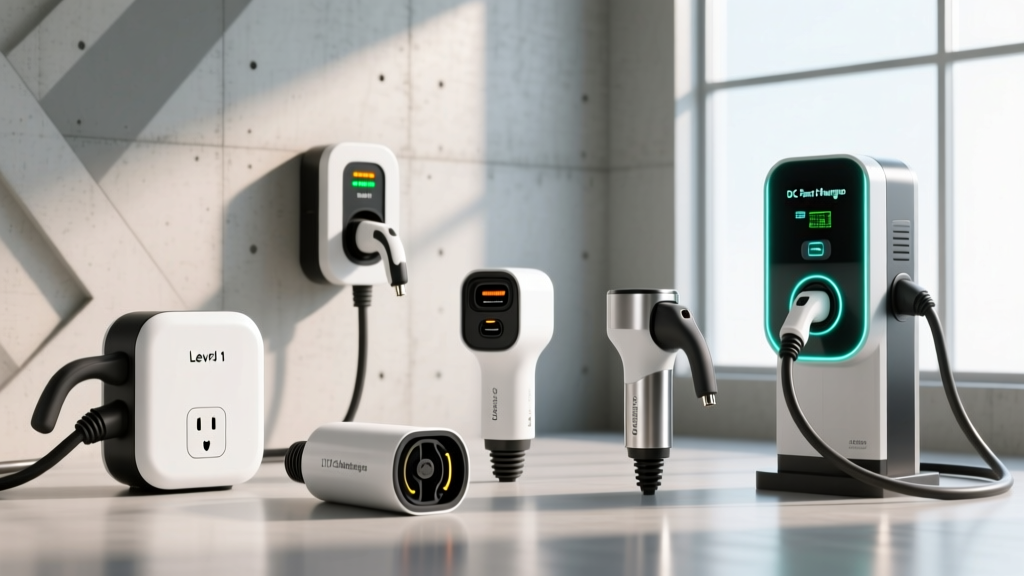
Choosing the right charger is the single most consequential decision you'll make after buying an electric vehicle. Get it wrong and you're staring at a 14-hour charge time before a road trip. Get it right and you'll wake up every morning with a full battery at a fraction of what gas would cost. The confusion starts with terminology: when people search for car charger types, they're usually looking for clarity on three distinct charging levels — and the connectors, costs, and electrical requirements that come with each.
Before we break down each level, let's settle the most common EV literacy gap: kW (kilowatts) measures power — how fast electricity flows into your battery, like water pressure from a hose. kWh (kilowatt-hours) measures energy — the total amount stored, like gallons in a tank. A 72 kWh battery charged at 11.5 kW takes roughly 6.3 hours from empty. That distinction will matter every time you evaluate a charger.
| Charging Level | Voltage | Power (kW) | Miles of Range Added per Hour | Typical Use Case |
|---|---|---|---|---|
| Level 1 (120V) | 120V AC | 1.0–1.4 kW | 3–5 mi/hr | Overnight trickle, PHEVs, emergency top-ups |
| Level 2 (240V) | 240V AC | 3.3–19.2 kW | 12–75 mi/hr | Daily home charging, workplace, shopping centers |
| DC Fast Charging | 200–900V DC | 50–350+ kW | 150–1,200+ mi/hr (peak) | Road trips, highway corridors, quick top-ups |
The miles-per-hour figures vary based on vehicle efficiency. A Hyundai Ioniq 6 (EPA-rated at 27 kWh/100mi combined per fueleconomy.gov) gains range faster than a GMC Hummer EV (which pushes over 47 kWh/100mi). Always cross-reference the charger's kW output with your vehicle's onboard charger capacity — a 48-amp Level 2 station delivers 11.5 kW, but if your car's onboard charger maxes at 7.7 kW (common on older Nissan Leaf models), you'll only receive 7.7 kW regardless.
Level 1 Charging: What You Get From a Standard Wall Outlet
Every EV sold in the US ships with a Level 1 charging cable that plugs into a standard 120V household outlet (NEMA 5-15). It's the simplest car charger type — no installation, no permits, no electrician. The tradeoff is speed: at roughly 1.2 kW, you're adding about 4 miles of range per hour. For a 75 kWh battery pack (like the Tesla Model Y Long Range), a full charge from 10% takes over 55 hours.
Level 1 makes practical sense in two scenarios. First, plug-in hybrid owners: a PHEV like the Toyota RAV4 Prime has just 18.1 kWh of usable battery, so Level 1 replenishes the full electric range (42 EPA miles) in roughly 12 hours overnight. Second, BEV owners who drive fewer than 30 miles daily and can leave the car plugged in for 12+ hours consistently. For everyone else, Level 1 is a backup — the cable you keep in the trunk for emergencies or hotel stays.
Level 2 Home Charging: The Daily Driver's Standard
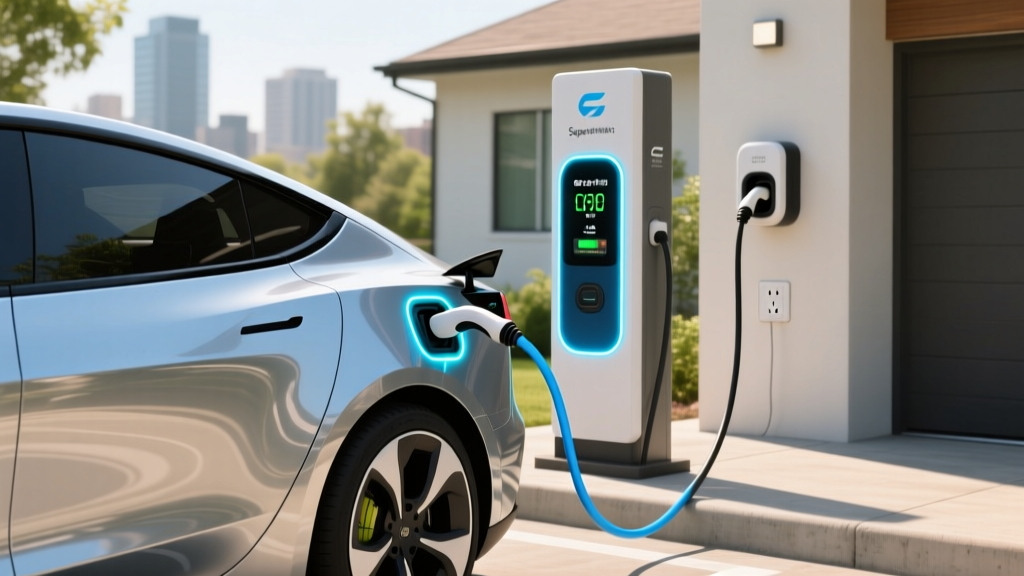
Level 2 is where 90%+ of EV charging actually happens for battery-electric owners. Operating at 240V (the same voltage as your electric dryer or oven), a Level 2 home charger delivers between 3.3 kW and 19.2 kW depending on the circuit amperage and your vehicle's onboard charger. Most homes install a 40-amp or 48-amp circuit, yielding 9.6 kW or 11.5 kW respectively — enough to fully recharge a 75 kWh battery in 6.5 to 8 hours overnight.
Electrical Requirements for Level 2 Installation
A 48-amp Level 2 charger requires a dedicated 60-amp circuit (the National Electrical Code requires circuits to be rated at 125% of the continuous load). That means 6-gauge copper wire run from your electrical panel to the charger location. Here's what your electrician will evaluate:
- Panel capacity: Most modern homes have 200-amp service panels. If your panel is already near capacity (common with electric heating, tankless water heaters, or older 100-amp panels), you may need a service upgrade to 200A or 400A — a $2,000–$5,000 job on its own.
- Dedicated circuit: The charger must have its own breaker — no sharing with other appliances. A 60A breaker occupies two slots in your panel.
- GFCI protection: The 2023 NEC (adopted in most jurisdictions by 2026) requires GFCI protection for EV charging circuits. Some chargers have built-in GFCI; otherwise, your electrician will install a GFCI breaker ($50–$120 additional).
- Outdoor rating: If mounting outside, the charger must carry a NEMA 4 or NEMA 4X weather-resistance rating. All recommended units below qualify.
- Permit: Nearly all US jurisdictions require an electrical permit for a new 240V circuit. Your electrician typically pulls this and schedules inspection.
How Much Does It Cost to Install a Home EV Charger?
Installation costs vary enormously based on your home's electrical setup and the distance from panel to charger. A straightforward install in a garage with the panel nearby runs $500–$1,200 in labor. A complex run through finished walls, under a crawlspace, or requiring a panel upgrade can push past $3,500. Here's a realistic breakdown:
| Cost Component | Simple Install (Garage, Panel Adjacent) | Complex Install (Long Run, Panel Upgrade) |
|---|---|---|
| Level 2 Charger Equipment | $350–$650 | $350–$650 |
| Electrician Labor (2–4 hrs typical; 6–10 hrs complex) | $300–$800 | $900–$2,000 |
| Materials (Wire, Conduit, Breaker) | $100–$300 | $300–$800 |
| Permit Fee | $50–$150 | $50–$200 |
| Panel Upgrade (if needed: 100A → 200A) | Not required | $1,500–$3,500 |
| Total Estimated Cost | $800–$1,900 | $3,100–$7,150 |
The federal Alternative Fuel Vehicle Refueling Property Credit (IRC §30C) covers 30% of home charger equipment and installation costs, up to $1,000, for eligible taxpayers in qualifying census tracts. Check the IRS eligibility tool — the census-tract requirement eliminates many suburban and rural addresses.
DC Fast Charging: Road-Trip Speeds and Connector Realities
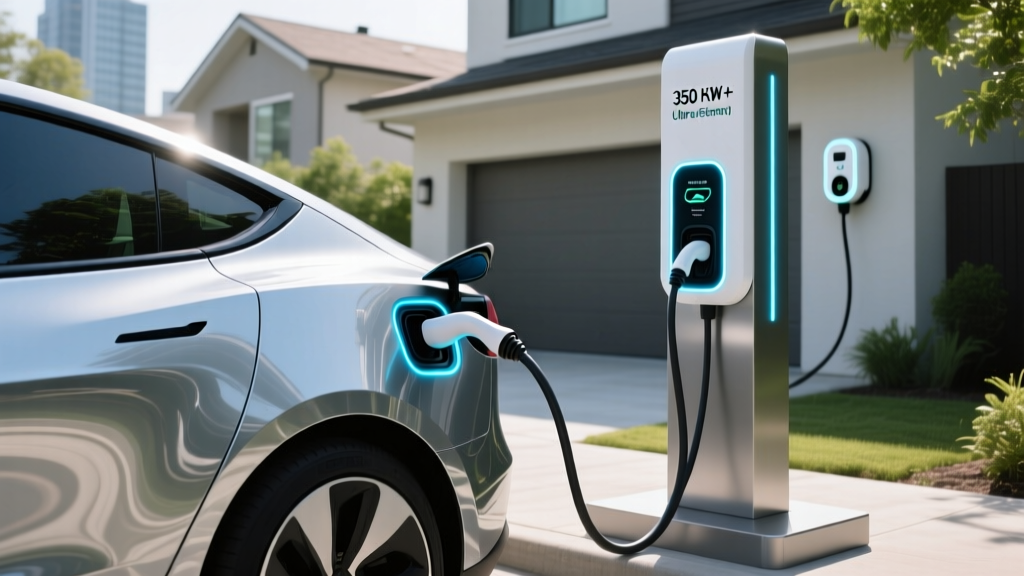
DC fast chargers bypass your car's onboard charger and feed direct current straight to the battery at 50 kW to over 350 kW. These are the units you'll find at highway rest stops, shopping plazas, and dedicated charging stations operated by networks like Electrify America, EVgo, and Tesla Supercharger. A 350 kW station can add 200+ miles of range in 15 minutes to a compatible vehicle like the Hyundai Ioniq 5 or Porsche Taycan — but only under ideal conditions.
Real-world DC fast charging involves a charge curve taper that most marketing materials gloss over. Your vehicle will accept peak power only between roughly 10% and 40% state of charge. Above 50%, the rate throttles significantly to protect battery health. A vehicle that "peaks at 240 kW" may sustain that rate for only 8–12 minutes before tapering to 100 kW, then 50 kW above 80%. This is why the industry standard metric is 10–80% charge time, not peak kW alone.
10–80% Charging Time Examples for Common Battery Sizes
| Vehicle (2025–2026) | Battery (kWh usable) | Peak DC Rate (kW) | 10–80% Time (minutes) | Charger Type Needed |
|---|---|---|---|---|
| Tesla Model 3 Long Range | 75 kWh | 250 kW | ~25 min | V3 Supercharger (250 kW) or CCS adapter |
| Hyundai Ioniq 5 (Long Range AWD) | 77.4 kWh | 240 kW (800V architecture) | ~18 min | 350 kW CCS station |
| Ford F-150 Lightning (Extended Range) | 131 kWh | 155 kW | ~41 min | 150+ kW CCS station |
| Chevrolet Equinox EV (3RS) | 85 kWh | 150 kW | ~32 min | 150+ kW CCS or NACS station |
| Nissan Ariya (e-4ORCE) | 87 kWh | 130 kW | ~38 min | CHAdeMO or CCS (market-dependent) |
Note that the Ioniq 5's 800V architecture lets it sustain higher charge rates longer than 400V competitors — the reason its 10–80% time beats vehicles with similar battery sizes. Battery chemistry also matters: LFP (lithium iron phosphate) packs, used in the Tesla Model 3 RWD and some Ford Mustang Mach-E trims, tolerate frequent 100% charges better than NMC chemistries but generally accept DC fast charging at slightly lower peak rates.
Connector Compatibility: NACS, CCS1, and CHAdeMO in 2026
The connector landscape has consolidated dramatically since 2023, when Ford, GM, Rivian, Volvo, and most major automakers committed to adopting Tesla's North American Charging Standard (NACS) for their vehicles. By the 2026 model year, the majority of new EVs sold in the US ship with a native NACS port. CCS1 — the previous standard backed by most non-Tesla automakers — remains on many 2023–2025 models and is still supported at public stations, but it's becoming the legacy connector. CHAdeMO, used primarily on the Nissan Leaf and Mitsubishi Outlander PHEV, is effectively discontinued for new vehicles.
| Connector | Current Status (2026) | Vehicles Using It | Adapter Availability |
|---|---|---|---|
| NACS (Tesla standard) | Dominant standard for new vehicles | All Tesla models; 2025+ Ford, GM, Rivian, Volvo, Hyundai, Kia (select models); expanding rapidly | CCS-to-NACS adapters available from Tesla and third parties (~$200–$250) |
| CCS1 | Legacy but widely supported at public stations | 2022–2024 non-Tesla EVs (VW ID.4, older Ioniq 5, BMW i4, etc.) | NACS-to-CCS adapters available; many networks adding NACS cables |
| CHAdeMO | Discontinued for new vehicles; stations phasing out | Nissan Leaf (all years), Mitsubishi Outlander PHEV (older) | Limited adapter options; rely on remaining CHAdeMO stations |
If you own a CCS-equipped vehicle from 2023–2025, you can access Tesla's Supercharger network using an approved CCS-to-NACS adapter. Tesla officially opened its Supercharger network to non-Tesla EVs with adapters, and as of 2026, over 15,000 Supercharger stalls in North America support NACS-equipped non-Tesla vehicles. Before purchasing any adapter, confirm compatibility with your specific model year — some early adapters had firmware issues with certain vehicles.
How Much Does EV Charging Cost Per Mile vs. Gas?
Charging costs depend entirely on where and when you charge. Home charging on an off-peak utility rate is the cheapest scenario; DC fast charging on a road trip is the most expensive. Here's a realistic cost breakdown using the national average electricity rate of $0.17/kWh (home) and typical public/DCFC rates, compared against a gas vehicle averaging 28 MPG combined at $3.40/gallon:
| Charging Scenario | Rate ($/kWh) | Cost to Add 200 Miles* | Cost Per Mile | Gas Equivalent (28 MPG, $3.40/gal) |
|---|---|---|---|---|
| Home Level 2 — Off-Peak Utility Rate | $0.09–$0.13 | $5.04–$7.28 | $0.025–$0.036 | $24.29 ($0.121/mi) |
| Home Level 2 — Standard Flat Rate | $0.15–$0.19 | $8.40–$10.64 | $0.042–$0.053 | $24.29 ($0.121/mi) |
| Public Level 2 (Workplace, Shopping) | $0.20–$0.35 | $11.20–$19.60 | $0.056–$0.098 | $24.29 ($0.121/mi) |
| DC Fast Charging (Highway Network) | $0.35–$0.55 | $19.60–$30.80 | $0.098–$0.154 | $24.29 ($0.121/mi) |
*Based on a vehicle averaging 28 kWh/100mi (typical mid-size crossover EV like the Tesla Model Y or Hyundai Ioniq 5). More efficient sedans use ~25 kWh/100mi; heavy trucks like the F-150 Lightning use 45–50 kWh/100mi.
The takeaway: home charging delivers 50–75% fuel cost savings versus gas. Public DC fast charging on road trips can approach or even exceed gas costs per mile — the convenience premium is real. This is why home Level 2 installation pays for itself within 1–3 years for most drivers covering 10,000+ miles annually. Enroll in your utility's time-of-use (TOU) rate plan to lock in off-peak rates between 10 PM and 6 AM.
Equipment Recommendations: Best Home Level 2 Chargers in 2026
The home charger market has matured considerably. In 2026, a quality Level 2 unit should deliver at least 40 amps (9.6 kW), include a 25-foot cable minimum, offer Wi-Fi connectivity for scheduling and energy monitoring, and carry UL certification. Here are three proven options across price tiers:
Emporia Level 2 EV Charger
- Power Output: 48 amps / 11.5 kW (requires 60A circuit)
- Connector: NACS native (J1772 adapter included)
- Cable Length: 24 feet
- Smart Features: Wi-Fi, app-based scheduling, solar integration, energy monitoring, load management for homes with limited panel capacity
- Price: ~$399
- Best For: Budget-conscious buyers wanting full smart features and solar-home integration
ChargePoint Home Flex
- Power Output: Configurable 16–50 amps / up to 12 kW (adjustable to match your circuit)
- Connector: NACS (J1772 adapter available); previous-gen units shipped J1772
- Cable Length: 23 feet
- Smart Features: Wi-Fi, Alexa/Google Home integration, flexible amperage dial for panel-limited homes, detailed charging history
- Price: ~$549
- Best For: Homes with older panels where adjustable amperage avoids a costly upgrade
Tesla Wall Connector (Gen 4)
- Power Output: 48 amps / 11.5 kW (requires 60A circuit)
- Connector: NACS native (J1772 adapter sold separately, ~$200)
- Cable Length: 24 feet
- Smart Features: Wi-Fi, over-the-air updates, Power-Sharing (link up to 6 units on one circuit for multi-EV garages), Tesla app integration
- Price: ~$475
- Best For: Tesla owners or multi-EV households wanting power-sharing capability
All three units are NEMA 4X rated for outdoor installation, UL-listed, and eligible for the federal §30C charger tax credit (30% of cost, up to $1,000, subject to census-tract eligibility per IRS guidelines). If your vehicle still has a CCS port, confirm that the charger's connector or adapter is compatible before purchasing.
Safety, Code Compliance, and Installation Best Practices
A Level 2 charger draws continuous high current for hours — it's one of the most demanding loads in your home. Cutting corners on installation risks fire, voided warranties, and insurance claim denials. Here's what proper installation requires:
- Dedicated circuit only: Never share the charger circuit with other outlets or appliances. Continuous loads (defined by the NEC as operating 3+ hours) must have a circuit rated 125% above the load — a 48A charger needs a 60A breaker.
- Correct wire gauge: 6 AWG copper for 60A circuits over runs under 100 feet. Longer runs may require 4 AWG to prevent voltage drop. Your electrician calculates this.
- GFCI protection: Required by the 2023 NEC for EV supply equipment. Some chargers integrate GFCI internally; confirm with your electrician to avoid nuisance tripping from a double-GFCI setup.
- Hardwired vs. plug-in: Hardwired installations (no plug — wires connect directly inside the unit) are preferred for 48A+ chargers. A NEMA 14-50 receptacle is acceptable up to 40A but requires a high-quality industrial-grade outlet ($40–$80, not the $12 hardware-store version) — cheap receptacles have caused documented fire incidents under sustained EV charging loads.
- Permit and inspection: Skipping the permit saves $50–$150 but creates liability if a fire occurs. Your homeowner's insurance may deny a claim stemming from unpermitted electrical work. Most jurisdictions offer straightforward EV charger permits with 1–2 week inspection timelines.
- Surge protection: Consider a whole-panel surge protector ($150–$300 installed) to guard the charger and vehicle from voltage spikes, particularly in areas with frequent lightning or grid instability.
Always hire a licensed electrician — not a handyman — for 240V EV charger installation. Look for electricians who advertise EV charger experience or hold manufacturer certifications (Tesla and ChargePoint both offer installer certification programs). Get at least two quotes; pricing varies 30–50% between electricians in most metro areas.
Frequently Asked Questions About Car Charger Types
How fast will each charging level add range to my EV?
Level 1 (120V) adds 3–5 miles of range per hour. Level 2 (240V) at 48 amps adds roughly 30–45 miles per hour for a typical crossover EV. DC fast charging at 150+ kW can add 150–250 miles in 15–20 minutes, though the charge curve tapers significantly above 50% state of charge. Exact rates depend on your vehicle's efficiency (kWh/100mi) and onboard charger capacity.
Which connector type is compatible with my EV?
For 2025–2026 model-year vehicles, most new EVs from Ford, GM, Rivian, Tesla, and expanding others use the NACS connector. Vehicles from 2022–2024 predominantly use CCS1. The Nissan Leaf uses CHAdeMO. Check your vehicle's charge port or owner's manual. If your car has CCS and you want to use Tesla Superchargers, purchase an approved CCS-to-NACS adapter.
How much does it cost to install a home Level 2 EV charger?
A straightforward garage installation with the electrical panel nearby typically costs $800–$1,900 total (equipment, labor, materials, permit). Complex installations requiring long wire runs, trenching, or a panel upgrade from 100A to 200A can reach $3,100–$7,150. The federal §30C credit may cover 30% of equipment and installation costs up to $1,000 if your address qualifies.
How much does EV charging cost per mile compared to gasoline?
Home charging on off-peak utility rates costs approximately $0.03–$0.05 per mile for a typical EV — roughly 60–75% less than a 28 MPG gas car at $3.40/gallon ($0.12/mile). Public DC fast charging at $0.35–$0.55/kWh costs $0.10–$0.15 per mile, approaching or matching gas costs. The savings case for EVs depends heavily on consistent home charging access.
What electrical upgrades might I need before installing a charger?
The most common upgrade is a panel service increase from 100A to 200A ($1,500–$3,500), needed if your existing panel lacks capacity for a 60A charger circuit. You may also need panel space for a new double-pole breaker, wire upgrades for long runs, or a load-management device that dynamically reduces charger amperage when other appliances draw power. A licensed electrician can perform a load calculation to determine your exact requirements.
Can I charge my EV with a regular 120V outlet, or do I need a 240V charger?
Every EV can charge on a standard 120V outlet (Level 1), but at only 3–5 miles of range per hour, it's practical only for PHEVs with small batteries or BEV owners driving under 30 miles daily with 12+ hours of plugged-in time. For most BEV owners, a 240V Level 2 installation is necessary for convenient daily charging. Consider Level 1 a backup option for travel or emergencies.