Why Hotel EV Charging in Canada Matters More Than Ever
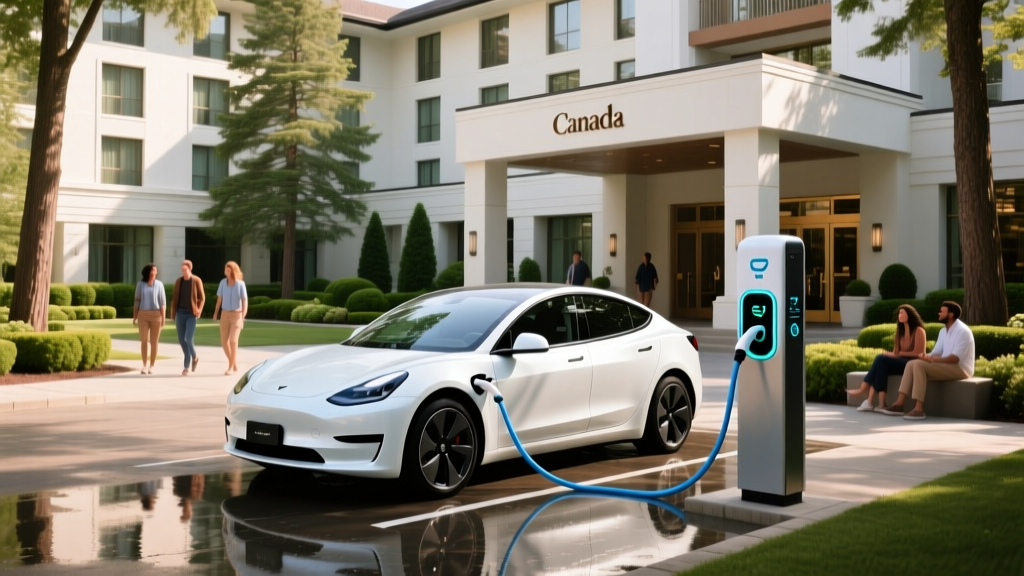
Canada added over 280,000 new EV registrations in 2025, and cross-province road trips in electric vehicles are no longer a novelty — they're routine. But here's the friction point every EV-driving traveler hits: overnight charging at hotels. You pull up to a property after a 400 km drive on the Trans-Canada, plug in, and… nothing. Or worse, a single 3.3 kW Level 2 station shared among 200 rooms, occupied by a gas car.
The keyword on every Canadian EV road-tripper's mind: best hotel parent brands in Canada for EV charging. This guide evaluates the major hotel parent companies operating across Canada — Marriott, Hilton, IHG, Accor, Choice Hotels, and Wyndham — on their actual EV charging infrastructure, connector availability, charging speeds, and the real-world economics of topping up while you sleep. We'll also cover what you need to know about charging levels, connector compatibility, and costs so you can plan smarter.
Charging Levels Explained: What You'll Find at Canadian Hotels
Before we rank brands, you need to understand the three charging levels and what they mean for your overnight stay. This distinction determines whether you wake up with a full battery or barely enough range to reach the next fast charger.
| Level | Voltage | Power (kW) | Miles Added/Hour | Typical Hotel Scenario |
|---|---|---|---|---|
| Level 1 | 120V AC | 1.2–1.9 kW | 3–5 mi/hr | Rare; standard outlet in garage (not practical overnight) |
| Level 2 | 208–240V AC | 3.3–19.2 kW | 12–75 mi/hr | Most common hotel offering; overnight sweet spot |
| DC Fast Charge | 400–800V DC | 50–350 kW | 180–1,200+ mi/hr | Uncommon at hotels; found at highway rest stops and select urban properties |
The critical distinction: kW (kilowatts) measures power — how fast energy flows into your battery. kWh (kilowatt-hours) measures energy — the total capacity of your battery. A 75 kWh battery charged at 7.2 kW takes roughly 10 hours from empty to full. A 50 kW DC fast charger can refill that same battery from 10–80% in about 50–60 minutes. For hotel overnight stays, Level 2 at 7.2 kW or higher is the practical target.
Ranking the Best Hotel Parent Brands in Canada for EV Charging
We evaluated six major hotel parent brands by their Canadian EV charging rollout, station density per property, connector types, and charging speeds. Data reflects publicly listed amenities as of early 2026, cross-referenced with PlugShare and ChargePoint network maps.
1. Marriott International (Marriott, Sheraton, Westin, Delta, Courtyard)
Marriott leads among legacy hospitality brands with a stated commitment to install EV charging at over 40% of its North American properties by 2027. In Canada, flagship properties like the Delta Hotels by Marriott Calgary Downtown and Sheraton Vancouver Guildford feature 7.2 kW Level 2 ChargePoint stations. However, rollout is inconsistent — suburban Courtyard locations often have zero chargers. Connector: predominantly J1772 (CCS1-compatible vehicles plug directly; NACS/Tesla vehicles need an adapter).
2. Hilton (Hilton, DoubleTree, Hampton, Homewood Suites)
Hilton partnered with EV charging networks to expand Canadian coverage, particularly at highway-adjacent properties along the 401 corridor in Ontario and the Trans-Canada in Alberta. Most installations are 7.2 kW Level 2 via ChargePoint or FLO (Canada's dominant network). Select DoubleTree locations in BC now feature 50 kW DC fast chargers. Connector: J1772 standard.
3. IHG Hotels & Resorts (Holiday Inn, Crowne Plaza, Staybridge)
IHG's Canadian EV infrastructure lags behind Marriott and Hilton. Holiday Inn Express properties — the most common roadside option — rarely list EV charging. Crowne Plaza locations in major metros (Toronto, Montreal) are better equipped, often with 2–4 Level 2 spaces. Connector: J1772.
4. Accor (Fairmont, Novotel, Pullman, ibis)
Fairmont properties — particularly the Fairmont Banff Springs and Fairmont Château Lake Louise — cater to EV-driving tourists with Level 2 charging, often through the FLO network. Budget-tier ibis and Novotel locations in Canada rarely offer charging. Accor's luxury tier punches above its weight for destination EV travelers.
5. Choice Hotels (Comfort Inn, Quality Inn, Clarion)
Choice Hotels has the lowest EV charging penetration among major brands in Canada. A handful of Quality Inn locations in Ontario and BC have added Level 2 stations, but most Comfort Inn properties along rural highways do not. For budget travelers, plan your charging stops independently using the FLO or Electrify Canada apps.
6. Wyndham (Ramada, Super 8, Days Inn, Howard Johnson)
Wyndham's Canadian portfolio is predominantly budget/mid-scale, and EV charging is scarce. Some Ramada properties near major airports have 1–2 Level 2 chargers, but availability is unreliable. Not recommended as a charging-dependent strategy.
Connector Compatibility: Will Your EV Plug In at Canadian Hotels?
Canadian hotels almost universally install J1772 connectors for Level 2 charging. Here's what that means for your vehicle:
| Your EV's Charge Port | Hotel Connector (J1772) | Adapter Needed? | Notes |
|---|---|---|---|
| CCS1 (Ford, GM, Hyundai, VW, most non-Tesla) | J1772 plugs directly into the AC portion of CCS1 | No | Plug and charge |
| NACS / Tesla (Model 3/Y/S/X, 2025+ Ford/GM/Rivian) | J1772 | Yes — J1772-to-NACS adapter | Tesla includes this adapter; Ford/GM NACS vehicles may need to purchase one (~$50–$100) |
| CHAdeMO (Nissan Leaf, older Mitsubishi) | J1772 | No (for AC Level 2) | CHAdeMO is a DC standard; Level 2 AC charging uses the J1772 inlet on these vehicles |
Pro tip: Always carry your J1772-to-NACS adapter if you drive a Tesla or a 2025+ NACS-equipped vehicle. Hotel front desks don't have adapters to lend. For DC fast chargers (rare at hotels), the connector will be either CCS1 or NACS — check the station listing on PlugShare before you book.
How Much Does Hotel EV Charging Cost in Canada?
Hotel EV charging pricing varies wildly — from complimentary (increasingly rare) to premium rates that exceed public fast-charging costs. Here's the breakdown:
| Charging Scenario | Cost ($CAD/kWh) | Cost per 100 km (avg EV at 18 kWh/100 km) | Equivalent Gas Cost per 100 km (at $1.65/L, 8 L/100 km) |
|---|---|---|---|
| Free hotel Level 2 | $0.00 | $0.00 | $13.20 |
| Hotel Level 2 (typical paid) | $0.15–$0.28/kWh | $2.70–$5.04 | $13.20 |
| FLO public Level 2 (Canada) | $0.15–$0.22/kWh | $2.70–$3.96 | $13.20 |
| Electrify Canada DC Fast | $0.35–$0.48/kWh | $6.30–$8.64 | $13.20 |
| Home charging (off-peak, Ontario) | $0.065/kWh | $1.17 | $13.20 |
Even at the highest hotel Level 2 rates, overnight EV charging costs roughly $3–$5 CAD for a full charge — a fraction of what a gas car would spend on the same distance. The economics only break down if a hotel charges a flat session fee (some charge $10–$15 per plug-in regardless of energy delivered). Always check the station pricing on the FLO or ChargePoint app before plugging in.
Charging Time Examples for Common EV Battery Sizes
Here's how long popular Canadian-market EVs take to charge from 10% to 80% State of Charge at typical hotel Level 2 speeds:
| Vehicle | Battery (kWh usable) | Max AC Charge Rate | 10–80% at 7.2 kW | 10–80% at 3.3 kW |
|---|---|---|---|---|
| Tesla Model Y (2026) | 75 kWh | 11.5 kW | ~7.3 hours | ~15.9 hours |
| Hyundai Ioniq 5 (2026) | 77.4 kWh | 10.9 kW | ~7.5 hours | ~16.4 hours |
| Ford Mustang Mach-E (2026) | 91 kWh (ER) | 10.5 kW | ~8.8 hours | ~19.3 hours |
| Chevrolet Equinox EV (2026) | 85 kWh | 11.5 kW | ~8.2 hours | ~18.0 hours |
| Nissan Leaf (2025) | 60 kWh | 6.6 kW | ~5.8 hours | ~12.7 hours |
Key insight: If your hotel only offers 3.3 kW Level 2, you will NOT fully recharge a large-battery EV overnight. Seek out properties advertising 6.6 kW or 7.2 kW stations, or plan a DC fast-charge stop before arrival.
Home Charging Setup: What Canadian EV Owners Need to Know
Hotel charging is a road-trip supplement. For daily use, a home Level 2 charger is essential. Here's what a Canadian home installation actually involves and costs:
Electrical Requirements
- Voltage/Amperage: 240V circuit, 40A breaker (delivers up to 32A continuous / 7.7 kW to the vehicle) or 60A breaker (48A continuous / 11.5 kW)
- Panel capacity: Your electrical panel must have spare capacity. A 200A panel in a modern home usually handles a 40A EV circuit. Older homes with 100A panels often need a panel upgrade ($2,000–$4,000 CAD) before adding an EV charger.
- Permit: Required in virtually all Canadian jurisdictions. Your electrician pulls the permit; inspection follows installation.
- Code requirements: Dedicated circuit, GFCI breaker (2026 Canadian Electrical Code update), NEMA 14-50 outlet rated for outdoor use if installed externally, or hardwired connection (preferred for reliability).
Installation Cost Breakdown
| Component | Cost Range (CAD) | Notes |
|---|---|---|
| Level 2 charger (hardware) | $500–$1,200 | Varies by brand, power output, smart features |
| Electrician labor | $800–$2,500 | Depends on run length from panel to garage/driveway |
| Permit & inspection | $100–$300 | Municipal fee; varies by province/city |
| Panel upgrade (if needed) | $2,000–$4,000 | 100A to 200A upgrade; older homes only |
| Total (no panel upgrade) | $1,400–$4,000 | Most modern homes fall in this range |
| Total (with panel upgrade) | $3,400–$8,000 | Common in pre-1990 homes |
Several Canadian provinces offer rebates that offset installation costs. Quebec's Roulez vert program provides up to $600 CAD for home charger installation; BC's CleanBC program offers up to $350 CAD. Federal incentives may also apply — check the Natural Resources Canada website for current programs.
Recommended Home EV Chargers for Canadian Climates
FLO Home X5 (Canadian-made)
- Power output: 7.2 kW (30A) or 9.6 kW (40A)
- Connector: J1772 (SAE)
- Cable length: 25 ft (7.6 m)
- Smart features: FLO app scheduling, energy monitoring, load sharing
- Cold-weather rating: -40°C to +50°C — built for Canadian winters
- Price: ~$700–$900 CAD
ChargePoint Home Flex
- Power output: Up to 12 kW (50A) — adjustable via DIP switch
- Connector: J1772 (NACS adapter available separately)
- Cable length: 23 ft (7 m)
- Smart features: Wi-Fi, Alexa integration, ChargePoint app, flexible amperage
- Cold-weather rating: -30°C to +50°C
- Price: ~$850–$1,100 CAD
Tesla Wall Connector
- Power output: Up to 11.5 kW (48A)
- Connector: NACS (native Tesla); J1772 adapter included for non-Tesla EVs
- Cable length: 24 ft (7.3 m)
- Smart features: Wi-Fi updates, power sharing with multiple Wall Connectors, Tesla app
- Cold-weather rating: -30°C to +50°C
- Price: ~$600–$750 CAD
For Canadian EV owners, the FLO Home X5 is the pragmatic pick — manufactured in Quebec, rated to -40°C, and fully compatible with Canada's dominant public FLO network. The ChargePoint Home Flex wins on maximum power output for homes with 60A circuit capacity. Tesla owners (and 2025+ NACS adopters) get the cleanest integration with the Wall Connector.
Planning Your Canadian EV Hotel Stay: A Decision Framework
Choose Marriott/Hilton if: You want the highest probability of Level 2 charging at a mainstream hotel, especially in major cities and along the 401/QEW corridors. Bring your J1772 adapter if you drive a NACS vehicle.
Choose Fairmont (Accor) if: You're heading to mountain/luxury destinations (Banff, Lake Louise, Whistler) where Fairmont has invested in FLO charging infrastructure.
Don't rely on hotel charging if: You're booking Choice Hotels, Wyndham, or budget IHG properties in rural areas. Plan DC fast-charge stops via Electrify Canada or Petro-Canada's Ultra E-Chat network instead.
Always verify before booking: Check the specific property on PlugShare or the FLO/ChargePoint app — brand-level commitments don't guarantee every location has chargers.
Frequently Asked Questions
How fast will each charging level add range?
Level 1 (120V): 3–5 miles per hour — impractical for anything beyond trickle-charging. Level 2 (240V, 7.2 kW): ~25–30 miles per hour, or a full overnight charge for most EVs. DC Fast Charging (50–350 kW): 180–1,200+ miles per hour, but stations are rarely found at hotels.
Which connector/charger is compatible with my EV?
Canadian hotel Level 2 stations use J1772 connectors. CCS1 vehicles (Ford, Hyundai, VW, GM pre-2025) plug in directly. NACS/Tesla vehicles need a J1772-to-NACS adapter (included with Tesla, sold separately for other NACS vehicles). CHAdeMO vehicles (Nissan Leaf) use J1772 for AC Level 2 charging.
How much does charging cost per mile vs gas?
At a typical Canadian hotel Level 2 rate of $0.20/kWh and an average EV efficiency of 3.5 miles/kWh, you're paying roughly $0.057 CAD per mile. A comparable gas car at 8 L/100 km and $1.65/L pays about $0.132 per mile. EV hotel charging is roughly 57% cheaper per mile than gas — and free hotel charging makes it 100% cheaper.
What electrical upgrades might I need for a home charger?
If your home has a 200A electrical panel with spare breaker slots, you likely need only a dedicated 40A or 60A circuit — no panel upgrade. Homes with 100A panels (common in pre-1990 construction) often require a panel upgrade to 200A, adding $2,000–$4,000 CAD to your installation cost. Always have a licensed electrician assess your panel before purchasing a charger.
How much does it cost to install a home EV charger?
In Canada, expect $1,400–$4,000 CAD for a complete Level 2 home installation (charger + electrician + permit) in a home that doesn't need a panel upgrade. With a panel upgrade, total costs range $3,400–$8,000 CAD. Provincial rebates in Quebec, BC, and other provinces can offset $350–$600 of this cost.
Do Canadian hotels charge for EV charging or is it free?
It varies by property. Many Canadian hotels still offer complimentary Level 2 charging as a guest amenity, but paid stations (typically $0.15–$0.28/kWh via FLO or ChargePoint) are becoming the norm. Some hotels charge a flat session fee of $10–$15 regardless of energy consumed. Always check the station's pricing on the network app before plugging in.
Sources: Charging infrastructure data cross-referenced via PlugShare, FLO Network, and individual hotel brand amenity listings. Electrical code references per the 2026 Canadian Electrical Code (CEC). Vehicle efficiency data from fueleconomy.gov and manufacturer specifications.