Quick Verdict: Tesla Chargers and Non-Tesla EVs
The short answer to "can a Tesla charger charge other cars" is yes — but the details depend on which Tesla charger you mean. Tesla's ecosystem now spans three distinct products, and each interacts differently with non-Tesla electric vehicles:
- Tesla Wall Connector (home Level 2): Ships with the NACS (North American Charging Standard) plug native to Teslas. Non-Tesla EVs with CCS1 ports need a NACS-to-CCS adapter (~$100-$200). EVs already built with NACS ports (Ford, Rivian, GM, and most major brands from 2025 onward) plug in directly.
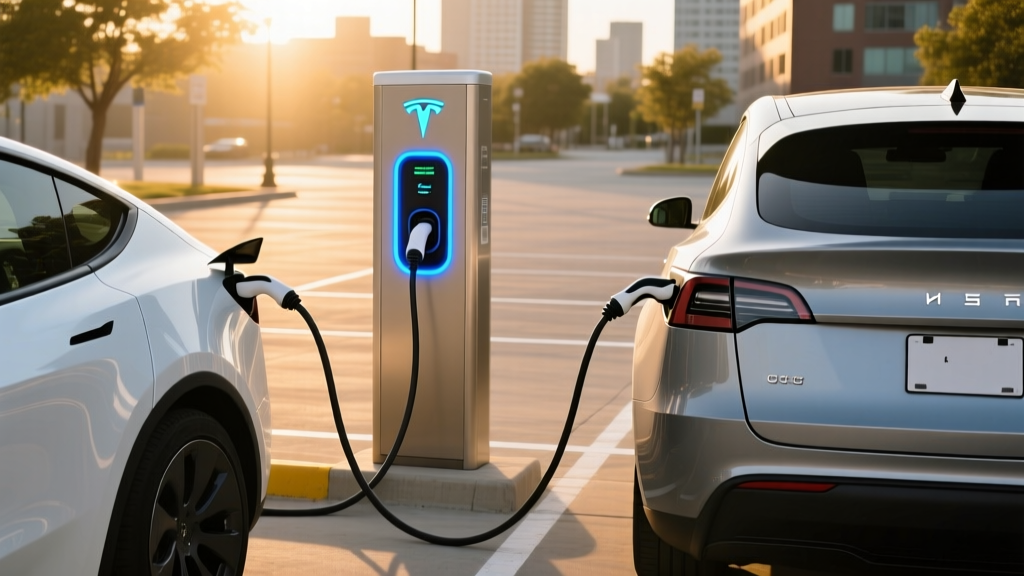
- Tesla Supercharger network (DC fast): As of 2026, the vast majority of new EVs sold in the US have adopted NACS ports and can access Superchargers natively. Older CCS1-equipped EVs require an approved adapter. Tesla has also opened select Supercharger stalls to CCS vehicles through its "Magic Dock" built-in adapter at specific locations.
- Tesla Mobile Connector (portable Level 1/2): Same NACS plug rules apply. Comes with a NEMA 14-50 adapter for 240V outlets.
Below, we break down charging speeds, installation costs, connector compatibility, and equipment picks so you can make a confident decision — whether you drive a Tesla, a Ford F-150 Lightning, a Hyundai Ioniq 5, or anything else.
Charging Levels Explained: kW, Speed, and What They Mean
Before choosing equipment, you need to understand the three charging levels and what each delivers. A critical distinction: kW (kilowatts) measures power — the rate of charging, while kWh (kilowatt-hours) measures energy — the battery's capacity. Think of kW as how fast water flows from a hose, and kWh as the size of the bucket you're filling.
| Level | Voltage | Power (kW) | Miles of Range Added Per Hour | Typical Use Case |
|---|---|---|---|---|
| Level 1 | 120V AC | 1.0 – 1.4 kW | 3 – 5 mi/hr | Overnight top-up, emergency |
| Level 2 | 240V AC | 7.2 – 19.2 kW | 25 – 75 mi/hr | Home daily charging, workplace |
| DC Fast Charge | 400V–800V DC | 50 – 350 kW | 150 – 1,000+ mi/hr (peak) | Road trips, rapid top-up |
Real-world charging time examples (10% to 80% State of Charge):
- 75 kWh battery (e.g., Tesla Model Y Long Range): ~18 min at a 250 kW DC fast charger (peak rate); ~8 hours on a 9.6 kW Level 2 home charger; ~55+ hours on Level 1.
- 84 kWh battery (e.g., Ford F-150 Lightning Extended Range): ~22 min at 250 kW DC; ~9 hours on 9.6 kW Level 2.
- 58 kWh battery (e.g., Volkswagen ID.4 Standard): ~28 min at 170 kW DC (its peak rate); ~6.5 hours on 9.6 kW Level 2.
Charge curve reality check: No EV sustains its peak charge rate for the entire session. DC fast charging follows a curve — power ramps up to a peak (typically between 10-30% SoC), holds for a window, then tapers significantly above 80%. That's why manufacturers quote 10-80% times, not 0-100%. Charging from 80% to 100% on DC fast can take as long as the 10-80% session. For daily driving, most owners set a charge limit at 80% (or 100% for LFP batteries, per manufacturer guidance) and use DC fast charging only for road trips.
Connector Compatibility: NACS, CCS1, CHAdeMO, and Adapters
The connector landscape shifted dramatically between 2023 and 2026. Here's where things stand:
| Connector | Brands Using It (New Vehicles) | Tesla Charger Compatibility |
|---|---|---|
| NACS (Tesla) | Tesla, Ford, GM, Rivian, Volvo, Polestar, Mercedes-Benz, Nissan (2025+), Honda, Hyundai/Kia (2025+), BMW, Lucid, Fisker | Native — plug directly into Wall Connector or Supercharger |
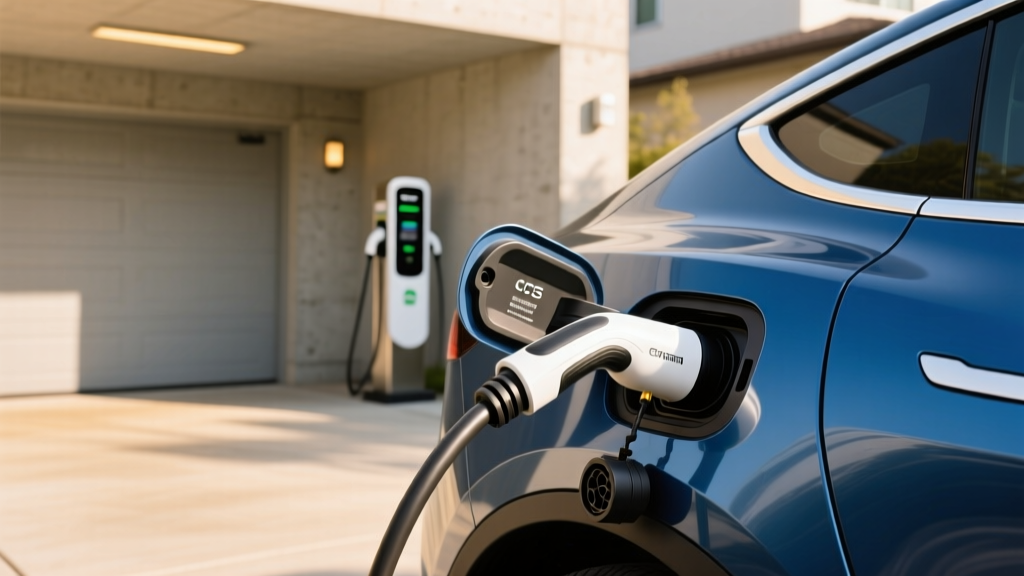
| CCS1 | Older Hyundai/Kia (pre-2025), VW ID.4 (pre-2025), BMW i4/iX (pre-2025), Stellantis, some legacy models still on dealer lots | Requires NACS-to-CCS adapter ($100–$200) for home Wall Connector; Supercharger access via adapter or Magic Dock stalls |
| CHAdeMO | Nissan Leaf (discontinued), Mitsubishi Outlander PHEV (older) | No practical adapter to NACS; use CHAdeMO public stations |
Installing a Tesla Wall Connector at Home: Costs and Electrical Requirements
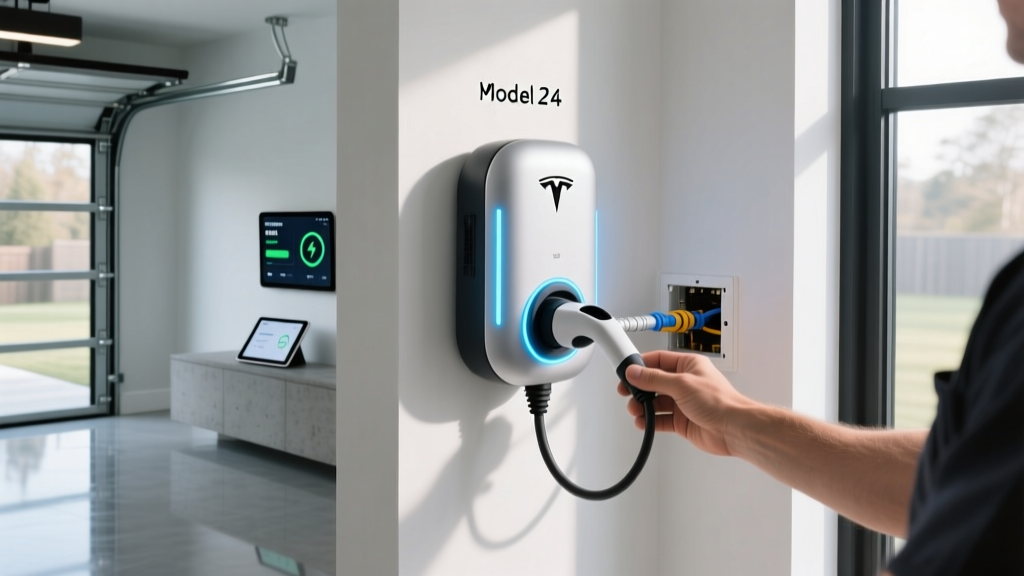
The Tesla Wall Connector (Gen 3) is one of the most popular home Level 2 chargers on the market — and not just for Tesla owners. Here's what installation involves.
Electrical Requirements
- Voltage: 240V (requires a dedicated double-pole breaker in your electrical panel)
- Amperage options: The Wall Connector supports up to 48 amps, which requires a 60-amp dedicated circuit (code requires circuits to be rated at 125% of continuous load). If your panel can't support 60A, the unit can be configured down to 40A (50A circuit), 32A (40A circuit), or lower during setup.
- Power output: Up to 11.5 kW at 48A; 9.6 kW at 40A; 7.7 kW at 32A
- Hardwired vs. plug-in: The Wall Connector is hardwired by default (no plug). Tesla also offers a NEMA 14-50 plug version that plugs into a 240V/50A outlet — useful if you want portability or your garage already has a dryer-style outlet.
Do You Need a Panel Upgrade?
This is the variable that catches many homeowners off guard. A typical older home may have a 100-amp electrical service panel. Adding a 60-amp EV circuit to a panel already running electric range, dryer, HVAC, and water heater may exceed the panel's capacity. An electrician will perform a load calculation (per NEC Article 220) to determine if your panel can handle the addition.
- 200-amp panel (most homes built after ~2000): Usually sufficient for a 48A/60A EV circuit without upgrade.
- 100-amp panel (older homes): May require an upgrade to 200A, costing $1,500–$3,500 depending on your utility and local labor rates.
- Load management devices: Products like the Emporia Smart Load Management or Tesla's own load-sharing feature (when paired with Powerwall) can allow EV charging on a smaller panel by dynamically reducing charge rate when other loads spike — avoiding a full panel upgrade.
Installation Cost Breakdown
| Component | Low End | High End | Notes |
|---|---|---|---|
| Charger equipment (Tesla Wall Connector) | $420 | $475 | Gen 3, 24-ft cable; NACS plug standard |
| Electrician labor (standard install, panel within 30 ft of garage) | $600 | $1,200 | Running conduit, wiring, breaker, mounting |
| Permit and inspection | $50 | $300 | Varies by municipality; some jurisdictions waive for EV |
| Electrical panel upgrade (if needed) | $1,500 | $3,500 | 100A → 200A service upgrade |
| Total (no panel upgrade) | $1,070 | $1,975 | |
| Total (with panel upgrade) | $2,570 | $5,475 |
According to the U.S. Department of Energy, most homeowners spend between $1,000 and $2,500 for a Level 2 home installation when no panel upgrade is needed. Always get at least two quotes from licensed electricians and confirm they pull a permit — unpermitted work can void home insurance and create safety hazards.
Federal Tax Credit for Home Charging Equipment
The IRS §30C Alternative Fuel Vehicle Refueling Property Credit covers 30% of home EV charger equipment and installation costs, up to a maximum of $1,000. This credit applies to equipment placed in service at your primary residence. Eligibility depends on census-tract requirements (the property must be in a qualifying non-urban or low-income census tract). Consult a tax professional to confirm your eligibility — do not assume the credit applies automatically.
How Much Does EV Charging Cost Per Mile vs. Gas?
One of the strongest arguments for home charging is cost. Let's run the numbers using real 2026 electricity and fuel prices.
| Scenario | Cost per kWh / Gallon | Vehicle Efficiency | Cost Per Mile |
|---|---|---|---|
| Home charging (national avg. residential rate) | $0.16/kWh | 3.5 mi/kWh (typical EV) | $0.046 |
| Home charging (off-peak utility rate, e.g., time-of-use plan) | $0.09/kWh | 3.5 mi/kWh | $0.026 |
| Public Level 2 (networks like ChargePoint, EVgo L2) | $0.25–$0.35/kWh | 3.5 mi/kWh | $0.071–$0.10 |
| DC fast charging (Tesla Supercharger, Electrify America) | $0.30–$0.48/kWh | 3.5 mi/kWh | $0.086–$0.137 |
| Gasoline vehicle (avg. 28 MPG combined, $3.30/gal) | $3.30/gal | 28 mi/gal | $0.118 |
The takeaway: Home charging — especially on a time-of-use plan with off-peak rates — costs roughly 4 to 5 cents per mile, about a third of what a 28-MPG gas car costs. Even DC fast charging at the highest rates ($0.48/kWh) is competitive with gasoline on a per-mile basis. However, if you rely exclusively on public DC fast charging at premium rates, your fuel cost advantage narrows significantly. This is why home charging access is the single biggest factor in EV ownership economics.
Equipment Recommendations: Home Chargers That Work With Any EV
If you're choosing a home Level 2 charger and want maximum compatibility across Tesla and non-Tesla EVs, here are the top picks for 2026:
Tesla Wall Connector (Gen 3)
- Power: Up to 11.5 kW (48A)
- Connector: NACS native
- Cable length: 24 ft
- Smart features: Wi-Fi, OTA updates, load sharing (multiple units), access control via app
- Price: ~$420
- Best for: Tesla owners; non-Tesla NACS-equipped EVs (Ford, GM, Rivian, Hyundai/Kia 2025+); CCS vehicles with an adapter
ChargePoint Home Flex
- Power: Up to 12 kW (50A), configurable down to 16A
- Connector: Available in NACS or J1772/CCS (choose at purchase)
- Cable length: 23 ft
- Smart features: Wi-Fi, scheduling, Alexa integration, detailed energy tracking
- Price: ~$550–$650
- Best for: Multi-EV households with mixed connector needs; flexible amperage for smaller panels
Emporia Level 2 EV Charger
- Power: Up to 11.5 kW (48A)
- Connector: J1772 (CCS-compatible vehicles) or NACS
- Cable length: 24 ft
- Smart features: Wi-Fi, integrates with Emporia Vue energy monitor for solar-aware charging, load management
- Price: ~$400
- Best for: Budget-conscious buyers; solar-panel homes; energy-monitoring enthusiasts
Safety and Electrical Code Considerations
EV charging is a high-draw, continuous electrical load — it runs for hours at a time, which places different demands on your wiring than intermittent appliances. Key safety requirements per the National Electrical Code (NEC):
- Dedicated circuit: Your Level 2 charger must be on its own dedicated circuit — it cannot share a breaker with other outlets or appliances.
- 125% rule: Because EV charging is classified as a continuous load (operating 3+ hours), the circuit must be rated at 125% of the charger's max draw. A 48A charger requires a 60A breaker; a 40A charger requires a 50A breaker.
- GFCI protection: NEC 2020 and later require GFCI (Ground Fault Circuit Interrupter) protection for all EV charging outlets. Hardwired chargers are typically exempt from this specific requirement, which is one reason hardwired installs are preferred by many electricians.
- Outdoor rating: If your charger is installed outdoors (driveway, exterior wall), the unit must carry a NEMA 4 or IP65 weatherproof rating. The Tesla Wall Connector, ChargePoint Home Flex, and Emporia charger are all rated for outdoor use.
- Wire gauge: A 60A circuit typically requires 4 AWG copper wire (or 3 AWG aluminum) in conduit. Your electrician will size wire based on run length and local code amendments.
Never attempt a DIY electrical installation for a Level 2 charger. Improper wiring on a continuous 40-48A load is a fire risk and will fail inspection. According to NFPA 70 (National Electrical Code), all EV charging installations must comply with Article 625.
Frequently Asked Questions
Can a Tesla charger charge other cars without an adapter?
It depends on the other car's charging port. Starting in 2025, most major automakers — Ford, GM, Rivian, Hyundai, Kia, Honda, Volvo, BMW, and others — began shipping vehicles with native NACS ports. These vehicles plug directly into a Tesla Wall Connector or Supercharger without any adapter. If your EV still has a CCS1 port (common on 2023 and older models), you'll need a NACS-to-CCS adapter, which costs $100–$200.
How much does it cost to install a home EV charger?
For a standard Tesla Wall Connector installation with no panel upgrade, expect to pay between $1,070 and $1,975 total (equipment + electrician labor + permit). If your home has a 100-amp electrical panel that needs upgrading to 200 amps, total costs can range from $2,570 to $5,475. Always get multiple quotes and confirm the electrician pulls a permit.
Can I use a Tesla Supercharger with a non-Tesla EV?
Yes. Tesla has opened its Supercharger network to non-Tesla vehicles equipped with NACS ports. As of 2026, the majority of new EVs sold in the US have NACS ports and can use Superchargers natively. For CCS-equipped vehicles, Tesla has installed "Magic Dock" adapters at select Supercharger stalls, and you can also use a personal NACS-to-CCS adapter at any Supercharger (check Tesla's compatibility list before purchasing an adapter). Access is managed through the Tesla app for non-Tesla vehicles.
How fast will a Level 2 Tesla Wall Connector charge my non-Tesla EV?
The Wall Connector delivers up to 11.5 kW (48A), but your actual charge speed depends on your vehicle's onboard charger. Most non-Tesla EVs accept between 7.2 kW and 11.5 kW on Level 2. For example, a Ford F-150 Lightning with the extended-range battery accepts up to 19.2 kW on AC but will be limited to 11.5 kW by the Wall Connector. A Hyundai Ioniq 5 accepts up to 10.9 kW on AC, so it would charge at nearly the Wall Connector's full rate. Check your vehicle's specs for its maximum AC charge rate.
What electrical upgrades might I need for a home charger?
The most common upgrade is a panel capacity increase from 100A to 200A, which costs $1,500–$3,500. You may also need a new conduit run if your panel is far from the garage (conduit and wire costs add ~$8–$15 per linear foot). Some utility companies offer rebates or load-management programs that can offset upgrade costs — check with your local utility before proceeding.
Is the Tesla Wall Connector better than third-party chargers for non-Tesla EVs?
For pure value, the Tesla Wall Connector at ~$420 with 11.5 kW output and a 24-foot cable is hard to beat. However, third-party options like the ChargePoint Home Flex offer more granular amperage configuration (useful if your panel is limited) and broader connector options out of the box. If your household has a mix of NACS and CCS vehicles and you don't want to manage adapters, a ChargePoint or Emporia charger in the CCS/J1772 variant paired with a NACS adapter may be more practical.