The 2026 Toyota Camry Hybrid posts an EPA-estimated 51 MPG combined and a total driving range north of 580 miles on a single tank — figures that make it a benchmark for electrified efficiency without a plug. But for buyers cross-shopping the Camry Hybrid against plug-in hybrids and battery-electric vehicles, the real question isn't just range. It's how much you'll spend per mile, what it costs to charge at home, and whether the electrical infrastructure in your house can support a Level 2 charger.
This guide uses the Camry Hybrid's range and fuel economy as a baseline, then walks through the complete economics and logistics of home EV charging — from circuit requirements and installation costs to connector compatibility and per-mile cost comparisons. Whether you're sticking with the hybrid or going full plug-in, the numbers below will tell you exactly what to expect.
Camry Hybrid Range and Efficiency: The Baseline
Before evaluating plug-in charging costs, it's worth anchoring the comparison with hard data from the 2026 Camry Hybrid lineup. All trims use Toyota's fifth-generation hybrid powertrain pairing a 2.5-liter four-cylinder with two electric motor-generators for a combined 225 horsepower.
| Trim | EPA MPG (City/Hwy/Combined) | Fuel Tank | Est. Total Range | MSRP |
|---|---|---|---|---|
| LE (FWD) | 53 / 50 / 52 | 13.0 gal | ~676 mi | $29,990 |
| SE (FWD) | 48 / 47 / 48 | 13.0 gal | ~624 mi | $31,590 |
| XLE (AWD) | 51 / 49 / 50 | 13.0 gal | ~650 mi | $34,290 |
Source: fueleconomy.gov
Real-world caveat: The Camry Hybrid's EPA-estimated range assumes a mix of city and highway driving. In sustained 75-mph highway testing, expect fuel economy to drop to roughly 44–46 MPG in the SE trim, yielding about 570–600 miles of real-world range. Cold weather below 30°F can reduce efficiency by an additional 5–8% due to increased engine idling for cabin heat.
At a national average of $3.25 per gallon for regular unleaded, the Camry Hybrid LE costs roughly $0.063 per mile to fuel. That's the number a plug-in vehicle needs to beat.
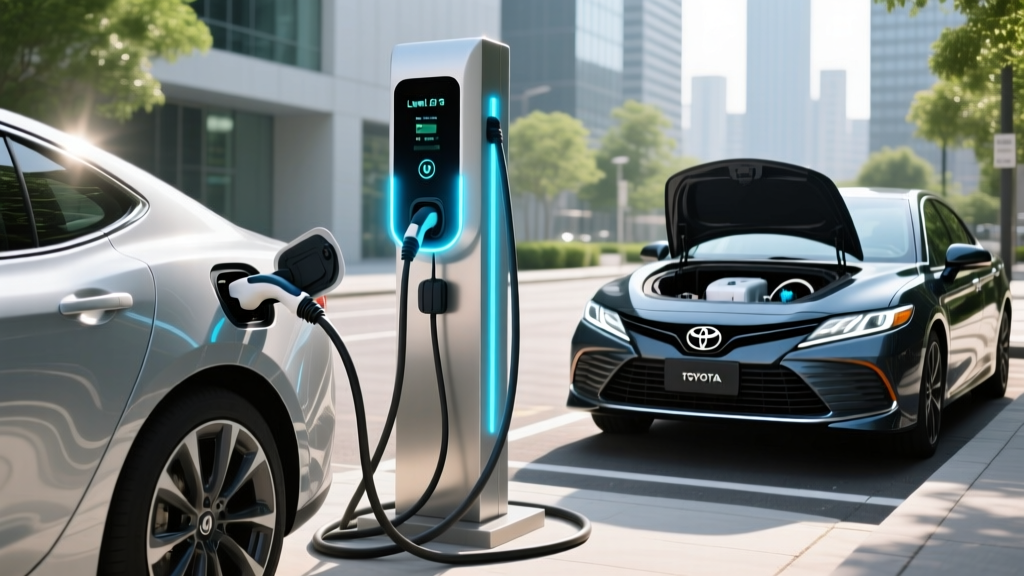
Charging Levels Explained: Speeds in kW and Miles per Hour
EV charging is measured in kW (kilowatts), which is the rate of power delivery — think of it as how fast water flows through a hose. The battery capacity is measured in kWh (kilowatt-hours) — the total volume of the tank. Confusing these two is the single most common mistake in EV research.
| Level | Voltage | Power (kW) | Miles of Range Added per Hour | Typical Use |
|---|---|---|---|---|
| Level 1 | 120V AC | 1.0–1.4 kW | 3–5 mi/hr | Overnight top-up, PHEVs |
| Level 2 | 240V AC | 3.3–19.2 kW | 12–75 mi/hr | Home daily charging, workplace |
| DC Fast Charge | 400–800V DC | 50–350 kW | 150–1,200+ mi/hr (peak) | Road trips, rapid top-ups |
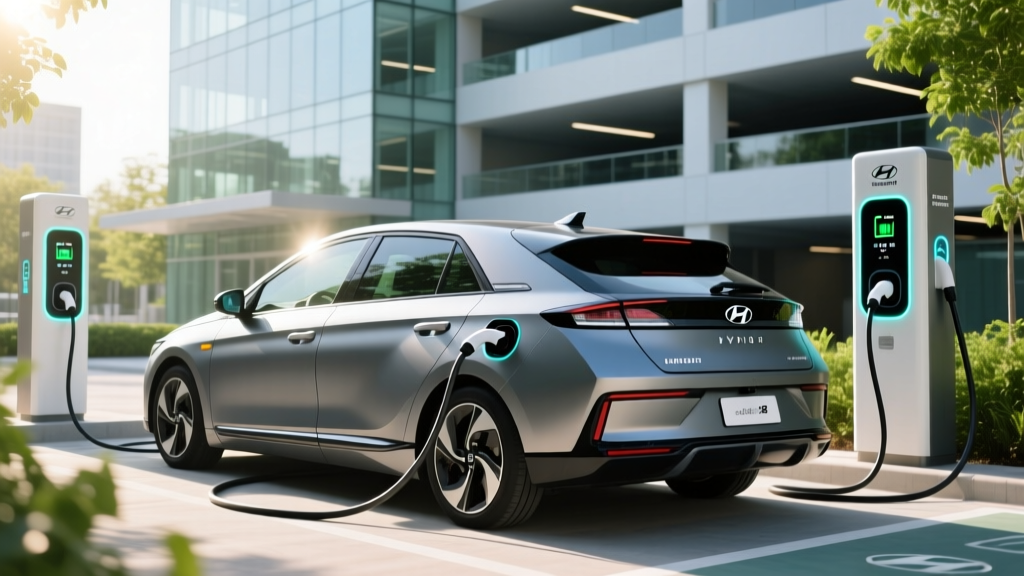
The Camry Hybrid doesn't use any of these — it has no plug and charges its small 1.6 kWh nickel-metal hydride battery solely through regenerative braking and the gasoline engine. But if you're comparing against a plug-in alternative like the Toyota Prius Prime (44 miles electric-only range, 13.6 kWh battery) or a full BEV like the Hyundai Ioniq 6 (360-mile EPA range, 77.4 kWh battery), these charging levels define your daily experience.
Charging Time Examples for Common Battery Sizes
Here's how long typical vehicles take to charge from 10% to 80% state of charge (SoC) at each level:
| Vehicle Type | Battery (kWh usable) | Level 1 (1.4 kW) | Level 2 (11.5 kW / 48A) | DC Fast (peak kW) |
|---|---|---|---|---|
| PHEV (Prius Prime) | 13.6 kWh | ~8 hrs | ~1 hr | N/A (no DC port) |
| Compact BEV (Chevy Equinox EV) | 85 kWh | ~42 hrs | ~5.2 hrs | ~28 min (150 kW peak) |
| Mid-size BEV (Tesla Model Y) | 75 kWh | ~37 hrs | ~4.6 hrs | ~20 min (250 kW peak) |
| Large BEV (Ford F-150 Lightning Ext.) | 131 kWh | ~65 hrs | ~8 hrs | ~41 min (150 kW peak) |
Charge curve reality check: DC fast charging doesn't sustain peak kW for the entire session. A vehicle rated at 250 kW peak may only hold that rate between 10–30% SoC, then taper to 150 kW, then 90 kW, and finally under 30 kW above 85%. The "10–80% in 20 minutes" spec assumes ideal battery temperature and preconditioning — cold batteries can double charge times.
Home Charger Installation: Electrical Requirements and Costs
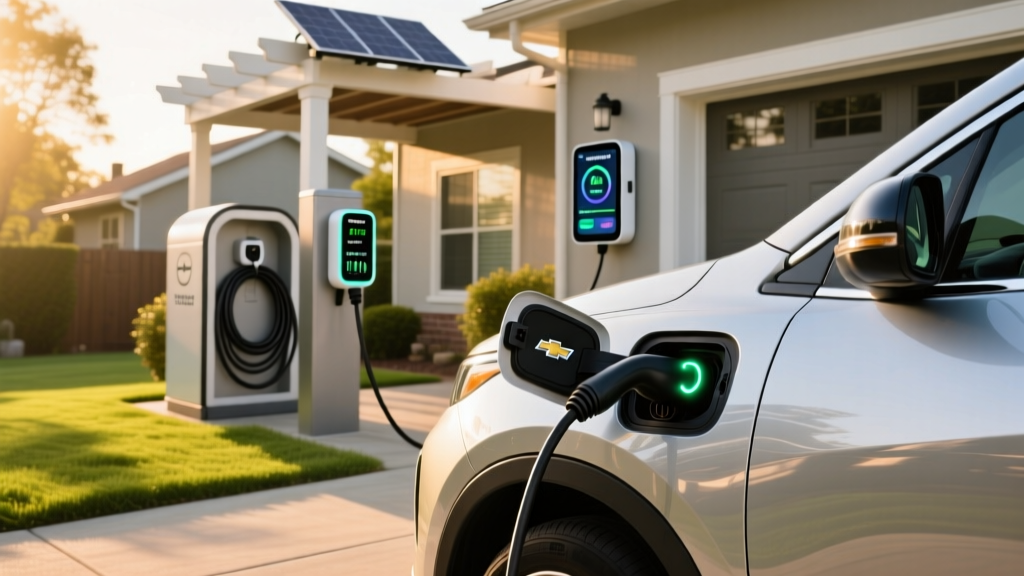
Installing a Level 2 home charger is the single biggest infrastructure decision an EV buyer makes. The Camry Hybrid requires zero infrastructure — you fill it at any gas station. A plug-in EV or PHEV demands a dedicated 240V circuit, and the cost varies dramatically based on your home's electrical panel.
Core Electrical Requirements
- Voltage: 240V (same as an electric dryer or oven)
- Amperage: 40A circuit for a 32A charger (NEC requires circuits rated at 125% of continuous load), or 60A circuit for a 48A charger
- Dedicated circuit: The charger must have its own breaker — no sharing with other appliances
- GFCI protection: Required by NEC 2020 and later for all EV charging outlets
- Outdoor rating: If mounted outside, the charger and receptacle must carry a NEMA 4 or IP55+ weatherproof rating
| Component | Low-End Estimate | High-End Estimate | Notes |
|---|---|---|---|
| Level 2 Charger (hardware) | $300 | $700 | Smart Wi-Fi models cost more |
| Electrician labor | $400 | $1,500 | Depends on run length from panel |
| Electrical permit | $50 | $250 | Varies by municipality |
| Panel upgrade (if needed) | $1,500 | $4,000 | Required if panel is at capacity or below 200A |
| Conduit, wiring, receptacle | $100 | $600 | Long runs in finished walls cost more |
| Total (no panel upgrade) | $850 | $3,050 | |
| Total (with panel upgrade) | $2,350 | $7,050 |
The panel-upgrade gotcha: Homes built before 1990 often have 100A or 150A electrical service. Adding a 40A or 60A EV circuit may push total load beyond the panel's capacity, requiring an upgrade to 200A service. This is the single largest cost variable and the one most online install estimates omit. Always get a licensed electrician to perform a load calculation before budgeting.
Connector Compatibility: Which Plug Fits Which EV?
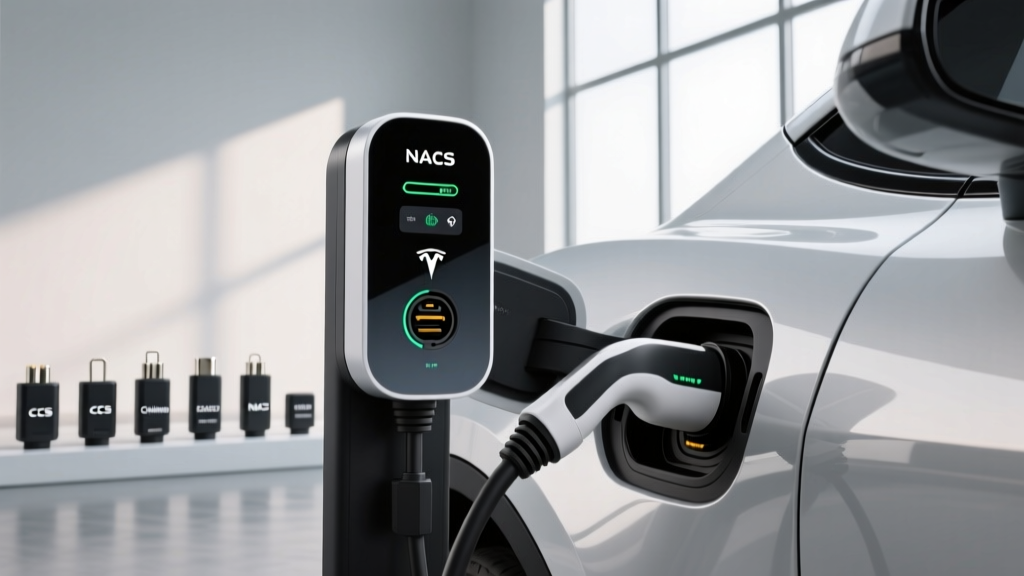
As of 2026, the connector landscape has consolidated significantly after Ford, GM, Rivian, Hyundai, and most major automakers adopted the North American Charging Standard (NACS), originally developed by Tesla. Here's the current compatibility map:
| Connector | Brands Using It (2026 Models) | Notes |
|---|---|---|
| NACS (Tesla / J3400) | Tesla (all), Ford (F-150 Lightning, Explorer EV), GM (Equinox EV, Blazer EV, Silverado EV), Rivian, Hyundai (Ioniq 5/6 2025+), Kia (EV6/EV9 2025+) | Now the dominant standard; access to Tesla Superchargers natively |
| CCS1 (Combo) | VW (ID.4), BMW (iX, i4), Stellantis, some legacy models from Hyundai/Kia pre-2025 | Being phased out on new models; adapters available to NACS |
| CHAdeMO | Nissan Leaf (discontinued after 2025), Mitsubishi Outlander PHEV (legacy) | Effectively obsolete for new vehicles |
| J1772 (AC only) | All non-Tesla EVs/PHEVs for Level 1/2 AC charging | NACS vehicles use a J1772-to-NACS adapter for non-Tesla Level 2 stations |
The Camry Hybrid sidesteps all of this — no plug, no connector, no adapter. But if you're evaluating a switch to a PHEV or BEV, buy a charger with the correct connector for your vehicle, or plan to purchase a manufacturer-approved adapter ($100–$250).
Cost to Charge vs. Camry Hybrid Fuel Cost
The Camry Hybrid LE at 52 MPG combined costs about $0.063 per mile at $3.25/gallon. How does that compare to plugging in?
| Vehicle / Scenario | Energy Source | Rate | Efficiency | Cost per Mile |
|---|---|---|---|---|
| Camry Hybrid LE | Gasoline | $3.25/gal | 52 MPG | $0.063 |
| BEV — Home off-peak | Electricity | $0.12/kWh | 3.5 mi/kWh | $0.034 |
| BEV — Home peak | Electricity | $0.25/kWh | 3.5 mi/kWh | $0.071 |
| BEV — Public Level 2 | Electricity | $0.30/kWh | 3.5 mi/kWh | $0.086 |
| BEV — DC Fast (Electrify America) | Electricity | $0.48/kWh | 3.2 mi/kWh* | $0.150 |
| Prius Prime (electric only) | Electricity | $0.12/kWh | 3.8 mi/kWh | $0.032 |
| Prius Prime (gas hybrid mode) | Gasoline | $3.25/gal | 48 MPG | $0.068 |
*Highway DC fast-charge efficiency is lower due to higher speeds and thermal loads.
The takeaway: home-charged electricity at off-peak rates is roughly half the per-mile cost of the Camry Hybrid. But rely exclusively on DC fast charging and you'll actually pay more per mile than the hybrid — and sometimes more than a conventional gas car. The economics of a plug-in EV depend almost entirely on your access to cheap home charging.
Recommended Home Level 2 Chargers
Below are three proven Level 2 chargers suited to different budgets and needs, all current for 2026:
Emporia Vue — Best Value
- Power output: 11.5 kW (48A on 60A circuit) or 9.6 kW (40A on 50A circuit)
- Connector: NACS (J3400) native; J1772 adapter included
- Cable length: 24 ft
- Smart features: Wi-Fi, energy monitoring via Emporia app, solar integration, scheduled charging
- Price: ~$349
ChargePoint Home Flex — Best for Flexibility
- Power output: Adjustable from 16A to 50A (3.8–12 kW) — set to match your circuit
- Connector: NACS or J1772 (select at purchase)
- Cable length: 23 ft
- Smart features: Wi-Fi, app scheduling, Alexa/Google integration, amperage dial for panel-limited installs
- Price: ~$549
Tesla Wall Connector — Best for Tesla Owners
- Power output: 11.5 kW (48A on 60A circuit)
- Connector: NACS native; J1772 adapter included
- Cable length: 24 ft
- Smart features: Wi-Fi, over-the-air updates, power sharing between two units on one circuit, load management
- Price: ~$450
All three units are UL-listed, carry a NEMA 4 outdoor rating, and support hardwired installation (preferred) or NEMA 14-50 plug connection. A hardwired install eliminates the GFCI breaker requirement, saving $40–$80 on the electrical bill.
Safety and Electrical Code Essentials
Whether you're charging a Prius Prime or an F-150 Lightning, the National Electrical Code (NEC) and your local jurisdiction set non-negotiable requirements:
- Dedicated circuit: NEC Article 625 requires EV charging equipment to be on its own dedicated branch circuit. No sharing with laundry, HVAC, or lighting.
- GFCI protection: Required for all receptacle-based (plug-in) EV chargers. Hardwired units are exempt in most jurisdictions, which is one reason electricians often recommend hardwiring.
- Outdoor rating: Any charger mounted outside must be rated NEMA 4 (watertight) or better. The receptacle, if used, needs an in-use weatherproof cover.
- Wire gauge: A 48A charger on a 60A circuit requires 4 AWG copper wire for runs under 50 feet, or 3 AWG for longer runs to prevent voltage drop.
- Permit and inspection: Most municipalities require a permit ($50–$250) and a post-install inspection. Skipping this can void home insurance coverage for electrical fires.
Always hire a licensed electrician for Level 2 installation. The combination of high continuous current and 240V makes this a project where DIY errors carry serious fire and shock risk.
Decision Framework: Camry Hybrid vs. Plug-In
Stick with the Camry Hybrid if:
- You lack access to home charging (apartment, street parking, older home with a 100A panel)
- Your daily commute is under 40 miles and you take frequent long road trips
- You want zero infrastructure investment — no charger, no electrician, no permit
- You want 600+ miles of total range without planning stops
Switch to a plug-in EV or PHEV if:
- You can install a Level 2 charger at home and access off-peak electricity rates under $0.15/kWh
- Your daily driving is under 50 miles (PHEV covers this on electricity alone)
- You want to cut per-mile fuel costs to $0.03–$0.04 — roughly half the Camry Hybrid
- You're eligible for the §30D federal tax credit (up to $7,500 for qualifying BEVs/PHEVs, subject to MSRP caps, income limits, and battery sourcing requirements)
Frequently Asked Questions
How much does it cost to install a home EV charger?
A typical Level 2 home charger installation costs between $850 and $3,050 when your electrical panel has sufficient capacity. If a panel upgrade from 100A to 200A is needed, add $1,500–$4,000. The total range is $850–$7,050 depending on panel capacity, wiring run length, and local permit fees.
How fast will each charging level add range?
Level 1 (120V) adds 3–5 miles per hour. Level 2 (240V) adds 12–75 miles per hour depending on amperage. DC fast charging can add 150–1,200+ miles per hour at peak rate, but sustained speeds taper significantly above 50% state of charge.
Which connector or charger is compatible with my EV?
For 2026 models, most new EVs from Tesla, Ford, GM, Rivian, Hyundai, and Kia use NACS. Volkswagen and some legacy models still use CCS1. CHAdeMO is effectively obsolete. Check your vehicle's charge port before purchasing a home charger — or buy an approved adapter.
How much does charging cost per mile vs. gas?
At home off-peak rates (~$0.12/kWh), an efficient BEV costs about $0.034/mile — roughly half the Camry Hybrid's $0.063/mile. Public DC fast charging at $0.48/kWh pushes the cost to ~$0.15/mile, more than double the hybrid. Home charging access is the key variable.
What electrical upgrades might I need?
If your home has a 200A panel with available capacity, you likely just need a new 60A breaker and a wiring run. Homes with 100A or 150A panels, or panels already near capacity (electric heat, pool, hot tub), may require a full service upgrade — the single most expensive variable in a home charging install.
Does the Camry Hybrid need a charger?
No. The Camry Hybrid is a conventional hybrid (HEV) with no plug. It charges its small battery through regenerative braking and the gasoline engine. It cannot operate on electric power alone for meaningful distances and does not qualify for the §30D federal EV tax credit.