The Real Math Behind EV Charging Costs
Before you buy an electric vehicle, you need to answer one question with hard numbers: what will charging actually cost per mile? The answer varies dramatically depending on where and how you charge. A kilowatt-hour (kWh) of electricity at home on an off-peak rate might cost $0.08, while the same kWh at a DC fast charger on a highway corridor could run $0.48 or more. That's a 6x difference that directly impacts your cost per mile.
This guide walks through every variable you need to calculate EV charging cost accurately — from home electricity rates and Level 2 installation expenses to public network pricing and how it all compares to gasoline. We'll also cover the equipment, electrical requirements, and connector compatibility you need to make informed decisions.
Understanding kW vs. kWh: The Foundation
Before calculating anything, let's eliminate the most common EV confusion:
- kWh (kilowatt-hour) = energy. This is what your battery holds (e.g., 75 kWh usable) and what you pay for. Think of it like gallons of gas.
- kW (kilowatt) = power. This is the rate at which energy flows into your battery. Think of it like the diameter of the fuel hose.
When you calculate EV charging cost, you're always multiplying kWh consumed by the price per kWh. The kW rating of your charger determines how fast those kWh accumulate, not how much they cost.
Charging Levels: Speed, Power, and Range Added
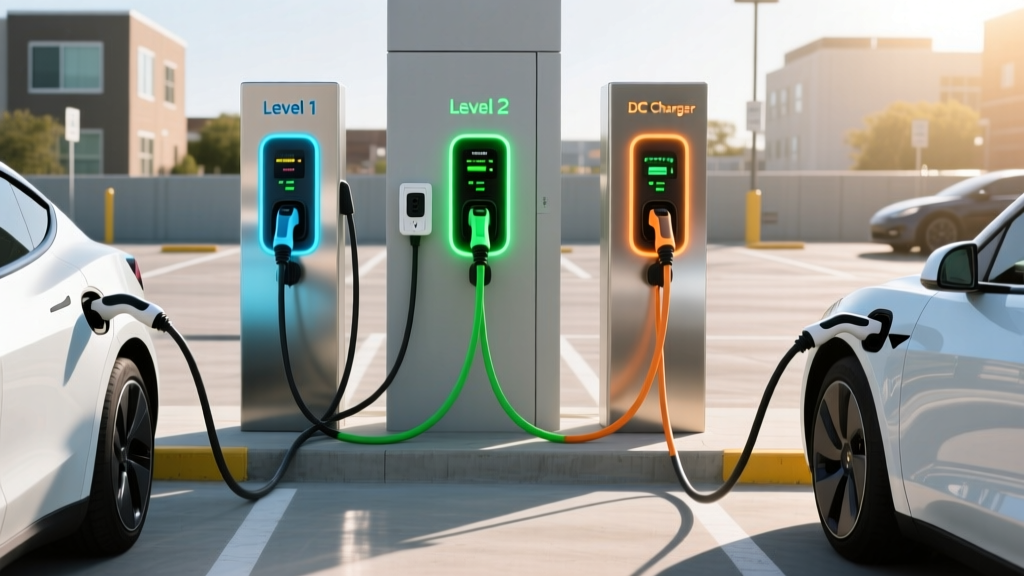
Every EV owner uses a mix of three charging levels. Here's what each delivers in real-world terms:
| Level | Voltage | Power (kW) | Miles of Range Added Per Hour | Typical Use Case |
|---|---|---|---|---|
| Level 1 | 120V AC | 1.0–1.4 kW | 3–5 mi/hr | Overnight trickle; PHEV daily top-ups |
| Level 2 (Home/Public) | 240V AC | 7.2–19.2 kW | 25–65 mi/hr | Daily home charging; destination charging |
| DC Fast Charging | 400–800V DC | 50–350 kW | 150–800+ mi/hr (peak) | Road trips; highway corridors |
Real-world charging time examples (10–80% State of Charge):
- 60 kWh battery (e.g., base Tesla Model 3 RWD): ~20 min on a 250 kW DC fast charger (peak); ~8.5 hours on a 7.2 kW Level 2 home charger
- 82 kWh battery (e.g., Ford Mustang Mach-E Extended Range): ~25 min on a 150 kW DC fast charger; ~11 hours on a 7.2 kW Level 2
- 100 kWh battery (e.g., GMC Sierra EV): ~30 min on a 350 kW DC fast charger (800V architecture); ~13 hours on a 7.7 kW Level 2
Charge curve reality check: DC fast charging does not sustain peak kW for the entire session. A charger rated at 250 kW may only deliver that rate between 10–40% SoC, then taper to 150 kW, then 90 kW, then 40 kW above 80%. The advertised "10–80% time" accounts for this taper. Charging from 80–100% on DC fast can take as long as 10–80% due to the steep taper — which is why road-trip strategy focuses on 10–80% stops.
How to Calculate EV Charging Cost Per Mile
The formula is simple once you have the inputs:
Cost per mile = (kWh per mile) × (price per kWh)
To find your vehicle's kWh per mile, take the reciprocal of its EPA efficiency rating. For example, a vehicle rated at 3.5 miles/kWh consumes 0.286 kWh per mile. A heavier, less efficient EV like the Rivian R1T might consume 0.45 kWh/mi (2.2 mi/kWh).
| Charging Scenario | $/kWh | Cost Per Mile | Notes |
|---|---|---|---|
| Home (off-peak utility rate) | $0.08 | $0.024 | Time-of-use plan, overnight charging |
| Home (national avg. residential) | $0.17 | $0.051 | U.S. average as of 2026 per EIA data |
| Public Level 2 (network charging) | $0.25–$0.39 | $0.075–$0.117 | ChargePoint, EVgo Level 2 typical |
| DC Fast (Electrify America, Tesla Supercharger) | $0.35–$0.48 | $0.105–$0.144 | Varies by time-of-use and location |
| DC Fast (idle-fee networks, peak hours) | $0.55–$0.69 | $0.165–$0.207 | Urban peak pricing, some CA/NY stations |
| Gasoline comparison (25 MPG, $3.40/gal) | — | $0.136 | Mid-grade regular unleaded national avg. |
The key takeaway: Home charging on an off-peak rate is roughly 5–6× cheaper per mile than gasoline. Even at the national average residential rate, EV charging costs about one-third of what gas costs per mile. However, exclusive reliance on DC fast charging at peak rates can push EV per-mile costs above gas — which is why home charging access is the single biggest factor in EV economics.
Home Charger Installation: Costs, Electrical Requirements, and Gotchas
Installing a Level 2 home charger is the single most impactful investment for EV ownership. Here's what's involved and what it costs.
Electrical Requirements
A typical Level 2 home charger requires a 240-volt dedicated circuit, similar to what an electric dryer or oven uses. The most common configurations:
- 40-amp circuit / 32-amp continuous output (7.7 kW): The most common residential setup. Sufficient for most EVs to fully replenish overnight.
- 50-amp circuit / 40-amp continuous output (9.6 kW): Faster charging, recommended for larger batteries (80+ kWh) or if you need faster turnaround.
- 60-amp circuit / 48-amp continuous output (11.5 kW): Maximum practical for most homes with 200-amp panels. Ideal for high-acceptance vehicles like the Hyundai Ioniq 5 or Lucid Air.
Panel upgrade reality: If your home has a 100-amp electrical panel (common in homes built before 1990), adding a 40–60 amp EV circuit may require a panel upgrade to 200 amps. This is the single biggest cost variable and one that many online guides understate.
| Component | Cost Range | Details |
|---|---|---|
| Level 2 Charger (Equipment) | $300–$700 | Smart Wi-Fi chargers; hardwired or NEMA 14-50 plug |
| Electrician Labor (simple install) | $400–$1,200 | Short run from panel to garage; conduit, wiring, breaker |
| Electrician Labor (complex install) | $1,200–$3,000 | Long wire runs, trenching, sub-panel addition |
| Electrical Permit | $50–$300 | Required in most jurisdictions; varies by municipality |
| Panel Upgrade (if needed) | $1,500–$4,000 | 100A to 200A service upgrade; may involve utility coordination |
| Total (simple, no panel upgrade) | $750–$2,200 | Most common scenario for newer homes with 200A panels |
| Total (with panel upgrade) | $2,250–$7,000+ | Older homes, long wire runs, or high-amperage setups |
Always get a quote from a licensed electrician before committing to a charger purchase. They can assess your panel capacity, wire run distance, and local code requirements. The Department of Energy's home charging guide provides additional planning resources.
Safety and Code Considerations
- Dedicated circuit: Your EV charger must be on its own dedicated breaker — never shared with other appliances.
- GFCI protection: NEC 2020 and later require GFCI protection for outdoor receptacles and some indoor garage installations. Hardwired chargers may bypass this requirement depending on local code.
- NEMA 14-50 vs. hardwired: A NEMA 14-50 outlet gives you portability (take the charger when you move), but hardwired installations avoid the GFCI nuisance-tripping issues some owners experience with 14-50 receptacles on 40A+ circuits.
- Outdoor rating: If your charger is installed outside or in an exposed carport, ensure it carries a NEMA 4 (weather-resistant) rating.
- Cable management: Choose a charger with at least 18–25 feet of cable to reach your charge port regardless of parking orientation.
Which Connector Does Your EV Use?
The connector landscape has consolidated significantly since 2024, but compatibility still matters — especially if you own a non-Tesla or plan to use older public chargers.
| Connector | Brands Using It (2026) | Notes |
|---|---|---|
| NACS (North American Charging Standard / Tesla) | Tesla, Ford, GM, Rivian, Volvo, Polestar, Mercedes-Benz, Nissan, Honda, Hyundai/Kia (2025+ models) | Now the dominant standard; provides access to Tesla Supercharger network |
| CCS1 (Combined Charging System) | Legacy models from VW, BMW, Stellantis, some Hyundai/Kia pre-2025 | Still on many 2022–2024 used EVs; most new models have switched to NACS |
| CHAdeMO | Nissan Leaf (discontinued), Mitsubishi Outlander PHEV (legacy) | Effectively discontinued; infrastructure declining |
Adapter needs:
- NACS-equipped vehicles at CCS stations: You'll need a NACS-to-CCS adapter ($150–$250). Tesla sells one; third-party options from Lectron and A2Z are widely available.
- CCS-equipped vehicles at NACS/Supercharger stations: Tesla and third-party CCS-to-NACS adapters are available. Ford and GM have provided adapters to early EV buyers; check your manufacturer's program.
- CHAdeMO vehicles: No practical adapter exists for DC fast charging at NACS or CCS stations. CHAdeMO owners are increasingly limited to older public chargers.
Recommended Home Level 2 Chargers (2026)
These chargers represent the best value and reliability based on long-term ownership experience and installer feedback:
Emporia Level 2 EV Charger
- Power: 48A / 11.5 kW (hardwired) or 40A / 9.6 kW (NEMA 14-50)
- Connector: J3400 (NACS) — native fit for Tesla and all 2025+ NACS-adopting brands
- Cable length: 24 feet
- Smart features: Wi-Fi, energy monitoring, solar integration, scheduled charging, utility demand-response compatible
- Price: ~$400 (frequently discounted to $350)
- Best for: Budget-conscious buyers who want full smart features and energy tracking
ChargePoint Home Flex
- Power: Adjustable from 16A to 50A (up to 12 kW at 50A hardwired)
- Connector: J3400 (NACS) or CCS1 — select at purchase
- Cable length: 23 feet
- Smart features: Wi-Fi, ChargePoint app, Alexa integration, flexible amperage to match your circuit
- Price: ~$600–$700
- Best for: Flexibility across circuit sizes; strong app ecosystem
Tesla Wall Connector (Gen 4)
- Power: 48A / 11.5 kW (hardwired, 60A circuit)
- Connector: NACS native
- Cable length: 24 feet
- Smart features: Wi-Fi, over-the-air updates, Tesla app integration, load sharing (pair two units on one circuit), Powerwall integration
- Price: ~$450
- Best for: Tesla owners and NACS-adopting EV owners wanting OEM-grade reliability
Grizzl-E Smart
- Power: 40A / 9.6 kW (NEMA 14-50) or 48A / 11.5 kW (hardwired)
- Connector: J3400 (NACS) or J1772 (legacy)
- Cable length: 24 feet
- Smart features: Wi-Fi, OCPP-compatible, works with utility demand-response programs, adjustable amperage via DIP switches
- Price: ~$450–$550
- Best for: Cold-climate durability (rated to -40°F), utility program compatibility
Public Charging Network Costs: What You'll Actually Pay
Public charging pricing varies by network, location, time of day, and membership tier. Here's a realistic breakdown for 2026:
- Tesla Superchargers: $0.25–$0.48/kWh depending on location and time-of-use. Non-Tesla vehicles with NACS adapters pay a ~15% surcharge at participating stations unless they have a membership.
- Electrify America: $0.39–$0.55/kWh for DC fast charging; Pass+ membership ($4/month) reduces rates to $0.31–$0.43/kWh and includes 800 kWh annually.
- EVgo: $0.35–$0.48/kWh DC fast; EVgo Plus membership ($4.99/month) lowers rates by 10–15%.
- ChargePoint (Level 2 public): Highly variable — $0.15–$0.39/kWh or per-hour pricing set by the property owner. Many workplaces and shopping centers still offer free Level 2.
Pro tip: Many utilities offer EV-specific time-of-use (TOU) rate plans that drop electricity to $0.06–$0.10/kWh during off-peak hours (typically 11 PM – 7 AM). If you charge at home overnight, enrolling in a TOU plan is the single most effective way to minimize your cost per mile. Contact your utility to ask about EV rate programs.
EV Charging Cost vs. Gas: The 5-Year Picture
Let's model a realistic 5-year ownership scenario comparing a battery EV charged primarily at home to a comparable gas vehicle:
| Scenario | Cost Per Mile | Annual Cost | 5-Year Cost |
|---|---|---|---|
| EV — 90% home (off-peak $0.08/kWh) + 10% DC fast ($0.42/kWh) | $0.034 | $510 | $2,550 |
| EV — 50% home (avg. $0.17/kWh) + 50% public ($0.35/kWh) | $0.089 | $1,335 | $6,675 |
| EV — 100% DC fast charging ($0.45/kWh avg.) | $0.135 | $2,025 | $10,125 |
| Gas vehicle (27 MPG combined, $3.40/gal) | $0.126 | $1,890 | $9,450 |
The data is clear: EV owners with reliable home charging save $5,000–$7,000 in energy costs over five years compared to gas. However, apartment dwellers or those who must rely entirely on public DC fast charging may see their EV energy costs match or exceed gasoline — a critical consideration before purchasing.
Frequently Asked Questions
How much does it cost to install a home EV charger?
For most homes with a 200-amp electrical panel and a short wire run to the garage, expect $750–$2,200 total (charger equipment + electrician labor + permit). Older homes with 100-amp panels may need a $1,500–$4,000 panel upgrade, pushing the total to $2,250–$7,000+. Always get a professional assessment from a licensed electrician before purchasing equipment.
How fast will each charging level add range?
Level 1 (120V) adds 3–5 miles per hour — suitable only for PHEVs or very low daily mileage. Level 2 (240V) adds 25–65 miles per hour depending on amperage — enough to fully recharge any EV overnight. DC fast charging adds 150–800+ miles per hour at peak, enabling 10–80% charges in 18–35 minutes for most modern EVs.
Which connector/charger is compatible with my EV?
For 2025–2026 models, NACS (the Tesla-standard connector) is now used by Tesla, Ford, GM, Rivian, Volvo, Hyundai, Kia, and most other major brands. Older models (2022–2024) may still have CCS1. CHAdeMO is effectively discontinued. Check your vehicle's charge port or the manufacturer's spec sheet. Adapters are available to bridge NACS and CCS, but buying a charger with the native connector for your vehicle is always preferable.
How much does charging cost per mile vs. gas?
Home charging on off-peak rates averages $0.02–$0.05 per mile — roughly 75% cheaper than gas at $0.12–$0.14 per mile. Even at the national average residential rate ($0.17/kWh), EV charging runs about $0.05/mile. However, exclusive DC fast charging at $0.40–$0.55/kWh can push costs to $0.12–$0.17/mile, matching or exceeding gas.
What electrical upgrades might I need?
The most common upgrade is a panel replacement from 100A to 200A service ($1,500–$4,000). You may also need a new breaker slot, upgraded service wire from the utility, or a sub-panel if your main panel is full. Some utilities offer rebates or financing for panel upgrades tied to EV adoption — check with your local provider. A licensed electrician can evaluate your panel's available amperage and recommend the right circuit size.
Is there a tax credit for home charger installation?
The federal Alternative Fuel Vehicle Refueling Property Credit (IRS §30C) covers up to 30% of home EV charger equipment and installation costs, capped at $1,000. However, eligibility is restricted to census tracts classified as low-income or non-urban. Check the IRS §30C page and consult a tax professional to confirm your eligibility based on your address and tax situation.