Understanding EV Charging Costs: The Math That Actually Matters
If you're shopping for an electric vehicle or already own one, understanding exactly what you'll pay to keep it charged is essential. Unlike filling a gas tank — where the price per gallon is posted on a sign — EV charging costs depend on where you charge, when you charge, and what equipment you're using. The good news: the math is straightforward once you understand two core units.
kWh (kilowatt-hour) measures energy — it's what your battery stores and what you're billed for, like gallons of gas. kW (kilowatt) measures power — it's how fast energy flows into your battery, like the flow rate of a gas pump nozzle. You pay per kWh consumed, not per kW of charging speed. Confusing these two is the single most common mistake new EV owners make.
The formula for calculating a full charge is simple:
Cost = Battery capacity (kWh) × Price per kWh ($)
A 75 kWh battery charged at $0.16/kWh (the U.S. residential average in early 2026, per the U.S. Energy Information Administration) costs $12.00 from empty to full. But you rarely charge from 0 to 100%, and you rarely pay the same rate everywhere. Let's break down every scenario.
Charging Levels Explained: Speed, Power, and Range Added
EV charging is categorized into three levels, each defined by its power delivery in kW. Here's how they stack up in real-world terms:
| Level | Voltage | Power (kW) | Miles of Range Added per Hour | Best For |
|---|---|---|---|---|
| Level 1 | 120V AC | 1.0–1.9 kW | 3–5 miles | Overnight top-ups, PHEVs, low-mileage drivers |
| Level 2 | 240V AC | 3.3–19.2 kW | 12–75 miles | Daily home charging, workplace, destination |
| DC Fast Charging | 400–900V DC | 50–350 kW | 150–1,200+ miles (equivalent/hr) | Road trips, rapid top-ups away from home |
For a typical 75 kWh battery (like the one in a Tesla Model Y or Ford Mustang Mach-E Extended Range), here's what charging times look like in practice:
- Level 1 (1.4 kW): 10–80% in roughly 37 hours. Practical only for plug-in hybrids or very low daily mileage.
- Level 2 (11.5 kW / 48A): 10–80% in approximately 4.5 hours. Ideal overnight charge for most BEVs.
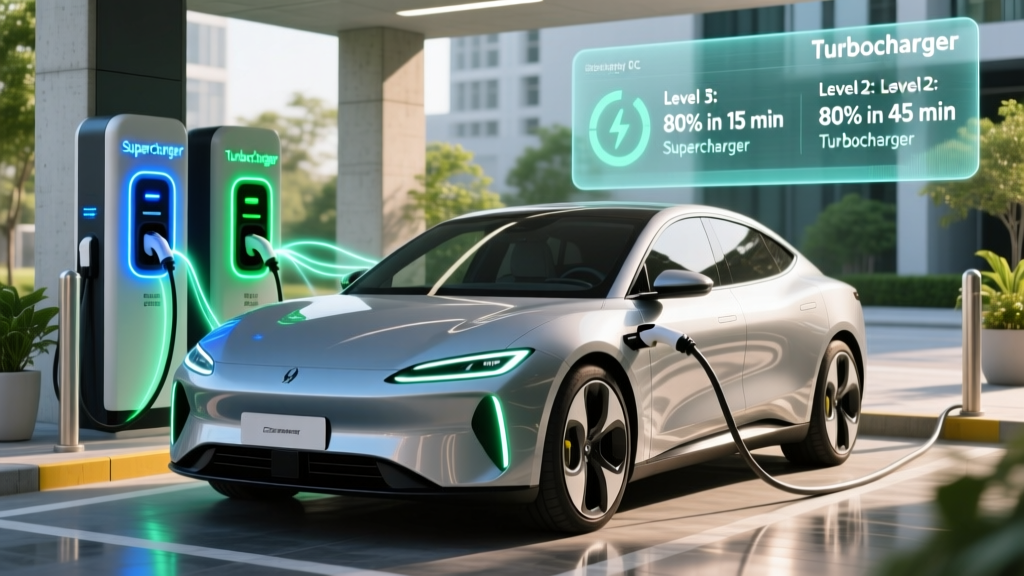
- DC Fast (250 kW peak): 10–80% in approximately 18–25 minutes on vehicles that can accept that rate (e.g., Hyundai Ioniq 5, Porsche Taycan, Tesla Model 3 Highland). Note that charging speed tapers significantly above 80% SoC to protect battery health — you won't sustain peak kW for the full session.
How Much Does Charging Cost Per Mile vs. Gas?
This is the question that decides whether an EV saves you money. The answer depends on your electricity rate and your vehicle's efficiency, measured in kWh per 100 miles (the EV equivalent of MPG — lower is better).
Let's use a 2026 Tesla Model Y Long Range as our baseline: EPA-rated at 28 kWh/100mi (or roughly 3.6 mi/kWh). Here's what you'd pay per mile in different charging scenarios:
| Charging Scenario | $/kWh | Cost per Mile (Model Y at 28 kWh/100mi) | Cost to "Fill" 75 kWh Battery (10–80%) |
|---|---|---|---|
| Home (national avg. residential) | $0.16 | $0.045 | $8.40 |
| Home (off-peak TOU rate) | $0.08 | $0.022 | $4.20 |
| Home (high-cost state, e.g. CA/CT) | $0.30 | $0.084 | $15.75 |
| Public Level 2 (ChargePoint, EVgo L2) | $0.25–$0.40 | $0.07–$0.11 | $13.13–$21.00 |
| DC Fast Charging (Electrify America, Tesla Supercharger) | $0.35–$0.55 | $0.10–$0.15 | $18.38–$28.88 |
| Gasoline comparison (25 MPG combined, $3.40/gal) | — | $0.136 | $22.67 (equivalent 10–80%) |
The bottom line: At home on an average residential rate, charging an EV costs roughly one-third what gasoline costs per mile. Even on DC fast chargers at peak pricing, EVs are competitive with or cheaper than gas. The savings widen dramatically if your utility offers time-of-use (TOU) rates and you charge overnight at $0.06–$0.10/kWh.
How Much Does It Cost to Install a Home EV Charger?
Most EV owners do 80–90% of their charging at home on a Level 2 charger. The total installed cost depends on your home's electrical panel, the distance from panel to charger location, and local permitting. Here's a realistic breakdown:
| Cost Component | Typical Range | Notes |
|---|---|---|
| Level 2 charger hardware | $350–$750 | Smart Wi-Fi chargers (ChargePoint Home Flex, Emporia Level 2, Wallbox Pulsar Plus) |
| Electrician labor (standard install) | $500–$1,500 | 240V/40–50A dedicated circuit, 10–40 ft run from panel |
| Electrical permit | $50–$200 | Varies by municipality; required in most jurisdictions |
| Panel upgrade (if needed) | $1,500–$3,500 | Required if your panel is 100A or near capacity; upgrading to 200A service |
| Total (no panel upgrade) | $900–$2,450 | Most homes with 200A service fall in this range |
| Total (with panel upgrade) | $2,400–$5,950 | Older homes with 100A panels or maxed-out breaker boxes |
Panel upgrade reality check: If your home was built before 1990 and has a 100-amp electrical panel, adding a 40-amp EV circuit may push you over the panel's safe capacity. A licensed electrician will perform a load calculation (NEC Article 220) to determine if you need a service upgrade. Don't skip this — an overloaded panel is a fire hazard, and your insurer may deny a claim if unpermitted work caused damage.
Electrical requirements for a standard Level 2 install:
- Voltage: 240V (same as a dryer or oven outlet)
- Amperage: 40A circuit for a 32A charger, or 50A circuit for a 40A charger (NEC requires circuits rated at 125% of continuous load)
- Wiring: 6 AWG copper (for 40A) or 4 AWG copper (for 50A), run in conduit where exposed
- Breaker: Dedicated double-pole breaker, properly sized
- GFCI protection: Required for outdoor installations in most jurisdictions per NEC 2023/2026 updates
Which Connector and Charger Is Compatible with My EV?
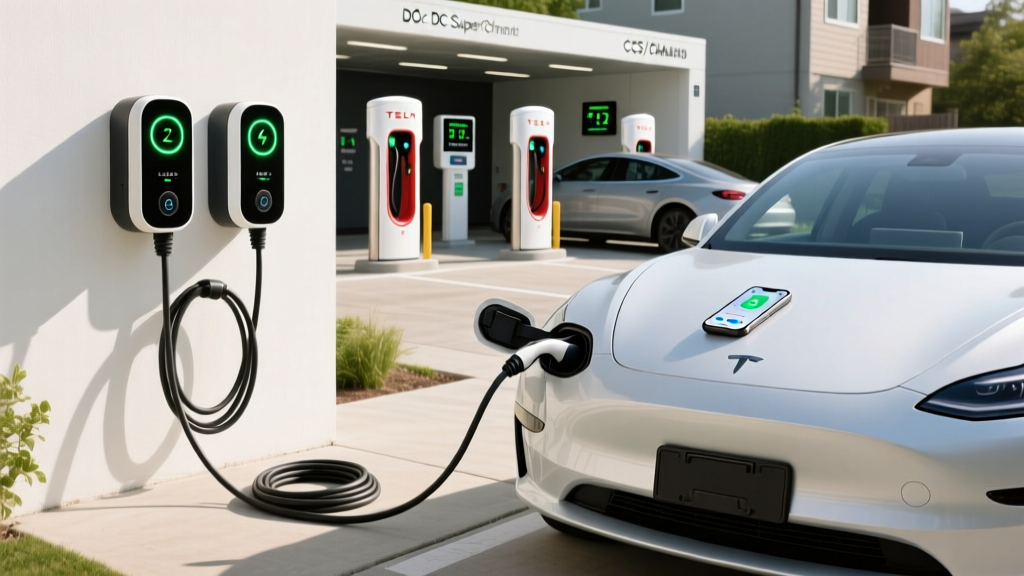
Connector standards have consolidated significantly by 2026. The Tesla-designed NACS (North American Charging Standard) is now the dominant connector, adopted by Ford, GM, Rivian, Hyundai, Kia, BMW, and most major automakers for new vehicles. CCS1 remains on vehicles sold before the transition, and CHAdeMO is effectively legacy (Nissan Leaf being the last major holdout).
| Connector | Brands Using It (2026 Models) | Adapter Availability |
|---|---|---|
| NACS (Tesla) | Tesla, Ford, GM, Rivian, Hyundai, Kia, BMW, Volvo, Polestar, Mercedes-Benz, Lucid | N/A — native on most new EVs |
| CCS1 | VW ID.4 (pre-2026), some older Ford/GM/Hyundai models | CCS-to-NACS adapters available (~$150–$250) for access to Superchargers |
| CHAdeMO | Nissan Leaf (legacy) | Limited adapter options; network support declining |
For home charger purchases in 2026: If you drive a NACS-equipped vehicle (or plan to buy one), purchase a charger with a native NACS connector. If you currently own a CCS1 vehicle but plan to switch to NACS in the future, choose a charger with a swappable connector or purchase a J1772/NACS adapter. Most smart chargers sold today ship with NACS as the default.
Recommended Home EV Chargers for 2026
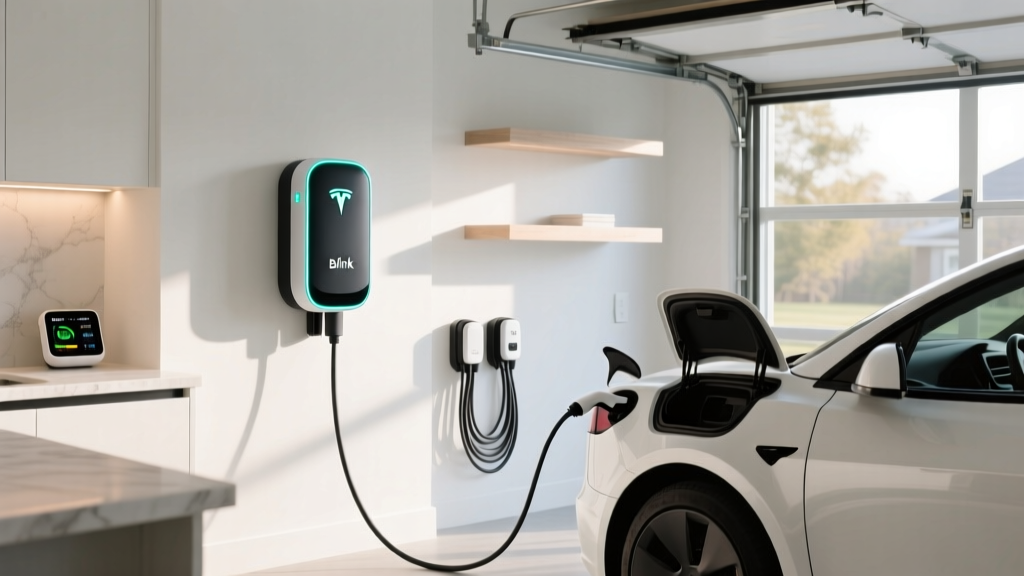
These are the chargers I recommend based on real-world use, electrical compatibility, and value. All are hardwired or NEMA 14-50 plug-in units rated for indoor and outdoor use.
ChargePoint Home Flex (NACS)
- Power Output: Up to 12 kW (50A circuit / 40A continuous) on 240V
- Connector: Native NACS (also available in J1772)
- Cable Length: 23 feet
- Smart Features: Wi-Fi, app scheduling, TOU rate optimization, Alexa integration, energy dashboard
- Price: ~$599 (hardware only)
- Best For: Most EV owners; flexible amperage settings let you match your circuit capacity
Wallbox Pulsar Plus (NACS)
- Power Output: Up to 11.5 kW (48A) on 240V
- Connector: Native NACS
- Cable Length: 25 feet
- Smart Features: Wi-Fi + Bluetooth, Eco-Smart mode (solar integration), Power Sharing for two units on one circuit, app scheduling
- Price: ~$549
- Best For: Homes with solar panels or two-EV households
Emporia Level 2 EV Charger
- Power Output: Up to 11.5 kW (48A) on 240V
- Connector: NACS (J1772 version also available)
- Cable Length: 24 feet
- Smart Features: Wi-Fi, real-time energy monitoring via Emporia Vue integration, scheduling, load management
- Price: ~$399
- Best For: Budget-conscious buyers who want full energy monitoring
One often-overlooked spec: cable length matters more than people think. Measure the distance from your planned charger location to your EV's charge port. A 23–25 foot cable covers most garage and driveway configurations, but if your panel is on the far side of a two-car garage, you may need the extra length or a different mounting location.
Safety, Electrical Code, and Permit Considerations
A Level 2 EV charger is a continuous high-amperage load — it runs for hours at a time, unlike a microwave that cycles on and off. This makes proper installation non-negotiable.
Key safety requirements:
- Dedicated circuit: Your EV charger must have its own breaker — no sharing with other appliances. A 40A charger needs a 50A dedicated double-pole breaker.
- Hardwired vs. plug: Hardwired installations (no plug, direct wire connection) are generally preferred for 48A+ chargers and are required by some local codes for circuits above 40A. NEMA 14-50 receptacles are acceptable for 40A circuits and allow portability, but must be installed with proper torque specifications — loose 14-50 outlets have been linked to overheating incidents.
- GFCI protection: The NEC requires ground-fault circuit interrupter protection for outdoor EV charging outlets. Many modern chargers include built-in GFCI, which avoids nuisance tripping from double-GFCI configurations. Confirm with your electrician.
- Outdoor rating: If mounting outside, ensure the charger carries a NEMA 4 (weatherproof) rating. All three chargers recommended above are rated for outdoor installation.
- Permits: Most municipalities require an electrical permit for a new 240V circuit. The permit fee is typically $50–$200, and the work will be inspected. Skipping the permit risks insurance claim denial and complications at home sale.
The National Electrical Code (NEC) is updated every three years, and many states have adopted the 2023 or 2026 edition with EV-specific provisions. Your electrician should be current on local amendments.
Calculating Your Personal Charging Cost: A Step-by-Step Framework
Here's a repeatable method to estimate your monthly EV charging expense:
- Find your vehicle's efficiency: Check fueleconomy.gov for your specific model's kWh/100mi rating. Example: 2026 Hyundai Ioniq 6 SE Long Range = 25 kWh/100mi.
- Estimate monthly mileage: U.S. average is ~1,200 miles/month (FHWA data).
- Calculate monthly energy use: (1,200 mi ÷ 100) × 25 kWh = 300 kWh/month.
- Apply your electricity rate: Check your utility bill for your actual $/kWh (not the headline rate — look for delivery charges and fees bundled in). If you charge 90% at home ($0.16/kWh) and 10% on DC fast chargers ($0.45/kWh): (270 kWh × $0.16) + (30 kWh × $0.45) = $43.20 + $13.50 = $56.70/month.
- Compare to gas: A 25 MPG vehicle at $3.40/gal driving 1,200 miles = (1,200 ÷ 25) × $3.40 = $163.20/month.
That's roughly $106/month or $1,278/year in fuel savings — before accounting for EVs' lower maintenance costs (no oil changes, reduced brake wear from regenerative braking).
Quick Decision Framework
Choose home charging optimization if: You drive under 40 miles/day, have a garage or driveway with panel access, and your utility offers TOU rates. A Level 2 home charger will cover 90%+ of your needs at the lowest per-mile cost.
Choose a DC fast-charging-heavy lifestyle if: You lack home charging access (apartment, street parking), drive a high daily mileage route, or your vehicle supports 200+ kW charging speeds that make public stops practical. Budget $0.10–$0.15/mile.
Consider a PHEV if: You can't install a home charger and public infrastructure in your area is sparse. A plug-in hybrid eliminates range risk while still offering electric-only commuting.
Frequently Asked Questions
How much does it cost to install a home EV charger?
A typical Level 2 home charger installation costs $900–$2,450 when your electrical panel has sufficient capacity (200A service with available breaker slots). If your home needs a panel upgrade from 100A to 200A service, add $1,500–$3,500, bringing the total to $2,400–$5,950. Always get a load calculation from a licensed electrician before committing.
How fast will each charging level add range?
Level 1 (120V) adds 3–5 miles of range per hour. Level 2 (240V, 40A) adds roughly 30–35 miles per hour for most EVs. DC fast charging at 150–250 kW can add 150–300+ miles in a 20-minute session, though the charge rate tapers significantly above 80% state of charge to protect battery longevity.
Which connector/charger is compatible with my EV?
For 2026 model-year vehicles, most new EVs from Tesla, Ford, GM, Hyundai, Kia, Rivian, BMW, and others use the NACS connector. Vehicles sold before 2024–2025 may use CCS1. The Nissan Leaf uses CHAdeMO. Check your vehicle's charge port or owner's manual. For home chargers, buy a unit matching your vehicle's native connector to avoid adapter hassle.
How much does charging cost per mile vs. gas?
At the U.S. residential average of $0.16/kWh, an efficient EV (28 kWh/100mi) costs about $0.045 per mile to charge at home — roughly one-third the cost of a 25 MPG gas car at $3.40/gallon ($0.136/mile). Even on DC fast chargers at $0.45/kWh, the EV costs $0.126/mile, still competitive with gasoline.
What electrical upgrades might I need?
Homes with 100-amp electrical service or panels near capacity will likely need a service upgrade to 200A ($1,500–$3,500) before adding a 40–50A EV circuit. Homes with 200A service and available breaker space typically need only a new double-pole breaker and wiring run. A licensed electrician will perform an NEC Article 220 load calculation to determine your panel's available capacity.
Can I use a time-of-use rate to save money?
Yes. Most utilities offer TOU plans that drop rates to $0.06–$0.10/kWh during overnight hours (typically 10 PM – 6 AM). Scheduling your charger via its app to charge only during off-peak windows can cut your home charging cost in half compared to the blended residential rate. This is the single most impactful cost-saving strategy for EV owners with home charging.