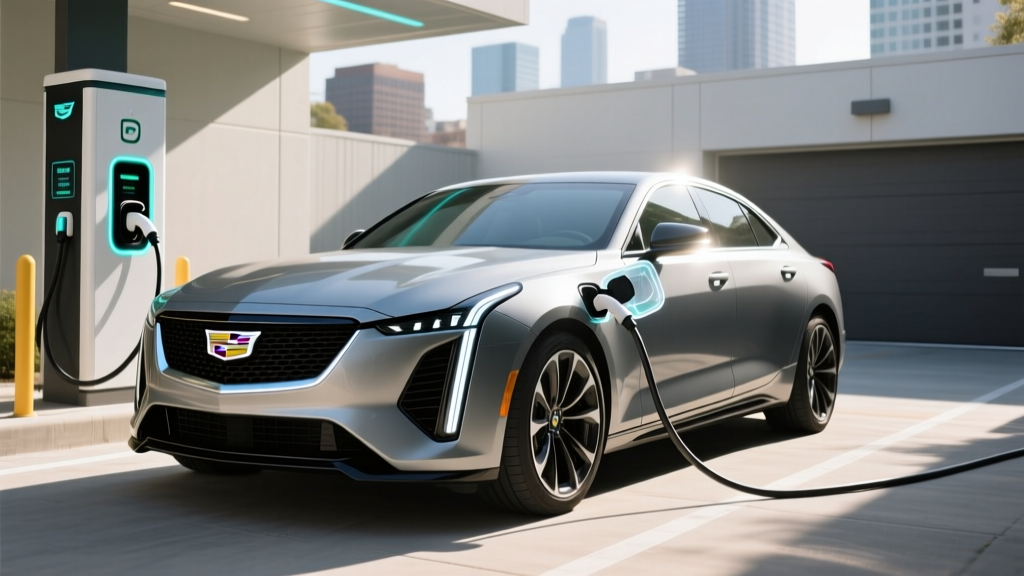
The Cadillac Optiq arrives as GM's compact luxury electric crossover built on the Ultium platform, and for prospective buyers, the sticker is only half the story. The other half is how quickly and cheaply you can keep its ~85 kWh (usable) lithium-ion battery full. Below is a data-driven look at Cadillac Optiq charging performance across Level 1, Level 2, and DC fast charging, plus the real costs of home installation, public charging, and the electrical upgrades you may need before delivery day.
Optiq Battery and Charging Architecture at a Glance
The Optiq shares GM's Ultium battery architecture with peers like the Chevrolet Equinox EV and Cadillac Lyriq. It uses a nickel-rich NMC (nickel manganese cobalt) chemistry optimized for energy density and cold-weather resilience. The onboard charger is rated for up to 11.5 kW on AC power, and the DC fast-charging system supports a peak rate around 150 kW on a 400-volt-class architecture. Unlike 800-volt rivals such as the Hyundai Ioniq 5 or Porsche Macan EV, the Optiq's charge curve tapers more noticeably above 80% state of charge (SoC).
| Usable battery capacity | ~85 kWh (NMC) |
| EPA estimated range | ~300 miles (varies by trim/AWD) |
| Max AC charge rate (Level 2) | 11.5 kW |
| Max DC fast charge rate | ~150 kW peak |
| 10–80% DC fast charge | ~27 minutes (ideal conditions) |
| Onboard charger | 11.5 kW / 48A AC |
| Native connector (2025+) | NACS (Tesla standard) |
Source: Cadillac official specs. Real-world 10–80% times vary with battery temperature, SoC, and charger availability.
Charging Levels Explained: How Fast Will Each Add Range?
The single most common EV confusion is mixing up kW (kilowatts — the rate of power delivery, like water pressure from a hose) and kWh (kilowatt-hours — the total energy stored, like the size of the tank). A charger rated at 11.5 kW delivers 11.5 kWh of energy per hour. The Optiq's ~85 kWh battery needs roughly 85 kWh from empty to full — so math gives us our charge times.
| Level | Voltage / Amperage | Power (kW) | Miles of Range / Hour | 0–100% Full Charge Time |
|---|---|---|---|---|
| Level 1 (120V outlet) | 120V / 12A | ~1.4 kW | ~4–5 mi/hr | ~60+ hours |
| Level 2 (240V home/public) | 240V / 48A | 11.5 kW | ~33–37 mi/hr | ~7.5–8 hours |
| DC Fast (public) | 400V+ DC | Up to ~150 kW peak | ~200+ mi in 20 min | 10–80% in ~27 min |
DC Fast Charging in Practice: The Charge Curve Reality
Peak kW numbers are marketing-friendly, but the charge curve determines your actual stop duration. The Optiq's Ultium battery can accept up to ~150 kW at low state of charge (roughly 10–30% SoC), but that rate does not hold. Here is what a typical DC fast-charge session looks like:
- 10–30% SoC: ~130–150 kW peak (fastest segment)
- 30–60% SoC: ~100–120 kW sustained
- 60–80% SoC: ~60–80 kW (taper begins)
- 80–100% SoC: ~20–40 kW (heavy taper to protect cells)
This means a 10–80% session takes roughly 27 minutes at a capable 150+ kW station, but pushing from 80–100% can add another 30–40 minutes. On road trips, the practical strategy is to charge to 80% and go — you'll spend less total time charging by making one extra short stop than by waiting for a full battery.
Preconditioning matters. If you navigate to a DC fast charger using the Optiq's built-in navigation, the battery thermal management system will warm (or cool) the pack to an optimal temperature before you arrive. Skipping preconditioning in cold weather can add 5–10 minutes to your 10–80% time and reduce peak kW acceptance.
Home Charging Installation: What It Actually Costs
Most Optiq owners will do 80–90% of their charging at home on Level 2. To unlock the Optiq's full 11.5 kW AC charging capability, you need a 240-volt, 60-amp dedicated circuit with a hardwired wall connector rated for 48 amps continuous draw (the National Electrical Code requires circuits rated at 125% of continuous load).
How much does it cost to install a home EV charger?
The answer depends heavily on your home's electrical panel and the distance from the panel to your garage or parking spot. Here is a realistic cost breakdown for a 2025/2026 installation:
| Component | Simple Install (panel nearby) | Complex Install (long run / panel upgrade) |
|---|---|---|
| Level 2 charger (hardware) | $400–$700 | $400–$700 |
| Electrician labor (2–4 hrs simple / 6–12 hrs complex) | $500–$1,200 | $1,500–$3,500 |
| Electrical permit | $50–$150 | $50–$200 |
| Conduit, wiring, breaker (60A) | $100–$300 | $400–$800 |
| Electrical panel upgrade (100A → 200A, if needed) | $0 (not needed) | $1,500–$3,500 |
| Total estimated cost | $1,050–$2,350 | $3,850–$8,700 |
What electrical upgrades might I need?
Homes built before 2000 often have 100-amp or 150-amp electrical panels that may already be near capacity. Adding a 60-amp EV circuit can push total demand past the panel's rating, requiring an upgrade to 200 amps. Signs you may need a panel upgrade:
- Your panel is 100A or less and you run central AC, an electric dryer, and an electric range simultaneously
- Your panel has no open breaker slots
- An electrician's load calculation (required by code) shows insufficient headroom
- You have a Federal Pacific or Zinsco panel (known safety hazards that must be replaced regardless)
Some utility companies offer make-ready programs that cover the cost of wiring from the street to your panel. Check with your local utility before scheduling work. Additionally, the federal residential clean energy credit (IRC §25D) may cover up to 30% of charger hardware and installation costs — consult a tax professional for your specific eligibility.
Connector Compatibility: NACS, CCS, and Adapters
Starting with the 2025 model year, GM transitioned all new Ultium-based EVs — including the Optiq — to the NACS (North American Charging Standard) connector, the same physical plug used by Tesla. This is a significant practical advantage because it grants native access to Tesla's Supercharger network, the largest and most reliable DC fast-charging network in North America.
| Connector Type | Native Support? | Adapter Needed? | Networks Available |
|---|---|---|---|
| NACS (Tesla standard) | ✅ Yes — native port | No | Tesla Supercharger, Electrify America (new stalls), EVgo, many others |
| CCS1 | ❌ Not native | Yes — NACS-to-CCS adapter (~$200–$300) | Electrify America (legacy CCS stalls), ChargePoint DC, EVgo (legacy) |
| CHAdeMO | ❌ Not native | Not recommended (legacy, being phased out) | Limited — mostly older Nissan Leaf infrastructure |
| J1772 (Level 2 AC public) | ✅ Yes — NACS accepts J1772 via included adapter | Included with vehicle | ChargePoint, Blink, public Level 2 stations |
GM includes a NACS-to-J1772 adapter in the box for compatibility with the thousands of public Level 2 chargers still using the older J1772 connector. For CCS1 DC fast chargers, you will need to purchase a separate adapter. As of 2026, the industry is rapidly transitioning to NACS, so most new public DC stations will have NACS cables natively.
Cost to Charge: Per-Mile Economics vs. Gasoline
Electricity pricing varies enormously depending on where and when you charge. Here is a realistic comparison using the Optiq's estimated efficiency of ~3.0 miles per kWh (roughly 112 MPGe combined, per fueleconomy.gov methodology).
| Charging Scenario | Price per kWh | Cost per Mile | Cost for 300-Mile "Tank" |
|---|---|---|---|
| Home — off-peak (utility time-of-use rate) | $0.08–$0.12 | $0.027–$0.040 | $8–$12 |
| Home — standard residential rate | $0.13–$0.18 | $0.043–$0.060 | $13–$18 |
| Public Level 2 (workplace, mall, parking garage) | $0.20–$0.35 | $0.067–$0.117 | $20–$35 |
| DC Fast (Tesla Supercharger, Electrify America) | $0.28–$0.48 | $0.093–$0.160 | $28–$48 |
How much does charging cost per mile vs gas?
A comparable gasoline luxury compact SUV (e.g., BMW X3, Audi Q5) averaging 25 MPG combined at $3.50/gallon costs $0.14 per mile in fuel alone. The Optiq charged at home off-peak costs $0.03–$0.04 per mile — roughly one-quarter the fuel cost. Even at peak DC fast-charging prices, the Optiq is cost-competitive with gasoline on a per-mile basis. Over 15,000 miles per year, home charging saves approximately $1,500–$1,800 annually versus a 25 MPG gas vehicle.
Recommended Home Chargers for the Cadillac Optiq
To maximize the Optiq's 11.5 kW onboard charger, you need a Level 2 unit capable of at least 48 amps continuous output on a 60-amp circuit. Here are three vetted options:
Tesla Wall Connector (NACS)
- Power output: Up to 11.5 kW (48A)
- Connector: NACS native — perfect Optiq match
- Cable length: 24 ft
- Smart features: Wi-Fi, OTA updates, power sharing between two units, load management
- Price: ~$475
- Best for: Optiq owners wanting seamless NACS integration and Tesla's proven hardware reliability
ChargePoint Home Flex (NACS)
- Power output: Up to 12 kW (50A) — adjustable down to match your circuit
- Connector: Available in NACS (2025+ models)
- Cable length: 23 ft
- Smart features: Wi-Fi, ChargePoint app scheduling, Alexa integration, energy reports
- Price: ~$599
- Best for: Drivers who want detailed energy tracking and flexible amperage settings for older panels
Emporia Vue + Level 2 Charger
- Power output: Up to 11.5 kW (48A)
- Connector: NACS or J1772 options
- Cable length: 24 ft
- Smart features: Whole-home energy monitoring, solar integration, EV-only circuit tracking
- Price: ~$399 (charger) + $149 (Vue monitor)
- Best for: Solar-panel owners who want to charge exclusively on excess solar production
Safety, Code, and Installation Best Practices
EV charging draws sustained high current for hours — this is fundamentally different from the brief load of starting a gas car or running a microwave. Proper installation is non-negotiable:
- Dedicated circuit: Your Level 2 charger must be on its own dedicated 60-amp breaker. Sharing a circuit with other appliances is a code violation and fire hazard.
- GFCI protection: The 2023 NEC (National Electrical Code) requires GFCI (ground-fault circuit interrupter) protection for EV outlets in garages. Hardwired installations may be exempt depending on local interpretation — ask your electrician.
- Outdoor rating: If your charger is mounted outside, it must be rated NEMA 4 (weather-resistant). All three chargers recommended above carry outdoor ratings.
- Permit and inspection: Nearly all jurisdictions require an electrical permit for a new 60-amp circuit. The inspection ensures the work meets code and is essential for insurance coverage in the unlikely event of an electrical fire.
- Wire gauge: A 60-amp circuit requires 6 AWG copper wire (or 4 AWG aluminum). Your electrician will size this based on the run length — longer runs may need thicker wire to prevent voltage drop.
Frequently Asked Questions
How fast will each charging level add range to the Optiq?
Level 1 (120V) adds about 4–5 miles per hour — useful only for overnight top-ups if you drive under 40 miles daily. Level 2 (240V/48A) adds 33–37 miles per hour, fully recharging the Optiq overnight in roughly 7.5–8 hours. DC fast charging at peak rate can add 200+ miles in about 20 minutes, though the charge curve tapers significantly above 80% SoC.
Which connector and charger is compatible with my Cadillac Optiq?
The Optiq uses the NACS connector natively. This means direct compatibility with Tesla Superchargers, new Electrify America NACS stalls, and most new public DC infrastructure. For older CCS1 chargers, you will need a NACS-to-CCS adapter. For public Level 2 (J1772), GM includes a J1772-to-NACS adapter in the vehicle.
How much does it cost to install a home EV charger for the Optiq?
A straightforward installation with the electrical panel near the garage typically costs $1,050–$2,350 (equipment + electrician + permit). If your home needs a panel upgrade from 100A to 200A, or the wiring run is long and complex, total costs can reach $3,850–$8,700. Always get a load calculation from a licensed electrician before committing.
How much does charging the Optiq cost per mile vs. a gas car?
Charging at home on off-peak rates ($0.08–$0.12/kWh), the Optiq costs approximately $0.03–$0.04 per mile. A comparable 25 MPG gasoline SUV at $3.50/gallon costs $0.14 per mile. Even the most expensive public DC fast charging ($0.28–$0.48/kWh) at $0.09–$0.16 per mile remains competitive with gasoline. Annual fuel savings of $1,500+ are realistic for most drivers.
What electrical upgrades might I need before installing a home charger?
The most common upgrade is an electrical panel replacement from 100A to 200A service, which costs $1,500–$3,500. You may also need additional breaker slots, upgraded service entrance wiring, or a second meter if your utility offers a separate EV rate. A licensed electrician's load calculation will determine exactly what your home requires. Some utilities offer rebates or make-ready programs that offset these costs.
Does the Optiq's charging speed slow down in cold weather?
Yes. Lithium-ion batteries charge more slowly when cold because the battery management system limits current to prevent lithium plating. In temperatures below 32°F, expect your 10–80% DC fast-charge time to increase by 20–40% unless you use the vehicle's navigation-based battery preconditioning. Always navigate to the charger through the Optiq's built-in system to trigger preconditioning automatically.
Sources: Cadillac Optiq official specifications, U.S. EPA fueleconomy.gov, IRS Residential Clean Energy Credit (§25D). Pricing and availability current as of the 2025/2026 model year. Tax credit eligibility depends on individual circumstances — consult a tax professional.