Cadillac Lyriq Charging at a Glance
The 2026 Cadillac Lyriq uses a 102 kWh (usable) Ultium NMC lithium-ion battery pack and is EPA-rated for up to 314 miles of range in rear-wheel-drive form. But range is only half the ownership equation — how quickly and cheaply you replenish that battery determines your daily experience. This guide covers every Cadillac Lyriq charging scenario: overnight Level 2 at home, DC fast charging on road trips, connector compatibility (including the NACS transition), and the real cost of keeping this luxury EV powered.
The Lyriq's EPA rating of 314 miles (RWD) or 284 miles (AWD) assumes a mixed driving cycle. On sustained highway driving at 70–75 mph, expect approximately 265–285 miles (RWD). In freezing temperatures (below 30°F), range can drop 20–30%, putting real-world winter range closer to 220–250 miles for RWD models. The Lyriq's standard heat pump helps mitigate cold-weather losses compared to EVs without active thermal management.
| Spec | 2026 Lyriq RWD | 2026 Lyriq AWD |
|---|---|---|
| Battery (usable) | 102 kWh (NMC) | 102 kWh (NMC) |
| EPA Range | 314 mi | 284 mi |
| Max DC Fast Charge | 190 kW peak | 190 kW peak |
| 10–80% DCFC Time | ~33 min | ~33 min |
| Level 2 (AC) Acceptance | 19.2 kW / 77A | 19.2 kW / 77A |
| EPA MPGe (combined) | 89 MPGe | 88 MPGe |
| 0–60 mph | 6.0 sec | 4.6 sec |
| Base MSRP | $58,590 | $62,090 |
| Battery Warranty | 8 yr / 100,000 mi | 8 yr / 100,000 mi |
Charging Levels Explained: How Fast Can the Lyriq Charge?
Understanding the three charging tiers is essential before you invest in equipment or plan a road trip. Power is measured in kilowatts (kW), which is the rate of energy delivery. The Lyriq's battery stores energy measured in kilowatt-hours (kWh) — 102 kWh usable. Think of kW as how fast water flows from a hose, and kWh as the size of the bucket you're filling.
| Level | Voltage | Max Power (kW) | Miles of Range Added per Hour | Best For |
|---|---|---|---|---|
| Level 1 | 120V AC | 1.4 kW | ~4–5 mi/hr | Emergency/trickle top-up |
| Level 2 | 240V AC | Up to 19.2 kW | ~52–64 mi/hr | Daily home & workplace charging |
| DC Fast Charge | 400V+ DC | Up to 190 kW | ~5–7 mi/min (at peak) | Road trips, quick replenishment |
Level 1 uses a standard 120V household outlet and the portable cord that ships with the Lyriq. At roughly 1.4 kW, you'll gain about 4–5 miles of range per hour — enough to recover a day's commuting if you plug in for 12 hours overnight, but impractical as a primary strategy for a 102 kWh battery. A full 0–100% charge on Level 1 would take approximately 73 hours.
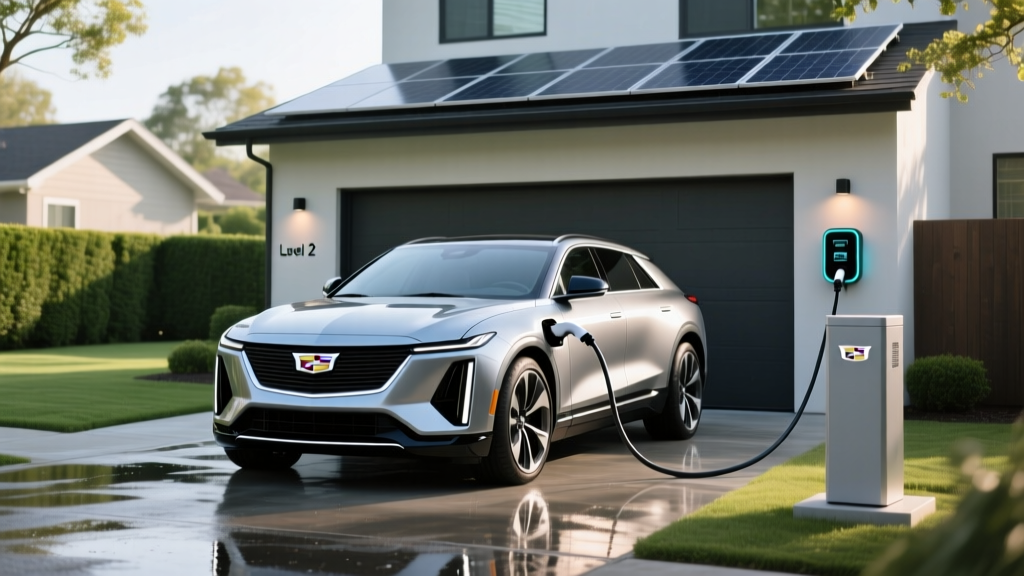
Level 2 is where most Lyriq owners will do 90% of their charging. The Lyriq's onboard charger accepts up to 19.2 kW (77 amps) on a 240V circuit — this is one of the highest AC acceptance rates in the luxury EV segment, ahead of competitors like the BMW iX (11 kW) and Genesis Electrified GV70 (10.9 kW). With a properly sized 100-amp dedicated circuit and a hardwired Level 2 station delivering 19.2 kW, the Lyriq can add roughly 60+ miles of range per hour. A full 10–100% charge takes approximately 5.5–6 hours. Most owners install a 48-amp or 60-amp charger on a 60-amp or 80-amp breaker respectively, which still delivers ample overnight replenishment at 11.5–14.4 kW.
DC Fast Charging bypasses the onboard charger and delivers direct current straight to the Ultium battery. The Lyriq peaks at approximately 190 kW at a compatible 350 kW (or higher) station. GM quotes a 10–80% time of roughly 33 minutes under ideal conditions. However, the charging curve tapers significantly above 80% — going from 80–100% can add another 25–30 minutes. On road trips, plan your stops around the 10–80% window to minimize time at the plug.
Connector Compatibility: NACS, CCS, and the Tesla Supercharger Network
The 2026 Cadillac Lyriq ships with the North American Charging Standard (NACS) connector as standard equipment, following GM's transition away from CCS1 beginning with the 2025 model year. This is a major advantage: NACS grants the Lyriq native access to the Tesla Supercharger network (V3 and V4 stalls), which remains the most reliable and extensive DC fast-charging network in North America.
| Connector | Native on 2026 Lyriq? | Network Access | Adapter Needed? |
|---|---|---|---|
| NACS (Tesla) | Yes (standard) | Tesla Superchargers, Electrify America (NACS stalls), Rivian Adventure Network | No |
| CCS1 | No (adapter required) | Legacy Electrify America, EVgo, ChargePoint DCFC | Yes — NACS-to-CCS adapter (~$150–250) |
| CHAdeMO | No | Largely discontinued in North America | Not practical / unavailable |
| J1772 (Level 2) | Adapter included | Public Level 2 stations, older workplace chargers | NACS-to-J1772 adapter (usually included with vehicle) |
Practical implication: If you have a CCS1-era home charger installed before 2024, you'll need a CCS-to-NACS adapter or a charger swap. For public DC fast charging, the Supercharger network now covers the vast majority of US highway corridors. Some older Electrify America and EVgo stations still use CCS1 connectors — carry a NACS-to-CCS adapter for redundancy on road trips through areas with limited Supercharger coverage.
Home Charger Installation: Requirements, Costs, and Electrical Upgrades
To unlock the Lyriq's 19.2 kW Level 2 capability, you need a 240V circuit with sufficient amperage. Here's what's involved electrically and financially.
Electrical Requirements
The Lyriq's 19.2 kW onboard charger draws 77 amps at 240V. Per the National Electrical Code (NEC), continuous loads (like EV charging) can only use 80% of a circuit's rated capacity. That means you need a 100-amp breaker on a dedicated circuit to deliver the full 19.2 kW. This requires 2 AWG copper wire (or equivalent aluminum) run from your panel to the charger location.
If you opt for a more common 48-amp charger (11.5 kW), a 60-amp breaker with 6 AWG copper wire suffices. A 60-amp charger (14.4 kW) requires an 80-amp breaker with 4 AWG copper. Most homes can accommodate a 60-amp circuit without a panel upgrade; a 100-amp dedicated circuit is more likely to trigger an electrical service upgrade.
Panel Upgrade Considerations
Homes with a 100-amp main electrical service will almost certainly need an upgrade to 200 amps before adding a high-power Level 2 charger — especially if you already run electric HVAC, an electric dryer, and an electric range. A 200-amp service is the modern standard and typically supports a 60-amp EV circuit without issue. Homes with existing 200-amp service usually have enough headroom for a 48–60 amp charger, but a licensed electrician should perform a load calculation per NEC Article 220 to confirm.
| Component | Typical Cost Range | Notes |
|---|---|---|
| Level 2 Charger (hardware) | $400–$750 | 48A–80A smart Wi-Fi charger |
| Electrician labor (standard install) | $600–$2,000 | Varies by wire run distance, wall type |
| Electrical permit | $50–$200 | Required in most jurisdictions |
| Panel upgrade (100A → 200A) | $2,000–$5,000 | Only if existing service is insufficient |
| Total (no panel upgrade) | $1,050–$2,950 | Most common scenario |
| Total (with panel upgrade) | $3,050–$7,950 | Older homes with 100A service |
Key tip: Some utilities offer rebates of $250–$1,000 for Level 2 charger installation, and certain states provide additional incentives. Check with your local utility and the Alternative Fuels Data Center for current programs in your area. Always hire a licensed electrician and pull a permit — unpermitted work can void home insurance coverage and create fire risk.
Charging Cost: Lyriq vs. Gas per Mile
One of the strongest ownership arguments for the Lyriq is the per-mile energy cost, particularly when charging at home on off-peak rates. Here's how the numbers break down across common scenarios.
| Scenario | Rate | Cost to Fill 102 kWh | Cost per Mile (314 mi range) |
|---|---|---|---|
| Home off-peak (utility TOU rate) | $0.09/kWh | $9.18 | $0.029/mi |
| Home average (national residential) | $0.17/kWh | $17.34 | $0.055/mi |
| Public Level 2 (ChargePoint, etc.) | $0.30/kWh | $30.60 | $0.097/mi |
| DC Fast Charge (EA, EVgo) | $0.45/kWh | $45.90 | $0.146/mi |
| Tesla Supercharger (avg 2026) | $0.35/kWh | $35.70 | $0.114/mi |
| Gas equivalent (25 MPG SUV, $3.40/gal) | — | $42.57 (for ~314 mi) | $0.136/mi |
At home off-peak rates, the Lyriq costs roughly 3 cents per mile to drive — about one-quarter the cost of a comparable gas-powered luxury SUV like the BMW X5 or Mercedes GLE. Even at DC fast-charging rates, the Lyriq is competitive with or cheaper than gasoline on a per-mile basis. The Lyriq's EPA-rated efficiency of 89 MPGe (RWD) translates to approximately 34 kWh per 100 miles, which is reasonable for a 5,600-pound luxury crossover but not class-leading — the BMW iX xDrive50 achieves 86 MPGe with similar weight, for reference. Source: fueleconomy.gov.
Best Level 2 Home Chargers for the Cadillac Lyriq
To take full advantage of the Lyriq's 19.2 kW onboard charger, you need a high-amperage Level 2 station. Here are three strong options across price and power tiers.
ChargePoint Home Flex (up to 50A / 12 kW)
Power: 12 kW max (50A on 240V) | Connector: NACS (2025+ models) or J1772 with adapter | Cable: 23 ft | Smart features: Wi-Fi, Alexa, scheduling, energy tracking via app | Price: ~$549
A proven, widely available unit. At 12 kW, a full Lyriq charge takes about 8.5 hours — fine for overnight use but doesn't exploit the Lyriq's full 19.2 kW AC capability. NEMA 14-50 plug or hardwired. UL-listed.
Wallbox Pulsar Max (48A / 11.5 kW)
Power: 11.5 kW max (48A on 240V) | Connector: NACS (2025+ models) | Cable: 25 ft | Smart features: Wi-Fi, Bluetooth, app scheduling, solar integration, Power Sharing for dual units | Price: ~$499
Compact, well-priced, and NACS-native in its latest generation. The 25-foot cable is generous for garages where the outlet isn't adjacent to the parking spot. Requires a 60-amp breaker. Good choice if you don't need maximum charge speed.
Emporia Vue / Emporia Level 2 EV Charger (48A / 11.5 kW or 80A / 19.2 kW)
Power: Up to 19.2 kW (80A model, hardwired) | Connector: NACS | Cable: 24 ft | Smart features: Real-time energy monitoring, whole-home integration with Emporia Vue panel monitor, scheduling, TOU optimization | Price: ~$599 (48A) / ~$899 (80A)
The 80A Emporia is one of the few residential chargers that can deliver the Lyriq's full 19.2 kW AC rate. It requires a 100-amp dedicated circuit and hardwired installation. If your electrical panel supports it, this is the optimal pairing — you'll add roughly 64 miles of range per hour and fully recharge overnight in about 5.5 hours.
Safety, Code, and Installation Best Practices
EV charging draws sustained high current for hours — making proper installation non-negotiable. Here's what the NEC and best practices require:
- Dedicated circuit: Your Level 2 charger must be on its own dedicated breaker — not shared with any other appliance or outlet.
- GFCI protection: The 2020 NEC (and 2023 updates) requires GFCI protection for all EV charging outlets. Hardwired chargers with built-in ground-fault protection may satisfy this without an external GFCI breaker, but confirm with your local inspector. Note: some EV owners report nuisance tripping with GFCI breakers on NEMA 14-50 outlets; hardwiring eliminates this issue.
- Outdoor rating: If your charger is installed outdoors (carport, driveway), ensure the unit carries a NEMA 4 or IP65 rating for weather resistance. All three chargers recommended above are outdoor-rated.
- Wire gauge: Undersized wire causes heat buildup and fire risk. Follow NEC Table 310.15(B)(16) for copper ampacity — 6 AWG for 60A circuits, 4 AWG for 80A, 2 AWG for 100A.
- Permit and inspection: Most municipalities require an electrical permit for EV charger installation. An inspector will verify wire gauge, breaker size, grounding, and GFCI compliance. Skipping the permit risks insurance denial in the event of a fire.
Cadillac Lyriq Charging FAQ
How long does it take to fully charge a Cadillac Lyriq at home?
On a 48-amp (11.5 kW) Level 2 charger, a full 0–100% charge takes approximately 9 hours. On a 60-amp (14.4 kW) charger, about 7 hours. On an 80-amp (19.2 kW) charger, roughly 5.5 hours. Most Lyriq owners charge from 20–80% overnight, which takes 3.5–5.5 hours depending on charger amperage.
Can I use Tesla Superchargers with the Cadillac Lyriq?
Yes. The 2025 and 2026 Lyriq ships with a native NACS charge port, which is the same connector used by Tesla Superchargers. You can plug directly into any V3 (250 kW) or V4 Supercharger stall without an adapter. The Lyriq will peak at approximately 190 kW on a V3 stall, limited by the vehicle's onboard charge acceptance rather than the station's output.
Does the Lyriq support preconditioning for faster DC charging?
Yes. When you enter a DC fast-charging station as a navigation destination in the Lyriq's Google Built-in infotainment system, the vehicle will precondition the battery to its optimal temperature before arrival. This is critical in cold weather, where a cold battery may initially accept only 50–80 kW before warming up, adding 10–15 minutes to your charge stop. Always navigate to the charger rather than driving there manually.
What happens if I charge to 100% every night?
The Lyriq uses NMC (nickel manganese cobalt) battery chemistry, which degrades faster when held at 100% state of charge for extended periods. GM recommends setting your daily charge limit to 80–90% for routine use and reserving 100% for road trips. The Lyriq's battery management system includes a buffer (the 102 kWh usable is less than the gross pack capacity), which provides some protection, but following the 80% daily guideline will maximize long-term battery health over the 8-year/100,000-mile warranty period.
How much does it cost to install a home EV charger for the Lyriq?
A standard installation with a 48–60 amp charger on an existing 200-amp electrical panel typically costs $1,050–$2,950 total (charger + electrician + permit). If your home has a 100-amp main service and needs a panel upgrade to 200 amps, expect the total to rise to $3,050–$7,950. Get quotes from at least two licensed electricians and always pull a permit. Check IRS.gov for whether the Alternative Fuel Infrastructure Tax Credit (up to $1,000 for residential charging equipment, subject to eligibility and census-tract requirements) applies in your area.
Is DC fast charging bad for the Lyriq's battery?
Occasional DC fast charging has a negligible effect on battery health. However, exclusive reliance on DCFC (charging above 50 kW daily) can accelerate degradation by 2–5% over the battery's lifetime compared to Level 2 charging, based on industry-wide NMC data. The Lyriq's active liquid thermal management system mitigates much of this risk. For daily use, Level 2 at home remains the optimal strategy; reserve DCFC for road trips.