If you're researching the Cadillac Lyriq charger type before taking delivery—or trying to optimize the charging setup you already have—you're navigating a connector landscape that shifted dramatically between 2024 and 2026. The Lyriq launched with a CCS1 port, but General Motors' pivot to the North American Charging Standard (NACS) means the answer to "which plug does my Lyriq use?" depends entirely on your model year. This guide breaks down exactly what connector your Lyriq has, how fast it charges at every level, what a home installation actually costs, and which equipment delivers the best value.
Which Connector Does the Cadillac Lyriq Use?
The Lyriq's charge port changed mid-generation:
- 2023–2024 model years: CCS1 (Combo) connector — the J1772-based standard used by most non-Tesla EVs at launch.
- 2025–present model years: Native NACS connector — the Tesla-designed standard that GM adopted across its EV lineup starting with the 2025 model year.
Both connector types support AC Level 1/Level 2 charging and DC fast charging, but the physical plug and public-network compatibility differ. Here's how the Lyriq stacks up against the broader connector ecosystem:
| Connector | 2023–2024 Lyriq | 2025+ Lyriq | Adapter Needed? |
|---|---|---|---|
| NACS (Tesla) | No — requires CCS-to-NACS adapter | Native | 2023–24: Yes (aftermarket or GM-supplied) |
| CCS1 (Combo) | Native | No — requires NACS-to-CCS adapter | 2025+: Yes (for legacy Electrify America stations) |
| CHAdeMO | No | No | Not recommended; no reliable adapter path |
| J1772 (AC only) | Yes (top portion of CCS1) | Yes (with NACS-to-J1772 adapter for older L2 stations) | 2025+: Adapter for non-NACS L2 |
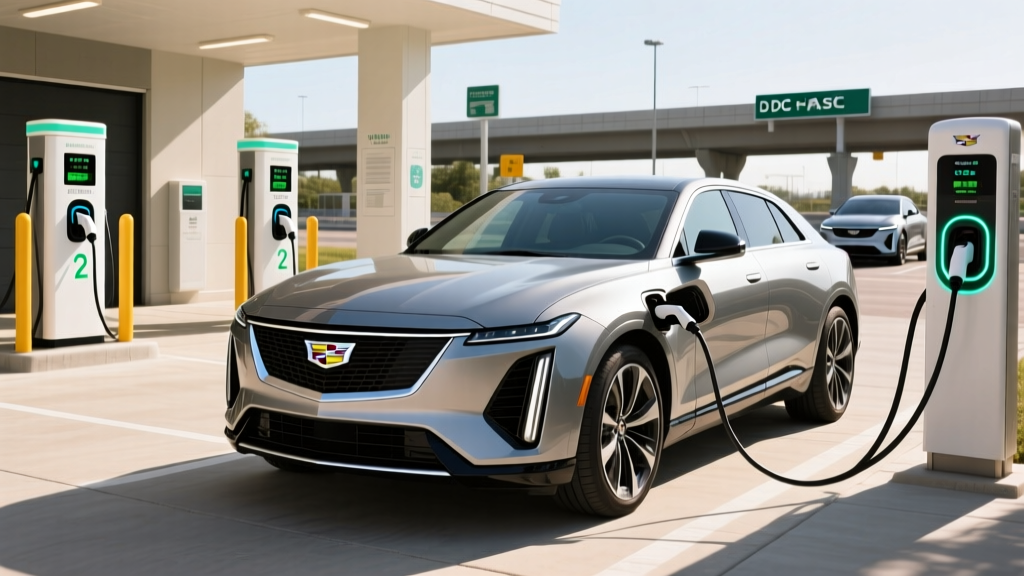
Practical takeaway: If you own a 2023–2024 Lyriq and want Tesla Supercharger access, GM began shipping a CCS-to-NACS adapter to eligible owners in late 2024. For the 2025+ Lyriq, the native NACS port opens the entire Supercharger network (now over 25,000 stalls in North America) without any adapter. You'll only need a NACS-to-CCS adapter if you frequently use older Electrify America or EVgo stations that haven't retrofitted NACS cables.
Charging Levels Explained: kW, Miles per Hour, and 10–80% Times
Before comparing speeds, let's lock in the critical distinction: kW (kilowatts) measures power—how fast energy flows into the car. kWh (kilowatt-hours) measures energy—the total capacity of the battery. The Lyriq's usable battery capacity is 102 kWh (NMC chemistry). Dividing kWh by kW gives you hours; multiplying kW by efficiency gives you miles added per hour.
The Lyriq's EPA range sits at 314 miles for the rear-wheel-drive Luxury trim and 307 miles for the all-wheel-drive Sport trim (per fueleconomy.gov). In real-world highway driving at 70 mph, expect roughly 260–280 miles; in sub-freezing temperatures, plan for 220–250 miles.
| Level | Voltage / Power | Peak kW | Miles of Range Added per Hour | 10–80% Time |
|---|---|---|---|---|
| Level 1 (120V household) | 120V / 1.4 kW | 1.4 kW | ~4 mi/hr | ~60+ hours (impractical) |
| Level 2 (240V home/public) | 240V / up to 19.2 kW | 19.2 kW (Lyriq onboard charger max) | ~52–58 mi/hr at 19.2 kW; ~35 mi/hr at 11.5 kW | ~5.5 hours at 19.2 kW; ~9 hours at 11.5 kW |
| DC Fast Charging | 400V architecture / up to 190 kW | 190 kW peak | ~350+ mi/hr (peak) | ~33 minutes (10–80%) |
Charging-curve reality check: The Lyriq's 190 kW peak only holds between roughly 10% and 35% State of Charge (SoC). Above 50%, the rate tapers to ~120 kW; above 80%, it drops to ~50 kW to protect battery health. That's why the 10–80% metric matters more than peak kW—it reflects the sustained average, not a momentary spike. On a 300-mile road trip, plan your DC fast stops around 30 minutes each, and precondition the battery (via the Lyriq's navigation-routed charging) to hit peak speeds.
Home Charger Installation: Electrical Requirements and Real Costs
The Lyriq's 19.2 kW onboard AC charger is one of the most powerful in its class—most competitors max out at 11.5 kW. To exploit that full speed, you need a 100-amp dedicated circuit feeding a hardwired Level 2 station rated at 80 amps continuous (the National Electrical Code requires circuits sized at 125% of continuous load). Most homes don't have this capacity readily available, so a 48-amp circuit feeding a 40-amp continuous charger (delivering 11.5 kW) is the more common and cost-effective setup.
Electrical Panel and Circuit Requirements
- Ideal setup (19.2 kW): 240V, 100A dedicated breaker, hardwired station, 2/0 AWG copper wire. Requires a 200A+ main service panel with at least 4 open slots and sufficient bus-bar capacity.
- Standard setup (11.5 kW): 240V, 60A dedicated breaker, hardwired or NEMA 14-50 receptacle, 6 AWG copper wire. Fits most 200A panels with 2 open slots.
- Minimum viable (7.7 kW): 240V, 40A dedicated breaker, NEMA 14-50 or hardwired, 8 AWG copper. Adequate for overnight charging if you drive under 60 miles daily.
Panel upgrade reality: If your home has a 100A main panel (common in pre-1990 construction), you'll likely need a service upgrade to 200A before adding a 60A EV circuit. This is the single biggest cost variable in home charging.
| Component | Standard Install (11.5 kW, no panel upgrade) | Full-Speed Install (19.2 kW, no panel upgrade) | With 200A Panel Upgrade |
|---|---|---|---|
| Level 2 charger equipment | $500–$750 | $700–$1,200 | $500–$1,200 |
| Electrician labor (2–6 hours) | $600–$1,500 | $1,000–$2,500 | $600–$1,500 (charger circuit only) |
| Electrical permit | $50–$200 | $50–$200 | $100–$300 |
| Panel upgrade (if needed) | N/A | N/A | $2,000–$4,500 |
| Wire/conduit materials | $100–$400 | $200–$600 | $100–$400 |
| Total range | $1,250–$2,850 | $1,950–$4,500 | $3,300–$7,900 |
Always hire a licensed electrician familiar with EV circuits. The NEC requires a GFCI breaker for receptacle-based installations (NEMA 14-50), and outdoor chargers must carry a NEMA 4 weatherproof rating. Many utilities offer rebates of $250–$500 for Level 2 installations—check with your local provider before scheduling work.
Cost to Charge the Lyriq: Home vs. Public vs. Gas
The Lyriq's efficiency is rated at approximately 89 MPGe combined (RWD), translating to roughly 34 kWh per 100 miles. Using that figure, here's what charging actually costs across different scenarios:
| Scenario | Rate ($/kWh) | Cost per 100 Miles | Cost per Mile | Annual Cost (12,000 mi) |
|---|---|---|---|---|
| Home, off-peak utility rate | $0.11 | $3.74 | $0.037 | $449 |
| Home, average residential rate | $0.17 | $5.78 | $0.058 | $694 |
| Public Level 2 (ChargePoint, etc.) | $0.30 | $10.20 | $0.102 | $1,224 |
| DC Fast Charging ( Electrify America, EA Pass) | $0.43 | $14.62 | $0.146 | $1,754 |
| Tesla Supercharger (NACS, 2025+ Lyriq) | $0.35 | $11.90 | $0.119 | $1,428 |
| Gasoline equivalent (25 MPG, $3.40/gal) | — | $13.60 | $0.136 | $1,632 |
Home off-peak charging delivers the clearest economic advantage—roughly one-quarter the per-mile cost of gasoline. Even exclusive DC fast charging is cost-competitive with gas in most markets, though it sacrifices the convenience advantage. For a Lyriq owner who charges at home 80% of the time and uses DC fast charging for road trips, a blended annual fuel cost of $600–$800 is realistic, saving $800–$1,000 per year versus a comparable gas-powered Cadillac XT5.
Best Level 2 Chargers for the Cadillac Lyriq
Because the Lyriq supports up to 19.2 kW AC charging, it benefits more than most EVs from a high-output home station. Here are three chargers matched to different budgets and electrical scenarios:
Emporia Vue + Emporia Level 2 Charger (48A)
- Power output: 11.5 kW at 48 amps / 240V
- Connector: J1772 (2023–24 Lyriq native; 2025+ needs NACS adapter) or NACS version available
- Cable length: 24 feet
- Smart features: Wi-Fi, energy monitoring via Emporia Vue panel integration, scheduled charging, solar-aware charging
- Price: ~$550 (charger) + $150 (Vue monitor)
- Best for: Budget-conscious owners with solar panels or time-of-use rate optimization
ChargePoint Home Flex (up to 50A)
- Power output: Up to 12 kW at 50 amps / 240V (adjustable via dip switches to match circuit)
- Connector: J1772 or NACS (select at purchase)
- Cable length: 23 feet
- Smart features: Wi-Fi, ChargePoint app scheduling, Alexa integration, load-sharing with second unit
- Price: ~$650
- Best for: Owners wanting a proven brand with flexible amperage for older panels
FLO Home X80 (80A)
- Power output: 19.2 kW at 80 amps / 240V — unlocks the Lyriq's full onboard charger
- Connector: J1772 (NACS version expected mid-2026)
- Cable length: 25 feet
- Smart features: Wi-Fi, FLO app, RFID authentication, load management, NEMA 4 outdoor rating
- Price: ~$1,100
- Best for: Lyriq owners with 100A+ circuit capacity who want the fastest possible home charging (~5.5 hours for a full 10–100% cycle)
For most Lyriq owners, the ChargePoint Home Flex at 48 amps hits the sweet spot: it charges a depleted 102 kWh battery in roughly 9 hours—plenty fast for overnight replenishment—and works with a standard 60A breaker. The FLO X80 is worth the investment only if your electrical panel supports a 100A circuit and you regularly need full-battery turnarounds in under 6 hours (e.g., high daily mileage or frequent road-trip prep).
Safety, Code, and the Panel-Upgrade Gotcha
The National Electrical Code (NEC Article 625) governs EV charging installations, and a few requirements consistently surprise first-time EV owners:
- Dedicated circuit: Your Level 2 charger must have its own breaker—no sharing with dryers, ranges, or HVAC. This is non-negotiable.
- GFCI protection: Any receptacle-based install (NEMA 14-50) requires a GFCI breaker. Hardwired stations do not. GFCI breakers cost $50–$100 more than standard breakers and can occasionally nuisance-trip; many EV electricians now recommend hardwiring to avoid this.
- Outdoor rating: If your charger mounts outside, it must carry at least a NEMA 4 rating (splash and sleet resistant). The FLO X80 and ChargePoint Home Flex both qualify; the Emporia charger requires an optional weatherproof enclosure for outdoor use.
- Load calculation: Your electrician must perform a NEC Article 220 load calculation to verify your panel can handle the new circuit. A 200A panel with existing heavy loads (electric range, heat pump, dryer) may not have headroom for a 60A EV circuit without a panel upgrade or smart load-management device.
- Permit and inspection: Virtually all jurisdictions require an electrical permit for a new 240V circuit. The inspection typically costs $50–$200 and protects your home insurance coverage. Skipping the permit risks denied claims if an electrical fire originates at the charger circuit.
The panel-upgrade gotcha: Homes built before 1990 often have 100A or 150A main service. Adding a 60A EV circuit to a 100A panel that already serves electric heat, a dryer, and a range will almost certainly fail the load calculation. A service upgrade to 200A costs $2,000–$4,500 and adds 1–3 weeks to your project timeline. Some utilities offer load-management devices (like the Emporia Smart Load Center) that throttle the charger when other appliances draw heavily—this can avoid a panel upgrade in borderline cases.
Public Charging the Lyriq: Networks and Practical Tips
With the 2025+ Lyriq's native NACS port, the Tesla Supercharger network is your primary DC fast-charging resource—over 25,000 stalls across North America, with typical V3 stations delivering 250 kW (the Lyriq will accept up to its 190 kW ceiling). For 2023–2024 Lyriq owners using the GM-supplied CCS-to-NACS adapter, Supercharger access is enabled, though charge speeds may be slightly throttled by adapter overhead.
Non-Tesla networks remain important, especially along corridors where Superchargers are sparse:
- Electrify America: CCS1-native stations up to 350 kW; the Lyriq will peak at 190 kW. 2025+ NACS Lyriqs need a NACS-to-CCS adapter (sold separately, ~$200).
- EVgo: Mixed CCS/NACS stations; newer locations feature NACS cables. Check the EVgo app for connector availability before routing.
- ChargePoint / EV Connect: Primarily Level 2 destinations (hotels, workplaces); connector mix varies by site.
For road-trip planning, the Lyriq's built-in navigation (Google Built-in) automatically routes through compatible chargers and preconditions the battery for optimal charge speed upon arrival—a feature that can shave 5–10 minutes off a DC fast stop in cold weather.
Frequently Asked Questions
How much does it cost to install a home EV charger for the Cadillac Lyriq?
A standard 11.5 kW (48-amp) Level 2 installation with no panel upgrade typically costs $1,250–$2,850 including equipment, electrician labor, permit, and materials. If your home requires a 200A service panel upgrade, add $2,000–$4,500, bringing the total to $3,300–$7,900. The higher-output 19.2 kW (80-amp) setup costs $1,950–$4,500 without a panel upgrade. Always get 2–3 quotes from licensed electricians, and check with your utility for rebates that can offset $250–$500 of the cost.
How fast will each charging level add range to the Lyriq?
Level 1 (120V) adds roughly 4 miles per hour—useful only for emergency trickle charging. Level 2 at 11.5 kW adds ~35 miles per hour; at 19.2 kW it adds ~52–58 miles per hour. DC fast charging at peak power adds 350+ miles per hour, but the sustained 10–80% average delivers about 190 miles in 33 minutes. Real-world speed depends on battery temperature, SoC, and station output.
Which connector and charger is compatible with my Lyriq?
The 2023–2024 Lyriq uses a CCS1 connector natively and requires a CCS-to-NACS adapter for Tesla Supercharger access. The 2025 and newer Lyriq uses a native NACS connector and requires a NACS-to-CCS adapter for older Electrify America stations. For home Level 2 charging, any J1772 station works with the 2023–24 model; 2025+ models need a NACS-equipped home charger or a J1772-to-NACS adapter.
How much does charging the Lyriq cost per mile vs. gasoline?
At the U.S. average residential electricity rate of $0.17/kWh, the Lyriq costs about $0.058 per mile to charge at home. A comparable gas SUV at 25 MPG and $3.40/gallon costs $0.136 per mile. Even exclusive DC fast charging at $0.43/kWh comes to $0.146 per mile—roughly equal to gas. The savings are maximized with home off-peak charging at $0.037 per mile, saving over $1,100 annually versus gasoline for a 12,000-mile driver.
What electrical upgrades might I need for a Lyriq home charger?
At minimum, you need a dedicated 240V circuit (40A–100A depending on charger power) with a properly sized breaker and copper wire gauge. Homes with 100A main service panels or limited breaker slots will likely need a panel upgrade to 200A, adding $2,000–$4,500. Older homes may also need service lateral upgrades from the utility. A licensed electrician's load calculation (NEC Article 220) determines your exact requirements—never skip this step.
Does the Lyriq support 800V DC fast charging?
No. The Lyriq uses a 400V architecture, limiting its DC fast-charge peak to 190 kW. Competitors like the Hyundai Ioniq 5 and Kia EV6 use 800V systems that accept 240–350 kW. In practice, the Lyriq's 10–80% time of ~33 minutes is competitive, but it won't match the 18-minute 10–80% times of 800V vehicles at ultra-fast 350 kW stations.
For the latest Cadillac Lyriq specifications and charging details, consult the manufacturer's official site, and verify current IRS §30D tax credit eligibility if you're purchasing new—credit rules around battery sourcing, MSRP caps, and income limits continue to evolve through 2026.