2025 Cadillac Escalade IQ Range and Charging: What Buyers Need to Know
The 2025 Cadillac Escalade IQ is the first full-size electric luxury SUV to clear 450 miles of EPA-estimated range, thanks to a massive Ultium-based battery pack. But range is only half the ownership equation — how fast you can replenish that pack at home, on the road, and at what cost determines whether this $130,000+ flagship integrates smoothly into daily life or becomes a charging hassle.
This guide breaks down the Escalade IQ's real-world range expectations, every charging method available to owners, home installation costs and electrical requirements, connector compatibility, and per-mile cost comparisons versus the gas Escalade. All figures reflect the 2025 model year and current 2026 infrastructure.
| EPA Range | 460 miles (Luxury trim, 24" wheels: ~440 mi) |
| Battery (usable) | ~200 kWh (Ultium, NMC chemistry) |
| Max DC Fast Charge | ~350 kW peak (800V architecture) |
| 10–80% DC Time | ~30 minutes (at 350 kW stall) |
| Onboard Charger (L2) | 19.2 kW / 77A |
| Connector | CCS1 (NACS adapter available) |
| 0–60 mph | ~4.7 seconds (dual motor AWD) |
| Horsepower | 680 hp (Velocity); 750 hp (Sport) |
| Base MSRP | $129,990 (Luxury); $149,990 (Sport) |
Real-World Range vs. the EPA Sticker
The EPA-estimated 460 miles applies to the Luxury trim with standard 24-inch wheels. That figure is remarkable for a vehicle weighing over 8,500 lbs, but real-world conditions rarely match laboratory testing.
EPA: 460 miles — Expect approximately 370–410 miles on the highway at 70–75 mph, and 300–340 miles in cold weather (below 30°F) with cabin heating active. Regenerative braking recovers less energy in stop-and-go traffic compared to lighter EVs due to the Escalade IQ's mass.
The Ultium pack uses NMC (nickel-manganese-cobalt) chemistry, which offers high energy density but is more temperature-sensitive than LFP. GM's thermal management system is robust, but preconditioning the battery before DC fast charging is essential — the Escalade IQ does this automatically when you navigate to a charger via the infotainment system. Skipping preconditioning in cold weather can cut peak charge rates by 40–50%.
Sources: fueleconomy.gov EV technology overview, Cadillac Escalade IQ official page.
Charging Levels Explained: Speeds in kW and Miles Per Hour
Understanding charging requires separating kW (kilowatts) — the rate of power delivery — from kWh (kilowatt-hours) — the total energy stored. Think of kW as the speed of water flowing through a hose and kWh as the size of the bucket. The Escalade IQ's ~200 kWh bucket is enormous, so fill rates matter enormously.
| Level | Power (kW) | Miles Added Per Hour | Typical Use Case |
|---|---|---|---|
| Level 1 (120V outlet) | ~1.4 kW | ~3–4 mi/hr | Emergency / trickle only |
| Level 2 (240V home) | 7.7–19.2 kW | ~20–50 mi/hr | Daily home charging |
| DC Fast (public) | 50–350 kW | ~130–700+ mi/hr (peak) | Road trips / quick top-ups |
At Level 1, fully recharging the Escalade IQ from 10% would take over 5 days — effectively unusable for anything beyond maintaining charge. Level 2 is where 90%+ of Escalade IQ charging will happen. The onboard charger accepts up to 19.2 kW (77 amps), which is among the highest in any production EV. At that rate, a 10–80% fill takes roughly 7–8 hours — perfect for overnight replenishment.
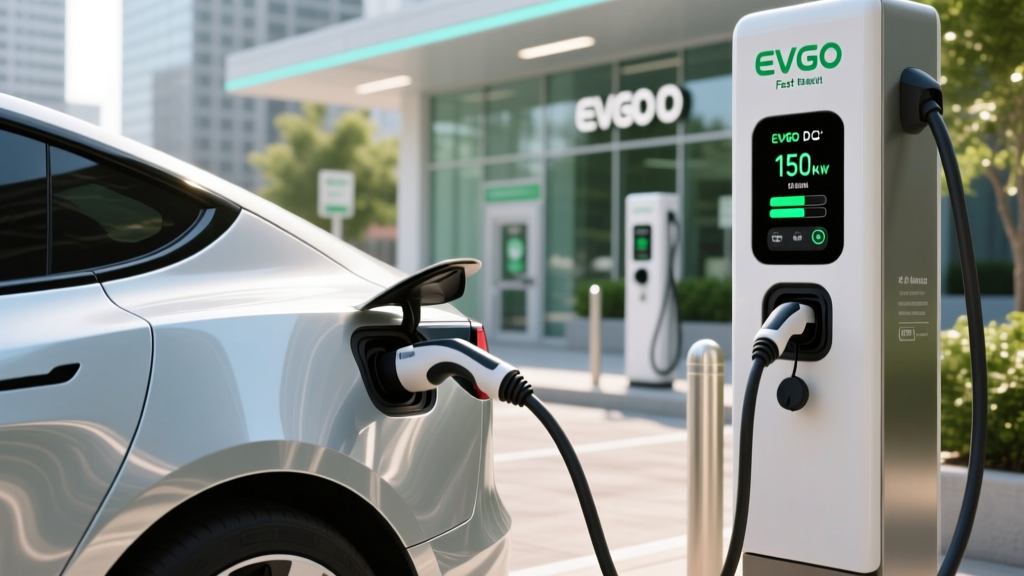
At a 350 kW DC fast charger, the 800V architecture enables a 10–80% charge in approximately 30 minutes. However, charging curves are not linear: the Escalade IQ sustains peak rates up to roughly 40–50% State of Charge, then tapers progressively. Expect the final 20% (80–100%) to add another 25–35 minutes. GM recommends daily charging to 80% for NMC battery longevity.
Home Charger Installation: Electrical Requirements and Costs
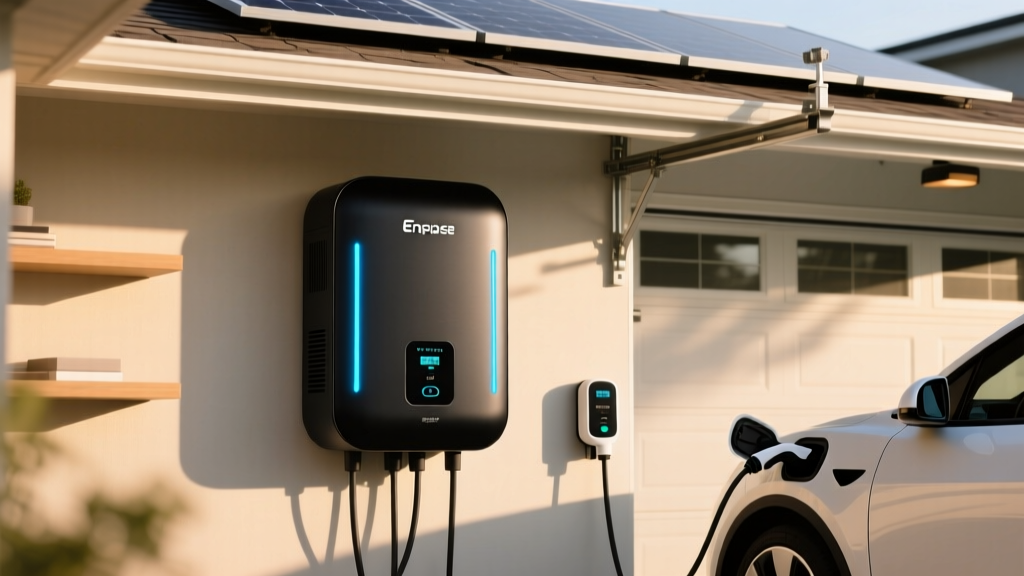
The Escalade IQ's 19.2 kW onboard charger is a major advantage — but only if your home electrical system can deliver it. Most residential panels were not designed for continuous 80-amp loads, so planning the install correctly avoids costly surprises.
Electrical Requirements by Charger Speed
| Target Charge Rate | Circuit Voltage / Amperage | Wire Gauge | Panel Headroom Needed |
|---|---|---|---|
| 11.5 kW (48A) | 240V / 60A breaker | 6 AWG copper | ~60A spare capacity |
| 19.2 kW (77A) | 240V / 100A breaker | 2 AWG copper | ~100A spare capacity |
A standard 200-amp residential panel may not have 100 amps of spare capacity after accounting for HVAC, water heater, dryer, and other loads. A licensed electrician will perform a NEC Article 220 load calculation to determine whether a panel upgrade (to 400A or a secondary subpanel) is necessary.
Homes built before 2000 frequently have 100A or 150A main panels. Upgrading to 200A–400A service can add $2,000–$5,000+ to your project and may require utility coordination. Always get a load calculation before purchasing equipment.
Installation Cost Breakdown
| Component | Low End | High End | Notes |
|---|---|---|---|
| Level 2 EVSE (hardware) | $400 | $1,200 | Smart Wi-Fi charger, 48A–80A |
| Electrician labor | $600 | $2,500 | Depends on run length, conduit, walls |
| Permit / inspection | $100 | $400 | Varies by municipality |
| Panel upgrade (if needed) | $2,000 | $5,000+ | 200A→400A service upgrade |
| Total (no panel upgrade) | $1,100 | $4,100 | Most typical installs |
| Total (with panel upgrade) | $3,100 | $9,100+ | Older homes / high-load panels |
The IRS §30D tax credit does not cover home charger installation for 2025–2026 (the Alternative Fuel Vehicle Refueling Property Credit, §30C, expired for most residential installations after 2023, though some census-tract-based eligibility may remain — consult a tax professional). Some utilities offer rebates of $250–$1,000 for smart charger installs; check your local provider.
Connector Compatibility: NACS, CCS1, and Adapter Needs
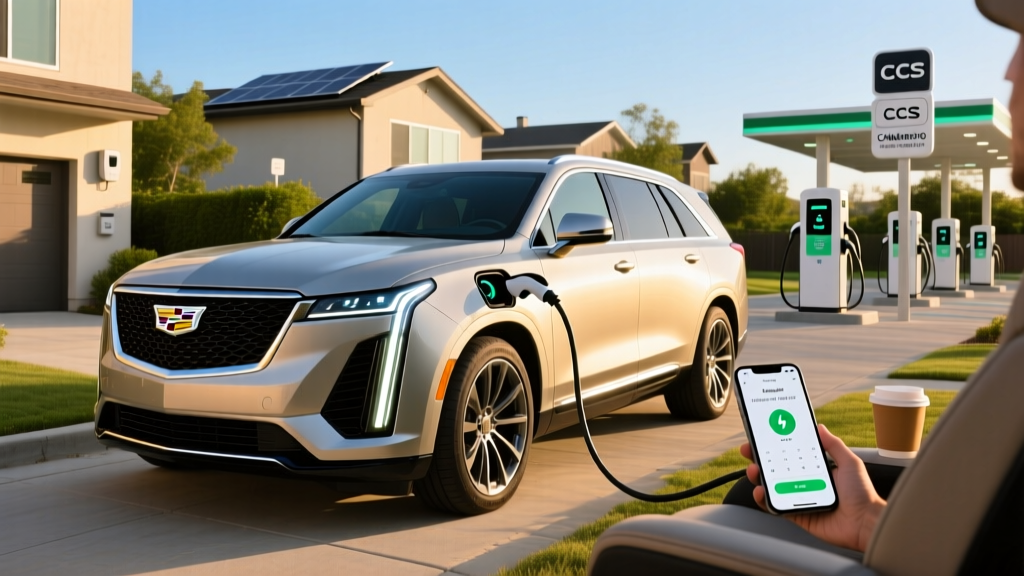
The 2025 Escalade IQ ships with a CCS1 (Combined Charging System) port. However, GM has committed to transitioning to the NACS (Tesla-style) connector for future models, and adapters are available for accessing Tesla Supercharger networks.
| Connector | Native / Adapter | Network Access |
|---|---|---|
| CCS1 | Native (built-in) | Electrify America, EVgo, ChargePoint, Ionity (EU) |
| NACS (Tesla) | GM-approved adapter (~$200–$400) | Tesla Supercharger network (V3/V4 stalls) |
| CHAdeMO | Not supported | N/A — legacy standard, largely discontinued |
| J1772 (Level 2) | Native (CCS1 includes J1772 upper coupler) | All public Level 2 stations |
For road trips, the GM-approved NACS adapter unlocks over 20,000 Tesla Supercharger stalls across North America. Note that adapter use may slightly reduce peak DC charge rates compared to a native NACS port. At home, any J1772 or hardwired Level 2 EVSE will work natively.
Charging Cost Per Mile: Escalade IQ vs. Gas Escalade
The Escalade IQ's efficiency is approximately 2.0–2.2 kWh/mile (roughly 47–50 MPGe equivalent) given its mass and aerodynamics. That figure drives operating cost calculations.
| Scenario | Rate | Cost Per Mile | Annual (12,000 mi) |
|---|---|---|---|
| Home (off-peak, $0.12/kWh) | $0.12/kWh × 2.1 kWh/mi | $0.25/mi | $3,024 |
| Home (peak, $0.22/kWh) | $0.22/kWh × 2.1 kWh/mi | $0.46/mi | $5,544 |
| Public Level 2 ($0.35/kWh) | $0.35/kWh × 2.1 kWh/mi | $0.74/mi | $8,820 |
| DC Fast ($0.48/kWh avg) | $0.48/kWh × 2.1 kWh/mi | $1.01/mi | $12,096 |
| Gas Escalade (16 MPG, $3.50/gal) | $3.50 ÷ 16 MPG | $0.22/mi | $2,625 |
| Gas Escalade (16 MPG, $4.50/gal) | $4.50 ÷ 16 MPG | $0.28/mi | $3,375 |
Key takeaway: Home off-peak charging is the economic sweet spot. At $0.12/kWh, the Escalade IQ costs roughly the same per mile as the gas Escalade at $3.50/gallon. But if you rely primarily on DC fast charging at $0.48/kWh, electricity costs can be 3–4× higher than gas. Escalade IQ buyers with home Level 2 access will save on fuel; those dependent on public charging will not.
Recommended Home Charging Equipment
Given the Escalade IQ's 19.2 kW onboard charger, investing in a high-amperage Level 2 EVSE maximizes overnight convenience. Below are three vetted options spanning budget, performance, and premium tiers.
Budget Pick: Emporia Vue 48A
- Power: 11.5 kW (48A, 240V)
- Connector: J1772 (NACS adapter-compatible)
- Cable: 24 ft
- Smart Features: Wi-Fi, app scheduling, energy monitoring, load management
- Price: ~$400–$500
- Best for: Owners who charge overnight and don't need the full 19.2 kW
Performance Pick: ChargePoint Home Flex (80A config)
- Power: Up to 19.2 kW (80A, 240V, hardwired)
- Connector: J1772 (NACS adapter-compatible)
- Cable: 23 ft
- Smart Features: Wi-Fi, Alexa integration, amperage dial (16A–80A), detailed app analytics
- Price: ~$700–$800 (hardwired version)
- Best for: Maximizing the Escalade IQ's 19.2 kW onboard charger
Premium Pick: Wallbox Pulsar Max (48A)
- Power: 11.5 kW (48A, 240V)
- Connector: J1772 (NACS version available)
- Cable: 25 ft
- Smart Features: Wi-Fi + Bluetooth, Power Sharing (daisy-chain multiple units), eco-scheduling
- Price: ~$650–$750
- Best for: Multi-EV households or solar-integrated homes
Important: To unlock the full 19.2 kW (80A), you need a hardwired installation on a 100A dedicated circuit. Plug-in (NEMA 14-50) installations are limited to 40A continuous (9.6 kW) per NEC derating rules. Hardwired is strongly recommended for the Escalade IQ.
Safety, Code, and Permit Considerations
EV charger installations must comply with NEC Article 625 and local building codes. Key requirements:
- Dedicated circuit: The EVSE must have its own breaker — no sharing with other appliances.
- GFCI protection: Required for outdoor installations and some jurisdictions require it indoors as well (NEC 2023+ updates).
- Outdoor rating: If mounting outside, the EVSE must carry a NEMA 4 (weatherproof) rating. All three units recommended above qualify.
- Permit and inspection: Most municipalities require an electrical permit ($100–$400) and a post-install inspection. Skipping this voids homeowner insurance coverage for electrical fires.
- Cable management: For garage installs, a wall-mounted holster and cable organizer prevent tripping hazards and cord damage.
Always hire a licensed electrician — DIY high-amperage 240V work is dangerous and may violate insurance terms. Reference the NHTSA EV safety resources for additional guidance on EV ownership safety practices.
Frequently Asked Questions
How much does it cost to install a home EV charger for the Escalade IQ?
Expect $1,100–$4,100 for a standard installation (equipment + electrician + permit) if your panel has sufficient capacity. If a panel upgrade is needed, add $2,000–$5,000+. A hardwired 80A/19.2 kW install on a 100A circuit is recommended to maximize the Escalade IQ's onboard charger.
How fast will each charging level add range to the Escalade IQ?
Level 1 (120V): ~3–4 miles per hour. Level 2 at 19.2 kW: ~50 miles per hour. DC fast charging at 350 kW: up to ~700 miles per hour at peak, though the charge curve tapers significantly above 50% State of Charge.
Which connector and charger is compatible with the Escalade IQ?
The Escalade IQ uses a native CCS1 port, which includes J1772 for Level 2. A GM-approved NACS adapter (~$200–$400) enables Tesla Supercharger access. CHAdeMO is not supported. Any J1772 or hardwired Level 2 EVSE works for home charging.
How much does charging cost per mile compared to gas?
At home off-peak rates ($0.12/kWh), the Escalade IQ costs ~$0.25/mile — comparable to a gas Escalade at $3.50/gallon. However, exclusive DC fast charging at $0.48/kWh pushes costs to ~$1.01/mile, roughly 3–4× the gas equivalent. Home charging access is critical for cost savings.
What electrical upgrades might I need?
A 19.2 kW charger requires a 100A dedicated circuit on a 240V line. Homes with 200A main panels may need a panel upgrade to 400A or a subpanel if existing loads consume too much capacity. A licensed electrician must perform an NEC Article 220 load calculation before installation.
Does the Escalade IQ qualify for the federal EV tax credit?
The 2025 Escalade IQ's MSRP exceeds $80,000, which is the IRS §30D SUV/van cap. It does not qualify for the $7,500 new clean vehicle credit. Buyers should consult a tax professional for state-level incentive eligibility, which varies by jurisdiction.
The Bottom Line: Is the Escalade IQ Practical to Charge?
The 2025 Cadillac Escalade IQ's 460-mile EPA range and 350 kW DC fast-charging capability are class-leading for a full-size electric SUV. However, its ~200 kWh battery demands serious home infrastructure: a 100A dedicated circuit for full-speed Level 2 charging, and potentially a panel upgrade in older homes. Budget $1,500–$5,000 for a proper install, and prioritize off-peak home charging to keep operating costs competitive with the gas Escalade. For road trips, the GM NACS adapter unlocks Tesla's Supercharger network, making cross-country travel viable with ~30-minute stops at 350 kW stalls. The Escalade IQ is practical for homeowners with adequate electrical service — but apartment dwellers or those without reliable home charging should proceed with caution.