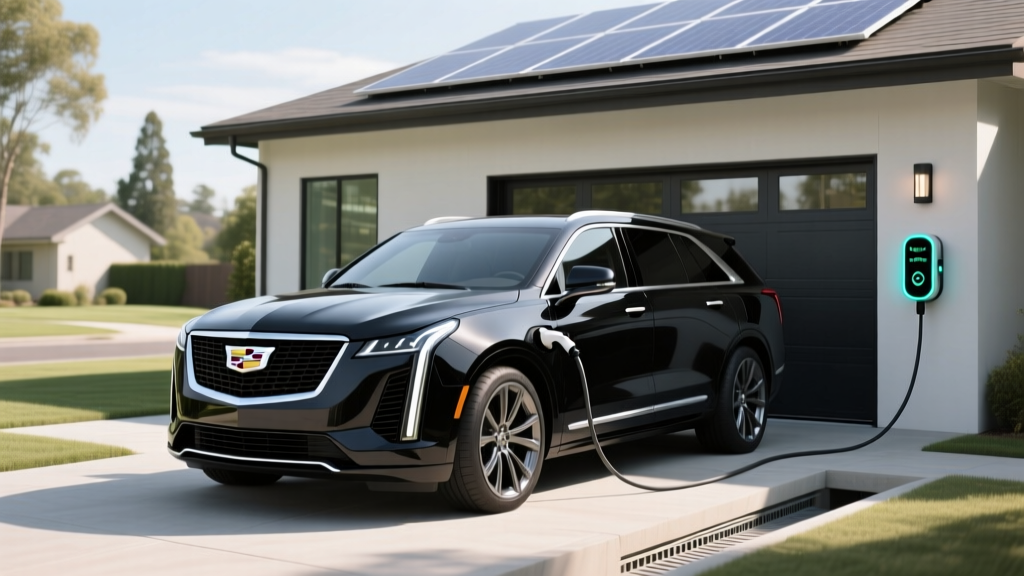
Cadillac Escalade EV Range and Battery: The Numbers
Before plugging in, it helps to understand what you are filling. The 2026 Cadillac Escalade IQ (the all-electric Escalade) uses a massive 200 kWh usable Ultium battery pack with NMC (nickel manganese cobalt) chemistry. That is roughly double the capacity of a Tesla Model Y Long Range and among the largest passenger-vehicle batteries on sale.
EPA range for the Escalade IQ Luxury 1 trim is an estimated 460 miles on a full charge, according to Cadillac's official specs. Real-world expectations depend heavily on driving style, temperature, and terrain. Expect 380–410 miles at sustained 75 mph highway speeds, and 300–340 miles in sub-freezing winter conditions where cabin heating and battery resistance take a toll.
EPA sticker: 460 miles
Real-world highway (70–80 mph): ~380–410 miles
Cold weather (below 32°F, mixed driving): ~300–340 miles
City / stop-and-go with regen: ~420–450 miles
With a pack this large, charging strategy matters more than on smaller-battery EVs. A full 0–100% session on Level 2 power takes well over a day, so most owners will rely on partial top-ups and occasional DC fast charging for road trips.
Charging Levels Explained: kW, Miles Per Hour, and Times
The single most common EV confusion is mixing up kW (power, or how fast energy flows) with kWh (energy, or how much the battery holds). Think of kW as the width of a hose and kWh as the size of the bucket. The Escalade IQ's 200 kWh bucket is enormous, so even a wide hose takes time.
| Level | Voltage / Amps | Power (kW) | Miles Added per Hour | 10–80% Time (approx.) |
|---|---|---|---|---|
| Level 1 (120V household) | 120V / 12A | ~1.4 kW | ~3 mi/hr | Not practical (~140+ hours) |
| Level 2 (240V home) | 240V / 48A | ~11.5 kW | ~25 mi/hr | ~12–14 hours |
| Level 2 (240V / 80A) | 240V / 80A | ~19.2 kW | ~42 mi/hr | ~7–8 hours |
| DC Fast Charge | 350 kW-capable station | Peak ~200 kW | ~440 mi/hr (at peak) | ~30–35 min (10–80%) |
The Escalade IQ supports DC fast charging at up to roughly 200 kW on the Ultium architecture. Like all EVs, it does not sustain peak rate for the entire session: charge speed tapers significantly above 80% State of Charge to protect the battery. Plan road-trip stops around the 10–80% window for the fastest throughput.
Home Charger Installation: Electrical Requirements and Costs
For daily ownership, a Level 2 home charger is essentially mandatory for a vehicle with a 200 kWh battery. Level 1 (standard 120V outlet) adds only about 3 miles per hour — barely enough to recover a day of errands overnight.
A typical Level 2 installation requires a dedicated 240V circuit. The most common configuration is a 60-amp breaker supporting 48 amps of continuous charging (the National Electrical Code requires circuits to be rated 125% of continuous load). Homes with older 100-amp or 150-amp electrical panels may need a panel upgrade to 200 amps, which is the single largest cost variable.
| Item | Low End | High End | Notes |
|---|---|---|---|
| Level 2 charger (hardware) | $400 | $1,200 | Smart Wi-Fi chargers, 40–80A |
| Electrician labor | $500 | $2,000 | Depends on run length, conduit, wall type |
| Electrical permit | $50 | $250 | Varies by municipality |
| Panel upgrade (if needed) | $1,500 | $4,500 | 100A→200A service upgrade |
| Total (no panel upgrade) | $950 | $3,450 | Most newer homes |
| Total (with panel upgrade) | $2,450 | $7,950 | Older homes, 100A service |
Always hire a licensed electrician and pull a permit. The NEC requires GFCI protection for outdoor receptacles, and hardwired chargers avoid the GFCI nuisance-tripping issue common with NEMA 14-50 outlets. If your garage is detached or the panel is far from the parking spot, conduit and wire costs climb quickly.
Connector Compatibility: NACS, CCS, and the Escalade IQ
The 2026 Cadillac Escalade IQ uses the J3400 (NACS) connector natively — the same standard adopted by Tesla and now the majority of the EV industry. This is a significant advantage for public charging access, since the Tesla Supercharger network is the largest and most reliable DC fast-charging network in the U.S.
| Connector | Standard Name | Escalade IQ Compatible? | Notes |
|---|---|---|---|
| NACS (J3400) | North American Charging Standard | Yes — native | Tesla Superchargers, new Electrify America & EVgo stations |
| CCS1 | Combined Charging System | Via adapter | Older Electrify America, ChargePoint, and independent stations |
| CHAdeMO | CHAdeMO | No | Largely phased out in the U.S.; no adapter commonly available |
For home Level 2 charging, most chargers now ship with a NACS connector. If you purchase a CCS-terminated charger, a CCS-to-NACS adapter (approximately $150–$250) will work, but native NACS hardware is the cleaner path for 2026 and beyond. According to the U.S. Department of Energy, NACS is projected to be available at over 70% of new public DC fast-charger installations by late 2026.
Charging Cost Per Mile: Home Electricity vs. Gas
The Escalade IQ's efficiency is rated at approximately 48 MPGe combined (EPA estimate via fueleconomy.gov), translating to roughly 2.1 kWh per mile driven. That figure drives your cost calculations.
| Scenario | Rate | Cost per Mile | Annual Cost (12,000 mi) |
|---|---|---|---|
| Home charging (off-peak utility rate) | $0.12/kWh | $0.25 | $3,000 |
| Home charging (average U.S. rate) | $0.17/kWh | $0.36 | $4,320 |
| Public DC fast charging (average) | $0.40/kWh | $0.84 | $10,080 |
| Gas Escalade (16 MPG combined, $3.50/gal) | $3.50/gal | $0.22/gal → $2.19/mi | $26,250 |
Even at average U.S. electricity rates, the Escalade IQ costs roughly one-sixth as much per mile to fuel as the gasoline Escalade. The savings widen dramatically with off-peak home charging or if your utility offers time-of-use (TOU) plans with overnight rates below $0.10/kWh. However, exclusive reliance on public DC fast charging narrows the gap — another reason home Level 2 installation is essential for this vehicle.
Recommended Home Chargers for the Escalade IQ
With a 200 kWh battery, charging speed at home directly affects daily usability. A 48-amp charger adds roughly 25 miles per hour (enough to recover 200 miles in 8 hours overnight). An 80-amp unit nearly doubles that rate. Here are three strong options:
ChargePoint Home Flex (NACS)
- Power: Up to 11.5 kW (48A) on a 60A circuit
- Connector: NACS native (2025+ models)
- Cable length: 23 feet
- Smart features: Wi-Fi, app scheduling, utility TOU integration, Alexa
- Price: ~$550
Tesla Wall Connector (J3400/NACS)
- Power: Up to 11.5 kW (48A) on a 60A circuit
- Connector: NACS native
- Cable length: 24 feet
- Smart features: Wi-Fi, OTA updates, power sharing between units
- Price: ~$450
FLO Home X80 (NACS)
- Power: Up to 19.2 kW (80A) on a 100A circuit
- Connector: NACS native
- Cable length: 25 feet
- Smart features: Wi-Fi, load management, scheduled charging, outdoor-rated (NEMA 4)
- Price: ~$1,100
For most Escalade IQ owners, a 48A charger on a 60A circuit is the practical sweet spot — it fully replenishes overnight and does not require a panel upgrade in most 200A-service homes. The 80A FLO X80 is worth considering if you regularly drive 300+ miles per day or want faster turnaround between trips, but it requires a 100A dedicated circuit and likely a 200A+ panel.
Safety, Electrical Code, and Panel-Upgrade Considerations
EV charging is a continuous electrical load — the NEC defines this as a load lasting 3 hours or more, which covers most Level 2 sessions. Key code and safety requirements:
- Dedicated circuit: Your charger must be on its own breaker. No sharing with dryers, HVAC, or other appliances.
- Wire gauge: 6 AWG copper for 48A (60A breaker); 3 AWG or 2 AWG for 80A (100A breaker). Aluminum wire is cheaper but requires larger gauge.
- GFCI protection: Required for outdoor outlets (NEMA 14-50). Hardwired chargers avoid this requirement and eliminate nuisance tripping.
- Outdoor rating: If mounted outside, the charger must be NEMA 4 (weatherproof) rated. All three units above meet this standard.
- Panel capacity: An electrician will perform a load calculation. If your existing loads plus the charger exceed 80% of panel capacity, a service upgrade is required.
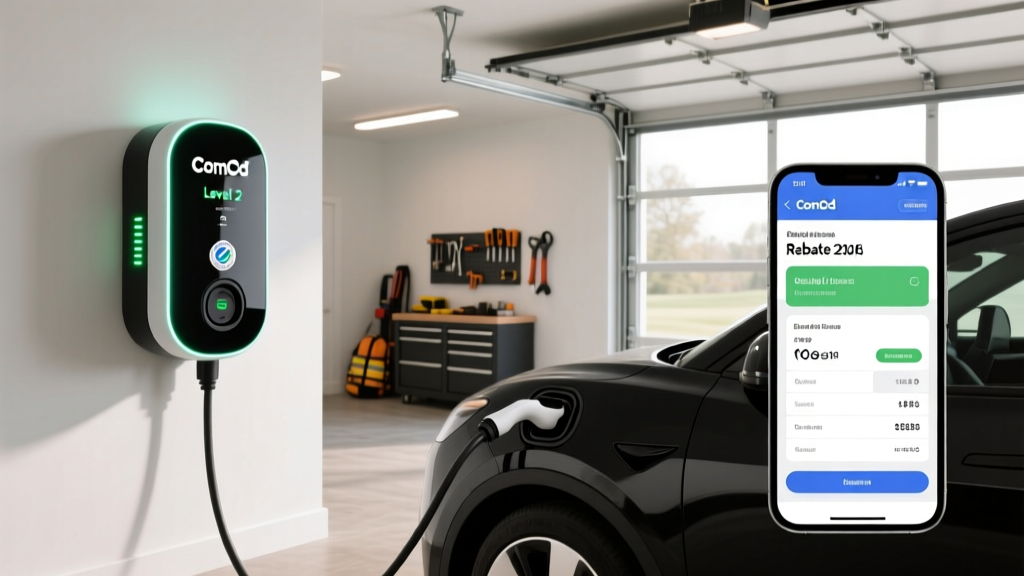
For older homes with 100-amp or 150-amp service, a panel upgrade to 200 amps typically costs $1,500–$4,500 depending on utility coordination, meter socket replacement, and local labor rates. Some utilities offer rebates covering $200–$500 of EV charger installation — check with your provider before scheduling work.
Frequently Asked Questions
How much does it cost to install a home EV charger for the Escalade IQ?
Expect $950–$3,450 for a standard Level 2 installation in a home with adequate panel capacity (200A service, short wire run). If your home needs a panel upgrade from 100A to 200A, total costs can reach $2,450–$7,950. Always get 2–3 quotes from licensed electricians.
How fast will each charging level add range to the Escalade IQ?
Level 1 (120V) adds about 3 miles per hour — impractical for daily use. Level 2 at 48A adds roughly 25 miles per hour, recovering 200 miles overnight. DC fast charging peaks at ~200 kW, adding up to 140 miles in 10 minutes at the start of the curve before tapering above 80%.
Which connector and charger is compatible with the Cadillac Escalade IQ?
The Escalade IQ uses the NACS (J3400) connector natively. This gives direct access to Tesla Superchargers and new NACS-equipped public stations. CCS1 stations require a CCS-to-NACS adapter. CHAdeMO is not compatible and is largely discontinued in the U.S.
How much does charging the Escalade IQ cost per mile vs. the gas Escalade?
At the U.S. average residential electricity rate of $0.17/kWh, the Escalade IQ costs approximately $0.36 per mile. The gasoline Escalade at 16 MPG combined and $3.50/gallon costs about $2.19 per mile — roughly six times more. Off-peak home charging drops the EV cost to around $0.25/mile.
What electrical upgrades might I need for a Level 2 charger?
Most homes with 200-amp service and a garage near the panel need only a new 60A breaker and a wire run. Homes with 100A or 150A panels, long wire runs to detached garages, or heavy existing loads may need a panel upgrade ($1,500–$4,500), conduit installation, or a smart load-management device that throttles charger amperage when other appliances are running.
Does the Escalade IQ qualify for the federal EV tax credit?
The §30D federal tax credit offers up to $7,500 for qualifying new EVs, but eligibility depends on MSRP caps ($80,000 for SUVs), buyer income limits, and battery critical-mineral sourcing requirements per IRS guidelines. The Escalade IQ's base MSRP exceeds $100,000, which likely places it above the SUV MSRP cap — consult a tax professional and check the latest IRS eligible-vehicle list before assuming credit availability. Point-of-sale transfer is available for qualifying purchases.