Why the Cadillac Escalade IQ Demands a Charging Strategy
The 2026 Cadillac Escalade IQ is not a typical EV. With a usable battery capacity hovering around 200 kWh on GM's Ultium platform, it carries roughly double the energy of a midsize electric sedan. That means the Cadillac Escalade electric range is genuinely impressive — EPA-estimated at approximately 450 miles for the Luxury 1 trim — but it also means charging logistics require more planning than smaller EVs.
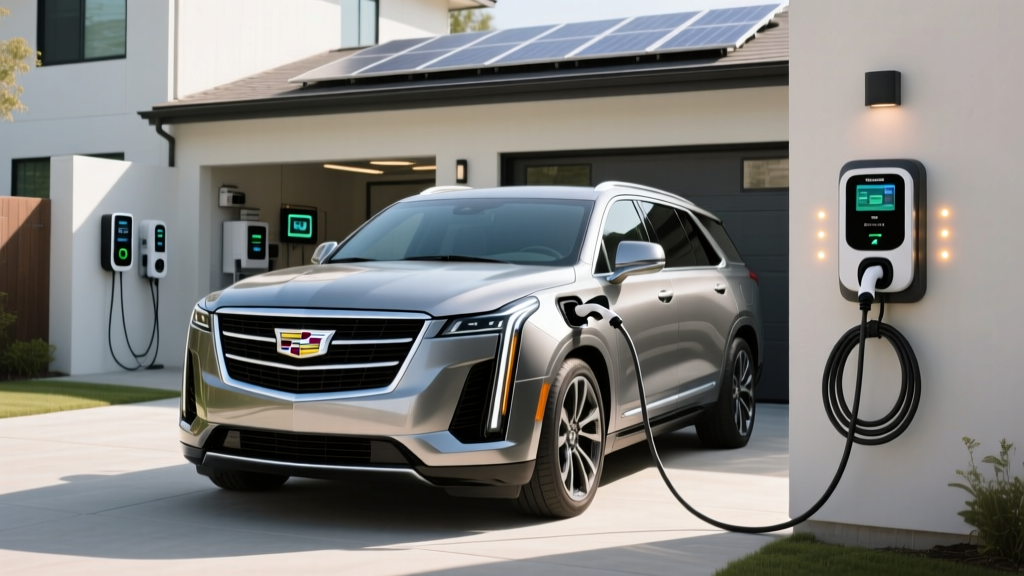
If you're bringing an Escalade IQ home, a standard 120V outlet won't meaningfully recharge this battery in any practical timeframe. Even a 48-amp Level 2 home charger needs overnight sessions to fully replenish. This guide walks through every charging scenario — home Level 2 installation, public DC fast charging, equipment picks, and cost-per-mile math — so Escalade IQ buyers (and owners of other large-battery EVs like the Silverado EV or Hummer EV) can plan with real numbers.
Charging Levels Explained: kW, Miles Per Hour, and What They Mean
The single most important distinction in EV charging is between kW (kilowatts) — the rate of power delivery — and kWh (kilowatt-hours) — the total energy stored in the battery. Think of kW as the width of a hose and kWh as the size of the bucket. The Escalade IQ's bucket is roughly 200 kWh; how fast you fill it depends entirely on the hose.
| Level | Power (kW) | Miles of Range Per Hour | 0–100% Time (approx.) | Best For |
|---|---|---|---|---|
| Level 1 (120V) | 1.4 kW | ~3 mi/hr | ~140+ hours | Emergency trickle only |
| Level 2 (240V, 48A) | 11.5 kW | ~25 mi/hr | ~18 hours | Daily home charging |
| Level 2 (240V, 80A) | 19.2 kW | ~42 mi/hr | ~11 hours | Optimized home/garage |
| DC Fast (350 kW peak) | Up to 350 kW | ~700+ mi/hr (peak) | 10–80% in ~30 min | Road trips |
The Escalade IQ supports up to 19.2 kW AC Level 2 charging (80 amps at 240V) — a critical advantage over EVs capped at 11.5 kW. That 80A capability cuts overnight charging time significantly, but it requires a dedicated 100-amp circuit and hardwired installation. We'll cover the electrical requirements below.
On DC fast charging, GM's Ultium architecture supports up to 350 kW on compatible CCS/NACS stations. The charge curve is not linear: you'll see peak speeds between 10–40% State of Charge (SoC), then a taper. Expect 10–80% in roughly 30 minutes at a 350 kW station, but 80–100% can take an additional 25–35 minutes as the battery management system protects cell longevity. For road trips, plan to charge to 80% and move on.
Home Charger Installation: Electrical Requirements, Costs, and Panel Upgrades
Installing a Level 2 home charger for a 200 kWh battery is not a casual project. The electrical demands are substantial, and cutting corners risks breaker trips, overheated wiring, or code violations. Here's what a proper installation requires.
Electrical Specifications by Charger Amperage
48-amp charger (11.5 kW): Requires a dedicated 60-amp breaker (NEC code mandates circuits be rated 125% of continuous load). Uses 6 AWG copper wire. This is the most common residential setup and works with a NEMA 14-50 outlet or hardwired connection.
80-amp charger (19.2 kW): Requires a dedicated 100-amp breaker and 3 AWG copper wire. Must be hardwired — no plug configuration is rated for this continuous load. This is the setup that unlocks the Escalade IQ's maximum AC charge rate, but it demands significant panel capacity.
Do You Need a Panel Upgrade?
Most homes built before 2010 have 100-amp or 150-amp main electrical panels. Adding a 60-amp circuit for a 48A charger may consume 40–60% of a 100-amp panel's capacity — a problem if you're also running electric HVAC, an electric oven, and a dryer. A licensed electrician will perform a load calculation per NEC Article 220 to determine if your panel can handle the circuit.
If you need a panel upgrade to 200 amps (the modern standard), expect a significant additional cost. Homes with 200-amp panels can typically accommodate a 60-amp EV circuit without issue, but an 80-amp charger circuit may still push limits depending on existing loads.
| Component | 48A / 60A Circuit | 80A / 100A Circuit |
|---|---|---|
| Level 2 Charger (Equipment) | $400 – $750 | $600 – $1,200 |
| Electrician Labor (run + termination) | $600 – $1,500 | $1,000 – $2,500 |
| Permit & Inspection | $100 – $300 | $150 – $400 |
| Panel Upgrade (if needed, 200A) | $1,500 – $3,500 | $1,500 – $3,500 |
| Total (No Panel Upgrade) | $1,100 – $2,550 | $1,750 – $4,100 |
| Total (With Panel Upgrade) | $2,600 – $6,050 | $3,250 – $7,600 |
Always get at least two quotes from licensed electricians. Ask specifically about the load calculation, whether the circuit will be hardwired or outlet-based, and if the installation includes a GFCI breaker (required by NEC 2020+ for garage outlets). Permits are not optional — they protect your home insurance coverage in the event of an electrical fire.
Connector Compatibility: NACS, CCS, and What the Escalade IQ Uses
The 2026 Cadillac Escalade IQ ships with the NACS (North American Charging Standard) connector — the Tesla-designed plug now adopted by GM and most major automakers. This is a significant advantage: NACS grants native access to Tesla Supercharger stations, which remain the most reliable and widespread DC fast-charging network in the U.S.
| Connector | Brands Using It (2026) | Adapter Needed for Escalade IQ? |
|---|---|---|
| NACS | Tesla, GM (Cadillac, Chevy, GMC), Ford, Rivian, Volvo, Polestar, BMW, Mercedes-Benz | No — native connector |
| CCS1 | Legacy: older VW ID.4, Hyundai Ioniq 5 (pre-2025), some Electrify America stations | Yes — NACS-to-CCS adapter (~$200–$300) if station has only CCS cables |
| CHAdeMO | Nissan Leaf (legacy), Mitsubishi Outlander PHEV | Not recommended — adapters rare, network declining |
For home Level 2 charging, the Escalade IQ uses the standard J1772 connector (which NACS vehicles accept via a small adapter included with most GM EVs, or the J1772 connector fits the NACS inlet directly on newer models). Verify with your dealer whether the vehicle ships with a J1772-to-NACS adapter in the kit.
The practical takeaway: the Escalade IQ's NACS port gives you the broadest public charging access of any connector type in 2026. Tesla Superchargers, Electrify America's newer stalls, and ChargePoint's NACS-equipped stations are all directly compatible. See GM's official Cadillac Escalade IQ page for the latest connector and charging specs.
Cost to Charge: Home vs. Public vs. Gas Comparison
The Escalade IQ's massive battery means charging costs scale accordingly. Here's how the math works out across scenarios, using the EPA-estimated efficiency of roughly 2.0–2.2 kWh per mile (approximately 45–50 kWh per 100 miles, consistent with a large luxury SUV).
| Scenario | Rate | Cost Per Mile | Full "Tank" (200 kWh / ~450 mi) |
|---|---|---|---|
| Home Off-Peak (utility rate) | $0.09/kWh | $0.04–$0.05/mi | ~$18–$20 |
| Home Standard Rate | $0.15/kWh | $0.07–$0.08/mi | ~$30–$33 |
| Public Level 2 (ChargePoint, etc.) | $0.25–$0.35/kWh | $0.12–$0.16/mi | ~$50–$70 |
| DC Fast (Electrify America / Tesla) | $0.35–$0.55/kWh | $0.16–$0.24/mi | ~$70–$110 |
| Gas Escalade (6.2L V8, 16 MPG, $3.60/gal) | $3.60/gallon | $0.23/mi | ~$104 (24-gal tank, ~384 mi) |
The numbers tell a clear story: home charging on an off-peak utility rate is roughly one-fifth the cost per mile of fueling a gas Escalade. Even at DC fast-charging prices on road trips, the per-mile cost is competitive with or cheaper than premium gasoline. The key is maximizing home charging — every mile charged at home is a mile at $0.04–$0.08 versus $0.23 for gas.
For a driver covering 12,000 miles per year with 80% home charging at $0.12/kWh and 20% public DC fast charging at $0.45/kWh, the annual electricity cost is approximately $2,160. The equivalent gas Escalade would spend roughly $2,700 on fuel. That's a modest $540 annual fuel savings — meaningful over a decade, but the Escalade IQ's value proposition is as much about the driving experience and tax incentives as it is about fuel-cost payback. Check current IRS §30D clean vehicle credit rules for eligibility details on the Escalade IQ, which may qualify for up to $7,500 depending on battery sourcing, buyer income caps, and MSRP thresholds.
Recommended Home Charging Equipment for Large-Battery EVs
Not all Level 2 chargers are built for a 200 kWh battery. You want a unit that can sustain high amperage for 10+ hour sessions without thermal throttling, with smart scheduling to exploit off-peak utility rates. Here are three proven options.
ChargePoint Home Flex
- Power: Up to 11.5 kW (48A) on a 60A circuit; configurable down to 16A for smaller circuits
- Connector: J1772 (use included NACS adapter) or NACS version available
- Cable: 23 feet
- Smart Features: Wi-Fi, Alexa, scheduled charging, energy tracking via app
- Price: ~$550–$650
- Best For: Most Escalade IQ owners on a 60A circuit; excellent app ecosystem
Tesla Wall Connector (NACS)
- Power: Up to 11.5 kW (48A) on 60A circuit
- Connector: NACS native — no adapter needed for Escalade IQ
- Cable: 24 feet
- Smart Features: Wi-Fi, power sharing (link multiple units), OTA firmware updates
- Price: ~$475
- Best For: NACS-native convenience; works seamlessly with Escalade IQ's charge port
Emporia Vue + EV Charger
- Power: Up to 19.2 kW (80A) on a 100A circuit — hardwired only
- Connector: J1772 (NACS adapter required) or NACS version
- Cable: 24 feet
- Smart Features: Whole-home energy monitoring integration, solar-aware charging, time-of-use scheduling
- Price: ~$800–$1,000 (charger); Vue panel monitor additional ~$350
- Best For: Owners who want 19.2 kW to maximize overnight recovery on the 200 kWh battery
For Escalade IQ owners, the 80A Emporia or a comparable 80A-rated unit (such as the Grizzl-E Smart or FLO Home X8) is the premium choice — it shaves roughly 7 hours off a full charge versus a 48A unit. But 80A requires a 100-amp dedicated circuit, 3 AWG wire, and a panel with adequate spare capacity. Most buyers will be well-served by a 48A unit, which still fully recharges overnight if you plug in by early evening.
Safety, Code, and Installation Best Practices
EV charging is a continuous high-load application — the charger draws maximum current for hours, unlike a dryer or oven that cycles on and off. This makes proper installation non-negotiable.
- Dedicated circuit: The EV charger must have its own breaker — never share a circuit with other appliances.
- GFCI protection: NEC 2020 and later requires GFCI (Ground Fault Circuit Interrupter) protection for all garage outlets rated 150V to ground or less and 50 amps or less. Hardwired installations may not require GFCI breakers, but your local inspector's interpretation governs. Check with your electrician.
- Outdoor rating: If your charger is mounted outside, the unit must carry a NEMA 4 or NEMA 4X rating for weather resistance. All recommended units above are outdoor-rated.
- Wire gauge: Undersized wire causes heat buildup and fire risk. Your electrician will size wire per NEC Table 310.16 — typically 6 AWG for 60A circuits and 3 AWG for 100A circuits in copper.
- Permit and inspection: Required in virtually all U.S. jurisdictions for new 240V circuits. The inspector verifies wire gauge, breaker sizing, grounding, and GFCI compliance. Skipping the permit can void homeowner's insurance coverage for electrical fires.
- Cable management: A 23–24 foot cable drags on garage floors and creates trip hazards. Wall-mount a cable organizer or retractable reel to keep the charging area clean and safe.
Charging Time Examples: What to Expect With the Escalade IQ's 200 kWh Battery
Because the Escalade IQ's battery is so large, "10–80% charge time" is a more practical metric than 0–100%. Most EV owners charge between 20% and 80% daily to preserve long-term battery health (charging to 100% regularly accelerates degradation in NMC chemistry cells, which the Escalade IQ uses for its high energy density).
| Charging Method | Power | Time (10–80%) | Range Added |
|---|---|---|---|
| Level 2 (48A / 11.5 kW) | 11.5 kW sustained | ~12 hours | ~310 miles |
| Level 2 (80A / 19.2 kW) | 19.2 kW sustained | ~7.5 hours | ~310 miles |
| DC Fast (150 kW station) | ~120 kW avg (curve taper) | ~70 minutes | ~310 miles |
| DC Fast (350 kW station) | ~250 kW avg (curve taper) | ~30 minutes | ~310 miles |
Note the charge curve taper on DC fast charging: even at a 350 kW station, the Escalade IQ won't sustain 350 kW for the entire session. Peak rates apply in the 10–40% SoC window, then taper to protect the battery. The "average" kW is what determines real-world charging time. This is why manufacturers quote "10–80% in X minutes" rather than peak kW alone.
For daily driving (30–50 miles), a 48A Level 2 charger running overnight adds roughly 200+ miles — more than enough to replenish a day's commute with margin. Reserve 80A or DC fast charging for days when you've driven 200+ miles or are preparing for a road trip.
Frequently Asked Questions
How much does it cost to install a home EV charger for the Escalade IQ?
Between $1,100 and $2,550 for a 48-amp installation on an existing 200-amp panel, including the charger ($400–$750), electrician labor ($600–$1,500), and permits ($100–$300). If your home needs a panel upgrade from 100A to 200A, add $1,500–$3,500. An 80-amp circuit installation runs $1,750–$4,100 without a panel upgrade. Always get itemized quotes from licensed electricians.
How fast will each charging level add range?
Level 1 (120V) adds about 3 miles per hour — impractical for daily use on a 200 kWh battery. Level 2 at 48 amps adds roughly 25 miles per hour. Level 2 at 80 amps adds about 42 miles per hour. DC fast charging at a 350 kW station can add over 200 miles in 15 minutes during the peak charge-curve window (10–40% SoC).
Which connector does the Cadillac Escalade IQ use?
The 2026 Escalade IQ uses the NACS (North American Charging Standard) connector, granting native access to Tesla Superchargers and the growing network of NACS-equipped public stations. For home Level 2 charging, you'll use the NACS inlet directly with a NACS Wall Connector, or a J1772 charger with the included NACS adapter.
How much does charging the Escalade IQ cost per mile compared to gas?
At a home electricity rate of $0.12/kWh, the Escalade IQ costs approximately $0.06–$0.07 per mile to drive. A gas-powered Escalade with the 6.2L V8 at 16 MPG combined and $3.60/gallon fuel costs about $0.23 per mile. Home charging saves roughly 70–75% per mile versus gasoline. Public DC fast charging at $0.45/kWh costs about $0.20/mile — still slightly cheaper than gas.
What electrical upgrades might I need for a home charger?
If your home has a 100-amp electrical panel, you'll likely need an upgrade to 200 amps ($1,500–$3,500) to safely accommodate a 60-amp EV circuit alongside existing loads like HVAC, electric range, and dryer. Homes with 200-amp panels can usually add a 60-amp circuit without upgrade. An 80-amp charger circuit (100-amp breaker) may require load management devices or a panel upgrade even on 200-amp service. A licensed electrician will perform a NEC Article 220 load calculation to determine your specific requirements. See fueleconomy.gov for general EV charging guidance and efficiency data.