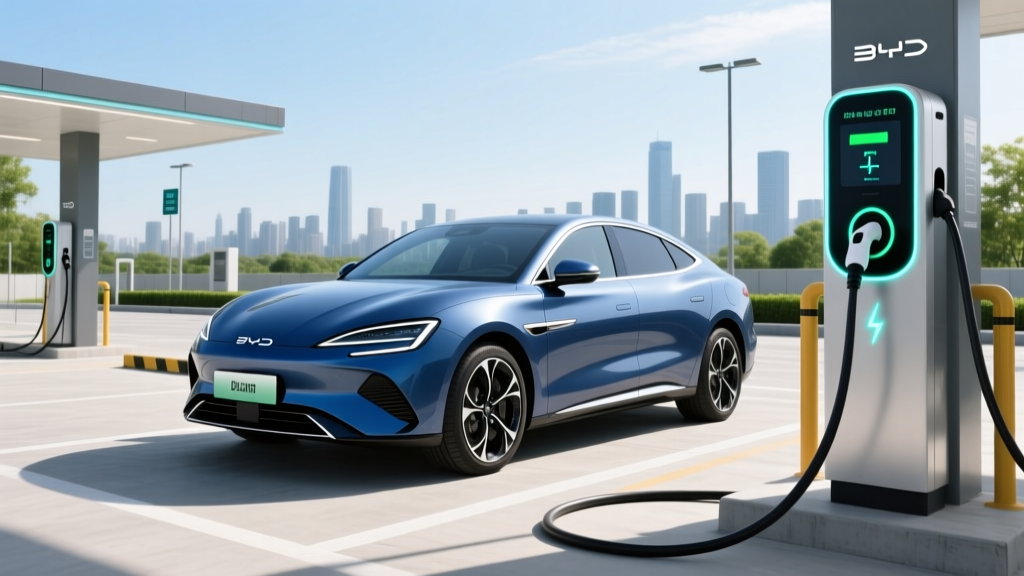
BYD's global expansion has put the Chinese automaker on the radar of cost-conscious EV shoppers, but one question dominates forums and search bars: what is BYD range in miles under real-world conditions? The answer depends heavily on which model you're looking at, the testing standard quoted (WLTP vs. EPA), and how you plan to charge. This guide covers BYD's current lineup range figures, the Blade Battery architecture underneath, and exactly what it takes to charge these vehicles at home and on the road — whether you own a BYD today or are researching before the brand's broader market entry.
BYD Range in Miles: Model-by-Model Breakdown
BYD publishes range under the WLTP (Worldwide Harmonised Light Vehicle Test Procedure) standard, which tends to run 10–15% higher than the EPA cycle used in the United States. For US-based buyers, translating WLTP to realistic EPA-equivalent range is essential. Below is a snapshot of core BYD models with their battery capacity, WLTP claim, and estimated EPA-equivalent real-world range.
| Model | Battery (kWh usable) | Chemistry | WLTP Range | Est. EPA-Equivalent | Real-World Highway |
|---|---|---|---|---|---|
| BYD Dolphin | 60.4 kWh | LFP Blade | 265 mi | ~225 mi | ~190 mi |
| BYD Atto 3 (Yuan Plus) | 60.5 kWh | LFP Blade | 260 mi | ~220 mi | ~185 mi |
| BYD Seal | 82.5 kWh | LFP Blade | 354 mi | ~300 mi | ~255 mi |
| BYD Seal U (PHEV) | 18.3 kWh (EV portion) | LFP Blade | 50 mi EV-only | ~42 mi EV-only | ~36 mi EV-only |
| BYD Han EV | 85.4 kWh | LFP Blade | 323 mi | ~275 mi | ~235 mi |
The Blade Battery: LFP Chemistry Explained
Every current BYD model uses the company's proprietary Blade Battery, which employs lithium iron phosphate (LFP) chemistry arranged in a cell-to-pack structural design. Understanding what this means for range and longevity is critical before you buy.
| Factor | LFP (BYD Blade) | NMC/NCA (Tesla, Hyundai, VW) |
|---|---|---|
| Energy Density | Lower (~160 Wh/kg) — heavier pack for same kWh | Higher (~250 Wh/kg) — lighter, more compact |
| Cycle Life | 3,000–5,000+ cycles before 80% SoH | 1,000–2,000 cycles before 80% SoH |
| Cold-Weather Performance | Greater range loss (~35–40% below freezing) | Moderate range loss (~25–30% below freezing) |
| Charging to 100% | Recommended — no degradation penalty | Generally limited to 80–90% daily for longevity |
| Thermal Stability | Excellent — far less thermal runaway risk | Good — but requires more active thermal management |
| Cost per kWh | Lower — contributes to BYD's aggressive pricing | Higher — nickel and cobalt cost exposure |
The trade-off is clear: LFP batteries sacrifice some energy density (meaning BYD vehicles tend to be heavier and slightly less range-efficient per kWh than NMC rivals) in exchange for dramatically longer cycle life, better safety margins, and the freedom to charge to 100% without guilt. For a daily commuter who charges at home every night, LFP is arguably the superior chemistry. For road-trippers in cold climates, the reduced cold-weather range is a genuine limitation.
Charging Levels: How Fast Each Level Adds BYD Range in Miles
Charging speed is measured in kW (kilowatts), which represents the rate of power delivery. The energy stored in your battery is measured in kWh (kilowatt-hours). Think of kW as the flow rate of a hose and kWh as the size of the bucket. Here's how each charging level fills a BYD battery:
| Level | Power Source | Max Power (kW) | Miles of Range Added Per Hour | Best Use Case |
|---|---|---|---|---|
| Level 1 | 120V household outlet | 1.4–1.9 kW | 3–5 mi/hr | Overnight top-up, PHEVs, emergencies |
| Level 2 | 240V dedicated circuit | 7.2–19.2 kW | 20–60 mi/hr | Daily home charging, workplace |
| DC Fast Charge | 480V+ commercial station | 50–350 kW | 150–400+ mi/hr (peak) | Road trips, rapid top-ups |
BYD-specific charging times:
- BYD Seal (82.5 kWh, 150 kW peak DC): 10–80% in approximately 26 minutes at a 150+ kW station. Level 2 at 11 kW: 0–100% in ~8.5 hours.
- BYD Dolphin (60.4 kWh, 88 kW peak DC): 10–80% in approximately 29 minutes. Level 2 at 7.2 kW: 0–100% in ~8.5 hours.
- BYD Atto 3 (60.5 kWh, 88 kW peak DC): 10–80% in approximately 30 minutes. Level 2 at 7.2 kW: 0–100% in ~8.5 hours.
Home Charger Installation: Electrical Requirements and Costs
Charging a BYD at home on Level 2 is the most cost-effective and convenient approach, but installation costs vary dramatically depending on your home's electrical panel, the distance from panel to charger location, and local permit requirements.
Electrical Requirements
- Circuit: Dedicated 240V circuit, typically 40A or 50A (for 32A or 40A continuous charging, respectively)
- Breaker: NEMA 14-50 receptacle (50A) or hardwired connection (60A breaker for 48A chargers)
- Wire gauge: 6 AWG copper for 50A circuits; 4 AWG for 60A — varies by run length
- Panel capacity: Most homes need 200A service minimum to add a 40–50A EV circuit. Older homes with 100A panels will likely need an upgrade ($1,500–$4,000+).
| Component | Low Estimate | High Estimate | Notes |
|---|---|---|---|
| Level 2 Charger Equipment | $300 | $750 | Smart Wi-Fi chargers (ChargePoint, Wallbox, Emporia) |
| Electrician Labor | $500 | $2,000 | Depends on panel proximity, wall type, conduit run |
| Permit & Inspection | $50 | $300 | Varies by municipality; some jurisdictions waive for EV |
| Electrical Panel Upgrade (if needed) | $1,500 | $4,500 | 100A → 200A service; older homes only |
| Total (no panel upgrade) | $850 | $3,050 | Most homes with 200A service |
| Total (with panel upgrade) | $2,350 | $7,550 | Homes needing service upgrade |
Always hire a licensed electrician and pull a permit. Unpermitted EV charger installs can void homeowner's insurance claims and create fire hazards. A licensed professional will assess your panel load calculation before adding the circuit.
Connector Compatibility: Will Your BYD Plug Into US Chargers?
This is where BYD ownership in North America gets complicated. BYD vehicles sold in international markets typically use CCS2 (Europe/Asia) or GB/T (China) connectors — neither of which is natively compatible with US public charging infrastructure. As BYD evaluates US market entry, CCS1 or NACS adoption would be required.
| Connector | Standard | Region | Compatible Brands |
|---|---|---|---|
| NACS (Tesla) | SAE J3400 | North America | Tesla (native); Ford, GM, Rivian, Hyundai, Volvo (2025+ via adapter or native) |
| CCS1 | SAE J1772 Combo | North America | VW, BMW, Hyundai, Kia, Mercedes, Stellantis (legacy) |
| CCS2 | IEC 62196-3 | Europe, Australia, BYD intl. | BYD, VW ID (EU), BMW (EU) |
| CHAdeMO | IEC 62196-2 | Japan (declining) | Nissan Leaf, Mitsubishi Outlander PHEV |
| GB/T | Chinese national | China | BYD (domestic), NIO, Xpeng |
Adapter situation: CCS2-to-CCS1 adapters exist but are expensive ($200–$400), add bulk, and may not support full DC fast-charge rates. If BYD enters the US market, expect CCS1 or NACS native ports on US-spec vehicles. Until then, imported BYD vehicles face a significant public charging barrier in North America.
Cost to Charge a BYD: Per-Mile Economics vs. Gas
The financial case for any EV comes down to fuel cost per mile. Here's what charging a BYD Seal (82.5 kWh battery, ~3.5 mi/kWh efficiency) actually costs across different scenarios, compared to a comparable gas sedan at 28 MPG combined.
| Charging Scenario | Rate ($/kWh) | Cost to Fill (82.5 kWh) | Cost Per Mile | Gas Equivalent ($3.50/gal) |
|---|---|---|---|---|
| Home Off-Peak (Time-of-Use) | $0.08 | $6.60 | $0.023 | $0.125 |
| Home Standard Rate | $0.14 | $11.55 | $0.040 | $0.125 |
| Public Level 2 (ChargePoint, etc.) | $0.25 | $20.63 | $0.071 | $0.125 |
| DC Fast Charge (Electrify America) | $0.48 | $39.60 | $0.137 | $0.125 |
Key takeaway: Home charging makes a BYD dramatically cheaper to fuel — roughly 4–5× less per mile than gas. However, exclusive reliance on DC fast charging can actually exceed gas costs per mile. The economics of EV ownership are overwhelmingly driven by access to affordable home or workplace Level 2 charging.
Recommended Home Level 2 Chargers for BYD Vehicles
If you're setting up home charging for a BYD (or any CCS-compatible EV), these are the chargers we recommend based on reliability, power output, smart features, and value:
ChargePoint Home Flex
- Power: Up to 12 kW (50A circuit, 40A continuous)
- Connector: J1772 (CCS1 compatible)
- Cable: 23 ft
- Smart Features: Wi-Fi, app scheduling, Alexa, load sharing
- Price: ~$549
- Best For: Versatile amperage adjustment (16A–50A) to match your panel
Wallbox Pulsar Plus
- Power: Up to 11.5 kW (48A)
- Connector: J1772 (CCS1 compatible)
- Cable: 25 ft
- Smart Features: Wi-Fi + Bluetooth, Power Sharing, app control
- Price: ~$449
- Best For: Compact size, outdoor-rated (NEMA 4), budget-friendly
Emporia Vue + EV Charger
- Power: Up to 11.5 kW (48A)
- Connector: J1772 (CCS1 compatible)
- Cable: 24 ft
- Smart Features: Whole-home energy monitoring integration, solar-aware charging
- Price: ~$399 (charger) + $99 (Vue monitor)
- Best For: Solar panel owners wanting optimized charge timing
Safety, Code, and Installation Best Practices
EV charging draws sustained high current for hours — this is fundamentally different from short-burst appliances. Follow these non-negotiable safety requirements:
- Dedicated circuit: Your EV charger must be on its own dedicated breaker. Never share a circuit with other high-draw appliances (dryer, oven, HVAC).
- GFCI protection: NEC 2020 and later require GFCI protection for outdoor receptacles used for EV charging. Hardwired chargers may have built-in GFCI.
- Outdoor rating: If installing outside, ensure the charger is rated NEMA 4 or NEMA 4X for weather resistance. Most quality chargers (Wallbox, ChargePoint) meet this standard.
- Cable management: Use a wall-mounted cable holster to prevent trip hazards and connector damage. Never leave a charging cable on the ground where vehicles can run over it.
- Continuous load rule: NEC requires EV chargers to be treated as continuous loads — meaning the circuit must be rated at 125% of the charger's maximum draw. A 40A charger needs a 50A breaker.
- Permit and inspection: Pull a permit with your local building department. An inspection ensures the installation meets NEC Article 625 (Electric Vehicle Charging System Equipment). Skipping this step risks insurance denial in the event of an electrical fire.
Frequently Asked Questions
How much does it cost to install a home EV charger?
Expect $850–$3,050 for a standard Level 2 installation in a home with adequate (200A) electrical service. This breaks down to $300–$750 for the charger unit, $500–$2,000 for electrician labor, and $50–$300 for permits. Homes requiring a panel upgrade from 100A to 200A service should budget an additional $1,500–$4,500.
How fast will each charging level add range to a BYD?
Level 1 (120V) adds roughly 3–5 miles of range per hour — only practical for PHEVs or emergency trickle charging. Level 2 (240V, 40A) adds 25–35 miles per hour on a BYD Seal, fully replenishing the battery overnight. DC fast charging at 150 kW can add up to 150+ miles in 15 minutes, but only during the peak portion of the charge curve (roughly 10–50% SoC).
Which connector and charger is compatible with my BYD?
BYD vehicles sold internationally use CCS2 connectors, which are not natively compatible with US CCS1 or NACS public chargers. If BYD enters the US market, expect CCS1 or NACS ports on domestic models. For home charging with an imported BYD, a CCS2-to-J1772 adapter may be needed for Level 2 — verify DC fast-charge compatibility separately, as adapters may limit peak charge rates.
How much does charging a BYD cost per mile vs. gas?
At home off-peak rates ($0.08/kWh), a BYD Seal costs roughly $0.023 per mile — about 5× cheaper than a 28 MPG gas sedan at $3.50/gallon ($0.125/mi). At standard residential rates ($0.14/kWh), the cost rises to $0.04/mi. Public DC fast charging at $0.48/kWh pushes the cost to $0.137/mi, essentially matching gasoline. Home charging access is the single biggest factor in EV cost savings.
What electrical upgrades might I need for a BYD home charger?
Homes with 200A electrical service typically need no panel upgrade — just a new 50A or 60A dedicated breaker and wiring run. Homes with older 100A panels, or those already running multiple high-draw circuits (electric range, dryer, HVAC, hot tub), will likely need a service upgrade to 200A or even 325A. Your electrician will perform a load calculation per NEC Article 220 to determine this. Some utilities offer rebates of $500–$1,500 toward panel upgrades when paired with EV charger installation.
Is the BYD Blade Battery safe?
BYD's Blade Battery has passed rigorous nail penetration tests without thermal runaway — a benchmark that most NMC batteries fail. The LFP chemistry is inherently more thermally stable, and the blade-form factor provides structural rigidity that doubles as pack reinforcement. BYD claims the Blade Battery can withstand crush, overcharge, and short-circuit conditions without fire. Independent testing by Euro NCAP has rated BYD models highly for electrical safety.
Sources: BYD official specifications, fueleconomy.gov (EPA testing methodology), IRS §30D clean vehicle credit guidelines, Euro NCAP safety ratings. Range estimates are based on WLTP-to-EPA conversion factors and real-world testing data from independent EV publications. All pricing and specifications reflect 2025–2026 model year information available at time of publication.