If you have been following BYD's global expansion, you have likely seen the term BYD Flash Charging surface in press releases and tech demos. The Chinese automaker has been pushing ultra-fast DC charging speeds on its newer e-Platform 3.0 vehicles — most notably the Seal, Atto 3 (Yuan Plus), and the newer Seal U — claiming peak rates that rival or exceed some of the fastest-charging EVs available in other markets. But what does BYD Flash Charging actually mean for real-world charging times, and how does the broader EV charging ecosystem — home Level 2, public DC fast charging — compare?
This guide breaks down every charging level by the numbers (kW, miles of range per hour, 10–80% times), walks through home installation costs and electrical requirements, and explains connector compatibility so you know exactly what hardware works with what vehicle. Whether you own a BYD, are considering one in markets where they are sold, or simply want a precise charging reference for any modern EV, this is your data-driven playbook.
Charging Levels Explained: kW Speeds and Miles of Range Per Hour
The single most important distinction in EV charging literacy is the difference between kW (kilowatts) and kWh (kilowatt-hours). kW measures power — the rate at which energy flows into your battery, like water pressure from a hose. kWh measures energy — the total capacity of your battery, like the size of the tank. A charger rated at 11 kW delivers 11 kWh of energy in one hour under ideal conditions.
Here is how the three charging levels translate to real-world range recovery:
| Level | Voltage / Current | Power (kW) | Miles of Range Added Per Hour | Typical Use Case |
|---|---|---|---|---|
| Level 1 | 120V / 12A | ~1.4 kW | 3–5 miles | Overnight trickle, emergency top-up |
| Level 2 | 240V / 32–48A | 7.7–11.5 kW | 25–45 miles | Daily home and workplace charging |
| DC Fast (Level 3) | 400–800V DC | 50–350+ kW | 150–1,200+ miles (first 30 min) | Road trips, highway corridors |
Those DC fast-charging "miles per hour" figures can be misleading because charging speed tapers significantly above 80% state of charge (SoC). A 350 kW charger may deliver peak power only between 10–40% SoC before ramping down. This is why manufacturers and testers quote 10–80% charging times — it is the most practical measure of how quickly you can get back on the road.
What Is BYD Flash Charging and How Fast Is It?
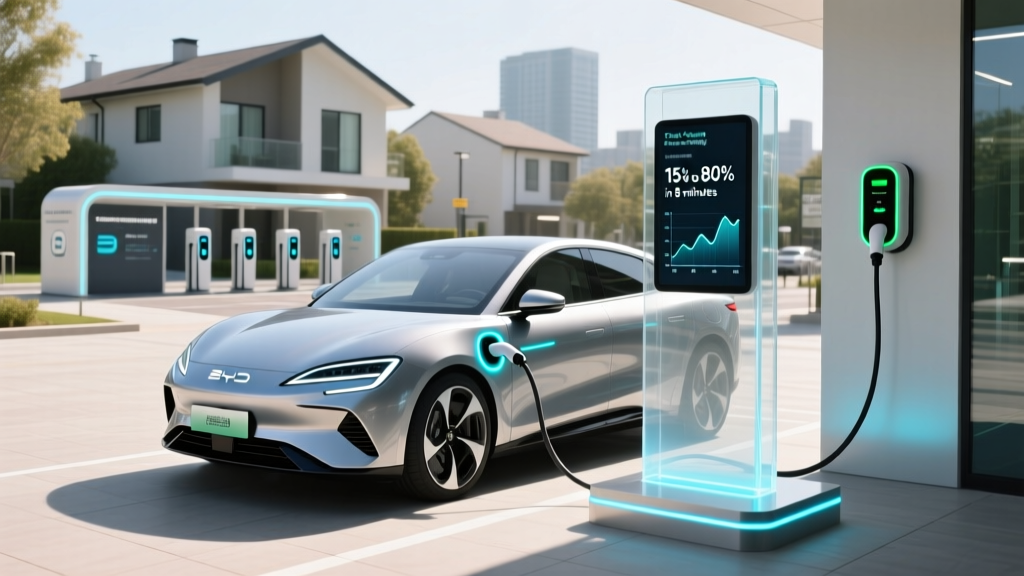
BYD Flash Charging is the automaker's branding for its dual-motor ultra-fast DC charging architecture, debuted on the e-Platform 3.0 vehicles. On vehicles equipped with the feature — such as the BYD Seal (82.5 kWh LFP Blade Battery) and the Denza N7 — BYD claims peak DC fast-charging speeds of up to 230 kW on 800V-capable models and around 150 kW on 400V models like the Atto 3.
Real-world 10–80% charging times based on testing and manufacturer data:
- BYD Seal (82.5 kWh, 800V dual-motor Flash Charging): 10–80% in approximately 26 minutes at a compatible 230+ kW DC charger
- BYD Atto 3 / Yuan Plus (60.5 kWh, 400V): 10–80% in approximately 29 minutes at an 80–100 kW DC charger, tapering at higher-power stations
- BYD Dolphin (60.5 kWh, 400V): 10–80% in approximately 30 minutes at 80 kW
A critical caveat: BYD's LFP (lithium iron phosphate) Blade Batteries have a different charge curve than NMC (nickel manganese cobalt) packs. LFP chemistry tolerates frequent 100% charging better — BYD actually recommends periodic full charges to recalibrate the battery management system — but LFP charge speeds tend to taper more aggressively above 80% SoC compared to NMC. This means the Flash Charging advantage is most pronounced in the 10–60% window.
For context, here is how BYD Flash Charging compares to other fast-charging benchmarks in 2026:
- Hyundai Ioniq 5 (84 kWh, 800V): 10–80% in ~18 min at 350 kW charger
- Tesla Model Y Long Range (75 kWh, 400V): 10–80% in ~25 min at 250 kW Supercharger
- Porsche Taycan (93.4 kWh, 800V): 10–80% in ~18 min at 350 kW charger
- Rivian R1T (141 kWh Max Pack, 400V): 10–80% in ~35 min at 200 kW charger
BYD Flash Charging is competitive, but not class-leading. The real advantage lies in BYD's pricing — vehicles equipped with the tech often cost significantly less than 800V rivals from Hyundai, Porsche, or Kia.
Home EV Charger Installation: Electrical Requirements, Costs, and Panel Upgrades
For daily driving, a home Level 2 charger is the single best investment an EV owner can make. Most EV drivers do 80–90% of their charging at home, waking up to a full battery every morning. Here is what a proper Level 2 installation requires.
Electrical Requirements for Level 2 Charging
A Level 2 home charger runs on a 240-volt dedicated circuit, identical to what a clothes dryer or electric range uses. The most common configurations:
- 40-amp circuit / 32-amp continuous charger: Delivers 7.7 kW — sufficient for most EVs overnight
- 50-amp circuit / 40-amp continuous charger: Delivers 9.6 kW — faster, recommended for larger batteries (100+ kWh)
- 60-amp circuit / 48-amp continuous charger: Delivers 11.5 kW — maximum Level 2 speed, requires substantial panel capacity
The National Electrical Code (NEC) requires that continuous loads (like EV charging) use no more than 80% of a circuit's rated amperage. A 40A breaker supports 32A continuous draw; a 50A breaker supports 40A continuous.
Do You Need a Panel Upgrade?
This is the variable that can double your installation cost. Homes built before 2000 often have 100-amp or 150-amp main service panels. If your panel is already near capacity — running central A/C, an electric dryer, and an electric range — adding a 40–50A EV circuit may exceed safe load limits.
A licensed electrician will perform a load calculation to determine whether your panel can handle the additional circuit. If an upgrade to 200A service is needed, expect to pay $1,500–$3,500 for the panel upgrade alone, plus the charger circuit installation.
Home Charger Installation Cost Breakdown
| Component | Cost Range | Notes |
|---|---|---|
| Level 2 charger hardware (smart, Wi-Fi enabled) | $350–$700 | Varies by brand, power output, cable length |
| Electrician labor (standard install, panel has capacity) | $500–$1,500 | Depends on run length from panel to garage/driveway |
| Permit and inspection | $50–$300 | Required in most jurisdictions; varies by municipality |
| Electrical panel upgrade (if needed) | $1,500–$3,500 | 100A → 200A service upgrade |
| Total (no panel upgrade) | $900–$2,500 | Most common scenario for newer homes |
| Total (with panel upgrade) | $2,400–$6,000 | Older homes with 100A service |
Some utilities offer rebates of $250–$1,000 for Level 2 charger installation, and the federal Residential Clean Energy Credit may cover up to 30% of equipment and installation costs (capped at $1,000) through 2032. Check with your local utility and a tax professional for current eligibility.
Connector Compatibility: NACS, CCS1, CHAdeMO, and Adapter Needs
Connector standards have consolidated significantly since 2024, but fragmentation still exists. Here is the 2026 landscape:
| Connector | Standard Name | Vehicles Using It (2026) | DC Fast Charge Support |
|---|---|---|---|
| NACS | North American Charging Standard (Tesla-origin) | Tesla (all), Ford, GM, Rivian, Volvo, Polestar, Mercedes, BMW, Hyundai, Kia (newer models) | Yes — up to 350 kW at Superchargers and NACS-equipped public stations |
| CCS1 | Combined Charging System (Combo) | Legacy VW ID.4, older Hyundai/Kia, Stellantis EVs, some Honda | Yes — up to 350 kW at Electrify America, EVgo, ChargePoint |
| CHAdeMO | CHAdeMO | Nissan Leaf (legacy only — discontinued), Mitsubishi Outlander PHEV | Yes — max 100 kW; network support declining |
| GB/T | Chinese national standard | BYD (China-market), NIO, Xpeng, other Chinese-market EVs | Yes — up to 480 kW (GB/T ChaoJi variant) |
For BYD vehicles: BYD uses the GB/T connector in its home market (China) and CCS2 in European markets. In markets where BYD is available with CCS2, adapters to NACS or CCS1 may be needed depending on local charging infrastructure. BYD has not officially launched in the US market as of 2026, so NACS/CCS1 adapter availability for BYD vehicles remains limited to gray-market imports or future official launches.
If you drive a CCS1-equipped EV and want access to the Tesla Supercharger network (now open to non-Tesla vehicles), a CCS-to-NACS adapter ($150–$250) is required. Ford, GM, and Rivian vehicles shipped from the factory with NACS ports starting in 2025, so newer models from those brands need no adapter.
Cost to Charge: Home vs. Public vs. Gas — Per-Mile Breakdown
The economics of EV charging depend heavily on where and when you charge. Here is a data-driven comparison using a mid-size EV averaging 3.5 miles per kWh (roughly 115 MPGe combined, similar to a Tesla Model Y or BYD Seal):
| Charging Scenario | Cost per kWh | Cost per Mile | Annual Cost (12,000 mi) |
|---|---|---|---|
| Home Level 2 (off-peak utility rate) | $0.08–$0.14 | $0.023–$0.040 | $276–$480 |
| Home Level 2 (standard residential rate) | $0.14–$0.20 | $0.040–$0.057 | $480–$684 |
| Public Level 2 (workplace, shopping) | $0.20–$0.35 | $0.057–$0.100 | $684–$1,200 |
| DC Fast Charging (Electrify America, EVgo) | $0.35–$0.55 | $0.100–$0.157 | $1,200–$1,884 |
| Tesla Supercharger (2026 avg) | $0.28–$0.40 | $0.080–$0.114 | $960–$1,368 |
| Gasoline (28 MPG avg, $3.40/gal) | — | $0.121 | $1,452 |
The takeaway: home charging is the economic sweet spot. Charging at off-peak residential rates costs roughly one-quarter to one-third of what gasoline costs per mile. Even DC fast charging on road trips is competitive with or cheaper than gas for most vehicles. But if you rely exclusively on public DC fast charging at peak rates, your per-mile cost can exceed gasoline.
For BYD vehicles with LFP batteries, the economics tilt further in your favor. LFP chemistry has a longer cycle life (3,000–5,000+ cycles vs. 1,500–2,500 for NMC), meaning the battery will likely outlast the vehicle itself under normal use. Source: fueleconomy.gov.
Recommended Home Level 2 Chargers for 2026
Not all Level 2 chargers are created equal. Here are four well-tested units across different budgets and power outputs, all with NACS connectors (CCS1 versions available for legacy vehicles):
ChargePoint Home Flex (NACS)
- Power output: Up to 11.5 kW (48A) on a 60A circuit; configurable down to 16A
- Cable length: 23 feet
- Smart features: Wi-Fi, Alexa integration, scheduled charging, energy tracking via app
- Price: ~$599
- Best for: Flexible amperage if your panel has limited capacity
Tesla Wall Connector (NACS native)
- Power output: Up to 11.5 kW (48A) on a 60A circuit
- Cable length: 24 feet
- Smart features: Wi-Fi, over-the-air updates, power sharing between two units, load management
- Price: ~$450
- Best for: Tesla and NACS-native vehicles; best value at 48A
Emporia Vue Level 2 Smart Charger
- Power output: Up to 11.5 kW (48A)
- Cable length: 24 feet
- Smart features: Integrated whole-home energy monitoring, solar-aware charging, utility demand-response compatible
- Price: ~$499
- Best for: Homes with solar panels or Emporia energy monitoring systems
Grizzl-E Smart (NACS or CCS1)
- Power output: Up to 10 kW (40A) on a 50A circuit
- Cable length: 24 feet
- Smart features: OCPP-compatible, works with utility demand-response programs, rugged outdoor-rated enclosure
- Price: ~$449
- Best for: Outdoor installations in cold climates; Canadian-built, rated to -40°F
For BYD vehicles (in markets where they are sold with CCS2), look for CCS2-compatible wallbox chargers from manufacturers like Wallbox (Pulsar Plus), Easee, or Zappi. These are widely available in European and Asia-Pacific markets.
Safety, Electrical Code, and Outdoor Installation Considerations
EV charging involves sustained high-current draw — often for 6–10 hours at a stretch. This is not the same as plugging in a power tool. Proper safety compliance protects your home and your vehicle's onboard charger.
- Dedicated circuit required: Your Level 2 charger must be on its own dedicated breaker — not shared with other outlets or appliances. This is an NEC requirement (Article 625).
- GFCI protection: The 2023 NEC update requires GFCI (ground-fault circuit interrupter) protection for all EV charging outlets rated 150V to ground or less and 60A or less. Hardwired chargers are exempt in many jurisdictions, which is one reason hardwired installs are preferred over plug-in NEMA 14-50 outlets.
- Outdoor rating: If your charger is installed outside, it must carry a NEMA 4 (weatherproof) rating. All four chargers recommended above meet this standard.
- Wire gauge: A 60A circuit requires 6 AWG copper wire; a 50A circuit requires 6 AWG; a 40A circuit requires 8 AWG. Your electrician will size wire based on run length and local code.
- Permit and inspection: Most municipalities require an electrical permit for EV charger installation. The inspection ensures proper grounding, wire sizing, and breaker rating. Skipping this step can void home insurance claims related to electrical fires.
Frequently Asked Questions
How much does it cost to install a home EV charger?
A typical Level 2 home charger installation costs $900–$2,500 when your electrical panel has sufficient capacity. If a panel upgrade from 100A to 200A service is needed, total costs range from $2,400–$6,000. The charger hardware itself runs $350–$700, with labor and permits making up the rest.
How fast will each charging level add range?
Level 1 (120V) adds roughly 3–5 miles of range per hour. Level 2 (240V, 32–48A) adds 25–45 miles per hour. DC fast charging (50–350 kW) can add 150–300+ miles in 20–30 minutes, depending on the vehicle's maximum charge rate and battery state of charge.
Which connector and charger is compatible with my EV?
In the US market for 2026, NACS is the dominant standard — used by Tesla, Ford, GM, Rivian, Hyundai, Kia, BMW, Mercedes, and Volvo. CCS1 is found on older models (pre-2025 VW, some Honda). CHAdeMO is essentially discontinued (Nissan Leaf ended production). BYD vehicles in international markets use CCS2 (Europe) or GB/T (China). Always check your vehicle's charge port before purchasing a home charger.
How much does charging cost per mile compared to gas?
Home charging at off-peak rates costs $0.02–$0.04 per mile — roughly one-quarter to one-third the cost of gasoline at $3.40/gal in a 28 MPG vehicle ($0.12/mile). Public DC fast charging at $0.35–$0.55/kWh costs $0.10–$0.16 per mile, still competitive with gas for most vehicles.
What electrical upgrades might I need for a home charger?
If your home has a 100-amp main service panel that is already heavily loaded (central A/C, electric range, electric dryer), you may need a panel upgrade to 200A service, costing $1,500–$3,500. A licensed electrician will perform a load calculation to determine this. Some utilities offer managed-charging programs that allow a lower-amperage install without a panel upgrade.
Does BYD Flash Charging work at any DC fast charger?
BYD Flash Charging achieves its maximum speed only at DC fast chargers that support the vehicle's voltage architecture (400V or 800V) and can deliver the required peak kW. At a typical 50 kW DC charger, a BYD vehicle will charge at the station's maximum rate regardless of its Flash Charging capability. For the fastest times, seek out 150+ kW chargers on compatible networks.