Understanding BYD Electric Vehicles Range and Charging Needs
BYD (Build Your Dreams) has rapidly expanded its global footprint, and as models like the Atto 3, Seal, and Dolphin arrive in left-hand-drive and potential North American markets, buyers are searching for detailed BYD electric vehicles range data and how to charge them efficiently at home. While EPA figures are limited for models not yet officially sold in the United States, we can analyze WLTP estimates and convert them to real-world expectations for a 2026 ownership scenario.
Charging an EV effectively requires understanding the difference between kW (kilowatts), which is the rate of power flow (like water pressure in a hose), and kWh (kilowatt-hours), which is the total energy stored (like the size of the water tank). BYD's Blade Battery—an LFP (Lithium Iron Phosphate) chemistry—offers distinct advantages for longevity and safety, though it behaves differently than the NMC (Nickel Manganese Cobalt) packs found in many competitors.
BYD Electric Vehicles Range: Real-World Expectations
Because BYD's current lineup uses the more generous WLTP testing cycle, we must adjust those figures downward by roughly 15-20% to approximate real-world highway driving or EPA-equivalent results. Below is a breakdown of expected range for popular BYD models using a 60 kWh and 82 kWh Blade Battery configuration.
Range Reality Check
- BYD Dolphin (60.4 kWh): WLTP 265 mi | Real-World Highway: ~215 mi
- BYD Atto 3 (60.4 kWh): WLTP 260 mi | Real-World Highway: ~210 mi
- BYD Seal (82.5 kWh): WLTP 354 mi | Real-World Highway: ~285 mi
Note: Cold weather (below 32°F) and sustained 75+ mph driving will further reduce these estimates by 10-20%.
Charging Levels and Speeds Explained
To maximize the range of any BYD electric vehicle, you need to understand the three tiers of charging. Most BYD models support AC charging at 7 kW or 11 kW and DC fast charging between 80 kW and 150 kW depending on the trim.
| Level | Voltage | Power (kW) | Miles Added/Hour | Best For |
|---|---|---|---|---|
| Level 1 | 120V AC | 1.4 kW | 3-5 miles | Emergency/PHEV |
| Level 2 (Home) | 240V AC | 7.2 - 11.5 kW | 20-40 miles | Daily Charging |
| DC Fast | 400V-800V DC | 50 - 150+ kW | 150-500+ miles | Road Trips |
Home Installation Requirements and Costs
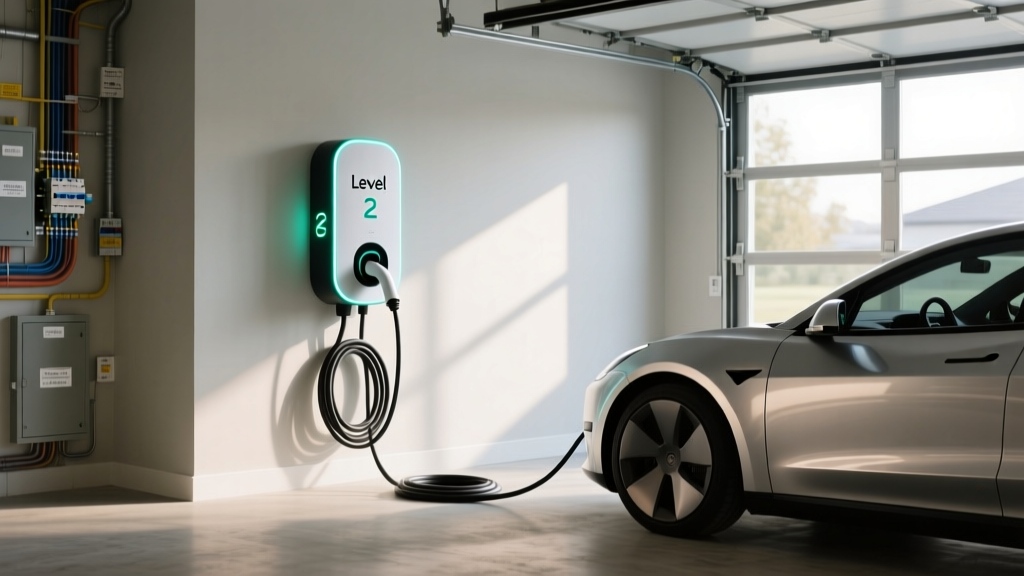
Installing a Level 2 home charger for a BYD electric vehicle typically requires a 240V circuit. Most modern EVSE (Electric Vehicle Supply Equipment) units recommend a 60-amp circuit to deliver 48 amps of continuous power (11.5 kW), though a 50-amp circuit (40 amps/9.6 kW) is sufficient for most BYD models given their onboard AC charging limits.
Estimated Installation Costs (2026)
| Component | Cost Range | Notes |
|---|---|---|
| Level 2 Charger Hardware | $400 - $750 | Smart Wi-Fi enabled |
| Electrician Labor | $500 - $1,500 | Depends on panel distance |
| Electrical Permit | $50 - $200 | Local jurisdiction fee |
| Panel Upgrade (If Needed) | $1,500 - $3,500 | Required for older 100A panels |
| Total (No Upgrade) | $950 - $2,450 | Standard 200A home |
Connector Compatibility: CCS vs. NACS vs. GB/T
Historically, BYD has used the GB/T connector in China and CCS2 in Europe. For any potential North American entry in 2026, BYD would likely adopt the NACS (North American Charging Standard) to ensure access to the Tesla Supercharger network, or provide a CCS1-to-NACS adapter.
| Standard | Region | BYD Status (2026) |
|---|---|---|
| NACS (Tesla) | North America | Expected for US models |
| CCS1 | North America | Legacy standard; adapter needed for Superchargers |
| CCS2 | Europe | Standard for EU-market BYD |
| GB/T | China | Domestic market standard |
Cost to Charge: Electricity vs. Gasoline
One of the primary benefits of the BYD electric vehicles range is the low cost per mile. LFP batteries are exceptionally durable, allowing owners to charge to 100% daily without the degradation concerns seen in NMC chemistry.
| Scenario | Price per kWh | Cost for 60 kWh (Full) | Cost per Mile (3.5 mi/kWh) |
|---|---|---|---|
| Home Off-Peak | $0.13 | $7.80 | $0.037 |
| Public Level 2 | $0.35 | $21.00 | $0.10 |
| DC Fast Charging | $0.55 | $33.00 | $0.15 |
| Gasoline (30 MPG) | $3.50/gal | $7.00/gal equiv. | $0.116 |
Equipment Recommendations for BYD Owners
When selecting a charger for a BYD with a 7 kW or 11 kW onboard AC limit, you should prioritize reliability and cable management.
1. Emporia Vue 2 Level 2 Charger
Power: 11.5 kW (48A) | Price: ~$450 | Features: Energy monitoring, load management for older panels.
2. ChargePoint Home Flex
Power: 12 kW (50A) | Price: ~$699 | Features: NACS/CCS options, excellent app integration, 25ft cable.
Safety and Code Considerations
According to the National Electrical Code (NEC), EV charging requires a dedicated circuit. If installing outdoors, the EVSE must carry a NEMA 4 or NEMA 4X rating to withstand weather. Many jurisdictions now require GFCI protection for outdoor receptacles, though many modern EVSEs have this built-in. Always consult a licensed electrician to verify your home's grounding and bonding meet 2026 local codes.
Frequently Asked Questions
How much does it cost to install a home EV charger for a BYD?
Most homeowners spend between $950 and $2,450 for a standard installation on a 200-amp panel. If your home requires a service upgrade to 200 amps, add $1,500 to $3,500 to that total.
How fast will each charging level add range to a BYD?
Level 1 adds roughly 4 miles per hour. Level 2 (240V) adds between 22 and 35 miles per hour depending on the onboard charger. DC Fast Charging can add 150+ miles in a 20-minute session.
Which connector does BYD use?
In Europe, BYD uses CCS2. In North America, future models are expected to use NACS (Tesla standard), though early imports may use CCS1 and require an adapter for Supercharger access.
Does the BYD Blade Battery require special charging care?
The LFP Blade Battery is more robust than NMC. BYD recommends charging to 100% at least once a week to help the Battery Management System (BMS) calibrate the cells accurately.