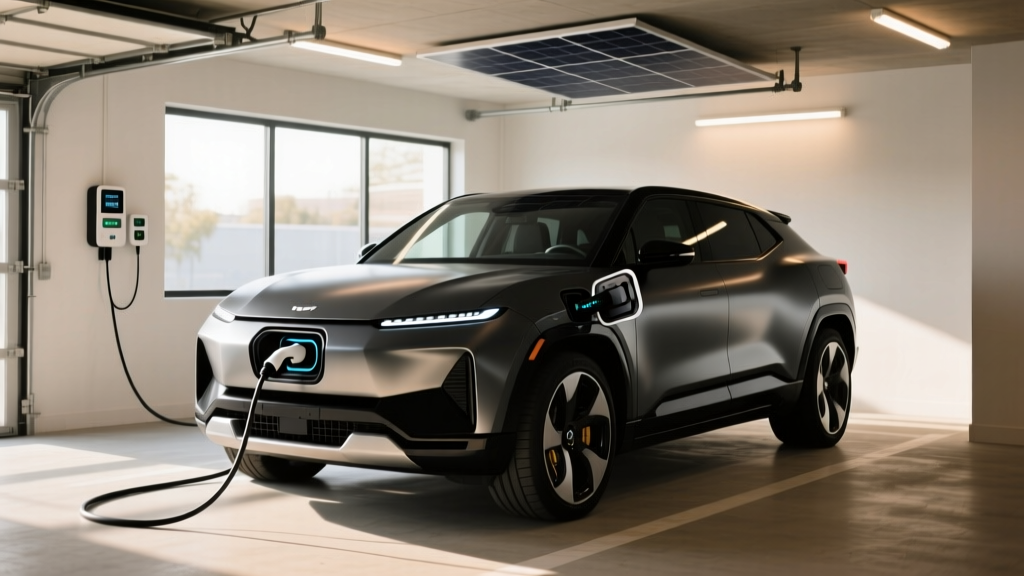
If you own or are considering a BYD electric vehicle — whether an Atto 3, Dolphin, Seal, or the newer Seal U — one of the first practical questions is how long charging actually takes across different scenarios. BYD's global lineup uses the Blade Battery (lithium iron phosphate / LFP chemistry), which has distinct charging characteristics compared to the NMC packs found in many competitors. This guide breaks down BYD charging time at every level, what you need for home installation, connector compatibility, and real cost-per-mile figures.
Understanding BYD Charging Time Across All Levels
Charging speed depends on two numbers: the power delivery of the charger (measured in kW, or kilowatts — the rate of energy flow) and the energy capacity of the battery (measured in kWh, or kilowatt-hours — the total energy stored). Confusing these two is the single most common mistake new EV owners make. A 7 kW charger delivering power to a 60 kWh battery is like filling a 60-liter tank through a hose that flows at 7 liters per hour.
BYD models sold globally typically feature battery capacities ranging from roughly 44.9 kWh (Dolphin) to 82.5 kWh (Seal), with DC fast-charge acceptance between 60 kW and 150 kW depending on the model. Here's how each charging level translates into real-world BYD charging time and range recovery.
| Level | Voltage / Amps | Power (kW) | Miles of Range Added / Hour | Typical Use Case |
|---|---|---|---|---|
| Level 1 (120V) | 120V / 12A | ~1.4 kW | 3–5 mi/hr | Emergency / overnight trickle |
| Level 2 (240V) | 240V / 32–48A | 7–11.5 kW | 20–35 mi/hr | Home daily charging |
| DC Fast Charge | 400V+ DC | 60–150 kW (model dependent) | 150–300+ mi/hr (peak) | Road trips, quick top-ups |
Real-world note: The "miles per hour" figures assume moderate efficiency (~3.5 mi/kWh, typical for a BYD Atto 3 or Dolphin). Heavier models like the Seal or Tang will recover fewer miles per kWh. Cold weather (below 40°F) can reduce charging speed by 20–40% unless the battery is preconditioned.
BYD Charging Time: 10–80% Examples by Model
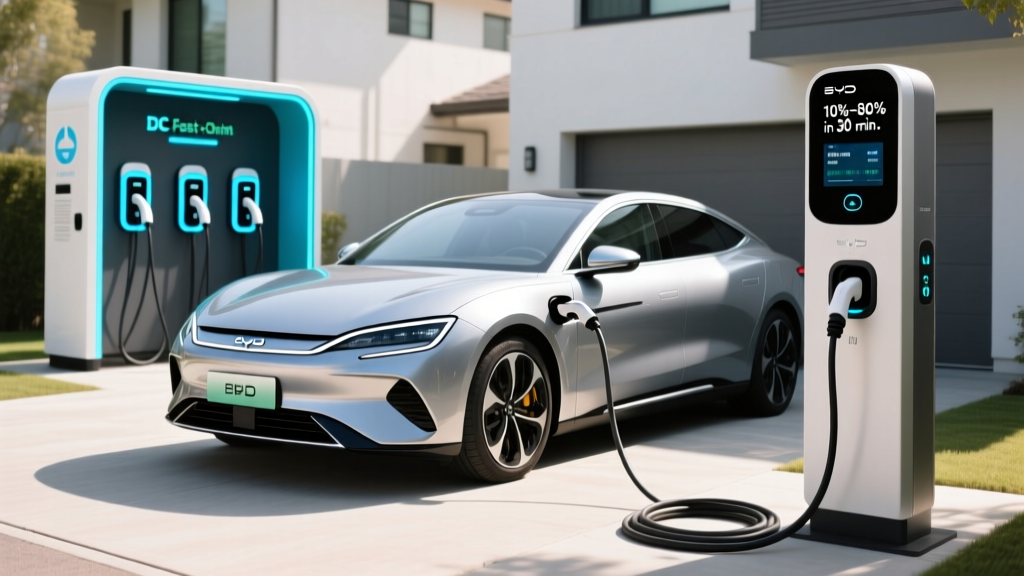
The most useful metric for DC fast charging is the 10–80% time, since charging above 80% slows dramatically to protect battery health — this is called the charge curve taper. BYD's LFP Blade Battery tends to sustain a more linear charge curve than NMC chemistries, but taper still begins noticeably around 80%.
| Model | Battery (kWh) | Max DC Rate (kW) | 10–80% DC Fast Time | Full Level 2 Charge (0–100%) |
|---|---|---|---|---|
| BYD Dolphin | 44.9 kWh (LFP) | 60 kW | ~34–38 min | ~6.5 hr at 7 kW |
| BYD Atto 3 | 58.56 kWh (LFP) | 88 kW | ~29–35 min | ~8.5 hr at 7 kW |
| BYD Seal | 82.5 kWh (LFP) | 150 kW | ~26–32 min | ~11.5 hr at 7 kW |
| BYD Seal U | 71.8 kWh (LFP) | 110 kW | ~30–36 min | ~10 hr at 7 kW |
These times assume a charger capable of delivering the vehicle's peak acceptance rate and a battery starting temperature between 60–80°F. In cold conditions or at a shared/low-power DC station, add 20–50% to these figures. Always check the specific model-year spec sheet on BYD's official global site, as powertrain revisions occur frequently.
Home Charger Installation: Costs, Electrical Requirements, and Upgrades
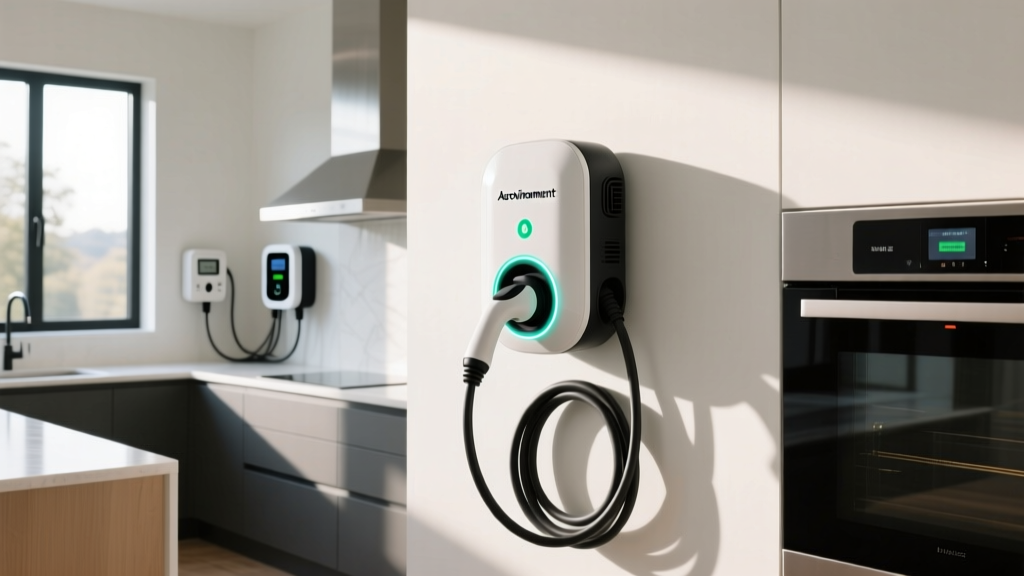
For daily BYD ownership, a Level 2 home charger is the backbone. Most BYD models accept up to 7 kW on Level 2 (single-phase, 32A), though some markets and models support 11 kW on three-phase power. Here's what a typical US or compatible-market installation looks like.
Electrical Requirements
- Circuit: Dedicated 40A breaker (for a 32A continuous-load charger) or 50A breaker (for a 40A charger)
- Voltage: 240V (NEMA 14-50 outlet or hardwired)
- Wire gauge: 6 AWG copper for 40A; 4 AWG for 50A circuits
- Panel capacity: Minimum 100A service; 200A recommended for homes with other electric loads (heat pump, electric range, dryer)
Panel Upgrade Reality
Homes built before 2000 often have 100A panels. Adding a 40A EV circuit to an already-loaded 100A panel may require a panel upgrade to 200A, which is the single largest variable in installation cost. A load calculation by a licensed electrician will determine if an upgrade is needed. Some utilities offer load-management devices (like the Emporia Smart Charger with grid-aware scheduling) that can avoid a panel upgrade by throttling charge rate during peak household usage.
| Component | Typical Cost Range | Notes |
|---|---|---|
| Level 2 Charger (Equipment) | $350–$700 | Smart Wi-Fi chargers with cable |
| Electrician Labor | $500–$2,000 | Depends on run length, conduit, wall type |
| Permit & Inspection | $50–$250 | Varies by municipality |
| Electrical Panel Upgrade (if needed) | $1,500–$4,000 | 100A → 200A upgrade; not always required |
| Total (no panel upgrade) | $900–$2,950 | Most homes with 200A service |
| Total (with panel upgrade) | $2,400–$6,950 | Older homes with 100A service |
Some US buyers may qualify for the Residential Clean Energy Credit (IRS §25D), which covers 30% of the cost of home EV charging equipment and installation through 2032 — up to $1,000 for the charger hardware. Check current eligibility with a tax professional, as rules and caps can change.
Connector Compatibility: What Fits a BYD?
BYD's connector depends entirely on the market where the vehicle is sold. This is one of the more confusing aspects for buyers importing or relocating with a BYD.
| Market | AC Connector (Level 1/2) | DC Connector (Fast Charge) | Adapter Needed? |
|---|---|---|---|
| China | GB/T AC | GB/T DC | N/A (domestic standard) |
| Europe / UK / Australia | Type 2 (Mennekes) | CCS2 | No — widely compatible at public chargers |
| Japan | Type 1 (J1772) | CHAdeMO | No on Japanese networks |
| US (if/when available) | J1772 / NACS (future) | CCS1 / NACS (future) | TBD — BYD has not confirmed US EV sales |
Key takeaway: BYD has not officially launched passenger EVs in the US market as of 2026. If you're reading this from Europe, Australia, or Southeast Asia, your BYD will use the CCS2 standard, which is the dominant DC fast-charging connector in those regions and compatible with the vast majority of public networks. In markets where NACS (Tesla's North American Charging Standard) is becoming dominant, CCS-to-NACS adapters are available from third-party manufacturers.
Cost to Charge a BYD: Home vs. Public vs. Gas
One of the strongest ownership arguments for BYD EVs is running cost. LFP batteries paired with efficient powertrains (the Atto 3 achieves roughly 3.5–4.0 mi/kWh in mixed driving) translate to very low cost-per-mile figures.
| Scenario | Cost per kWh | Cost to Fill 60 kWh (Atto 3) | Cost per Mile (at 3.5 mi/kWh) |
|---|---|---|---|
| Home (off-peak utility rate) | $0.08–$0.14 | $4.80–$8.40 | $0.023–$0.040 |
| Home (standard residential rate) | $0.14–$0.20 | $8.40–$12.00 | $0.040–$0.057 |
| Public Level 2 (network pricing) | $0.20–$0.40 | $12.00–$24.00 | $0.057–$0.114 |
| DC Fast Charge (public) | $0.30–$0.55 | $18.00–$33.00 | $0.086–$0.157 |
| Gasoline equivalent (30 MPG, $3.50/gal) | — | — | $0.117 |
At home off-peak rates, charging a BYD Atto 3 costs roughly one-quarter to one-third the per-mile cost of a comparable gasoline crossover getting 30 MPG. Even at DC fast-charging prices, the cost per mile is competitive with gas — and significantly lower on road trips if you plan around free or subsidized charging networks.
For context, a full home charge of a BYD Dolphin (44.9 kWh) at $0.12/kWh costs just $5.39 and provides roughly 140–155 real-world miles. That's the equivalent of filling a gas car for under $2 in most US markets.
Recommended Home Chargers for BYD EVs
Since most BYD models accept a maximum of 7 kW on AC (single-phase), a 32A/7 kW Level 2 charger is the sweet spot. Oversizing to 48A/11.5 kW is worthwhile only if your home has three-phase power (common in Europe/Australia) or you plan to future-proof for a higher-acceptance vehicle.
Emporia Level 2 Smart Charger
- Power: 48A / 11.5 kW (adjustable down to 32A)
- Connector: J1772 (US) / Type 2 (EU)
- Cable: 24 ft
- Smart features: Wi-Fi, energy monitoring, solar integration, load management
- Price: ~$399
- Best for: Budget-conscious smart charging with energy tracking
Wallbox Pulsar Plus
- Power: 40A / 9.6 kW (single-phase) or 48A
- Connector: J1772 (US) / Type 2 (EU)
- Cable: 25 ft
- Smart features: Wi-Fi + Bluetooth, app scheduling, Power Sharing for dual installs
- Price: ~$549–$649
- Best for: Compact form factor, reliable app, multi-charger households
ChargePoint Home Flex
- Power: Up to 50A / 12 kW (configurable via dip switch)
- Connector: J1772 (US) / Type 2 (EU)
- Cable: 23 ft
- Smart features: Wi-Fi, Alexa integration, flexible amperage, UL-listed
- Price: ~$699
- Best for: Maximum flexibility and future-proofing
All three chargers above support the Type 2 / J1772 AC connector standard that BYD vehicles use in their respective markets. For DC fast charging on the road, no equipment purchase is needed — you simply use the CCS2 (or market-appropriate) cable built into the charging station.
Safety and Electrical Code Considerations
EV charging places a sustained high-amperage load on your home's electrical system — far more demanding than intermittent appliances. Proper installation is non-negotiable for safety and insurance compliance.
- Dedicated circuit: Your Level 2 charger must be on its own dedicated breaker — never shared with other outlets or appliances.
- GFCI protection: The 2020 NEC (National Electrical Code) requires GFCI protection for EV charging outlets in garages and outdoor locations. Hardwired chargers may have GFCI built into the unit.
- Outdoor rating: If your charger is installed outdoors (carport, driveway), both the charger and the outlet/enclosure must carry a NEMA 4 (weatherproof) rating.
- Permit and inspection: Most jurisdictions require an electrical permit for EV charger installation. The inspection ensures wire gauge, breaker sizing, and grounding meet code. Skipping this can void homeowner's insurance coverage for electrical fires.
- Continuous load derating: NEC defines EV charging as a continuous load (3+ hours). The circuit must be rated at 125% of the charger's amperage — so a 32A charger needs a 40A breaker and wire rated for 40A.
Always hire a licensed electrician experienced with EV installations. The National Electrical Code (NFPA 70) sets the baseline, but local amendments vary.
Frequently Asked Questions
How much does it cost to install a home EV charger for a BYD?
Expect $900–$2,950 total (equipment + electrician + permit) if your home has a 200A electrical panel with spare capacity. If a panel upgrade from 100A to 200A is required, the total can reach $2,400–$6,950. The charger unit itself typically costs $350–$700. Federal tax credits under §25D may cover 30% of equipment cost (up to $1,000).
How fast will each charging level add range to my BYD?
Level 1 (120V) adds roughly 3–5 miles per hour — only practical for overnight trickle or emergencies. Level 2 (240V, 7 kW) adds 20–25 miles per hour, fully recharging a BYD Atto 3 overnight in about 8.5 hours. DC fast charging at the vehicle's peak rate (60–150 kW depending on model) recovers 10–80% in 26–38 minutes under ideal conditions.
Which connector and charger is compatible with my BYD?
In Europe, Australia, and most export markets, BYD EVs use the Type 2 connector for AC (Level 2) charging and CCS2 for DC fast charging. In China, the GB/T standard is used. BYD has not launched passenger EVs in the US market as of 2026, where J1772/CCS1 or NACS dominate. Always verify your specific model-year connector on BYD's official site.
How much does charging a BYD cost per mile compared to gas?
At a typical US home electricity rate of $0.14/kWh, a BYD Atto 3 (3.5 mi/kWh) costs about $0.04 per mile. A comparable gasoline crossover at 30 MPG and $3.50/gallon costs $0.117 per mile. Home charging is roughly one-third the cost of gas; even DC fast charging at $0.40/kWh ($0.114/mi) is competitive with gasoline.
What electrical upgrades might I need for a BYD home charger?
The most common upgrade is ensuring your electrical panel has enough spare capacity for a dedicated 40A circuit. Homes with 100A service may need a panel upgrade to 200A ($1,500–$4,000). Other potential costs include running new conduit (if the panel is far from the garage), upgrading the meter base, or installing a load-management device to avoid a panel upgrade entirely. A licensed electrician's load calculation is the definitive answer.
Does BYD's LFP Blade Battery charge differently than other EVs?
Yes, in two important ways. First, LFP batteries tolerate and benefit from regular 100% charging — BYD recommends charging to full at least weekly for accurate state-of-charge calibration. Second, the DC fast-charge curve on LFP tends to be more linear (less peak-and-taper) than NMC, meaning sustained charge rates closer to the peak for longer — though the absolute peak kW is sometimes lower than equivalent NMC vehicles. The 10–80% times remain competitive.