What a 'Burn Notice' on Your EV Charger Actually Means
If you've seen a "burn notice" warning on your EV charger — or noticed the plug getting uncomfortably hot during a charging session — you're encountering one of the most common yet under-discussed issues in home EV ownership. A burn notice typically indicates that the charger's internal thermal sensor has detected temperatures exceeding safe operating thresholds, triggering an automatic shutdown or power reduction to prevent damage or fire.
This isn't a rare glitch. As more EV owners install Level 2 chargers in garages, carports, and driveways, thermal management has become a critical factor in equipment selection and installation quality. In this guide, we'll break down exactly what causes charger overheating, how each charging level works, what it costs to install a proper home setup, and which chargers have the best thermal protection built in.
Understanding EV Charging Levels: Speed, Power, and Heat
Before diagnosing a thermal issue, you need to understand the three charging levels available to EV owners. The key distinction: kW (kilowatts) measures power — how fast energy flows into your battery. kWh (kilowatt-hours) measures energy — the total capacity of your battery. Think of kW as the width of a pipe and kWh as the size of the tank you're filling.
| Level | Voltage | Power (kW) | Miles Added/Hour | Typical Use |
|---|---|---|---|---|
| Level 1 | 120V AC | 1.0–1.4 kW | 3–5 mi/hr | Overnight trickle, PHEVs |
| Level 2 | 240V AC | 3.3–19.2 kW | 12–75 mi/hr | Home, workplace, public AC |
| DC Fast | 400–900V DC | 50–350 kW | 150–1,200+ mi/hr | Road trips, highway corridors |
Heat generation scales with current (amps). A Level 1 charger pulling 12 amps from a standard outlet generates minimal heat. A Level 2 charger pushing 48 amps continuously for 6+ hours is a different thermal story entirely — and that's where burn notices typically appear.
Real-World Charging Time Examples
Here's what charging looks like in practice for common battery sizes:
- 60 kWh battery (e.g., base Tesla Model 3): Level 2 at 11.5 kW (48A) → 0–100% in ~5.5 hours; 10–80% in ~4 hours
- 84 kWh battery (e.g., Hyundai Ioniq 5 Long Range): Level 2 at 11.5 kW → 0–100% in ~7.5 hours; 10–80% in ~5.5 hours
- 84 kWh battery on DC fast (peak 240 kW): 10–80% in ~18 minutes, tapering significantly above 80% SoC
- 100 kWh battery (e.g., Ford F-150 Lightning Extended): Level 2 at 11.5 kW → 0–100% in ~9 hours; DC fast at 150 kW peak → 10–80% in ~40 minutes
Note that DC fast charging times are heavily affected by the charge curve — batteries accept peak power only at low SoC, then taper as they fill. A charger rated for 250 kW peak may average 120–150 kW across the full 10–80% session.
What Causes an EV Charger to Overheat (and Trigger a Burn Notice)
Thermal shutdowns in EV chargers usually trace back to one of four root causes:
1. Undersized or Degraded Wiring
A 48-amp Level 2 charger requires a dedicated 60-amp circuit with 6 AWG copper wire (or 4 AWG aluminum). If an installer cuts corners with thinner gauge wire, or if older home wiring has degraded connections, resistance increases — and resistance generates heat. This heat builds at the breaker, the outlet (if using a NEMA 14-50 receptacle), or inside the wall.
2. NEMA 14-50 Outlet Issues
Many Level 2 chargers plug into a NEMA 14-50 outlet. Residential-grade receptacles not rated for continuous high-amperage duty can overheat at the plug-blade contact points. The National Electrical Code (NEC) considers EV charging a "continuous load" (running 3+ hours), which means the circuit must be rated for 125% of the charger's maximum draw. A 48A charger needs a 60A breaker — not a 50A breaker on a 14-50 outlet, which is a common and dangerous mismatch.
3. Poor Ventilation and Ambient Temperature
Chargers installed in enclosed spaces, direct sunlight, or unventilated garages in hot climates (Arizona, Texas, Florida) can exceed internal thermal limits. Most quality chargers are rated for operation up to 104°F (40°C) ambient, but surface temperatures in direct summer sun can exceed 140°F.
4. Equipment Quality and Age
Budget chargers with inadequate internal heat sinks, undersized contactors, or poor potting of electronics are more prone to thermal events. Chargers 5+ years old may have degraded thermal paste or failing cooling components.
Home EV Charger Installation: Electrical Requirements and Costs
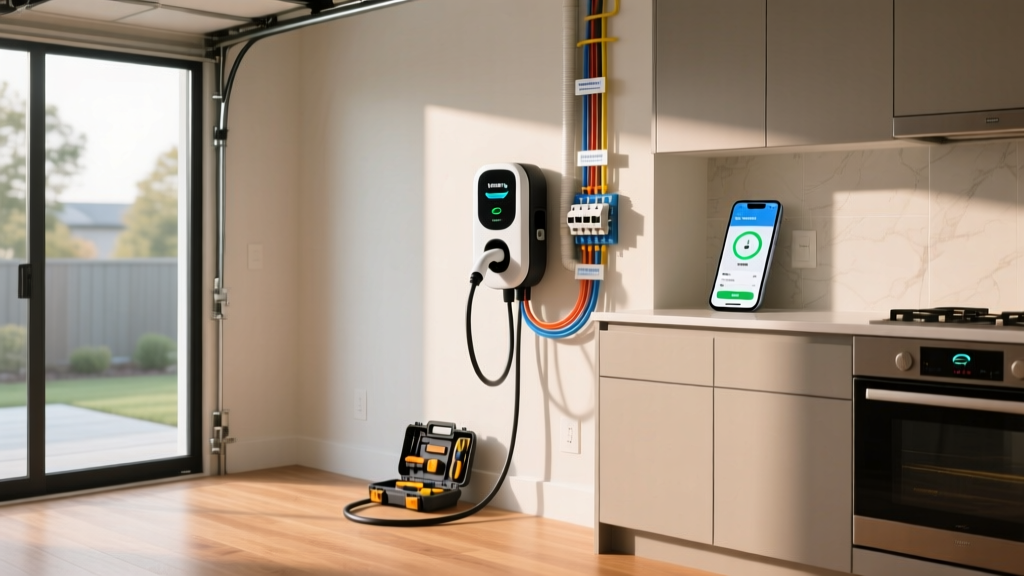
A proper installation is your best defense against overheating. Here's what a code-compliant Level 2 home charger setup requires:
Electrical Requirements
- Voltage: 240V AC (split-phase residential service)
- Amperage: Circuit rated at 125% of charger max draw (e.g., 48A charger → 60A circuit)
- Wire gauge: 6 AWG copper (THHN in conduit) or 4 AWG aluminum for 60A circuits
- Dedicated circuit: No other loads on the same breaker
- GFCI protection: Required by NEC 2020+ for outdoor receptacles; some jurisdictions require it indoors as well
- Hardwired vs. plug-in: Hardwired connections (no receptacle) are recommended for 48A+ chargers — they eliminate the outlet as a heat failure point
Panel Upgrade Considerations
Older homes with 100A or 150A main service panels may not have capacity for a 60A EV circuit. An electrician will perform a load calculation per NEC Article 220 to determine if your panel can handle the added draw. If not, a panel upgrade to 200A (or adding a sub-panel) may be required.
| Component | Cost Range | Notes |
|---|---|---|
| Level 2 Charger (Equipment) | $300–$750 | Smart Wi-Fi chargers at upper end |
| Electrician Labor | $500–$2,000 | Varies by run length, conduit, wall material |
| Electrical Permit | $50–$250 | Required in most jurisdictions |
| Panel Upgrade (if needed) | $1,500–$4,000 | 100A→200A service upgrade |
| Conduit & Wire (50–100 ft run) | $200–$600 | Longer runs = higher material cost |
| Total (no panel upgrade) | $850–$3,600 | Most homes with 200A service |
| Total (with panel upgrade) | $2,350–$7,600 | Older homes with 100A service |
The federal residential clean energy credit covers 30% of charger equipment and installation costs up to $1,000 through 2032, provided the home is in an eligible census tract. Check IRS.gov for current eligibility rules, as census-tract qualifications were added in recent tax years.
Connector Compatibility: NACS, CCS1, and CHAdeMO Explained
Choosing a charger means matching its connector to your vehicle. As of 2026, the connector landscape has consolidated significantly, but legacy connectors remain on the road.
| Connector | Brands Using It | Notes |
|---|---|---|
| NACS (Tesla / J3400) | Tesla, Ford, GM, Rivian, Volvo, Polestar, Hyundai/Kia (2025+), BMW, Mercedes | Industry standard as of 2025; compact, no locking pins |
| CCS1 | VW ID.4 (older), legacy BMW i4/iX, older Hyundai/Kia models | Being phased out on new models; still widely supported at public chargers |
| CHAdeMO | Nissan LEAF (all years), Mitsubishi Outlander PHEV | Legacy; declining public infrastructure support |
Adapter needs: If you own a CCS1-equipped EV and want to use Tesla Superchargers (now open to non-Tesla vehicles via NACS), you'll need a CCS-to-NACS adapter. Tesla sells one for ~$250; third-party options from Lectron and A2Z are available for $150–$200. CHAdeMO vehicles have no viable NACS adapter path for DC fast charging.
For home Level 2 charging, most chargers now ship with a NACS (J3400) connector. If your EV still has a CCS1 or J1772 inlet, you'll need a J1772-to-NACS adapter (typically $50–$100) or choose a charger that still offers a J1772 plug option.
Cost to Charge: Home vs. Public vs. Gas
Charging economics depend heavily on where and when you charge. Here's a realistic breakdown:
| Scenario | Rate ($/kWh) | Cost for 60 kWh Fill | Cost Per Mile (3.5 mi/kWh) |
|---|---|---|---|
| Home Off-Peak (utility TOU) | $0.08–$0.12 | $4.80–$7.20 | $0.023–$0.034 |
| Home Standard Rate | $0.14–$0.20 | $8.40–$12.00 | $0.040–$0.057 |
| Public Level 2 (ChargePoint, etc.) | $0.25–$0.49 | $15.00–$29.40 | $0.071–$0.140 |
| DC Fast (Electrify America, EVgo) | $0.35–$0.55 | $21.00–$33.00 | $0.100–$0.157 |
| Tesla Supercharger (member rate) | $0.25–$0.35 | $15.00–$21.00 | $0.071–$0.100 |
| Gasoline (25 MPG combined, $3.50/gal) | — | — | $0.140 |
The takeaway: home charging on off-peak rates is 4–6x cheaper per mile than gasoline. Even public DC fast charging is roughly cost-competitive with gas on a per-mile basis. But if you rely exclusively on public DC fast charging, your "fuel" cost can equal or exceed a fuel-efficient gas car.
Efficiency matters. A vehicle rated at 3.5 miles per kWh (roughly 110 MPGe) will cost less to charge than one at 2.5 mi/kWh (79 MPGe). Check your vehicle's efficiency on fueleconomy.gov for EPA-rated kWh/100mi figures.
Best Level 2 Home Chargers with Thermal Protection (2026 Picks)
These chargers are selected for robust thermal management, code compliance, and proven reliability. All support NACS (J3400) natively or via included adapter.
Emporia Vue Level 2 Smart Charger
- Power Output: 48A / 11.5 kW (hardwired) or 40A / 9.6 kW (plug-in NEMA 14-50)
- Connector: NACS (J3400), J1772 adapter included
- Cable Length: 24 ft
- Smart Features: Wi-Fi, energy monitoring, solar integration, scheduled charging, load management
- Thermal Protection: Internal temperature sensor with automatic current derating; UL-listed
- Price: ~$399 (hardwired) / ~$349 (plug-in)
Best for: Budget-conscious buyers who want smart features and energy monitoring without premium pricing.
ChargePoint Home Flex (2nd Gen)
- Power Output: Up to 50A / 12 kW (hardwired, adjustable 16–50A)
- Connector: NACS (J3400) or J1772 (configurable at order)
- Cable Length: 23 ft
- Smart Features: Wi-Fi, Alexa integration, ChargePoint network access, flex scheduling
- Thermal Protection: Dual thermal sensors, automatic power reduction, NEMA 3R outdoor rating
- Price: ~$599
Best for: Owners wanting adjustable amperage to match their circuit capacity and a proven network ecosystem.
Tesla Wall Connector (Gen 4)
- Power Output: 48A / 11.5 kW (hardwired, 60A circuit)
- Connector: NACS native; J1772 adapter available separately
- Cable Length: 24 ft
- Smart Features: Wi-Fi, over-the-air updates, power sharing (up to 6 units on one circuit), vehicle-specific access control
- Thermal Protection: Integrated thermal management, NEMA 3R rated, glass-fascia design dissipates heat effectively
- Price: ~$450
Best for: Tesla owners and NACS-equipped EV drivers who want the cleanest installation and multi-charger power sharing.
Grizzl-E Smart Level 2
- Power Output: 40A / 9.6 kW (plug-in) or 48A / 11.5 kW (hardwired)
- Connector: NACS (J3400) or J1772 options
- Cable Length: 24 ft
- Smart Features: Wi-Fi, OCPP compatibility, adjustable amperage, energy tracking
- Thermal Protection: Built in Canada for extreme cold and heat; IP67-rated enclosure, thermal cutoff at 185°F internal
- Price: ~$499–$549
Best for: Outdoor installations in extreme climates (–40°F to 122°F rated); the most rugged enclosure on the market.
Safety and Code Considerations for Burn-Notice-Free Charging
To minimize thermal events and ensure a safe, code-compliant installation:
- Always use a licensed electrician. EV charging is a continuous high-amperage load — not a DIY project. Improper wire sizing, loose connections, or missing torque specifications on breaker lugs are leading causes of overheating.
- Prefer hardwired over plug-in for 48A+ chargers. A hardwired connection eliminates the NEMA 14-50 receptacle, which is a known failure point under continuous 40–48A loads. If you must use a receptacle, specify an industrial-grade Hubbell or Bryant 14-50R rated for continuous duty.
- Ensure proper breaker sizing. NEC requires the breaker to be rated at 125% of the continuous load. A 48A charger requires a 60A breaker — not a 50A breaker.
- Install a GFCI breaker for outdoor chargers. NEC 2020 and later require GFCI protection for outdoor receptacles. For hardwired outdoor chargers, GFCI requirements vary by jurisdiction — confirm with your local inspector.
- Use a charger with UL or ETL listing. These certifications verify independent safety testing including thermal performance. Avoid uncertified chargers from marketplace sellers.
- Check for NEMA 3R or IP65+ rating for outdoor installations. This ensures the enclosure resists rain, dust, and UV degradation.
- Monitor your charger periodically. After the first few sessions, feel the plug, outlet, and breaker panel for unusual warmth. Warm is normal; hot is not.
Frequently Asked Questions
How much does it cost to install a home EV charger?
A typical Level 2 home charger installation costs $850–$3,600 when your electrical panel has sufficient capacity. This includes the charger ($300–$750), electrician labor ($500–$2,000), permit ($50–$250), and wiring materials. If your home needs a panel upgrade from 100A to 200A service, add $1,500–$4,000. The federal clean energy credit can offset 30% of equipment and installation up to $1,000.
How fast will each charging level add range?
Level 1 (120V) adds 3–5 miles per hour — suitable for PHEVs with small batteries but impractical for full BEVs. Level 2 (240V) at 48 amps adds roughly 35–45 miles per hour for most EVs, fully recharging overnight. DC fast charging at 150–250 kW can add 150–300+ miles in 20–30 minutes, though the charge curve means speeds taper significantly above 80% SoC.
Which connector/charger is compatible with my EV?
For 2025–2026 model-year vehicles from Tesla, Ford, GM, Rivian, Hyundai, Kia, Volvo, BMW, and Mercedes, the NACS (J3400) connector is now standard. Older CCS1-equipped vehicles (pre-2025 VW, some BMW, older Hyundai/Kia) will need a CCS-to-NACS adapter for Supercharger access. CHAdeMO vehicles (Nissan LEAF) are limited to CHAdeMO public chargers and can use any J1772/NACS Level 2 charger with an adapter for home charging.
How much does charging cost per mile vs gas?
Home charging on off-peak utility rates costs $0.02–$0.04 per mile — roughly one-quarter to one-third the cost of gasoline at $3.50/gallon and 25 MPG. Public DC fast charging costs $0.10–$0.16 per mile, which is comparable to gasoline. The biggest savings come from consistent home charging; relying entirely on public DC fast chargers erodes the cost advantage.
What electrical upgrades might I need?
The most common upgrade is a panel capacity increase. Homes with 100A or 150A main panels often need a 200A upgrade to safely add a 60A EV charging circuit alongside existing loads (HVAC, electric range, dryer). Your electrician will perform a NEC Article 220 load calculation. Other potential upgrades include running new conduit from the panel to the charger location (especially if the panel is on the opposite side of the house from the garage), adding a sub-panel, or upgrading the service drop from the utility.
What should I do if my charger shows a burn notice or thermal warning?
Stop charging immediately and let the unit cool. Check the plug and outlet for discoloration, melting, or a burnt smell — if present, do not resume use and have an electrician inspect the circuit. Verify your breaker is correctly sized (125% of charger amperage), that wire gauge matches the circuit rating, and that the charger has adequate ventilation. If the issue recurs, the charger's internal thermal management may be failing — contact the manufacturer for warranty service or replacement.