What Is the Bumble Bee Charger?
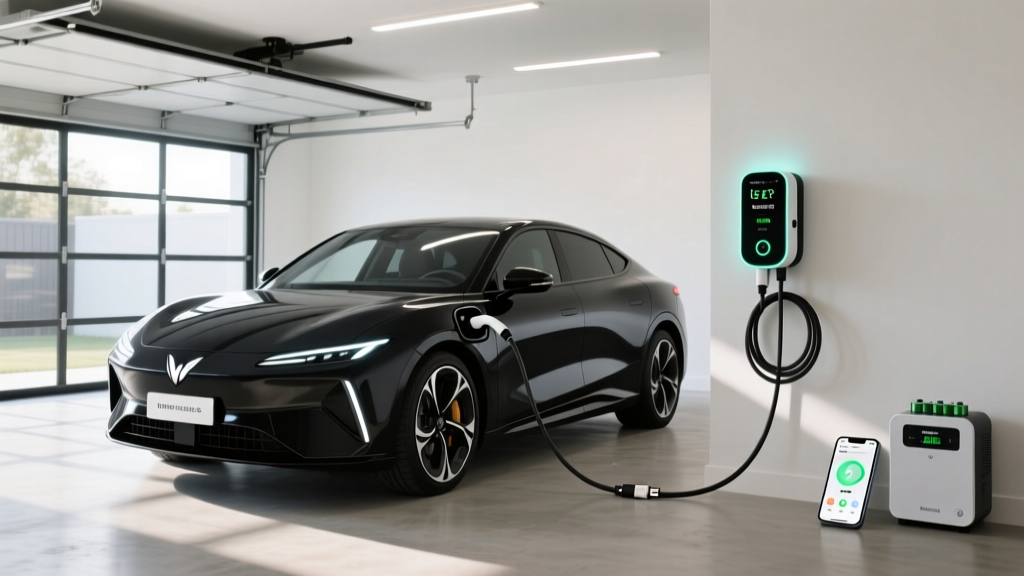
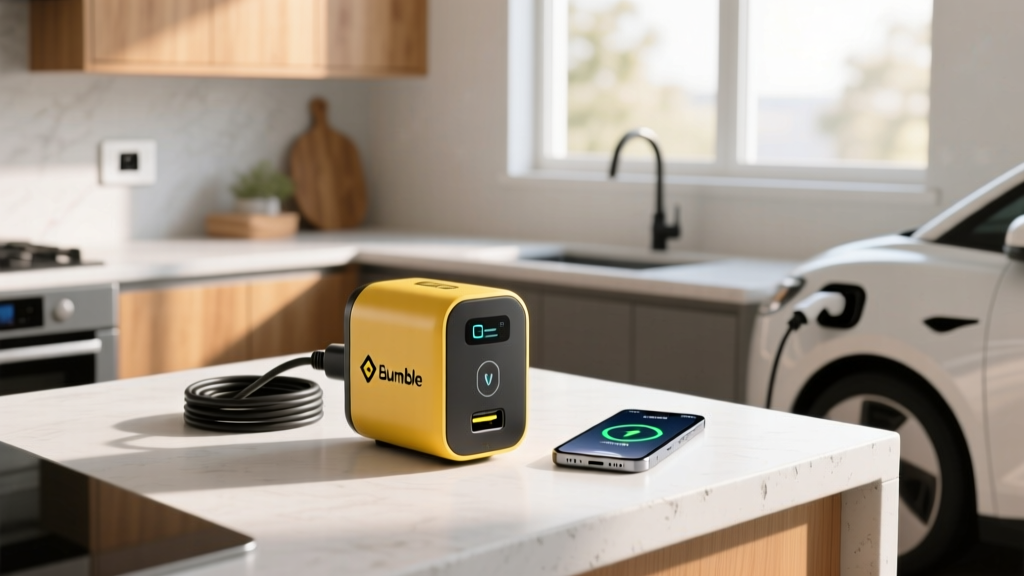
The Bumble Bee charger is a compact Level 2 home EV charger that has gained attention among electric vehicle owners looking for an affordable, space-saving wall-mounted charging solution. Marketed primarily through online retail channels, the Bumble Bee charger typically delivers up to 32 amps (7.7 kW) on a 240-volt circuit and comes equipped with a NACS (North American Charging Standard) connector — the plug now adopted by nearly every major automaker for the 2025 and 2026 model years.
Unlike premium smart chargers from ChargePoint, Tesla, or Emporia that offer Wi-Fi scheduling, load management, and energy dashboards, the Bumble Bee charger positions itself as a no-frills, plug-and-charge unit. That simplicity appeals to buyers who want a dedicated home charging circuit without paying $500–$700 for features they may never use. But simplicity comes with trade-offs: no app control, limited cable length options, and fewer third-party safety certifications than established brands.
This guide evaluates the Bumble Bee charger's specifications, installation requirements, real-world charging performance, and total cost — and compares it against proven alternatives so you can decide whether it belongs on your garage wall.
Charging Levels Explained: How Fast Does Each Level Add Range?
Before evaluating any home charger, it helps to understand the three charging levels available to EV owners. Power is measured in kW (kilowatts), which represents the rate of energy delivery. Energy stored in your battery is measured in kWh (kilowatt-hours). Think of kW as the width of a hose and kWh as the size of the bucket — a wider hose fills the bucket faster.
| Level | Voltage | Max Power (kW) | Miles of Range Added per Hour | Typical Use |
|---|---|---|---|---|
| Level 1 | 120V (standard outlet) | 1.4–1.9 kW | 3–5 mi/hr | Overnight trickle; PHEVs and low-mileage commuters |
| Level 2 | 240V (dryer-style circuit) | 3.3–19.2 kW | 14–75 mi/hr | Primary home and workplace charging |
| DC Fast Charging | 400–800V DC | 50–350 kW | 150–1,200+ mi/hr | Road trips; public stations (Tesla Supercharger, Electrify America) |
The Bumble Bee charger operates at Level 2, delivering up to 7.7 kW. For a vehicle like the 2026 Tesla Model Y (75 kWh usable battery, ~320 miles EPA range), that translates to roughly 30–32 miles of range per hour of charging. A full 10–80% charge takes approximately 7.5–8 hours — ideal for overnight charging on a time-of-use electricity plan.
Bumble Bee Charger Specifications and Equipment Details
Here is what the Bumble Bee charger delivers on paper and in practice:
| Specification | Detail |
|---|---|
| Max Power Output | 7.7 kW (32A at 240V) |
| Connector | NACS (Tesla-style); CCS1 adapter available separately |
| Cable Length | 18 ft (standard); 25 ft option available |
| Smart Features | None (no Wi-Fi, no app, no scheduling) |
| Mounting | Wall-mounted, indoor/outdoor rated (NEMA 4) |
| Safety Certifications | UL-listed (verify current certification at purchase) |
| Warranty | 2 years |
| Approximate Equipment Price | $180–$260 |
The 32-amp output requires a dedicated 40-amp circuit breaker (the National Electrical Code requires continuous loads to use no more than 80% of a circuit's rated capacity: 32A ÷ 0.80 = 40A minimum breaker). This is a common configuration for residential Level 2 charging and typically runs on 6 AWG copper wire.
| Feature | Bumble Bee Charger | Emporia Vue 2 | ChargePoint Home Flex | Tesla Wall Connector |
|---|---|---|---|---|
| Max Power | 7.7 kW (32A) | 11.5 kW (48A) | 12 kW (50A) | 11.5 kW (48A) |
| Circuit Required | 40A | 60A | 60A | 60A |
| Wi-Fi / App | No | Yes | Yes | Yes |
| Connector | NACS | NACS / J1772 | NACS / J1772 | NACS |
| Cable Length | 18–25 ft | 24 ft | 18–23 ft | 24 ft |
| Price (approx.) | $180–$260 | $350–$400 | $550–$650 | $425–$475 |
Installation Costs: What You Will Actually Pay
The Bumble Bee charger's low equipment price is attractive, but installation often represents the larger share of total cost. Every home's electrical situation is different, so treat these figures as ranges and get a quote from a licensed electrician before purchasing.
| Cost Component | Simple Install (panel nearby, no upgrade) | Complex Install (long wire run or panel upgrade) |
|---|---|---|
| Charger Equipment | $180–$260 | $180–$260 |
| Electrician Labor (2–6 hrs) | $300–$600 | $800–$2,000 |
| Electrical Permit | $50–$150 | $50–$200 |
| Wire & Conduit Materials | $50–$150 | $200–$600 |
| Panel Upgrade (100A → 200A, if needed) | $0 | $1,500–$3,500 |
| Total Estimated Range | $580–$1,160 | $2,730–$6,560 |
What Electrical Upgrades Might You Need?
Homes built before 1990 often have 100-amp electrical panels that may lack capacity for an additional 40-amp continuous load. If your panel is already near capacity — running central AC, an electric dryer, an electric range, and a water heater — an electrician may recommend a panel upgrade to 200 amps or a load-management device that throttles charger amperage when other appliances draw heavily.
Some utilities offer rebates for panel upgrades tied to EV adoption. Check with your local utility before scheduling work. The IRS §30D clean vehicle credit does not cover charger installation directly, but the separate §30C Alternative Fuel Vehicle Refueling Property Credit may cover up to $1,000 of home charging equipment and installation for eligible taxpayers in qualifying census tracts. Consult a tax professional for your specific situation.
Connector Compatibility: Will the Bumble Bee Charger Work With Your EV?
The connector landscape has shifted dramatically. As of the 2025–2026 model years, the NACS connector (originally developed by Tesla) has become the dominant standard in North America, adopted by Ford, GM, Rivian, Hyundai, Kia, BMW, and others. The Bumble Bee charger ships with a NACS plug, which means native compatibility with Tesla vehicles and all 2025+ models from manufacturers who have switched.
| Connector | Compatible Brands | Adapter Needed for Bumble Bee (NACS)? |
|---|---|---|
| NACS (Tesla-style) | Tesla, Ford, GM, Rivian, Hyundai, Kia, BMW, Volvo, Mercedes-Benz (2025+) | No — direct plug |
| CCS1 | Older (pre-2025) Ford, GM, VW, Hyundai, Kia, BMW models; some Stellantis | Yes — NACS-to-CCS1 adapter (~$100–$200) |
| CHAdeMO | Nissan Leaf (legacy); Mitsubishi Outlander PHEV (older) | Yes — NACS-to-CHAdeMO adapter (rare, ~$200–$350) |
| J1772 (Level 2 only) | All non-Tesla EVs (for Level 2 AC charging) | Yes — NACS-to-J1772 adapter for Level 2 (~$80–$150) |
If you own a pre-2025 EV with a CCS1 port — such as a 2023 Hyundai Ioniq 5 or a 2024 Ford Mustang Mach-E — you will need a NACS-to-CCS1 adapter to use the Bumble Bee charger. Most adapters handle Level 2 AC charging without issue, but verify that any adapter you purchase is rated for the charger's full 32A / 7.7 kW output.
Cost to Charge: Home vs. Public vs. Gas
One of the strongest economic arguments for home Level 2 charging is the cost advantage over both public DC fast charging and gasoline. Your actual cost depends on local electricity rates, but the following scenarios reflect typical U.S. averages as of early 2026.
| Scenario | Rate | Cost per Mile (EV at 3.5 mi/kWh) | Cost per Mile (Gas at 30 MPG) |
|---|---|---|---|
| Home (off-peak utility rate) | $0.09–$0.14/kWh | $0.026–$0.040 | — |
| Home (standard residential rate) | $0.15–$0.20/kWh | $0.043–$0.057 | — |
| Public Level 2 (network charging) | $0.25–$0.49/kWh | $0.071–$0.140 | — |
| DC Fast Charging (public) | $0.35–$0.65/kWh | $0.100–$0.186 | — |
| Gasoline (national avg. ~$3.40/gal) | $3.40/gallon | — | $0.113 |
At off-peak residential rates, a home-charged EV costs roughly $0.03–$0.04 per mile — about one-third the cost of gasoline at current prices. Even at standard residential rates, home charging remains significantly cheaper per mile. However, frequent reliance on DC fast charging at $0.48–$0.65/kWh can push EV per-mile costs above gasoline, which is why consistent home charging access is the key economic driver for EV ownership.
- 2026 Tesla Model Y (75 kWh usable): ~6.8 hours (10–80% = 52.5 kWh ÷ 7.7 kW)
- 2026 Chevrolet Equinox EV (85 kWh usable): ~7.7 hours
- 2026 Hyundai Ioniq 6 (77.4 kWh usable): ~7.0 hours
- 2026 Ford F-150 Lightning Std Range (98 kWh usable): ~8.9 hours
These times assume sustained 7.7 kW delivery. In practice, Level 2 charging is relatively linear — unlike DC fast charging, there is minimal taper below 80% SoC.
Safety, Code Compliance, and Installation Best Practices
Any Level 2 charger installation must comply with the National Electrical Code (NEC) Article 625, which governs EV charging systems. Key requirements and best practices include:
- Dedicated circuit: The charger must be on its own dedicated breaker — not shared with other appliances.
- GFCI protection: NEC 2020 and later require GFCI (Ground Fault Circuit Interrupter) protection for outdoor receptacles used for EV charging. Hardwired installations may have different requirements depending on jurisdiction.
- Outdoor rating: If installed outdoors, the charger must carry a NEMA 4 (or higher) enclosure rating for weather resistance. The Bumble Bee charger claims NEMA 4 rating — confirm this on the product listing before purchase.
- Wire gauge: A 40-amp circuit requires minimum 8 AWG copper wire (some jurisdictions require 6 AWG for continuous loads at this amperage). Your electrician will determine the correct gauge based on run length and local code.
- Permit and inspection: Nearly all jurisdictions require an electrical permit and post-installation inspection for a new 240V circuit. Skipping this step can void homeowner's insurance coverage in the event of an electrical fire.
- UL certification: Verify that the specific unit you purchase carries a current UL listing (or equivalent NRTL certification). Some budget chargers sold through third-party marketplaces have faced questions about certification validity — always check the UL database directly.
Hardwired vs. Plug-In (NEMA 14-50)
The Bumble Bee charger is available in both hardwired and NEMA 14-50 plug-in configurations. Hardwired installations are generally preferred for permanent setups: they eliminate the receptacle as a potential failure point, avoid the GFCI breaker requirement that some 14-50 installations trigger, and allow the charger to be mounted closer to the panel. A NEMA 14-50 plug offers portability — useful if you plan to take the charger when you move — but the receptacle itself adds $50–$150 to installation cost and must be installed to code with proper torque specifications.
Should You Buy the Bumble Bee Charger? Decision Framework
Choose the Bumble Bee Charger If:
- You want the lowest-cost Level 2 charger with NACS native compatibility
- You charge overnight and don't need app-based scheduling or energy monitoring
- Your electrical panel has spare capacity and the install run is short (under 30 ft)
- You drive a Tesla or a 2025+ NACS-equipped EV and don't want adapter hassle
- You prioritize a compact form factor over premium features
Choose an Established Alternative (Emporia, ChargePoint, Tesla) If:
- You want Wi-Fi scheduling to charge during off-peak utility rate windows
- Your utility offers demand-response programs that require smart-charger integration
- You need a charger with adjustable amperage (e.g., dial down to 24A on a 30A circuit)
- You want detailed energy tracking or solar-integration features
- You prefer a longer warranty (3 years from ChargePoint/Emporia vs. 2 years from Bumble Bee)
- You need higher power output (11.5 kW / 48A) to charge larger batteries faster
Frequently Asked Questions
How much does it cost to install a home EV charger?
For a Bumble Bee charger or similar Level 2 unit, expect $580–$1,160 total if your electrical panel has capacity and the run is short. If you need a panel upgrade from 100A to 200A, total costs can reach $2,700–$6,500. Always get a detailed quote from a licensed electrician that separates equipment, labor, materials, and permit fees.
How fast will each charging level add range?
Level 1 (120V) adds 3–5 miles per hour. Level 2 at 7.7 kW (like the Bumble Bee) adds roughly 25–35 miles per hour depending on vehicle efficiency. DC fast charging at 150+ kW can add 150–400+ miles per hour, though charging speed tapers significantly above 80% state of charge to protect the battery.
Which connector/charger is compatible with my EV?
For 2025–2026 model-year vehicles, NACS is the dominant standard — the Bumble Bee charger's native NACS plug works directly with Tesla, Ford, GM, Rivian, Hyundai, Kia, and BMW EVs from these years. Pre-2025 EVs with CCS1 ports require a NACS-to-CCS1 adapter. Check your vehicle's charge port or owner's manual to confirm.
How much does charging cost per mile vs. gas?
Home charging at off-peak rates ($0.09–$0.14/kWh) costs approximately $0.03–$0.04 per mile for an efficient EV. Gasoline at $3.40/gallon in a 30 MPG vehicle costs about $0.11 per mile. Home charging is roughly 60–70% cheaper per mile. Public DC fast charging at $0.48–$0.65/kWh narrows or eliminates this advantage.
What electrical upgrades might I need?
The most common upgrades are a new 40-amp breaker and dedicated wiring run from panel to charger location. Older homes with 100-amp panels may need a full panel upgrade to 200 amps ($1,500–$3,500) to safely accommodate the additional continuous load alongside existing appliances. A licensed electrician can perform a load calculation to determine whether your panel has sufficient capacity.
Is the Bumble Bee charger safe?
Verify current UL listing before purchasing. Any charger connected to a 240V circuit should carry certification from a Nationally Recognized Testing Laboratory (UL, ETL/Intertek, CSA). Install on a dedicated circuit with proper permitting and inspection regardless of brand.