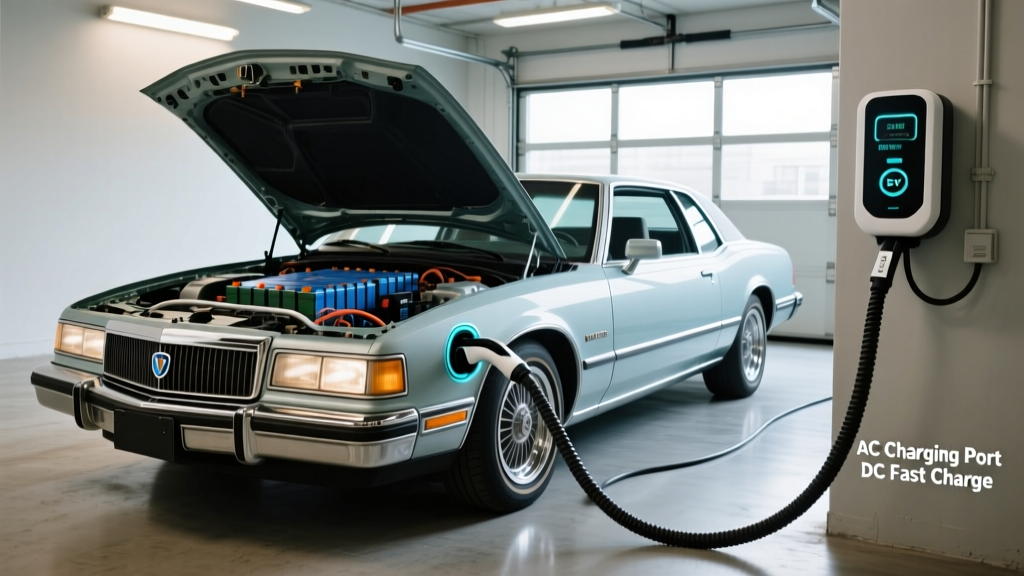
If you've spent years enjoying the supercharged 3.8L V6 in a 1996 Buick Riviera — that smooth 240-horsepower L67 engine with its effortless highway pull — and you're now considering an electric vehicle, the biggest practical question isn't the car itself. It's how you'll fuel it. Going from a gas tank you fill in three minutes to a battery you charge over hours requires a completely different home infrastructure mindset. This guide walks you through exactly what that transition looks like: the electrical work, the equipment, the costs, and the day-to-day reality of keeping an EV charged.
Whether you're stepping into a Tesla Model 3, a Hyundai Ioniq 5, a Ford Mustang Mach-E, or any other modern EV, the charging fundamentals are identical. Let's build your knowledge from the ground up — the same way you'd plan a garage electrical upgrade for a welder or a lift, except this time the load is your daily commute.
Charging Levels Explained: Speeds in kW and Miles Per Hour
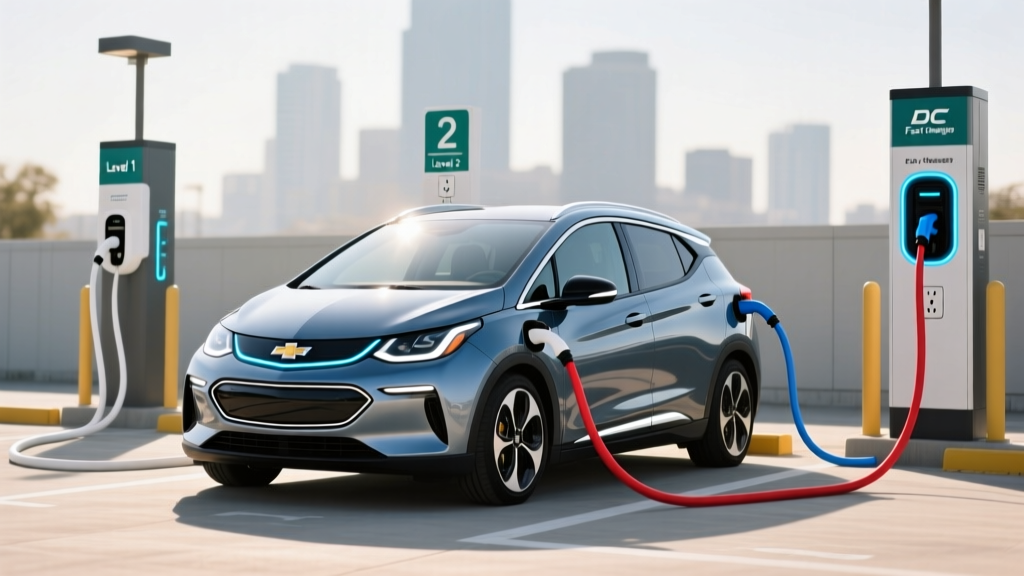
EV charging is organized into three tiers. The critical distinction to internalize: kW (kilowatts) measures power — how fast energy flows into the battery. kWh (kilowatt-hours) measures energy — how much the battery holds. Think of kW as the diameter of a hose and kWh as the size of the bucket. A bigger hose fills the bucket faster, but the bucket size doesn't change.
| Level | Voltage | Power (kW) | Miles of Range Added/Hour | Typical Use |
|---|---|---|---|---|
| Level 1 | 120V AC | 1.0–1.4 kW | 3–5 mi/hr | Overnight top-ups, PHEVs, low-mileage drivers |
| Level 2 | 240V AC | 7.2–19.2 kW | 25–75 mi/hr | Home daily charging, workplace, destinations |
| DC Fast (Level 3) | 400–800V DC | 50–350 kW | 150–1,200+ mi/hr (peak) | Road trips, quick top-ups on highways |
Real-world context: A Level 1 outlet (standard 120V household plug) adds roughly 40 miles overnight in 10 hours — adequate for a plug-in hybrid with 30 miles of electric range, but painfully slow for a full EV with a 75–100 kWh battery. Level 2 at home is the standard most EV owners rely on. DC fast charging is for road trips; it's too expensive and battery-stressing for daily use.
Charging speed isn't linear. Above roughly 80% state of charge (SoC), the battery management system tapers power to protect the cells. A charger rated at 250 kW may only sustain that peak for a few minutes before dropping to 100 kW, then 50 kW as the battery fills. This is the "charge curve," and it's why manufacturers quote 10–80% times rather than 0–100%.
Home Charger Installation: Electrical Requirements, Costs, and Panel Upgrades
This is where the 1996 Riviera owner's garage meets 2026 reality. Most homes built before the 2000s have 100-amp or 150-amp electrical panels. A Level 2 EV charger drawing 40 amps (9.6 kW at 240V) represents a significant continuous load — and the National Electrical Code (NEC) requires that continuous loads use only 80% of a circuit's rated capacity. That means a 40A charger needs a 50A dedicated circuit.
What Your Electrician Will Evaluate
- Panel capacity: A 200-amp panel with spare breaker slots and sufficient headroom can usually accommodate a 50A or 60A EV circuit. A 100-amp panel almost certainly cannot without an upgrade.
- Wire run distance: The farther the charger is from the panel, the thicker (and more expensive) the copper wire needs to be to prevent voltage drop. A 100-foot run costs significantly more than a 20-foot run.
- Permit requirements: Nearly all jurisdictions require a permit for EV charger installation. This is non-negotiable for code compliance, insurance validity, and future home resale.
- GFCI protection: NEC 2020 and later require GFCI (ground-fault circuit interrupter) protection for EV charging circuits — especially outdoors.
| Component | Simple Install (200A panel, short run) | Complex Install (panel upgrade, long run) |
|---|---|---|
| Level 2 charger unit (40–48A) | $400–$700 | $400–$700 |
| Electrical permit | $50–$150 | $50–$200 |
| Electrician labor (licensed) | $500–$1,200 | $1,500–$3,000 |
| Wire, conduit, breaker | $200–$500 | $500–$1,200 |
| Panel upgrade (100A → 200A, if needed) | N/A | $2,000–$4,500 |
| Total | $1,150–$2,550 | $4,450–$9,600 |
Panel upgrade reality check: If your home still has a 100-amp service — common in houses built before the 1980s — budget for a 200-amp upgrade. This adds $2,000–$4,500 but also modernizes your entire electrical system. Some utility companies offer rebates that offset $500–$1,000 of this cost. Check with your local provider before work begins.
Connector Compatibility: NACS, CCS1, and CHAdeMO in 2026
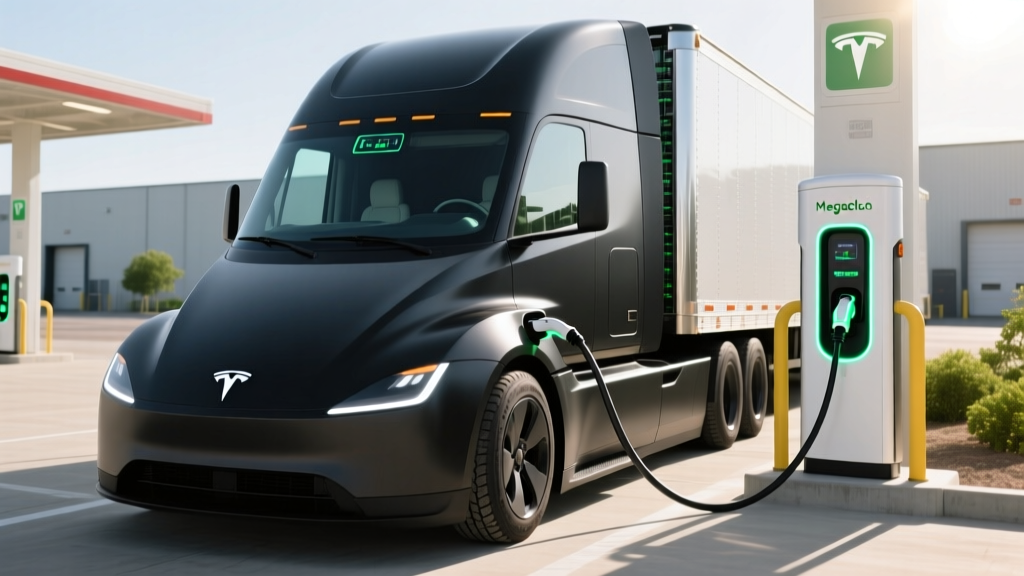
The connector landscape has consolidated significantly. As of 2026, the North American Charging Standard (NACS) — originally Tesla's proprietary plug — has become the dominant connector. Nearly every major automaker (Ford, GM, Hyundai/Kia, Rivian, Volvo, BMW, and others) has adopted NACS for new vehicles starting with 2025–2026 model years.
| Connector | AC Level 2 | DC Fast | Vehicles Using It |
|---|---|---|---|
| NACS (J3400) | Yes | Yes (up to 350 kW) | Tesla (all), Ford (2025+), GM (2025+), Hyundai/Kia (2025+), Rivian, Volvo, BMW |
| CCS1 (Combined Charging System) | Yes (via J1772) | Yes (up to 350 kW) | Older EVs (pre-2025 VW ID.4, older Bolt EV/EUV, legacy models) |
| CHAdeMO | No | Yes (up to 100 kW) | Nissan Leaf (legacy only — discontinued) |
Adapter needs: If you own an older CCS1-equipped EV, you can use a CCS-to-NACS adapter (roughly $200–$300) to access the Tesla Supercharger network, which now welcomes non-Tesla vehicles at most locations. NACS-equipped vehicles need no adapter at Superchargers or at the growing number of NACS-equipped public chargers from Electrify America, EVgo, and ChargePoint.
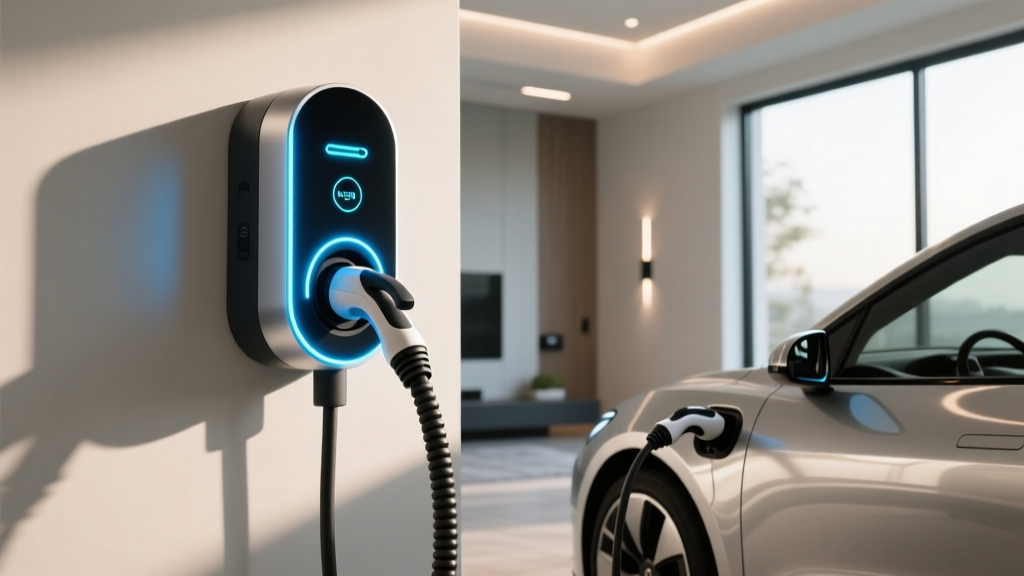
For home Level 2 charging, most chargers ship with either a NACS or J1772 connector. Adapters are readily available in both directions. Buy a charger that matches your vehicle's native connector to avoid adapter clutter in your garage.
Charging Cost Per Mile: EV vs. Gas (Bye-Bye Supercharged V6)
The 1996 Buick Riviera Supercharged achieves roughly 18 MPG city / 27 MPG highway per EPA estimates on fueleconomy.gov. At $3.50/gallon, that's approximately $0.16–$0.19 per mile in combined driving. Let's compare that to EV charging costs across different scenarios.
| Scenario | Rate | Cost Per Mile (3.5 mi/kWh EV) | Annual Cost (12,000 mi) |
|---|---|---|---|
| Home charging (off-peak utility rate) | $0.08–$0.12/kWh | $0.023–$0.034 | $276–$408 |
| Home charging (standard residential rate) | $0.14–$0.18/kWh | $0.040–$0.051 | $480–$612 |
| Public Level 2 (ChargePoint, workplace) | $0.20–$0.35/kWh | $0.057–$0.100 | $684–$1,200 |
| DC fast charging (Electrify America, EVgo) | $0.35–$0.55/kWh | $0.100–$0.157 | $1,200–$1,884 |
| 1996 Riviera Supercharged (gas, $3.50/gal) | ~22 MPG combined | $0.159 | $1,908 |
The takeaway: Home charging on an off-peak rate saves $1,500–$1,600 per year compared to the Riviera's fuel bill. Even at standard residential rates, you save $1,300+. The math flips only if you rely exclusively on DC fast charging — which is why home Level 2 installation is the single most important investment in EV ownership.
Time-of-use (TOU) utility plans are your best friend. Most utilities offer rates 40–60% lower during overnight hours (typically 10 PM – 6 AM). Program your EV or charger to charge during these windows and your cost per mile drops to pennies.
Charging Time Examples: What to Expect With Common Battery Sizes
Charging time depends on two numbers: your battery's usable capacity (kWh) and the charger's power output (kW). Here are realistic 10–80% charge times for popular 2026 EV battery sizes:
- 60 kWh battery (e.g., base Tesla Model 3 RWD): 70% of 60 = 42 kWh needed. On a 48A Level 2 (11.5 kW): ~3.7 hours. On a 170 kW DC fast charger: ~18 minutes (accounting for taper).
- 77 kWh battery (e.g., Ford Mustang Mach-E Extended Range): 70% of 77 = 54 kWh needed. On a 48A Level 2: ~4.7 hours. On a 150 kW DC fast charger: ~22 minutes.
- 84 kWh battery (e.g., Hyundai Ioniq 5 Long Range AWD): 70% of 84 = 59 kWh needed. On a 48A Level 2: ~5.1 hours. On a 350 kW DC fast charger (800V architecture): ~18 minutes.
- 100 kWh battery (e.g., GMC Sierra EV, Rivian R1T Max Pack): 70% of 100 = 70 kWh needed. On a 48A Level 2: ~6.1 hours. On a 350 kW charger: ~25 minutes.
For home Level 2 charging, the 4–6 hour window means you plug in when you get home and wake up to a full battery every morning. It's the EV equivalent of never visiting a gas station for daily driving.
Equipment Recommendations: Level 2 Chargers Worth Buying in 2026
Not all Level 2 chargers are equal. Here are proven units across three budgets, with the specs that actually matter:
Best Overall: ChargePoint Home Flex (NACS or J1772)
- Power output: Up to 12 kW (50A) on a 60A circuit, adjustable down to 16A
- Connector: Available in NACS or J1772
- Cable length: 23 feet
- Smart features: Wi-Fi, scheduling, energy tracking, Alexa integration, UL-listed
- Price: ~$550–$650
- Indoor/outdoor: Rated for both (NEMA 4 enclosure)
Best Value: Emporia Level 2 EV Charger
- Power output: Up to 11.5 kW (48A) on a 60A circuit
- Connector: J1772 (NACS adapter available)
- Cable length: 24 feet
- Smart features: Wi-Fi, app scheduling, solar integration, load management
- Price: ~$350–$400
- Indoor/outdoor: NEMA 4 rated
Premium Pick: Tesla Wall Connector (NACS)
- Power output: Up to 11.5 kW (48A) on a 60A circuit
- Connector: NACS (native Tesla, also works with all NACS-adopted vehicles)
- Cable length: 24 feet
- Smart features: Wi-Fi, power sharing (link two units on one circuit), OTA updates
- Price: ~$425–$475
- Indoor/outdoor: NEMA 3R rated (outdoor-capable)
Key buying advice: Don't buy a charger rated for more amps than your circuit supports. A 48A charger requires a 60A circuit (48 ÷ 0.8 = 60). If your electrician installs a 50A circuit, buy a charger adjustable to 40A. Oversizing the charger without matching the circuit is wasted money and a code violation.
Safety, Code Compliance, and Smart Installation Practices
EV charging is a high-draw, continuous electrical load — it runs for hours at near-maximum circuit capacity. This is not the same as plugging in a space heater for 20 minutes. The NEC treats it seriously, and so should you.
- Dedicated circuit: Your EV charger must have its own dedicated breaker. Never share the circuit with other appliances or outlets.
- Hardwired vs. plug-in: Hardwired installations (no plug, wired directly to the breaker) are preferred for circuits above 40A. They eliminate the failure point of a NEMA 14-50 receptacle, which has been linked to overheating in some installations when low-quality receptacles are used.
- GFCI breaker: Required for outdoor installations and increasingly required indoors under NEC 2023+. Budget an extra $50–$100 for a GFCI breaker if your panel requires it.
- Outdoor rating: If your charger mounts outside, confirm it carries a NEMA 4 (weatherproof) or NEMA 3R (rain-resistant) rating. Garage-mounted units can use NEMA 1 (indoor only).
- Utility notification: Some utilities require you to notify them before installing a Level 2 charger, especially if you're on a TOU rate plan or if the installation adds significant load to the local transformer.
For homes with older wiring — and if you're moving from a garage that housed a 1996 Riviera, there's a decent chance your home is 25+ years old — have your electrician perform a load calculation per NEC Article 220 before adding a 50A or 60A circuit. This calculation determines whether your panel can safely handle the additional load alongside your HVAC, water heater, dryer, and kitchen circuits.
Federal Tax Credit: Can You Offset Charger Installation Costs?
The IRS §30C Alternative Fuel Vehicle Refueling Property Credit offers a credit of up to 30% of the cost of home EV charging equipment and installation, capped at $1,000. However, eligibility depends on your census tract meeting specific low-income or non-urban criteria as defined by the Treasury Department. This credit is separate from the §30D vehicle purchase credit and has its own rules.
Consult a tax professional to confirm eligibility based on your address and income. The credit is non-refundable, meaning it can reduce your tax liability to zero but won't generate a refund beyond that.
Frequently Asked Questions
How much does it cost to install a home EV charger?
A straightforward Level 2 installation on an existing 200-amp panel with a short wire run costs $1,150–$2,550 total (charger + electrician + permit + materials). If your home needs a panel upgrade from 100A to 200A, total costs can reach $4,450–$9,600. Always get two or three quotes from licensed electricians.
How fast will each charging level add range?
Level 1 (120V) adds 3–5 miles per hour. Level 2 (240V, 48A) adds roughly 30–40 miles per hour for most EVs. DC fast charging at 150+ kW can add 150–300 miles in 20–30 minutes, though the charge curve tapers significantly above 80% SoC.
Which connector/charger is compatible with my EV?
For 2025–2026 model-year vehicles from Tesla, Ford, GM, Hyundai/Kia, Rivian, and Volvo, the NACS connector is standard. Older EVs (pre-2025) typically use CCS1 (J1772 for AC, CCS for DC). CHAdeMO is limited to the discontinued Nissan Leaf. Check your vehicle's charge port or the manufacturer's spec sheet to confirm.
How much does charging cost per mile vs. gas?
Home charging at off-peak rates ($0.08–$0.12/kWh) costs $0.023–$0.034 per mile in a typical EV. Gas at $3.50/gallon in a 22 MPG vehicle costs $0.159 per mile. That's a savings of roughly $1,500 per year at 12,000 miles driven. Even at standard residential rates, the EV saves $1,300+ annually.
What electrical upgrades might I need?
The most common upgrade is a panel increase from 100A to 200A service ($2,000–$4,500). You may also need a new dedicated circuit with appropriately gauged wire (6 AWG copper for 50A, 4 AWG for 60A), a GFCI breaker, and a permit. Homes with aluminum wiring or Federal Pacific/Zinsco panels may require more extensive remediation — flag this with your electrician early.
Can I use a regular 120V outlet to charge my EV?
Yes, but only as a supplement. Level 1 charging at 1.0–1.4 kW adds 3–5 miles per hour. That's enough for plug-in hybrids with small batteries (10–18 kWh) but impractical for full EVs with 60–100 kWh batteries. A full charge from empty on Level 1 can take 50–80 hours. Plan for Level 2 as your primary home charging solution.
Does fast charging damage my battery?
Occasional DC fast charging (road trips, a few times a month) has minimal impact on battery health. Daily DC fast charging accelerates degradation slightly — studies show roughly 2–4% additional capacity loss over 150,000 miles compared to Level 2-only charging. Modern battery thermal management systems mitigate most of the damage. For daily use, Level 2 at home is both cheaper and gentler on the battery.
Transitioning from a supercharged V6 to an electric drivetrain is a shift in how you think about energy — from quick fill-ups to strategic, mostly passive charging that happens while you sleep. The infrastructure investment is real ($1,150–$9,600 depending on your home), but the per-mile savings compound every day. Get the electrical work done right, buy a quality charger matched to your circuit, and the daily experience is simpler and cheaper than any gas station run the Riviera ever required.