Why Buc-ee's Tesla Supercharger Stops Are Rewriting the Road-Trip Playbook
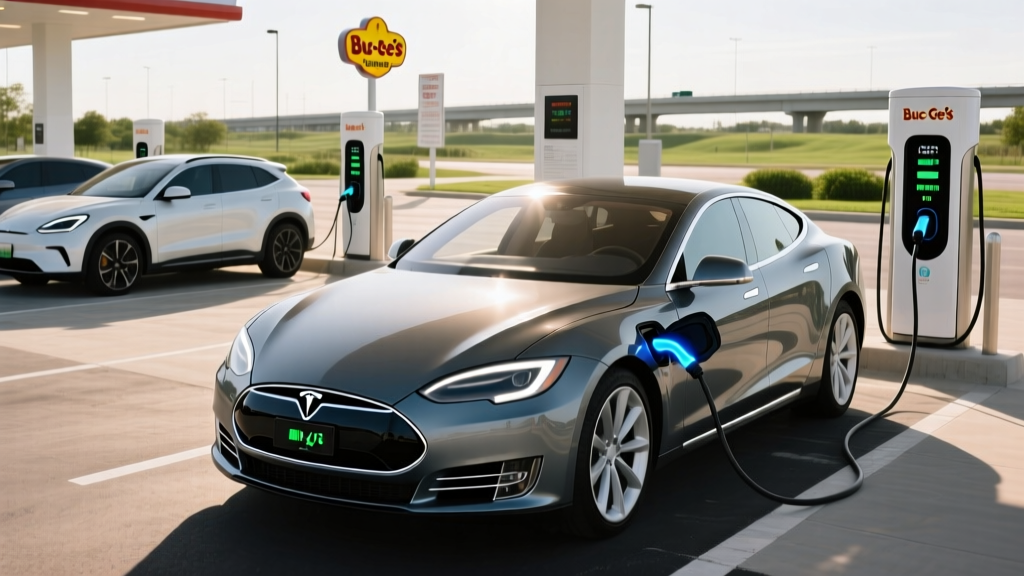
If you've driven a Tesla through Texas, you already know the Buc-ee's Tesla Supercharger pairing is one of the most practical pit-stop combinations in the EV world. Buc-ee's — the legendary Texas-based travel center chain — has partnered with Tesla to install Supercharger stalls at many of its massive locations, turning what used to be a 20-minute charging wait into a genuinely enjoyable break. Clean restrooms, brisket sandwiches, and beaver nuggets while your Model Y adds 200 miles of range? That's the formula.
But whether you're planning a cross-country trip using Buc-ee's Supercharger stops, or you're simply trying to understand how public DC fast charging compares to charging at home, you need hard numbers — not marketing. This guide covers the real-world charging speeds, costs, connector compatibility, and home-installation economics that every EV owner or buyer should know in 2026.
Charging Levels Explained: Speeds, Power, and Real-World Range Added
Every EV owner needs to understand the three charging tiers. The difference between plugging into a standard wall outlet versus a DC fast charger is the difference between adding 4 miles of range per hour versus adding 200+ miles in 20 minutes.
| Level | Voltage | Power (kW) | Miles of Range Added Per Hour | Typical Use Case |
|---|---|---|---|---|
| Level 1 | 120V AC | 1.0–1.4 kW | 3–5 miles | Overnight top-up, emergency |
| Level 2 | 240V AC | 3.3–19.2 kW | 12–75 miles | Home daily charging, workplace |
| DC Fast Charge | 400–800V DC | 50–350 kW | 150–1,000+ miles/hr equivalent | Road trips, public stations |
Real-world note on DC fast charging: Peak kW ratings are not sustained. A Tesla Model Y at a Buc-ee's V3 Supercharger (250 kW peak) will hit that peak only between roughly 10–30% state of charge. Above 50%, the charge curve tapers significantly. Expect a realistic 10–80% session to take 25–35 minutes depending on battery temperature and starting SoC. According to fueleconomy.gov, ambient temperature and battery preconditioning can swing charging times by 20–40%.
Charging Time Examples: 10–80% Sessions
| Vehicle (Battery Size) | Level 2 (11.5 kW) | DC Fast (250 kW peak) | DC Fast (150 kW peak) | DC Fast (50 kW) |
|---|---|---|---|---|
| Tesla Model Y LR (75 kWh usable) | ~5.5 hours | ~25 min | ~35 min | ~70 min |
| Ford Mustang Mach-E ER (91 kWh usable) | ~6.5 hours | ~30 min | ~42 min | ~85 min |
| Hyundai Ioniq 5 (77.4 kWh usable) | ~5.5 hours | ~18 min | ~30 min | ~72 min |
The Ioniq 5's ultra-fast 10–80% time (as low as 18 minutes at a 350 kW charger) is thanks to its 800V architecture, which sustains higher charge rates longer than 400V systems. At a Buc-ee's V3 Supercharger (250 kW, Tesla NACS connector), Teslas optimize well, but non-Tesla EVs using a NACS adapter will see speeds dictated by their own vehicle's max acceptance rate.
Connector Compatibility: NACS, CCS, CHAdeMO, and What You Need
The connector landscape in 2026 has largely consolidated around NACS (North American Charging Standard, originally Tesla's proprietary connector). Ford, GM, Rivian, Volvo, and most major automakers have adopted NACS on new vehicles starting with 2025–2026 model years. CCS1 is still present on many 2022–2024 EVs, and CHAdeMO is effectively legacy (Nissan Leaf being the primary holdout).
| Connector | Native Vehicles | Adapter Needed For | Availability |
|---|---|---|---|
| NACS (Tesla) | Tesla (all), Ford (2025+), GM (2025+), Rivian (2025+), Hyundai/Kia (select 2026) | CCS vehicles with adapter | Dominant — Tesla Superchargers, growing third-party |
| CCS1 | 2022–2024 Ford, GM, VW ID.4, Hyundai/Kia (pre-2026) | NACS vehicles at CCS stations | Electrify America, EVgo, ChargePoint DC stations |
| CHAdeMO | Nissan Leaf (legacy) | N/A — no practical adapter | Declining; few new installations |
Buc-ee's Supercharger specifics: Most Buc-ee's Supercharger installations are Tesla V3 (250 kW, NACS) or V4 (up to 350 kW, NACS with CCS compatibility via integrated cable in some deployments). Non-Tesla EVs can access select Supercharger locations through Tesla's "Open Supercharger" program using the Tesla app and a built-in CCS-to-NACS adapter, but availability varies by station. Check the Tesla app or your vehicle's navigation for whether a specific Buc-ee's location supports non-Tesla vehicles before relying on it.
How Much Does Public Charging Actually Cost? (Buc-ee's, Superchargers, and Beyond)
The cost-per-mile advantage of EVs over gas vehicles depends heavily on where you charge. Home charging on off-peak electricity is dramatically cheaper than DC fast charging on the road.
| Scenario | Cost per kWh | Cost per Gallon Equivalent | Cost per Mile (250 Wh/mi EV) | Cost per Mile (30 MPG gas @ $3.40/gal) |
|---|---|---|---|---|
| Home Level 2 (off-peak) | $0.08–$0.14 | $0.90–$1.55 | $0.02–$0.035 | $0.113 |
| Home Level 2 (standard rate) | $0.14–$0.20 | $1.55–$2.20 | $0.035–$0.05 | $0.113 |
| Tesla Supercharger (avg.) | $0.25–$0.38 | $2.75–$4.20 | $0.063–$0.095 | $0.113 |
| Electrify America / EVgo DC | $0.35–$0.55 | $3.85–$6.05 | $0.088–$0.138 | $0.113 |
The Buc-ee's Supercharger cost reality: Tesla Supercharger pricing in Texas typically runs $0.27–$0.35 per kWh in 2026, depending on location and time-of-use rates. For a Model Y Long Range charging from 10–80% (adding ~52 kWh), expect to pay roughly $14–$18 per session. That's still cheaper than filling a comparable gas SUV with 15 gallons at $3.40/gal ($51), but the savings gap narrows significantly compared to home charging.
Pro tip: Tesla's off-peak Supercharger rates at select locations can drop pricing by 20–30%. If your Buc-ee's stop is flexible, check the Tesla app for time-of-use pricing — charging at 10 PM vs. 2 PM can save $3–$5 per session.
Home EV Charger Installation: Requirements, Costs, and Gotchas
The single biggest ownership advantage of an EV is cheap overnight home charging. But setting up a proper Level 2 home charger involves electrical work that many buyers underestimate.
Electrical Requirements for Level 2 Home Charging
A Level 2 charger requires a 240V dedicated circuit — the same voltage as your electric dryer or oven. The most common home setup is a 240V/48A circuit supporting a 40A continuous charge (EVSE rated at 48A), delivering approximately 9.6 kW to 11.5 kW to the vehicle. Faster Level 2 chargers (like the 19.2 kW option) require a 100A circuit, which most residential panels cannot support without an upgrade.
| Component | Simple Install (near panel) | Standard Install (50–80 ft run) | Complex Install (panel upgrade + long run) |
|---|---|---|---|
| EVSE Equipment (Level 2 charger) | $350–$700 | $350–$700 | $350–$700 |
| Electrical Permit | $50–$150 | $50–$150 | $50–$200 |
| Electrician Labor | $300–$600 | $600–$1,500 | $1,500–$3,500 |
| Panel Upgrade (if needed) | $0 | $0 | $1,500–$3,500 |
| Conduit, Wiring, Misc. | $100–$250 | $200–$600 | $400–$1,200 |
| Total Estimated Cost | $800–$1,700 | $1,200–$3,100 | $3,800–$9,100 |
The panel-upgrade gotcha: Homes built before 2000 often have 100A or 150A main service panels. Adding a 48A EV circuit to an already-loaded 100A panel can exceed safe capacity, requiring a panel upgrade to 200A. This is the single largest variable in installation cost and can push your total from $1,500 to $5,000+. Always get a load calculation from a licensed electrician before purchasing equipment.
According to the IRS §30C credit, homeowners may be eligible for a 30% tax credit on EV charger equipment and installation costs, capped at $1,000, for equipment placed in service through 2032 — subject to census-tract eligibility requirements. Consult a tax professional to confirm qualification.
Recommended Home EV Chargers: Power, Features, and Pricing
Not all Level 2 chargers are equal. Here are proven picks for 2026, selected for reliability, power output, connector options, and smart features:
Best Overall: ChargePoint Home Flex
- Power: Up to 12 kW (50A, adjustable down to 16A)
- Connector: NACS or J1772 (configurable)
- Cable Length: 23 feet
- Smart Features: Wi-Fi, app scheduling, Alexa, energy tracking
- Price: $599–$649
- Best For: Most homeowners wanting flexible amperage
Best for Tesla Owners: Tesla Wall Connector
- Power: Up to 11.5 kW (48A)
- Connector: NACS native (J1772 adapter included)
- Cable Length: 24 feet
- Smart Features: Wi-Fi, OTA updates, power sharing (2 units on 1 circuit), Tesla app integration
- Price: $475
- Best For: Tesla-only households wanting seamless integration
Best Budget: Emporia Level 2 EV Charger
- Power: Up to 11.5 kW (48A)
- Connector: J1772 (NACS adapter available)
- Cable Length: 24 feet
- Smart Features: Wi-Fi, app scheduling, solar integration
- Price: $349–$399
- Best For: Budget-conscious buyers who want smart features
Best Premium: Grizzl-E Smart
- Power: Up to 10 kW (40A)
- Connector: J1772 or NACS
- Cable Length: 24 feet
- Smart Features: OCPP-compatible, works with multiple apps, extreme-cold rated (-40°F)
- Price: $499–$599
- Best For: Cold-climate garages and outdoor installs
Safety, Code, and Installation Best Practices
EV charging places a continuous high-current load on your home's electrical system for hours at a time. Cutting corners here is a fire risk. Here's what the National Electrical Code (NEC) and best practices require:
- Dedicated circuit: Your EVSE must be on its own dedicated breaker — never shared with other appliances. A 48A charger requires a 60A breaker (NEC 80% continuous-load rule).
- GFCI protection: The 2020 NEC and later require GFCI protection for outdoor receptacles used for EV charging. Hardwired EVSE installations (recommended) typically include ground-fault protection within the unit itself.
- Outdoor rating: If your charger is mounted outside, it must carry a NEMA 4 or NEMA 4X rating for weather resistance. All chargers listed above meet this standard.
- Wire gauge: A 60A circuit typically requires 4 AWG copper wire (or 2 AWG aluminum). Your electrician will size this based on run length and local code.
- Hardwired vs. plug: Hardwired installations are preferred for 48A+ chargers — they eliminate the failure point of a NEMA 14-50 receptacle, which can overheat under continuous heavy load if not installed with a commercial-grade receptacle.
- Permit and inspection: Most jurisdictions require a permit and post-installation inspection for EV charger circuits. Skipping this can void your homeowner's insurance coverage for electrical fires.
Frequently Asked Questions
How much does it cost to install a home EV charger?
A straightforward Level 2 home charger installation with the electrical panel nearby typically costs $800–$1,700 (equipment, labor, and permit combined). A standard installation with a 50–80 foot wire run ranges from $1,200–$3,100. If your home needs a 200A panel upgrade, total costs can reach $3,800–$9,100. Always get a load calculation from a licensed electrician first.
How fast will each charging level add range?
Level 1 (120V) adds roughly 3–5 miles per hour. Level 2 (240V) adds 12–75 miles per hour depending on amperage and vehicle acceptance rate. DC fast charging at a Buc-ee's Tesla Supercharger (250 kW V3) can add up to 175 miles in 15 minutes under ideal conditions, though real-world 10–80% sessions take 25–35 minutes due to charge-curve tapering above 50% SoC.
Which connector and charger is compatible with my EV?
If you drive a 2025+ Tesla, Ford, GM, or Rivian, your vehicle uses the NACS connector natively and can charge at any Buc-ee's Tesla Supercharger without an adapter. If you drive a 2022–2024 EV with a CCS port (older Mach-E, VW ID.4, Ioniq 5), you'll need the manufacturer-provided NACS-to-CCS adapter to use Tesla Superchargers, and only at locations opened to non-Tesla vehicles. CHAdeMO vehicles (Nissan Leaf) cannot use Superchargers.
How much does EV charging cost per mile compared to gas?
Home charging on off-peak electricity costs $0.02–$0.035 per mile — roughly 70–80% cheaper than a 30 MPG gas vehicle at $3.40/gallon ($0.113/mile). Tesla Supercharger rates average $0.063–$0.095 per mile, still cheaper than gas. Third-party DC fast chargers at $0.35–$0.55/kWh can approach or exceed gas costs at $0.088–$0.138 per mile. The real savings come from home charging.
What electrical upgrades might I need for a home charger?
If your home has a 100A main panel, you'll likely need a panel upgrade to 200A to safely support a 48A Level 2 charger alongside existing loads — this adds $1,500–$3,500. Homes with 200A panels usually have sufficient capacity. Alternatives include installing a lower-amperage charger (32A / 7.7 kW) or using a smart load-management device like the Emporia VUE with automatic EV circuit throttling to avoid exceeding panel capacity.
Can non-Tesla vehicles charge at Buc-ee's Tesla Supercharger locations?
Select Tesla Supercharger locations — including some at Buc-ee's — have been opened to non-Tesla EVs through Tesla's Open Supercharger program. You'll need the Tesla app to initiate a session, and your vehicle must have a NACS port or a CCS-to-NACS adapter. Check the Tesla app for specific Buc-ee's location compatibility before planning a trip around it. Pricing for non-Tesla vehicles is typically $0.04–$0.10/kWh higher than Tesla-member rates unless you subscribe to Tesla's monthly charging membership.
Is it worth charging at home vs. using public DC fast chargers?
Absolutely — for daily driving. Home Level 2 charging at $0.12/kWh costs roughly $0.03/mile, while exclusive reliance on public DC fast charging at $0.35/kWh costs $0.088/mile — nearly 3× more. Over 12,000 miles per year, that's a difference of roughly $696 vs. $1,056 in annual fuel costs. Reserve DC fast charging for road trips and use home charging for daily needs to maximize your EV's cost advantage.