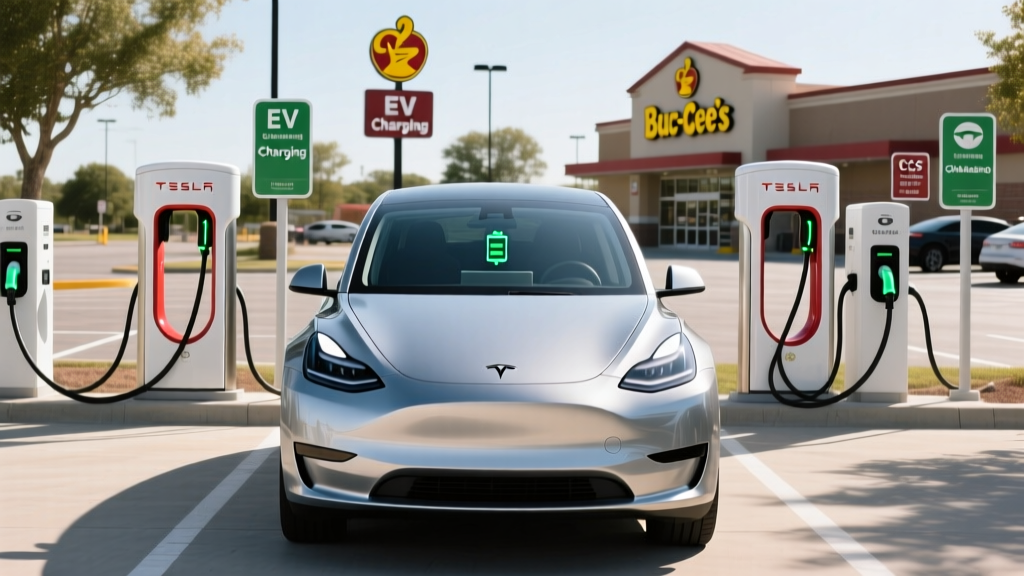
If you have driven through Texas, you already know Buc-ee's. The legendary travel centers — famous for spotless restrooms, brisket sandwiches, and beaver-themed merchandise — have become an unlikely ally in the electric vehicle revolution. Since 2023, Buc-ee's has rolled out Tesla Supercharger stalls at dozens of locations across the Lone Star State, transforming what was once a gas-car pilgrimage site into a bona fide EV road-trip hub. But the Buc-ee's Supercharger network is only one piece of a broader charging ecosystem that every EV owner needs to understand.
This guide breaks down everything from the charging levels and connectors you will encounter at Buc-ee's and beyond, to the real costs of installing a Level 2 charger at home, to how your per-mile electricity spend stacks up against gasoline. We will give you exact numbers — kilowatts, kilowatt-hours, dollars, and minutes — because vague promises do not help you plan a 400-mile drive or budget for a 240-volt outlet.
Charging Levels Explained: Level 1, Level 2, and DC Fast Charging
Before we talk about Buc-ee's Supercharger stalls specifically, you need a firm grasp on the three charging tiers. The single most important distinction in EV literacy is between kW (kilowatts), which measures power — how fast energy flows into your battery — and kWh (kilowatt-hours), which measures energy capacity — how much your battery holds. Think of kW as the width of a hose and kWh as the size of the bucket.
| Level | Voltage | Power (kW) | Miles of Range Added per Hour | Typical Use Case |
|---|---|---|---|---|
| Level 1 | 120V AC | 1.0–1.4 kW | 3–5 miles | Overnight trickle, emergency top-up |
| Level 2 | 240V AC | 3.3–19.2 kW | 12–75 miles | Home daily charging, workplace, retail |
| DC Fast (Level 3) | 400–900V DC | 50–350+ kW | 150–1,200+ miles (equivalent rate) | Road trips, highway corridors, Buc-ee's Supercharger |
Level 1 uses a standard household 120V outlet. It is slow — roughly 4 miles of range per hour — but it comes free with most EVs via the included mobile connector. For a 75 kWh battery (like the Tesla Model Y Long Range), a full Level 1 charge from empty takes over 60 hours. It works for plug-in hybrids with small batteries or as an emergency backup, but it is not a daily solution for most BEV owners.
Level 2 is the backbone of practical EV ownership. A 240V circuit — the same voltage your electric dryer uses — delivers between 7.7 kW and 11.5 kW in most residential setups, adding 25 to 45 miles of range per hour. An overnight session of 8–10 hours easily replenishes 200+ miles, which covers virtually any daily commute. This is the level you want installed at home.
DC Fast Charging bypasses the vehicle's onboard charger and feeds direct current straight into the battery pack. This is what you will find at a Buc-ee's Supercharger location, where Tesla V3 and V4 stalls deliver up to 250 kW (V3) or potentially higher at newer V4 installations. A Tesla Model 3 Long Range (75 kWh battery) can add roughly 170 miles of range in 15 minutes at a 250 kW Supercharger — but only during the peak portion of the charge curve. Above 80% state of charge, speeds taper significantly to protect battery health.
Buc-ee's Supercharger: What to Expect at the Stall
As of early 2026, Buc-ee's operates Tesla Supercharger stalls at over 30 Texas travel centers, with additional locations expanding into Alabama, Georgia, Florida, and Colorado. Most installations feature 8 to 16 V3 Supercharger stalls rated at 250 kW peak, though newer sites are beginning to include V4 hardware with CCS compatibility built in via Tesla's Magic Dock adapter.
Real-World Charging at Buc-ee's Supercharger Stalls: A Tesla Model Y Long Range (75 kWh usable, EPA 310 miles) arriving at 10% SoC will typically charge from 10–80% in approximately 22–26 minutes at a 250 kW V3 stall. However, expect the first 10–60% to happen rapidly (peak 250 kW tapering to ~150 kW by 50% SoC), while the 60–80% segment slows to 70–90 kW. Cold batteries, hot Texas summer ambient temperatures above 100°F, and battery preconditioning status all affect actual throughput. Always precondition your battery by navigating to the Supercharger in the Tesla app or navigation system — this warms the pack for optimal charge acceptance.
Connector access at Buc-ee's: Most Buc-ee's Supercharger stalls still use the native Tesla (NACS) connector. If you drive a non-Tesla EV with a CCS1 port, you will need either a Tesla Supercharger with Magic Dock (integrated CCS adapter) or a third-party NACS-to-CCS adapter approved by your vehicle manufacturer. As of 2026, Ford, Rivian, GM, and Volvo/Polestar have adopted NACS natively on new models, reducing adapter dependency. Hyundai, Kia, and BMW still use CCS1 on most vehicles on the road and may require an adapter.
Pricing at Buc-ee's Supercharger stalls follows Tesla's standard Supercharger rates, which in Texas typically range from $0.28 to $0.36 per kWh depending on the time of day and local utility rates. Some locations offer off-peak discounts. For a Model Y adding 50 kWh (roughly 200 miles), expect to pay $14–$18 per session — significantly less than the $35–$45 that same distance would cost in a 25 MPG gas vehicle at $3.20/gallon.
Home Level 2 Installation: Requirements, Costs, and Gotchas
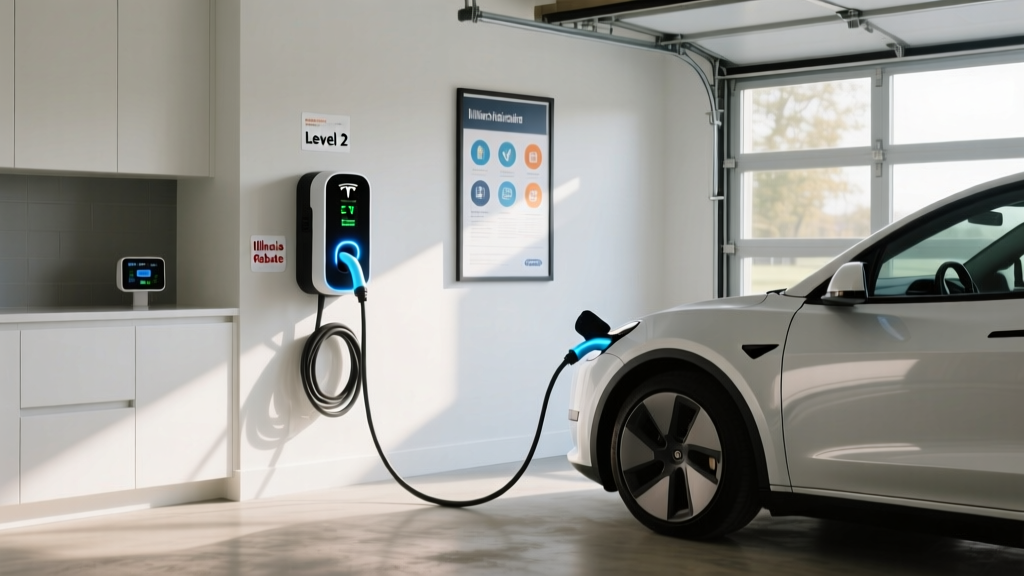
Public DC fast charging at places like Buc-ee's is essential for road trips, but 80–90% of all EV charging happens at home. A properly installed Level 2 charger is the single biggest quality-of-life upgrade an EV owner can make. Here is what it actually takes.
Electrical Requirements
A typical home Level 2 charger requires a dedicated 240V circuit on a breaker rated for the charger's amperage. The most common residential setups are:
- 40A circuit / 32A continuous — delivers 7.7 kW, sufficient for most EVs to fully recharge overnight. Uses a NEMA 14-50 outlet or hardwired connection.
- 50A circuit / 40A continuous — delivers 9.6 kW, faster replenishment for larger batteries (Ford F-150 Lightning 131 kWh pack, Rivian R1T, Hummer EV).
- 60A circuit / 48A continuous — delivers 11.5 kW, the practical maximum for most residential single-phase panels. Requires thicker 6 AWG or 4 AWG copper wire depending on run length.
Panel upgrade reality: Most modern homes with 200A electrical service can accommodate a 40–60A EV circuit without a panel upgrade. However, older homes with 100A service, or homes already running multiple high-draw appliances (electric range, dryer, HVAC, tankless water heater), may need a panel upgrade to 200A. A panel upgrade typically costs $1,500–$3,000 and should be evaluated by a licensed electrician during the initial site visit.
Installation Cost Breakdown
| Component | Low Estimate | High Estimate | Notes |
|---|---|---|---|
| Level 2 Charger (Equipment) | $200 | $700 | Depends on brand, power output, smart features |
| Electrician Labor | $400 | $1,500 | Varies by wire run length, conduit, wall material |
| Permit & Inspection | $50 | $250 | Required in most jurisdictions; varies by municipality |
| Panel Upgrade (if needed) | $1,500 | $3,000 | Only if existing service is insufficient |
| Electrical Materials (wire, conduit, breaker) | $100 | $400 | Longer runs from panel to garage increase cost |
| Total (no panel upgrade) | $750 | $2,850 | Most common scenario for 200A-service homes |
| Total (with panel upgrade) | $2,250 | $5,850 | Older homes or high-load panels |
The national average for a straightforward Level 2 installation (existing 200A panel, garage adjacent to electrical panel, 40A NEMA 14-50 outlet) falls between $1,000 and $1,800 all-in. Always get at least three quotes and verify that your electrician is licensed, insured, and experienced with EV charger installations — not all electricians are familiar with the continuous-load derating requirements (NEC Article 625) specific to EVSE.
Safety and Code Considerations
- Dedicated circuit: NEC requires the EV charger to be on its own dedicated breaker — no sharing with other appliances.
- GFCI protection: The 2020 NEC update (adopted by most states by 2026) requires GFCI protection for outdoor receptacles and some jurisdictions extend this to garage outlets used for EV charging. Hardwired chargers often avoid this requirement.
- Outdoor rating: If your charger will be mounted outside, ensure it carries a NEMA 4 or NEMA 4X rating for weather resistance. Most quality chargers (ChargePoint Home Flex, Tesla Wall Connector, Emporia Vue) are rated for outdoor use.
- Continuous-load rule: NEC defines EV charging as a continuous load, meaning the circuit must be rated at 125% of the charger's maximum draw. A 40A charger requires a 50A breaker. Do not let an electrician cut corners here.
Connector Compatibility: NACS, CCS1, and CHAdeMO in 2026
The connector landscape has consolidated significantly since Tesla opened its Supercharger network and licensed the North American Charging Standard (NACS). Here is where things stand for model-year 2025–2026 vehicles:
| Connector | Brands Using Natively | Adapter Needed for Tesla Superchargers? | Adapter Needed for CCS Networks? |
|---|---|---|---|
| NACS (Tesla) | Tesla, Ford (2025+), GM (2025+), Rivian (2025+), Volvo, Polestar, Fisker | No — native plug | Yes — NACS-to-CCS adapter for Electrify America, EVgo, etc. |
| CCS1 | Hyundai, Kia, BMW, VW, Mercedes, Porsche, Audi, Stellantis | Yes — CCS-to-NACS adapter or Magic Dock at equipped stalls | No — native plug |
| CHAdeMO | Nissan Leaf (legacy), Mitsubishi Outlander PHEV (legacy) | Not compatible without specialized adapter (rare) | Limited — CHAdeMO stalls declining |
What this means at a Buc-ee's Supercharger: If you drive a 2025+ Ford Mustang Mach-E, F-150 Lightning, or GM Equinox EV with native NACS, you can plug directly into any Supercharger stall at Buc-ee's without an adapter. If you drive a Hyundai Ioniq 5 or Kia EV6 with CCS1, you will need to find a Supercharger stall equipped with Tesla's Magic Dock (a built-in CCS adapter) — not all stalls have this yet, so check the Tesla app for compatibility icons before routing there.
According to the Alternative Fuels Data Center, CCS1-equipped public fast-charging stations still outnumber NACS-only stations outside the Tesla network, though the gap is narrowing rapidly as automakers transition.
Charging Cost Per Mile: EV vs. Gasoline
The economics of EV ownership hinge on the cost-per-mile calculation. Here is a detailed comparison using 2026 national averages:
| Scenario | Cost per kWh | Vehicle Efficiency | Cost per Mile | Cost for 300-Mile Trip |
|---|---|---|---|---|
| Home Level 2 (national avg residential rate) | $0.16/kWh | 3.5 mi/kWh (286 Wh/mi) | $0.046 | $13.71 |
| Home Level 2 (off-peak time-of-use) | $0.09/kWh | 3.5 mi/kWh | $0.026 | $7.71 |
| Buc-ee's Supercharger (Texas avg) | $0.32/kWh | 3.5 mi/kWh | $0.091 | $27.43 |
| Electrify America DC Fast | $0.48/kWh | 3.5 mi/kWh | $0.137 | $41.14 |
| Gasoline car (25 MPG combined) | $3.15/gallon | 25 mi/gallon | $0.126 | $37.80 |
| Gasoline car (35 MPG highway) | $3.15/gallon | 35 mi/gallon | $0.090 | $27.00 |
The takeaway: Home charging on an off-peak rate is the cheapest way to fuel any vehicle on the road — roughly one-third the per-mile cost of a 35 MPG gas car. Even at DC fast-charger rates like those at a Buc-ee's Supercharger, EV charging is competitive with or cheaper than gasoline. The only scenario where EV charging costs more than gas is using premium-priced networks like Electrify America without a membership plan.
For the most accurate vehicle-specific efficiency data, check the EPA's fueleconomy.gov database, which lists kWh/100mi and MPGe ratings for every EPA-certified EV sold in the United States.
Charging Time Examples: What to Expect with Common Battery Sizes
Charging speed is not linear. The battery management system (BMS) carefully controls the charge rate to protect cell health, which means peak kW only applies during a narrow window — typically between 10% and 40% SoC. Here are real-world charging time estimates for popular EV battery configurations:
| Vehicle (Battery Size) | Level 2 at 11.5 kW (Home) | 150 kW DC Fast | 250 kW DC Fast (e.g., Supercharger V3) | 350 kW DC Fast |
|---|---|---|---|---|
| Tesla Model 3 RWD (57.5 kWh, LFP) | ~3.5 hours | ~28 min | ~22 min | N/A (vehicle max ~170 kW) |
| Tesla Model Y LR (75 kWh, NMC) | ~5 hours | ~30 min | ~24 min | N/A (vehicle max ~250 kW) |
| Hyundai Ioniq 5 (77.4 kWh, NMC, 800V) | ~5.5 hours | ~25 min | N/A (CCS1 at most Superchargers) | ~18 min ( Electrify America 350 kW) |
| Ford F-150 Lightning ER (131 kWh, NMC) | ~9 hours | ~50 min | ~40 min | N/A (vehicle max ~210 kW) |
| Chevy Equinox EV (85 kWh, NMC) | ~6 hours | ~35 min | ~28 min (NACS native, 2025+) | N/A (vehicle max ~190 kW) |
Charge-curve reality check: Those 10–80% times assume the battery is preconditioned (warmed to optimal temperature) and ambient conditions are moderate (60–85°F). In winter conditions below 30°F, expect 10–80% times to increase by 20–40% unless your vehicle has an active battery preconditioning system that engages when you navigate to a charger. LFP batteries (like the Model 3 RWD) also tend to charge slower in cold weather than NMC packs.
Equipment Recommendations: Level 2 Chargers Worth Buying
Not all Level 2 chargers are created equal. Here are four units we recommend based on build quality, smart features, reliability, and value:
Tesla Wall Connector (Gen 4)
- Power output: Up to 11.5 kW (48A) on a 60A circuit
- Connector: NACS native; includes J1772 adapter in box
- Cable length: 24 feet
- Smart features: Wi-Fi connectivity, OTA firmware updates, power sharing between two units on one circuit, Tesla app integration
- Price: ~$475
- Best for: Tesla owners and NACS-native vehicles (Ford, GM, Rivian 2025+)
ChargePoint Home Flex
- Power output: Up to 12 kW (50A) on a 60A circuit; configurable down to 16A
- Connector: J1772 (works with all EVs; Tesla owners use included adapter)
- Cable length: 23 feet
- Smart features: Wi-Fi, ChargePoint app with scheduling, energy tracking, Alexa integration
- Price: ~$550–$650
- Best for: Multi-EV households, CCS/J1772 vehicles, those wanting detailed energy data
Emporia Level 2 EV Charger
- Power output: Up to 11.5 kW (48A) on a 60A circuit
- Connector: J1772 (NACS version available)
- Cable length: 24 feet
- Smart features: Wi-Fi, Emporia app with real-time energy monitoring, solar-integration scheduling, load management when paired with Emporia Vue home energy monitor
- Price: ~$400
- Best for: Budget-conscious buyers, solar-panel owners, energy-monitoring enthusiasts
Grizzl-E Smart
- Power output: Up to 10 kW (40A) on a 50A circuit
- Connector: J1772 (NACS adapter available)
- Cable length: 24 feet
- Smart features: Wi-Fi, OCPP protocol support, adjustable amperage via app
- Price: ~$450
- Best for: Cold-climate owners (rated to -40°F), outdoor installations, ruggedness priority
Frequently Asked Questions
How much does it cost to install a home EV charger?
A typical Level 2 home installation (40–60A, 240V) costs between $1,000 and $2,800 all-in when your electrical panel has sufficient capacity. This includes the charger ($200–$700), electrician labor ($400–$1,500), permits ($50–$250), and materials ($100–$400). If your home needs a panel upgrade from 100A to 200A service, add $1,500–$3,000. Always get a site assessment from a licensed electrician before purchasing equipment.
How fast will each charging level add range?
Level 1 (120V) adds 3–5 miles per hour. Level 2 (240V, 40A) adds 25–35 miles per hour depending on vehicle efficiency. DC fast charging at 150 kW can add 150–200 miles in 15–20 minutes, while 250 kW chargers like those at Buc-ee's Supercharger locations can add 170+ miles in 15 minutes during the peak charge window (10–50% SoC). Actual speeds vary based on battery temperature, state of charge, and vehicle charge acceptance rate.
Which connector/charger is compatible with my EV?
Check your vehicle's charge port. If you drive a 2025+ Tesla, Ford, GM, Rivian, Volvo, or Polestar, you have NACS and can plug directly into Tesla Superchargers (including those at Buc-ee's). If you drive a Hyundai, Kia, BMW, VW, or Mercedes EV, you have CCS1 and will need a CCS-to-NACS adapter or a Magic Dock-equipped Supercharger stall for Tesla network access. For home Level 2 charging, any J1772 charger works with all non-Tesla EVs, and Tesla owners can use the included J1772 adapter or install a Tesla Wall Connector with native NACS.
How much does charging cost per mile vs gas?
Home charging at the national average residential rate of $0.16/kWh costs approximately $0.046 per mile for an EV averaging 3.5 mi/kWh — roughly $13.71 for 300 miles. Off-peak rates can drop this to under $0.03/mile. By comparison, a 25 MPG gas car at $3.15/gallon costs $0.126/mile ($37.80 for 300 miles). Even DC fast charging at Buc-ee's Supercharger rates (~$0.32/kWh) costs about $0.091/mile, still cheaper than most gas vehicles.
What electrical upgrades might I need?
The most common upgrade is adding a dedicated 240V circuit with a 50A or 60A breaker. If your panel is full (no open breaker slots), you may need a tandem breaker rearrangement or a sub-panel installation ($300–$800). Homes with 100A service — common in pre-1990 construction — often need a full panel upgrade to 200A ($1,500–$3,000) to safely handle EV charging alongside existing loads. Your electrician will perform a load calculation per NEC Article 220 to determine if your service can handle the additional draw.
Can I charge a non-Tesla at a Buc-ee's Supercharger?
Yes, but with conditions. Tesla has opened select Supercharger stalls to non-Tesla EVs through the Magic Dock program, which provides a built-in CCS adapter. However, not every stall at every Buc-ee's location has Magic Dock. Check the Tesla app before your trip — it will show which stalls at a given location support non-Tesla vehicles. Alternatively, if your vehicle is a 2025+ Ford, GM, or Rivian with native NACS, you can use any Supercharger stall without an adapter.
Planning Your Next EV Road Trip Through Buc-ee's
The convergence of Buc-ee's travel-center infrastructure with Tesla's Supercharger network represents one of the most practical road-trip charging setups available in 2026. Clean restrooms, good food, and 250 kW charging stalls mean you can add 170+ miles of range in the 20–25 minutes it takes to grab a brisket sandwich and stretch your legs.
For daily driving, invest in a quality Level 2 home charger — the $1,000–$2,000 installation pays for itself within 12–18 months of fuel savings versus gasoline, and the convenience of a full battery every morning is something no gas station can match. Use the IRS clean vehicle credits page to check whether your charger installation qualifies for the Energy Efficient Home Improvement Credit (up to $1,000 for EVSE equipment and installation under IRC §25C).
Whether you are plugging in at a Buc-ee's Supercharger on I-10 or charging at home on a Tuesday night, understanding the numbers — kW, kWh, dollars per mile, and minutes to 80% — is what separates confident EV ownership from range-anxiety guesswork.