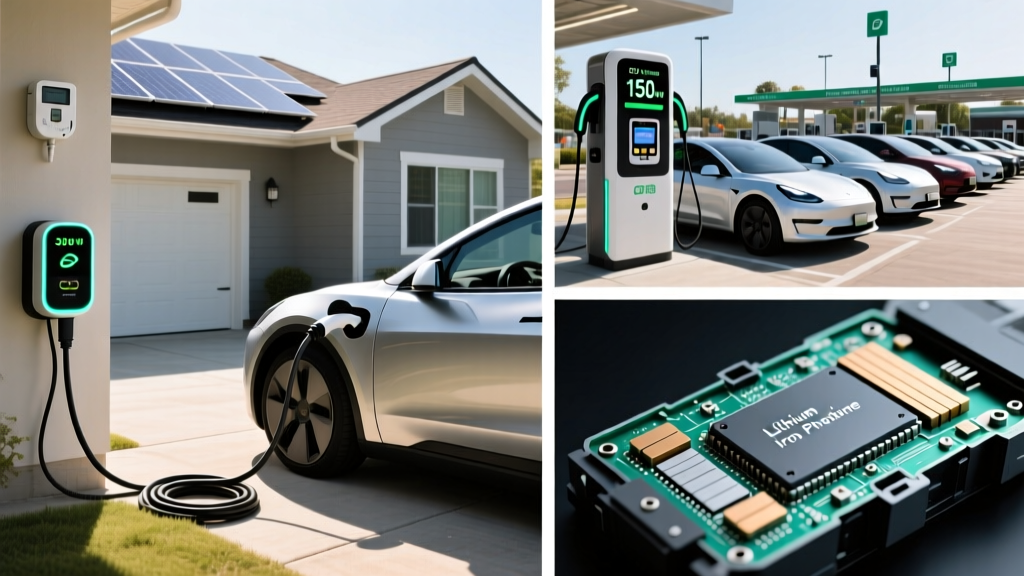
If you drive a BMW i4, iX, i5, or i7, you've likely noticed a frustrating gap in your charging options: Tesla's Supercharger network — the most reliable and expansive DC fast-charging network in North America — was built for Tesla's proprietary connector. For years, BMW EVs shipped exclusively with CCS1 ports, locking owners out of roughly 16,000+ Supercharger stalls nationwide. That changed as BMW joined the broader industry shift to the North American Charging Standard (NACS), and the BMW Tesla Supercharger adapter became a critical bridge for existing CCS-equipped vehicles.
This guide covers exactly how the adapter works, which BMW models need one, what your charging speeds look like across all three charging levels, and what it costs to set up reliable home and public charging as a BMW EV owner in 2026.
Why BMW Owners Need a Tesla Supercharger Adapter
BMW EVs sold through the 2024 model year — including the i4, iX, i5, and i7 — were equipped with the CCS1 (Combined Charging System) connector as standard. Starting with the 2025 model year, BMW began transitioning new vehicles to the NACS connector, aligning with Tesla's open standard that nearly every major automaker has now adopted.
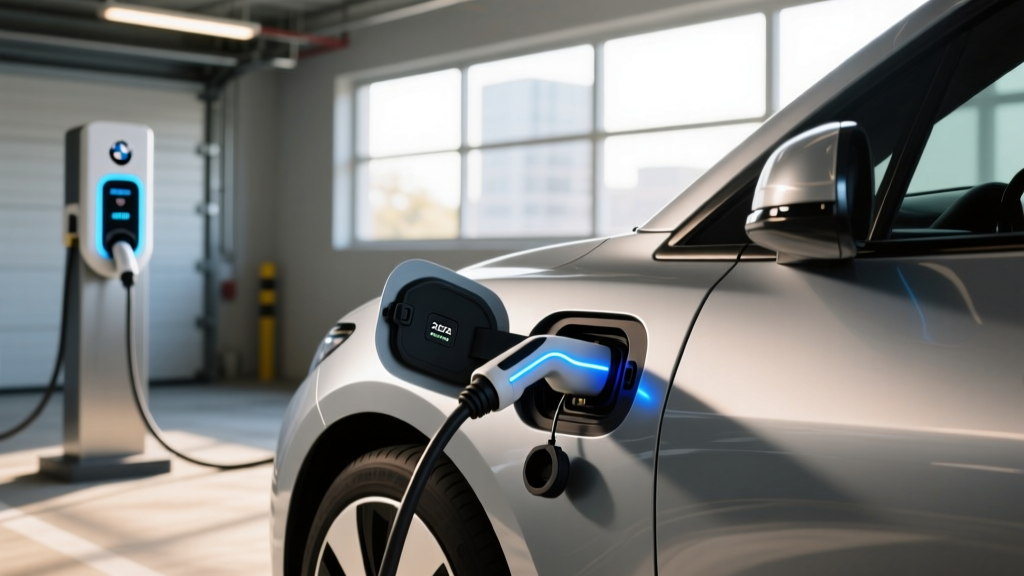
For the hundreds of thousands of CCS-equipped BMW EVs already on the road, the BMW Tesla Supercharger adapter is the hardware solution. It's a compact dongle that converts the CCS1 inlet on your vehicle to accept a NACS (Tesla-style) plug, allowing you to use Tesla Supercharger V3 and V4 stalls. BMW has offered this adapter through its dealer network and parts channels, and Tesla also sells a CCS-to-NACS adapter through its shop.
The adapter is not a universal workaround — it's specifically designed for DC fast charging at Supercharger stations that have been opened to non-Tesla vehicles through Tesla's "Open Supercharger" program or Magic Dock-equipped stalls. Here's what you need to know about compatibility:
| BMW Model / Model Year | Factory Connector | Tesla Supercharger Access | Adapter Needed? |
|---|---|---|---|
| i4 (2022–2024) | CCS1 | Via adapter + Open Supercharger | Yes — CCS-to-NACS |
| i4 (2025+) | NACS | Direct — no adapter | No (CCS adapter needed for non-Tesla DCFC) |
| iX (2022–2024) | CCS1 | Via adapter + Open Supercharger | Yes — CCS-to-NACS |
| iX (2025+) | NACS | Direct — no adapter | No |
| i5 (2024) | CCS1 | Via adapter + Open Supercharger | Yes — CCS-to-NACS |
| i5 (2025+) | NACS | Direct — no adapter | No |
| i7 (2023–2024) | CCS1 | Via adapter + Open Supercharger | Yes — CCS-to-NACS |
| i7 (2025+) | NACS | Direct — no adapter | No |
Key caveat: Not every Supercharger stall is open to non-Tesla vehicles. Tesla uses either the Magic Dock (a built-in CCS adapter at the stall) or software-gated access through the Tesla app for non-Tesla vehicles. Always check the Tesla app or your in-car navigation to confirm a station supports non-Tesla charging before driving there.
Charging Levels Explained: How Fast Will Each Level Add Range?
Understanding charging speed requires distinguishing between kW (kilowatts — the rate of power delivery) and kWh (kilowatt-hours — the total energy stored in your battery). Think of kW as the flow rate of a hose and kWh as the size of the tank you're filling. A BMW i4 eDrive40 has an 81.5 kWh usable battery; an iX xDrive50 has 105.2 kWh usable.
| Charging Level | Voltage / Amperage | Power (kW) | Miles of Range Added Per Hour | Typical Use Case |
|---|---|---|---|---|
| Level 1 (120V) | 120V / 12A | ~1.4 kW | 3–5 mi/hr | Emergency / trickle; PHEVs overnight |
| Level 2 (240V) | 240V / 32A–48A | 7.7–11.5 kW | 25–44 mi/hr | Home daily charging; workplace; public L2 |
| DC Fast Charge (CCS/NACS) | 400V–800V DC | 50–250+ kW (peak) | 150–600+ mi/hr (at peak) | Road trips; rapid top-ups |
For context, a BMW i4 eDrive40 (EPA range 301 miles, ~81.5 kWh battery) charging on a 48-amp Level 2 circuit at 11.5 kW will go from 10% to 80% state of charge in approximately 5.5 hours. That same car on a 200 kW DC fast charger (with the BMW Tesla Supercharger adapter at an open V3 Supercharger) can achieve 10–80% in roughly 31 minutes, though the charge curve tapers significantly above 80%.
On the larger iX xDrive50 (EPA range 324 miles, ~105.2 kWh battery), Level 2 charging from 10–80% takes about 7 hours at 11.5 kW. DC fast charging at a 150 kW Supercharger stall (a common V3 speed) achieves 10–80% in approximately 34 minutes.
Real-world charging reality check: Peak kW ratings are not sustained rates. A BMW i4 might peak at 200+ kW at low state of charge but taper to ~100 kW by 60% and ~50 kW by 80%. The 10–80% time is the practical metric that matters — always plan road-trip stops around this figure, not the peak number. Cold weather (below 40°F) can add 15–25% to charging times unless you precondition the battery via the vehicle's navigation-routed preconditioning feature.
Home Charging Installation: What It Costs and What You Need
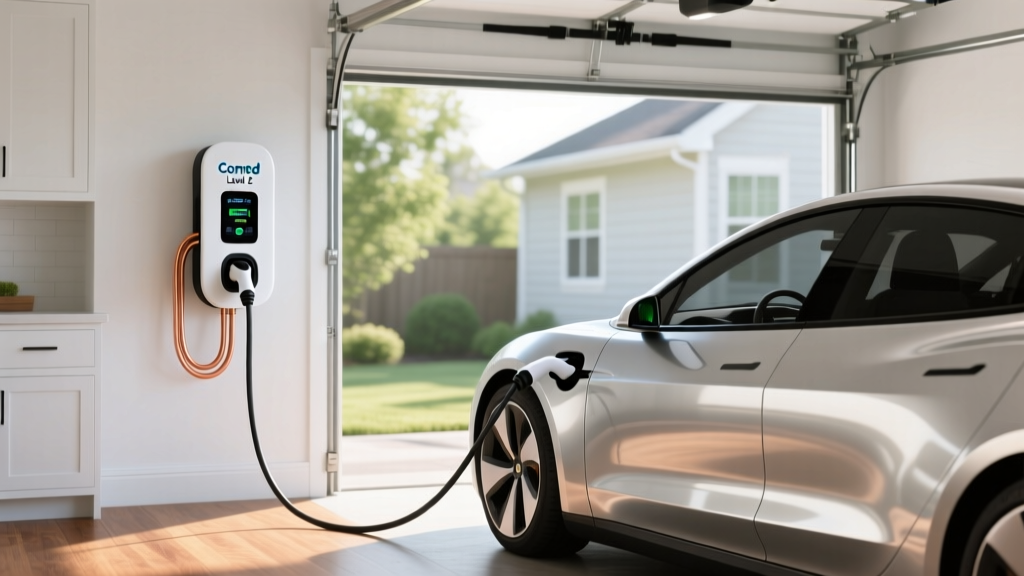
Most BMW EV owners will do 80–90% of their charging at home on a Level 2 circuit. This requires a dedicated 240V circuit installed by a licensed electrician, a hardwired or plug-in Level 2 charging station, and compliance with local electrical codes.
Electrical Requirements
A typical Level 2 home charger for a BMW EV requires:
- Voltage: 240V (split-phase residential)
- Amperage: 40A circuit minimum (supports 32A continuous charging); 60A circuit preferred (supports 48A continuous for 11.5 kW)
- Breaker: Dedicated — no shared circuits with appliances
- Wire gauge: 6 AWG copper for 40A; 4 AWG for 60A (may vary by run length and local code)
- GFCI protection: Required by NEC 2020+ for EV outlets; hardwired chargers with built-in GFCI may not need a GFCI breaker
- Outdoor rating: NEMA 4 or NEMA 4X rated enclosure if installed outdoors
Panel Upgrade Considerations
This is the cost variable that catches many homeowners off guard. If your home has a 100-amp electrical panel (common in homes built before 2000), adding a 40A or 60A dedicated EV circuit may require a panel upgrade to 200A. A panel upgrade typically costs $1,500–$3,500 depending on your utility, local labor rates, and whether a new meter base or service drop is needed.
Homes with existing 200A panels usually have enough spare capacity for a 40A EV circuit, but your electrician will perform a load calculation per NEC Article 220 to confirm. If you're near capacity, options include a lower-amperage circuit (e.g., 30A / 24A continuous, delivering ~5.8 kW) or a smart load-management system that shares capacity between your EV charger and other large loads.
| Component | Low-End Cost | High-End Cost | Notes |
|---|---|---|---|
| Level 2 Charger (hardware) | $350 | $750 | Varies by brand, amperage, smart features |
| Electrician labor (standard install) | $500 | $1,500 | Short run from panel to garage; longer runs cost more |
| Permit & inspection | $50 | $300 | Varies by municipality; some jurisdictions waive for EV |
| Electrical materials (wire, conduit, breaker) | $100 | $400 | Depends on run length and wire gauge |
| Panel upgrade (if needed) | $1,500 | $3,500 | 100A → 200A upgrade; not always required |
| Total (no panel upgrade) | $1,000 | $2,950 | Most common scenario for newer homes |
| Total (with panel upgrade) | $2,500 | $6,450 | Older homes with 100A service |
Federal incentive note: The §30D tax credit applies to vehicles, not chargers. However, the Residential Clean Energy Credit (IRS §25D) previously covered some home energy equipment. As of 2026, standalone EV charger hardware does not qualify for a federal tax credit — check with a tax professional and your state/utility for local rebates, which can offset $200–$1,000 of installation costs in some regions.
How Much Does Charging Cost Per Mile vs. Gas?
One of the strongest ownership arguments for a BMW i4 or iX over a comparable gas-powered 3 Series or X5 is the per-mile fuel cost. But the numbers vary dramatically depending on where and when you charge.
| Charging Scenario | Cost per kWh | Cost for 81.5 kWh (full battery) | Cost Per Mile (301 mi EPA) | Annual Fuel Cost (12,000 mi) |
|---|---|---|---|---|
| Home — off-peak utility rate | $0.09 | $7.34 | $0.024 | $288 |
| Home — average US rate | $0.17 | $13.86 | $0.046 | $552 |
| Public Level 2 (ChargePoint, etc.) | $0.25–$0.35 | $20.38–$28.53 | $0.068–$0.095 | $816–$1,140 |
| DC Fast (Tesla Supercharger, avg.) | $0.28–$0.38 | $22.82–$30.97 | $0.076–$0.103 | $912–$1,236 |
| DC Fast (Electrify America, peak) | $0.40–$0.56 | $32.60–$45.64 | $0.108–$0.152 | $1,296–$1,824 |
| Gas equivalent (BMW 330i, 30 MPG, $3.50/gal) | — | — | $0.117 | $1,404 |
The takeaway: home charging is where EV economics shine. At off-peak utility rates, a BMW i4 costs under $300/year to "fuel" — roughly 80% less than a comparable gas 3 Series. Even at average residential rates, you're saving $800+ annually. Public DC fast charging narrows the gap, and at peak Electrify America rates, you may actually spend more per mile than gas. This is why home Level 2 installation isn't optional for cost-conscious EV ownership — it's the entire value proposition.
Equipment Recommendations: Level 2 Chargers for BMW EVs
For BMW owners with a CCS1 port (2022–2024 models) or NACS port (2025+), here are three proven Level 2 home chargers, selected for reliability, amperage, and smart features:
ChargePoint Home Flex
- Power output: Up to 12 kW (50A circuit / 40A continuous) — configurable down to 16A for lower-capacity panels
- Connector: J1772 (standard for all non-Tesla Level 2); NACS-equipped BMWs use a J1772-to-NACS adapter (included with many 2025+ BMWs)
- Cable length: 23 feet
- Smart features: Wi-Fi, ChargePoint app scheduling, utility demand-response integration, Alexa
- Price: ~$599 (hardware only)
- Best for: Flexible amperage configuration; strong app ecosystem; works with all BMW model years
Wallbox Pulsar Plus
- Power output: Up to 11.5 kW (48A continuous on 60A circuit)
- Connector: J1772
- Cable length: 25 feet
- Smart features: Wi-Fi + Bluetooth, myWallbox app, Power Sharing (two chargers on one circuit), solar integration
- Price: ~$549
- Best for: Compact form factor; dual-charger garages; solar-panel homes
Emporia Level 2 EV Charger
- Power output: Up to 11.5 kW (48A continuous on 60A circuit)
- Connector: J1772
- Cable length: 24 feet
- Smart features: Wi-Fi, Emporia app, real-time energy monitoring, solar-aware charging, TOU scheduling
- Price: ~$399
- Best for: Budget-conscious buyers who want full smart features; energy-monitoring integration
Important connector note: All Level 2 home chargers in North America use the J1772 connector (or NACS for Tesla Wall Connectors). If your BMW has a NACS port (2025+), you'll need a J1772-to-NACS adapter for non-Tesla Level 2 chargers — BMW typically includes this with the vehicle. If your BMW has CCS1 (2022–2024), J1772 plugs directly into the upper portion of your CCS inlet — no adapter needed for Level 2.
Safety, Code Compliance, and the BMW Tesla Supercharger Adapter
The BMW Tesla Supercharger adapter is designed for DC fast charging only — it does not enable Level 1 or Level 2 AC charging through a Tesla connector. When using the adapter at an open Supercharger station, follow these guidelines:
- Inspect the adapter before each use. Check for cracked housing, bent pins, or moisture in the connector. A damaged adapter can cause arcing or incomplete connections.
- Use the Tesla app to initiate sessions. Non-Tesla vehicles at open Superchargers require the Tesla app for authentication and payment — the stall's screen won't activate your session directly.
- Precondition your battery. Navigate to the Supercharger in your BMW's infotainment system before arrival. The i4 and iX will begin warming the battery 10–20 minutes before you arrive, enabling faster charge acceptance — especially critical below 50°F.
- Monitor the charge curve. Expect peak speeds (150–200 kW) only between 10–40% state of charge. Plan to unplug around 80% to avoid the steep taper that makes the last 20% painfully slow and expensive.
- Store the adapter properly. Keep it in a padded case in your frunk or trunk. The adapter weighs under 2 lbs but contains precision contacts that can be damaged by loose storage.
For home installations, NEC 2020 and 2023 codes require GFCI protection on all EV receptacles, a dedicated circuit with no shared loads, and proper grounding. Outdoor installations must use weather-rated (NEMA 4) enclosures and UV-resistant cable. Always have your installation inspected — an unpermitted charger install can void homeowner's insurance coverage in the event of an electrical fire.
Frequently Asked Questions
How much does the BMW Tesla Supercharger adapter cost?
The BMW-branded CCS-to-NACS adapter typically retails for $200–$300 through BMW dealerships and parts channels. Tesla also sells a CCS-to-NACS adapter for approximately $250 through its online shop. Third-party adapters exist but may not carry the same safety certifications — stick with OEM or Tesla-sourced units for high-power DC applications.
Can I use the BMW Tesla Supercharger adapter for home Level 2 charging?
No. The adapter is designed exclusively for DC fast charging at Supercharger stalls. Home Level 2 charging uses AC power through the J1772 connector (or NACS for 2025+ models) — no adapter is needed between J1772 and CCS1, as the J1772 plug fits directly into the upper portion of the CCS inlet.
How fast will each charging level add range to my BMW i4?
Level 1 (120V): ~3–5 miles per hour. Level 2 (240V, 48A): ~35–40 miles per hour. DC Fast Charging (150 kW Supercharger, with adapter): approximately 180–220 miles in 30 minutes at optimal state of charge and battery temperature. These figures assume the i4 eDrive40's 301-mile EPA rating; the iX will add slightly fewer miles per kWh due to its higher curb weight and lower efficiency.
Will using the adapter void my BMW warranty?
Using an OEM BMW or Tesla-sourced adapter for its intended purpose (DC fast charging at compatible stations) does not void your vehicle's battery or powertrain warranty. BMW's high-voltage battery warranty covers 8 years/100,000 miles with a minimum 70% capacity retention threshold. Damage caused by third-party, uncertified adapters or improper use may not be covered — always use certified equipment.
What electrical upgrades might I need for a home charger?
If your home has a 200A electrical panel with available capacity, you likely need only a dedicated 40A or 60A breaker and a wire run to your garage or parking spot — total cost typically $1,000–$2,500. If your home has a 100A panel or your load calculation shows insufficient capacity, a panel upgrade to 200A will add $1,500–$3,500. Your licensed electrician will determine this during the initial assessment. Some utilities offer load-management programs that allow EV charging without a panel upgrade by throttling charge rate during peak household demand.
Is the BMW Tesla Supercharger adapter compatible with all Supercharger stations?
Not all. Only Supercharger stations enrolled in Tesla's Open Supercharger program accept non-Tesla vehicles. As of early 2026, roughly 30–40% of U.S. Supercharger locations are open to non-Tesla vehicles, with expansion ongoing. Stations with Magic Dock hardware have a built-in CCS adapter, so you wouldn't need your own adapter there. Always verify station compatibility in the Tesla app before routing to a Supercharger.
For the latest BMW EV specifications and EPA range figures, consult fueleconomy.gov. For Supercharger station availability and adapter compatibility, check the BMW USA owner portal or the Tesla app's non-Tesla charging map.