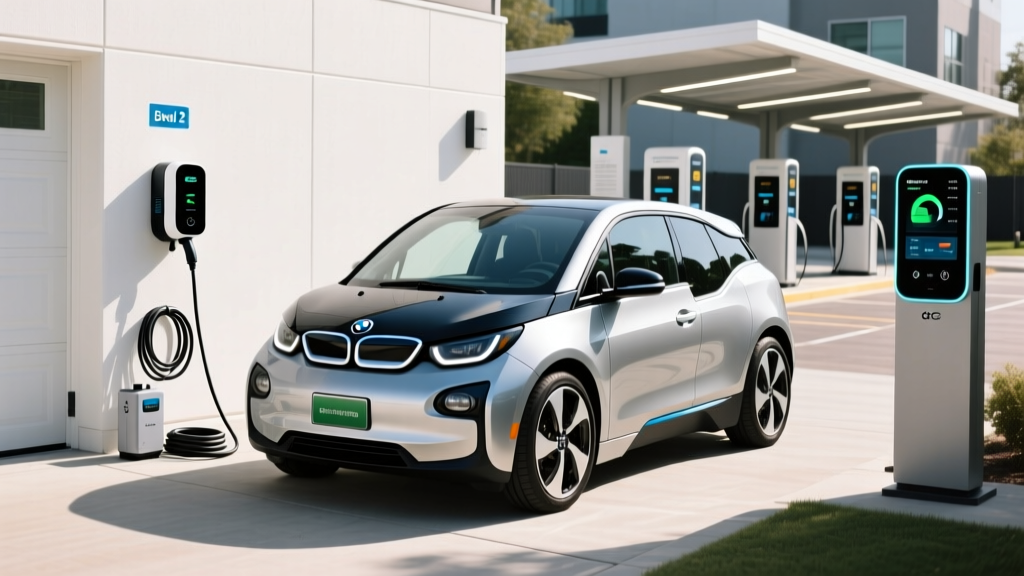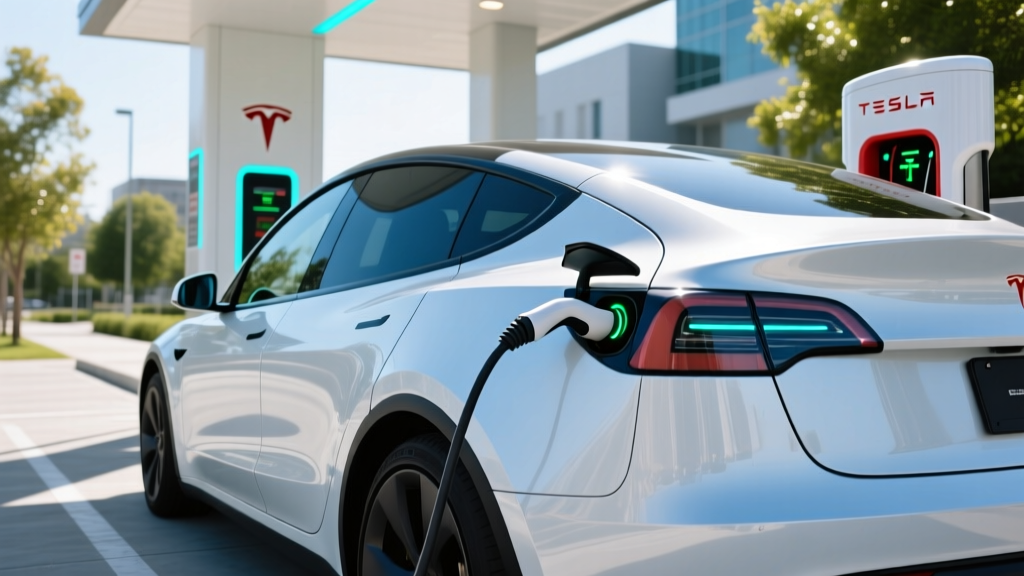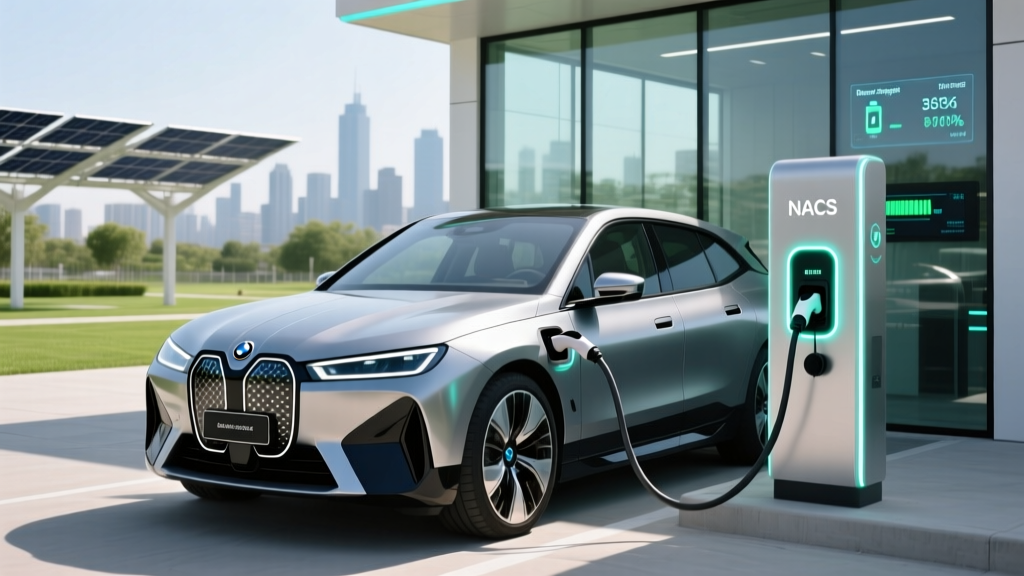
If you own a BMW i4, iX, i7, or the newer i5, one of the most practical questions you'll face is where to fast-charge on road trips. With Tesla opening its Supercharger network to non-Tesla EVs and the industry migrating to the North American Charging Standard (NACS), BMW owners now have access to thousands of additional DC fast-charging stalls — but the experience isn't as seamless as plugging in a Tesla. This guide breaks down exactly how BMW Tesla Supercharger access works in 2026, what adapter you need, how fast you'll actually charge, and what it costs compared to other networks and gasoline.
How BMW Tesla Supercharger Access Actually Works
BMW EVs sold through the 2024 model year — including the i4, iX, i7, and early i5 — were built with the CCS1 (Combined Charging Standard) connector. Starting in 2025, BMW began transitioning new models to the native NACS port, aligning with the broader industry shift. However, the vast majority of BMW EVs on the road in 2026 still carry CCS1.
Tesla's Supercharger network, which now includes over 25,000 stalls across North America, uses the NACS connector exclusively. To bridge this gap, BMW owners have two paths:
- CCS-to-NACS adapter: Tesla sells an official adapter (approximately $250) that allows CCS1-equipped vehicles to use NACS Supercharger stalls. BMW has also endorsed this adapter pathway for its customers.
- Native NACS port: 2025+ model-year BMW EVs ship with a native NACS charge port, eliminating the need for an adapter entirely.
To use a Supercharger, open the Tesla app (or use the built-in navigation in newer BMWs with integrated NACS support), locate a participating "Open to Non-Tesla EVs" stall, and follow the on-screen prompts. Not every Supercharger station is open to non-Tesla vehicles — Tesla has prioritized locations with extra capacity and adequate pull-through space for larger vehicles like the iX.
| BMW Model (Model Year) | Native Port | Adapter Required? | Supercharger Access |
|---|---|---|---|
| i4 (2022–2024) | CCS1 | Yes — CCS-to-NACS | Yes (participating stations) |
| iX (2022–2024) | CCS1 | Yes — CCS-to-NACS | Yes (participating stations) |
| i7 (2023–2024) | CCS1 | Yes — CCS-to-NACS | Yes (participating stations) |
| i5 (2024) | CCS1 | Yes — CCS-to-NACS | Yes (participating stations) |
| i4 (2025+) | NACS | No | Yes (full network) |
| iX (2025+) | NACS | No | Yes (full network) |
| i5 (2025+) | NACS | No | Yes (full network) |
Charging Levels Explained: kW, Speeds, and What to Expect
Before comparing Supercharger speeds to home charging, it's essential to distinguish between kW (kilowatts), which measures power — how fast energy flows — and kWh (kilowatt-hours), which measures energy capacity — the size of your battery. Think of kW as the width of a hose and kWh as the size of the bucket.
| Level | Voltage | Power (kW) | Miles of Range Added per Hour | Best For |
|---|---|---|---|---|
| Level 1 | 120V AC | 1.0–1.4 kW | 3–5 mi/hr | Overnight top-up, PHEVs, emergencies |
| Level 2 | 240V AC | 7.2–19.2 kW | 25–70 mi/hr | Daily home/workplace charging |
| DC Fast Charge | 400–800V DC | 50–350 kW | 150–1,000+ mi/hr (peak) | Road trips, rapid top-ups |
For context, a BMW i4 eDrive40 has a usable battery capacity of approximately 81.5 kWh and an EPA-estimated range of 301 miles. On a Level 2 charger at 11 kW, a full charge from empty takes roughly 8 hours. On a Tesla V3 Supercharger (peak 250 kW), BMW i4 owners can expect a 10–80% charge in approximately 31 minutes — though the actual rate depends on battery temperature, state of charge, and the adapter's throughput limitations.
Real-world Supercharger note: When using a CCS-to-NACS adapter, some owners report slightly reduced peak charge rates compared to a native NACS connection. The adapter itself does not bottleneck power significantly, but the vehicle's charge curve and thermal management play a larger role. Expect peak rates around 180–200 kW on a V3 Supercharger (250 kW max) for CCS1-equipped BMWs, tapering to under 60 kW above 80% state of charge. This is the nature of lithium-ion charging — the battery management system slows the charge rate to protect cell health as the battery fills.
Home Charger Installation: Costs, Electrical Requirements, and Panel Upgrades
Most BMW EV owners do the majority of their charging at home on Level 2. Installing a dedicated 240V home charger is the single biggest quality-of-life upgrade in EV ownership — but costs vary dramatically based on your electrical panel, wiring distance, and local code.
Electrical Requirements for BMW Level 2 Charging
BMW recommends a Level 2 charger capable of at least 40 amps (9.6 kW) for practical overnight charging. The i4 and i5 have an onboard charger rated at 11 kW (accepting up to 48 amps), while the iX can accept up to 11 kW as well. To get the full benefit, you'll want a 240V circuit rated at 50 or 60 amps with a hardwired charger or a NEMA 14-50 outlet.
- Circuit rating: 50A or 60A dedicated breaker
- Continuous draw: 40A or 48A (NEC requires circuits rated 125% above continuous load)
- Wire gauge: 6 AWG copper for 50A; 4 AWG for 60A (varies by run length)
- Outlet type: NEMA 14-50 (if using a plug-in charger) or hardwired (preferred for 48A+ units)
Do You Need a Panel Upgrade?
If your home has a 100-amp electrical service panel — common in homes built before the 1990s — adding a 50A EV circuit may exceed your panel's capacity, especially if you already have electric appliances (dryer, oven, HVAC). A licensed electrician will perform a load calculation per NEC Article 220 to determine if your panel can handle the additional draw. If not, a panel upgrade to 200A typically costs between $1,500 and $3,500 before any charger installation.
| Component | Low Estimate | High Estimate | Notes |
|---|---|---|---|
| Level 2 Charger (Equipment) | $400 | $750 | 40A–48A smart charger (e.g., ChargePoint, Wallbox) |
| Electrician Labor | $500 | $2,000 | Depends on wiring distance, conduit, and complexity |
| Permit & Inspection | $50 | $300 | Varies by municipality |
| Electrical Panel Upgrade (if needed) | $1,500 | $3,500 | 100A to 200A service upgrade |
| Total (no panel upgrade) | $950 | $3,050 | Most homes with 200A panels |
| Total (with panel upgrade) | $2,450 | $6,550 | Older homes with 100A service |
The IRS §30C Alternative Fuel Vehicle Refueling Property Credit may cover up to 30% of home charger installation costs (max $1,000), subject to income and census-tract eligibility. Consult a tax professional to confirm your eligibility.
Charging Cost: BMW on Superchargers vs. Home vs. Gasoline
One of the strongest arguments for EV ownership is fuel cost savings — but the gap narrows when you rely heavily on public DC fast charging. Here's a realistic breakdown for a BMW i4 eDrive40 (3.0 miles per kWh, based on its 301-mile EPA range and ~81.5 kWh usable battery).
| Charging Scenario | Cost per kWh | Cost per Mile | Annual Cost (12,000 mi) |
|---|---|---|---|
| Home Level 2 (off-peak utility rate) | $0.13 | $0.043 | $520 |
| Home Level 2 (average U.S. rate) | $0.17 | $0.057 | $680 |
| Tesla Supercharger (non-Tesla pricing) | $0.35–$0.48 | $0.12–$0.16 | $1,400–$1,920 |
| Electrify America / EVgo DC fast | $0.38–$0.55 | $0.13–$0.18 | $1,520–$2,200 |
| Gasoline equivalent (BMW 330i, 30 MPG combined, $3.50/gal) | — | $0.117 | $1,400 |
The takeaway: home charging on an off-peak rate delivers massive savings — roughly $0.04 per mile versus $0.12 for gasoline. But if you exclusively use Tesla Superchargers at non-Tesla pricing ($0.35–$0.48/kWh depending on location and time of day), your per-mile cost can actually exceed a fuel-efficient gas car. The economics of EV ownership strongly favor home or workplace Level 2 charging.
For a full comparison, the EPA's fuel-economy EV calculator lets you input your local electricity rate and compare against specific gas vehicles.
Charging Time Examples: 10–80% on Superchargers and Level 2
How long will you actually wait? Here are realistic 10–80% charge times for popular BMW EV models, accounting for real-world charge-curve taper:
| Model | Usable Battery | Peak DC Fast kW | 10–80% (V3 Supercharger, ~250 kW stall) | 10–80% (Level 2, 11 kW) |
|---|---|---|---|---|
| BMW i4 eDrive40 | 81.5 kWh | ~200 kW (CCS1 adapter) / ~205 kW (NACS) | ~31 minutes | ~5.2 hours |
| BMW iX xDrive50 | 105.2 kWh | ~195 kW (CCS1 adapter) / ~200 kW (NACS) | ~35 minutes | ~6.7 hours |
| BMW i5 eDrive40 | 81.2 kWh | ~205 kW (CCS1 adapter) / ~210 kW (NACS) | ~30 minutes | ~5.1 hours |
| BMW i7 xDrive60 | 101.7 kWh | ~195 kW (CCS1 adapter) / ~200 kW (NACS) | ~34 minutes | ~6.5 hours |
Charge-curve reality check: Those peak kW figures only apply between roughly 10–40% state of charge. As the battery fills past 60%, the charge rate drops significantly — often to 80–100 kW — and below 50 kW once you cross 80%. This is why manufacturers quote 10–80% times rather than 0–100%. Charging to 100% on a DC fast charger can add 30+ additional minutes for the last 20% of capacity, and routinely doing so accelerates battery degradation.
Recommended Home Chargers for BMW EVs
Not all Level 2 chargers are equal. Here are three well-regarded options that pair well with BMW EVs, each with distinct strengths:
ChargePoint Home Flex (48A)
- Power Output: Up to 11.5 kW (48A at 240V)
- Connector: NACS (J3400) — CCS1 adapter included in box for older BMWs
- Cable Length: 23 feet
- Smart Features: Wi-Fi, ChargePoint app scheduling, Alexa integration, energy tracking
- Price: ~$650
- Best For: BMW owners wanting app-based scheduling and utility demand-response programs
Wallbox Pulsar Plus (48A)
- Power Output: Up to 11.5 kW (48A at 240V)
- Connector: NACS (2025+ models); CCS1 versions still available
- Cable Length: 25 feet
- Smart Features: Wi-Fi + Bluetooth, myWallbox app, Power Sharing (dual-unit load balancing)
- Price: ~$599
- Best For: Garages with two EVs needing load-balanced dual charging on a single circuit
BMW Wallbox (48A)
- Power Output: Up to 11.5 kW (48A at 240V)
- Connector: NACS (current generation); prior gen was CCS1
- Cable Length: 21 feet
- Smart Features: BMW app integration, charge history in My BMW app
- Price: ~$700 (often bundled with vehicle purchase incentives)
- Best For: BMW loyalists wanting seamless integration with the My BMW ecosystem
Safety, Electrical Code, and Best Practices
EV charging involves sustained high-current draw — unlike a dryer that cycles on and off, a Level 2 charger can pull maximum current for 6–8 hours straight. This makes proper installation non-negotiable:
- Dedicated circuit: Your EV charger must be on its own dedicated breaker. Sharing a circuit with other appliances is a code violation and a fire risk.
- GFCI protection: NEC 2020 and later require GFCI (Ground Fault Circuit Interrupter) protection for outdoor EV outlets. Hardwired indoor installations may be exempt depending on jurisdiction — your electrician will advise.
- Outdoor rating: If your charger is installed outdoors (carport, driveway), it must carry a NEMA 4 or IP65 weather resistance rating. All three chargers recommended above meet this standard.
- Permit and inspection: Most municipalities require an electrical permit and post-installation inspection. Skipping this step can void your homeowner's insurance coverage for electrical fires and create problems at resale.
- Wire sizing: Undersized wire on a long run causes voltage drop, reducing charge speed and generating heat. A licensed electrician will calculate the correct gauge based on run distance.
Never use an extension cord with a Level 2 charger, and avoid adapters that convert a dryer outlet (NEMA 10-30) to a charger plug without proper grounding. These shortcuts are common causes of residential EV charging fires.
Frequently Asked Questions
How much does it cost to install a home EV charger for my BMW?
Expect $950–$3,050 for a standard Level 2 installation in a home with a 200-amp panel. If your home has an older 100-amp panel and needs an upgrade, total costs can reach $2,450–$6,550. The IRS §30C credit may offset up to $1,000 of installation costs for eligible taxpayers.
How fast will each charging level add range to my BMW?
Level 1 (120V) adds 3–5 miles per hour — adequate only for plug-in hybrids or emergency trickle charging. Level 2 (240V at 48A) adds roughly 35–40 miles per hour to a BMW i4. DC fast charging on a Tesla V3 Supercharger adds 150–200+ miles in 15–20 minutes at peak rates, though the rate tapers significantly above 60% state of charge.
Which connector and charger is compatible with my BMW EV?
BMW models from 2022–2024 use the CCS1 connector and require a CCS-to-NACS adapter (~$250) to access Tesla Superchargers. 2025+ BMW EVs use the native NACS (J3400) connector and can plug directly into Superchargers. For home Level 2 charging, all current-generation smart chargers (ChargePoint, Wallbox, BMW Wallbox) ship with NACS connectors and include or support CCS1 adapters.
How much does charging a BMW cost per mile versus gasoline?
Home charging at the U.S. average rate of $0.17/kWh costs approximately $0.057 per mile in a BMW i4 — less than half the $0.117 per mile of a comparable BMW 330i at $3.50/gallon. However, Tesla Supercharger pricing for non-Tesla vehicles ($0.35–$0.48/kWh) pushes the cost to $0.12–$0.16 per mile, which can exceed gasoline. Home charging is where EV economics shine.
What electrical upgrades might I need for a home charger?
The most common upgrade is a panel capacity increase from 100A to 200A service ($1,500–$3,500) in older homes. You may also need a new dedicated 50A or 60A breaker, appropriately sized wiring (6 or 4 AWG copper), and a NEMA 14-50 outlet or hardwired junction box. Homes with detached garages may face additional trenching and conduit costs. Always get a load calculation from a licensed electrician before committing to a charger purchase.
Can I use Tesla Superchargers for daily charging instead of installing a home charger?
Technically yes, but it's not recommended. Routine DC fast charging accelerates battery degradation compared to Level 2 charging, and at $0.35–$0.48/kWh for non-Tesla vehicles, you'll spend 2–3× more per mile than home charging. Reserve Superchargers for road trips and use Level 2 at home for daily needs. BMW's high-voltage battery warranty covers 8 years or 100,000 miles with a minimum 70% capacity retention threshold — but excessive DC fast charging can erode that margin faster.