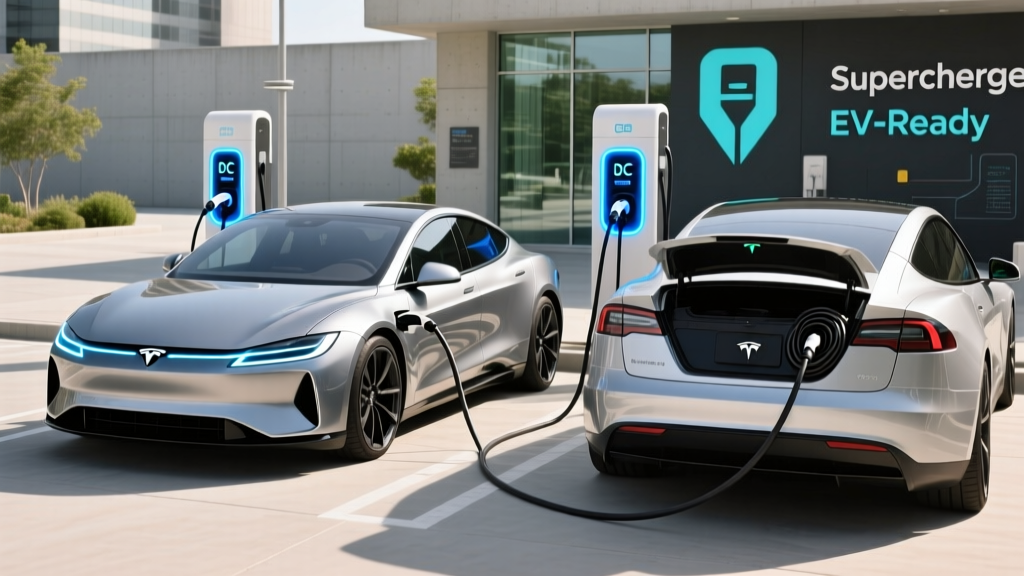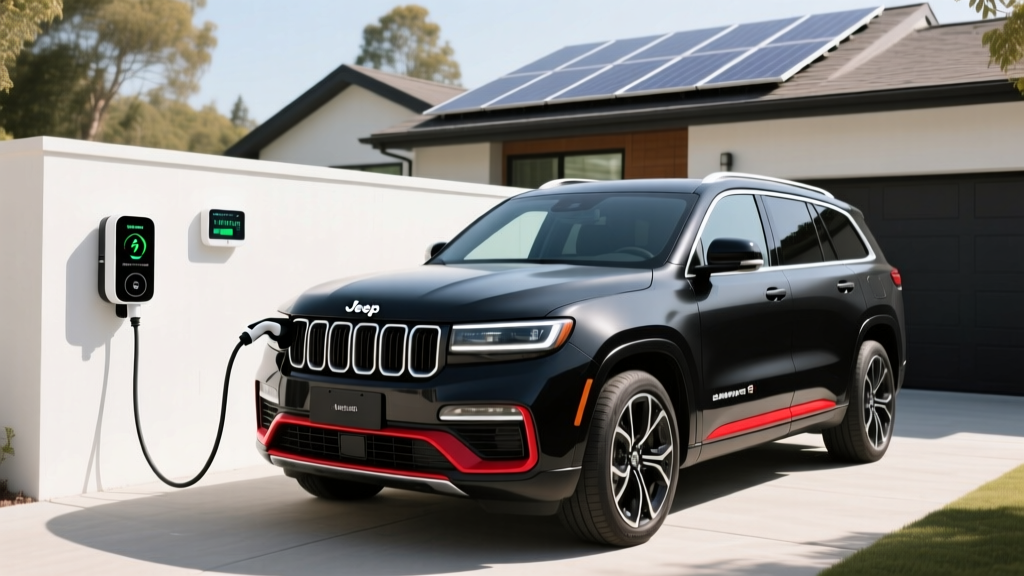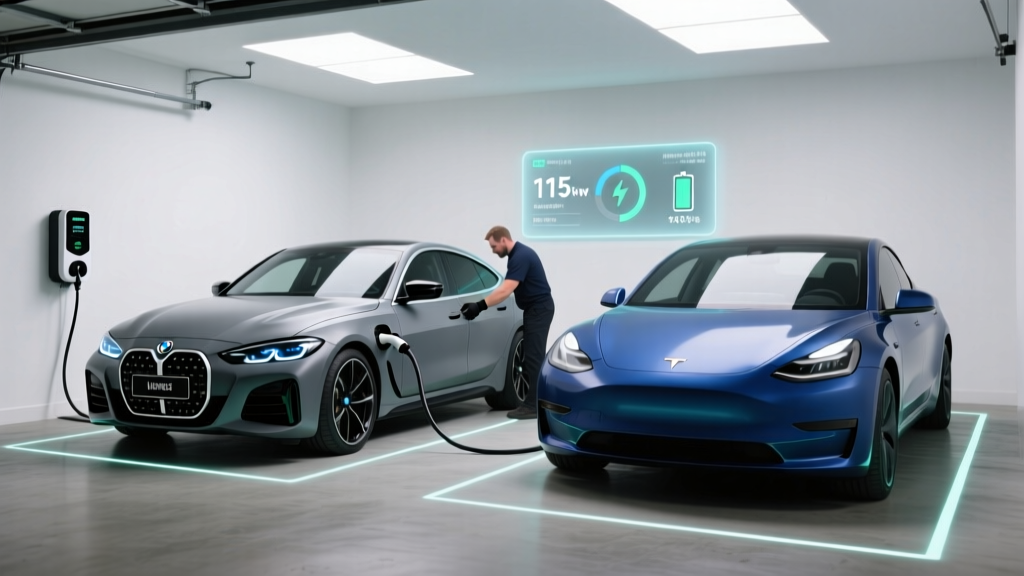
If you're parking a BMW i4 or iX next to a Tesla Model Y or Model 3 in the same garage, you've probably noticed the charging plugs don't match. As of the 2025 model year, Tesla continues to use its proprietary North American Charging Standard (NACS) connector, while BMW uses the CCS1 standard — though BMW has committed to adopting NACS starting with 2025-2026 models depending on region and production timing. That split creates real questions about home charger selection, adapter needs, and whether a single wallbox can serve both cars efficiently.
This guide breaks down exactly what BMW and Tesla owners need to know about charging infrastructure in 2026: the electrical requirements, connector compatibility, real-world charging speeds, and total installation costs — with no confusion between kilowatts (kW, the rate of power delivery) and kilowatt-hours (kWh, the unit of energy stored in your battery).
Understanding Charging Levels: What Each Delivers
Before choosing equipment, you need to understand the three charging tiers available to BMW and Tesla drivers. The critical distinction: kW measures power (how fast energy flows into your car), while kWh measures energy (the total capacity of your battery). A 19.2 kW charger delivering power for one hour adds 19.2 kWh of energy to your battery.
| Level | Voltage | Power (kW) | Miles of Range Per Hour | Best For |
|---|---|---|---|---|
| Level 1 (120V) | 120V AC | 1.0–1.4 kW | 3–5 mi/hr | Emergency/overnight trickle (PHEVs, small batteries) |
| Level 2 (240V) | 240V AC | 3.3–19.2 kW | 12–75 mi/hr | Daily home charging (primary method for most owners) |
| DC Fast Charging | 400V–800V DC | 50–350 kW | 150–300+ mi in 20-30 min | Road trips, rapid top-ups on public networks |
For context, a BMW i4 eDrive40 has a usable battery capacity of approximately 81.5 kWh (NMC chemistry), while a Tesla Model Y Long Range carries roughly 75 kWh (NMC/LFP depending on production batch). On a 48-amp (11.5 kW) Level 2 circuit, the i4 charges from 10% to 80% in roughly 5.5 hours, while the Model Y does the same in about 5 hours. On DC fast charging, BMW i4 peaks at 205 kW (10-80% in ~31 minutes), and the Tesla Model Y peaks at 250 kW on V3 Superchargers (10-80% in ~25 minutes).
Connector Compatibility: NACS, CCS1, and Adapters
The connector landscape has shifted dramatically. Tesla's NACS connector was adopted as the SAE J3400 standard, and nearly every major automaker — including BMW — has committed to transitioning to NACS. However, many BMW EVs currently on the road still use CCS1 (the Combined Charging System with a J1772 AC portion and DC pins below).
| Vehicle | Native Connector | Home Level 2 | DC Fast Charging | Adapter Needed? |
|---|---|---|---|---|
| Tesla Model 3/Y (all years) | NACS (proprietary/J3400) | NACS | NACS (Supercharger) | CCS adapter for Electrify America/Ionity |
| BMW i4/iX/i5/i7 (2022-2024) | CCS1 | J1772 (CCS1 AC portion) | CCS1 | NACS-to-CCS adapter for Supercharger access (select models) |
| BMW i4/iX/i5 (2025-2026, NACS-equipped) | NACS | NACS | NACS | CCS adapter for legacy Electrify America stations |
Tesla offers a J1772 adapter (included with most vehicles) for charging at non-Tesla Level 2 stations, and a CCS Combo adapter (~$250) for accessing Electrify America and other CCS networks. BMW owners with CCS1 ports can access Tesla Superchargers using a BMW-approved NACS adapter where available, though adapter availability and Supercharger network access terms vary — check BMW's official EV portal and Tesla's Supercharger compatibility page for current status.
Home Installation: Electrical Requirements and Costs
Installing a dedicated Level 2 home charger is the single highest-impact upgrade for BMW and Tesla owners. Here's what the electrical work actually involves and what it costs.
Electrical requirements for a 48-amp Level 2 charger:
- Circuit: Dedicated 60-amp breaker (NEC requires circuits to be rated 125% of continuous load, so 48A continuous = 60A breaker)
- Wire: 6 AWG copper (or 4 AWG aluminum) in conduit, run from panel to charger location
- Voltage: 240V split-phase (standard US residential)
- Panel capacity: Your main service panel must have sufficient amperage headroom — typically 200A service for modern homes with EV charging
| Component | Low Estimate | High Estimate | Notes |
|---|---|---|---|
| Level 2 Charger (hardware) | $400 | $750 | 40A–48A Wi-Fi-enabled units |
| Electrical permit | $50 | $250 | Varies by municipality |
| Electrician labor (simple install) | $400 | $800 | Short wire run, panel has capacity, same wall as panel |
| Electrician labor (complex install) | $800 | $2,000 | Long wire run through attic/crawlspace, conduit, trenching |
| Panel upgrade (if needed) | $1,500 | $4,000 | 100A to 200A service upgrade |
| Total (no panel upgrade) | $850 | $2,800 | Most homes with 200A panels |
| Total (with panel upgrade) | $2,350 | $6,800 | Older homes needing service upgrade |
The federal government does not currently offer a dedicated tax credit for home EV charger installation under §30D (that credit applies to vehicle purchases). However, some state and utility programs offer rebates of $200–$1,000 for smart charger installations — check your local utility and Department of Energy resources for current programs.
Charging Speeds in Practice: BMW and Tesla Real-World Times
Peak kW ratings on spec sheets rarely reflect sustained charging rates. Both BMW and Tesla batteries follow a charge curve that tapers significantly above 80% state of charge (SoC) to protect cell longevity. Here are realistic charging scenarios:
| Scenario | BMW i4 (81.5 kWh battery) | Tesla Model Y LR (~75 kWh battery) |
|---|---|---|
| Level 1 (120V, 12A) | ~68 hours (10-80%) | ~62 hours (10-80%) |
| Level 2 (240V, 32A / 7.7 kW) | ~8 hours (10-80%) | ~7.2 hours (10-80%) |
| Level 2 (240V, 48A / 11.5 kW) | ~5.5 hours (10-80%) | ~5 hours (10-80%) |
| DC Fast (peak rate, 10-80%) | ~31 min at 205 kW peak | ~25 min at 250 kW peak |
| DC Fast (real-world, 10-80%) | ~35-38 min (curve taper) | ~28-32 min (curve taper) |
The Tesla Model Y's onboard AC charger accepts up to 11.5 kW (48A), while the BMW i4's onboard charger accepts up to 11 kW (some trims offer an optional 22 kW three-phase onboard charger for markets with three-phase power — not standard in the US). Both vehicles benefit from battery preconditioning: the BMW will warm its battery when you navigate to a DC fast charger in the iDrive system, and Tesla does this automatically when you navigate to a Supercharger. Preconditioning can shave 5-10 minutes off a 10-80% DC session in cold weather.
Cost to Charge: Per-Mile Economics vs. Gasoline
One of the strongest arguments for home charging is the dramatic cost reduction compared to gasoline. Here's how BMW and Tesla charging costs compare across scenarios, using a national average electricity rate of $0.16/kWh and premium gasoline at $4.20/gallon.
| Scenario | Cost per kWh | BMW i4 (3.0 mi/kWh) | Tesla Model Y (3.3 mi/kWh) | Gas Car (28 MPG combined) |
|---|---|---|---|---|
| Home off-peak (utility TOU rate) | $0.09–$0.12 | $0.03–$0.04/mi | $0.027–$0.036/mi | $0.15/mi |
| Home standard rate | $0.16 | $0.053/mi | $0.048/mi | $0.15/mi |
| Public Level 2 (ChargePoint, etc.) | $0.25–$0.49 | $0.08–$0.16/mi | $0.075–$0.15/mi | $0.15/mi |
| DC Fast (Electrify America/Supercharger) | $0.35–$0.55 | $0.12–$0.18/mi | $0.11–$0.17/mi | $0.15/mi |
At home off-peak rates, both the BMW i4 and Tesla Model Y cost roughly one-quarter to one-fifth as much per mile as a comparable gasoline vehicle. Even at peak DC fast charging rates, EVs are competitive with or cheaper than gasoline. The breakeven is even more favorable if your utility offers time-of-use (TOU) plans with overnight rates below $0.10/kWh — common in parts of the Midwest, Southeast, and Pacific Northwest.
Recommended Home Chargers for BMW and Tesla Garages
If you're charging both a BMW and a Tesla in the same home, your charger selection depends on which connector standard dominates your fleet and whether you're willing to use adapters daily.
Tesla Wall Connector (Gen 4) — Best for Tesla-Primary Homes
- Power output: Up to 48A / 11.5 kW (on a 60A circuit)
- Connector: NACS native
- Cable length: 24 feet
- Smart features: Wi-Fi, OTA updates, load sharing (multiple units on one circuit), Tesla app integration
- Price: ~$475
- For BMW owners: Requires a J1772 adapter (e.g., Lectron or Tesla's own J1772-to-NACS adapter, ~$100-$200) — adds a step every charging session
ChargePoint Home Flex — Best Universal Option
- Power output: Configurable 16A–50A (up to 12 kW on a 60A circuit; 3.7–11.5 kW depending on circuit)
- Connector: J1772 (works natively with all CCS1 BMW EVs; Tesla uses included J1772 adapter)
- Cable length: 23 feet
- Smart features: Wi-Fi, ChargePoint app, Alexa integration, scheduled charging, energy tracking
- Price: ~$650–$700
- Advantage: No adapter needed for BMW; Tesla's J1772 adapter is included with the car
Emporia Vue Level 2 Charger — Best Budget Pick
- Power output: Up to 48A / 11.5 kW (on a 60A circuit)
- Connector: J1772
- Cable length: 24 feet
- Smart features: Wi-Fi, Emporia app, solar integration, energy monitoring, load management
- Price: ~$399
- Trade-off: Less polished app experience than ChargePoint; excellent value for the hardware
Grizzl-E Smart — Best for Harsh Climates
- Power output: Up to 40A / 9.6 kW (on a 50A circuit)
- Connector: J1772
- Cable length: 24 feet
- Smart features: Wi-Fi optional, OCPP-compatible, extreme temperature rated (-40°F to +122°F)
- Price: ~$550–$650
- Advantage: Built in Canada for cold climates; robust aluminum enclosure
Safety, Code, and Installation Best Practices
EV charging is a high-draw, continuous-load application that runs for hours at a time. Cutting corners on electrical work is both dangerous and a code violation. Here's what proper installation looks like:
- Dedicated circuit: Your Level 2 charger must be on its own dedicated breaker — never shared with other appliances. A 48A charger requires a 60A breaker per NEC 210.20(A) continuous-load rules.
- GFCI protection: NEC 2020 (Article 625.54) requires GFCI protection for all EV charging outlets rated 150V to ground or less and 60A or less. Hardwired chargers may have GFCI built into the unit; plug-in units require a GFCI breaker. Note: some EV owners report nuisance GFCI trips with certain breaker/charger combinations — consult your electrician about compatibility.
- Outdoor rating: If your charger is installed outdoors, it must carry a NEMA 3R or NEMA 4 rating for weather resistance. All chargers recommended above meet outdoor installation standards.
- Hardwired vs. plug-in: Hardwired installations (no plug, direct wire connection) are preferred for 48A+ chargers because NEMA 14-50 receptacles are rated for intermittent use, not continuous daily loads. If using a NEMA 14-50 outlet, ensure it's a commercial-grade receptacle (Hubbell, Bryant) — residential-grade outlets have caused fires under continuous EV charging loads.
- Permit and inspection: Most jurisdictions require an electrical permit for EV charger installation. Your electrician should pull the permit, and a local inspector will verify the work. This protects your home insurance coverage and ensures code compliance.
Frequently Asked Questions
How much does it cost to install a home EV charger?
For a typical 48-amp Level 2 charger on an existing 200-amp panel with a moderate wire run, expect $850–$2,800 all-in (hardware, permit, and electrician labor). If your home needs a panel upgrade from 100A to 200A service, total costs range from $2,350–$6,800. Always get a load calculation from a licensed electrician before assuming your panel has capacity.
How fast will each charging level add range?
Level 1 (120V) adds 3–5 miles per hour — sufficient only for PHEVs or emergency trickle charging. Level 2 (240V, 48A) adds approximately 35–45 miles per hour for a BMW i4 or Tesla Model Y, fully replenishing either vehicle overnight. DC fast charging adds 150–250+ miles in 20–30 minutes, though speeds taper significantly above 80% SoC.
Which connector and charger is compatible with my EV?
Tesla vehicles use NACS natively; BMW EVs from 2022–2024 use CCS1 (J1772 for AC). A J1772-connector home charger (like ChargePoint Home Flex) works with both: BMW plugs in directly, Tesla uses its included J1772 adapter. If you choose a Tesla Wall Connector, BMW owners need a third-party NACS-to-J1772 adapter. BMW's 2025–2026 models are transitioning to NACS — verify your specific model year's connector before purchasing equipment.
How much does charging cost per mile vs. gas?
At a national average home electricity rate of $0.16/kWh, the Tesla Model Y costs approximately $0.05 per mile and the BMW i4 costs about $0.05 per mile. A comparable gasoline SUV at 28 MPG and $4.20/gallon costs $0.15 per mile. With off-peak utility rates ($0.09–$0.12/kWh), EV costs drop to $0.03–$0.04 per mile — roughly one-quarter the cost of gasoline.
What electrical upgrades might I need?
The most common upgrade is ensuring your main panel has sufficient amperage. A 200-amp panel typically has enough headroom for a 60-amp EV circuit alongside normal household loads. Homes with 100-amp panels almost always need a service upgrade ($1,500–$4,000). Other potential upgrades include running new conduit from the panel to the garage, upgrading from aluminum to copper wiring, and installing a GFCI breaker if your charger requires one.
Can I charge my BMW at a Tesla Supercharger?
Select BMW EVs with CCS1 connectors can access Tesla Superchargers using a BMW-approved NACS-to-CCS adapter, though availability and terms depend on BMW's rollout schedule and Tesla's network access policies. BMW models with native NACS (expected on 2025–2026 production) will access Superchargers directly. Always verify current compatibility through BMW's official EV resources before relying on Supercharger access.
For the most accurate and current EPA range and efficiency data, consult fueleconomy.gov. For federal tax credit rules affecting vehicle purchases (not charger installation), refer to the IRS §30D guidelines.