If you own a BMW electric vehicle in 2026, the charging landscape has shifted dramatically in your favor. BMW Supercharger access — the ability to use Tesla's vast network of DC fast chargers — is now a reality for nearly every current-model BMW EV, either through a NACS adapter or a factory-installed North American Charging Standard port. This guide covers exactly how to access Tesla Superchargers in your BMW, what adapters you need, what it costs, and how to set up a complete home charging solution to complement public fast-charging.
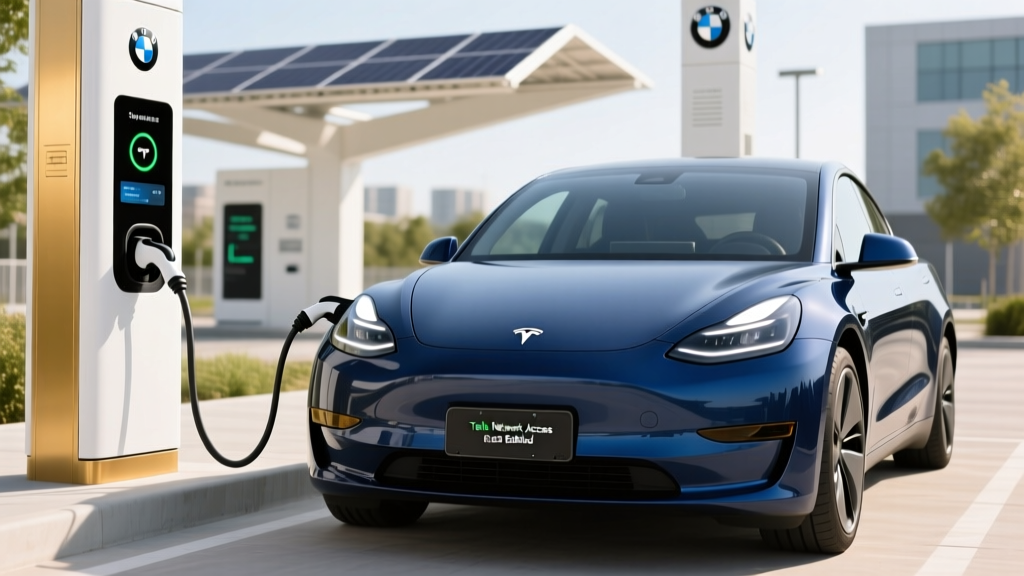
How BMW Owners Can Access Tesla Superchargers
Starting in 2024, BMW joined the broader industry migration to the NACS (North American Charging Standard) connector. Here's where things stand for the 2025 and 2026 model years:
- 2025–2026 BMW i4, iX, i7, i5: These models began shipping with a native NACS charge port (replacing CCS1) on vehicles produced from late 2024 onward. If your BMW has a NACS port, you can plug directly into any Tesla Supercharger — no adapter required.
- 2022–2024 BMW EVs with CCS1 ports: BMW offers an official NACS-to-CCS1 adapter (part number available through your dealer) that enables Supercharger access. Third-party adapters from brands like Lectron and A2Z are also available, though BMW recommends their OEM unit for warranty compliance.
- Software integration: BMW's iDrive system now supports Supercharger routing in the native navigation. You can search for Tesla Superchargers, see real-time stall availability, and precondition the battery for optimal charge speed — all from the car's touchscreen.
To start a session at a Tesla Supercharger, BMW drivers use the Tesla app or Tesla's website to create an account, link a payment method, and initiate charging. Tesla's "Open Supercharger" program — which expanded to all North American stalls by mid-2025 — means no proprietary handshake is required. Plug in, and the stall recognizes your vehicle via the adapter or native NACS connection.
Charging Levels Explained: Speeds, Power, and What They Mean
Understanding EV charging starts with one critical distinction: kW (kilowatts) measures power — the rate at which energy flows into your battery. kWh (kilowatt-hours) measures energy — the total capacity of your battery, like gallons in a fuel tank. A 250 kW charger delivers energy faster than a 50 kW charger, but both fill the same kWh battery.
| Level | Voltage | Power (kW) | Miles of Range Added Per Hour | Typical Use Case |
|---|---|---|---|---|
| Level 1 (120V) | 120V AC | 1.0–1.4 kW | 3–5 miles | Emergency / overnight trickle |
| Level 2 (240V) | 240V AC | 3.3–19.2 kW | 12–75 miles | Home daily charging, workplace |
| DC Fast Charging | 400–800V DC | 50–350 kW | 150–1,000+ miles/hr (peak) | Road trips, rapid top-ups |
For context, a 2026 BMW i4 eDrive40 has a usable battery capacity of approximately 81 kWh (NMC chemistry). Charging from 10% to 80% on a 200 kW DC fast charger takes roughly 31 minutes under ideal conditions. On a Level 2 home charger at 11 kW, that same 10–80% session takes about 7.5 hours — perfect for overnight charging.
Connector Compatibility: NACS, CCS1, and What You Need
The connector landscape has consolidated rapidly. Here's how BMW models map to the three major standards:
| Connector | BMW Models (2022–2024) | BMW Models (2025–2026) | Adapter Needed for Supercharger? |
|---|---|---|---|
| NACS (Tesla) | Not native | i4, i5, iX, i7 (native) | 2025+: No / 2022–24: Yes (NACS-to-CCS1) |
| CCS1 | i4, iX, i7, iX3 (native) | Phased out | N/A — CCS1 works at Electrify America, EVgo, etc. |
| CHAdeMO | Not supported | Not supported | N/A — legacy standard, not relevant for BMW |
If you're buying a 2025 or 2026 BMW EV new, you'll almost certainly receive a vehicle with a native NACS port. For 2022–2024 models, budget $200–$400 for a quality NACS adapter. BMW's OEM adapter is rated for up to 250 kW DC fast charging and maintains full warranty coverage. Third-party options like the Lectron Vortex ($230) are NACS-certified but verify that the unit carries UL or equivalent safety certification before purchasing.
Home Charger Installation: Costs, Electrical Requirements, and Upgrades
Installing a Level 2 home charger is the single highest-impact upgrade for EV ownership. Here's what's involved for a typical BMW EV owner in 2026:
Electrical Requirements
A Level 2 charger for your BMW requires a 240V dedicated circuit, similar to what powers an electric dryer or oven. Most BMW EVs accept up to 11 kW AC charging (48 amps), which requires a 60-amp circuit (the National Electrical Code requires circuits rated at 125% of the continuous load — 48A × 1.25 = 60A). If you opt for a 40-amp charger, a 50-amp circuit suffices.
Your home's electrical panel must have sufficient capacity. A modern 200-amp panel typically has enough headroom for a 60-amp EV circuit. Older homes with 100-amp or 150-amp service may need a panel upgrade — a significant added cost.
| Item | Low Estimate | High Estimate | Notes |
|---|---|---|---|
| Level 2 Charger (hardware) | $350 | $750 | 40A–48A smart charger, NACS or J1772 w/ adapter |
| Electrician labor | $500 | $2,000 | Depends on run length from panel to garage |
| Electrical permit | $50 | $250 | Varies by municipality |
| Panel upgrade (if needed) | $1,500 | $4,000 | 100A → 200A service upgrade |
| Total (no panel upgrade) | $900 | $3,000 | Most homes with 200A service |
| Total (with panel upgrade) | $2,400 | $7,000 | Older homes needing service upgrade |
Safety and Code Requirements
- Dedicated circuit: Your EV charger must be on its own breaker — never shared with other appliances.
- GFCI protection: NEC 2023 and later codes require Ground Fault Circuit Interrupter protection for all EV charging outlets. Hardwired chargers typically include built-in GFCI; plug-in units require a GFCI breaker.
- Outdoor rating: If your charger is mounted outside or in an unenclosed carport, it must carry a NEMA 4 or IP65 weatherproof rating.
- Permit and inspection: Nearly all jurisdictions require an electrical permit and post-installation inspection. Skipping this step can void homeowner's insurance coverage in the event of an electrical fire.
Always hire a licensed electrician for EV charger installation. Get at least three quotes, and ask whether the estimate includes permit fees and any necessary conduit or wiring upgrades between the panel and the charge point.
Cost to Charge: Home vs. Public vs. Gas
One of the strongest financial arguments for EV ownership is the per-mile energy cost. Here's how BMW EV charging costs compare across scenarios:
| Scenario | Avg. $/kWh | Cost to Fill 81 kWh Battery (BMW i4) | Cost Per Mile (at 3.0 mi/kWh) |
|---|---|---|---|
| Home (off-peak utility rate) | $0.08–$0.14 | $6.48–$11.34 | $0.027–$0.047 |
| Home (standard rate, no TOU) | $0.14–$0.20 | $11.34–$16.20 | $0.047–$0.067 |
| Tesla Supercharger (avg. 2026) | $0.28–$0.38 | $22.68–$30.78 | $0.093–$0.127 |
| Electrify America / EVgo DC fast | $0.32–$0.48 | $25.92–$38.88 | $0.107–$0.160 |
| Gasoline equivalent (30 MPG, $3.50/gal) | — | — | $0.117 |
At the national average electricity rate of ~$0.16/kWh (U.S. EIA), home charging a BMW i4 costs roughly $0.053 per mile — less than half the cost of fueling a comparable 30 MPG gas car at $3.50/gallon. Even at Tesla Supercharger rates, per-mile costs are competitive with gasoline. The savings compound: a driver covering 12,000 miles annually saves $800–$1,400 per year by charging at home versus buying gas.
For maximum savings, enroll in your utility's Time-of-Use (TOU) plan and schedule charging between 10 PM and 6 AM when off-peak rates drop to $0.06–$0.10/kWh in many regions.
Recommended Home Chargers for BMW EVs
Here are three Level 2 chargers well-suited for BMW electric vehicles in 2026, selected for reliability, power output, and smart features:
ChargePoint Home Flex
- Power: Up to 12 kW (50A) — configurable down to 16A
- Connector: NACS native (2025+ model) or J1772 with NACS adapter
- Cable length: 23 feet
- Smart features: Wi-Fi, app scheduling, Alexa integration, energy tracking
- Price: ~$550–$650
- Best for: Flexible amperage for homes with limited panel capacity
Tesla Wall Connector
- Power: Up to 11.5 kW (48A)
- Connector: NACS native
- Cable length: 24 feet
- Smart features: Wi-Fi, OTA updates, power sharing (multiple units on one circuit)
- Price: ~$425–$475
- Best for: BMW owners with native NACS ports seeking value
Emporia Vue + EV Charger
- Power: Up to 11.5 kW (48A)
- Connector: J1772 (NACS adapter included in 2026 kit)
- Cable length: 24 feet
- Smart features: Whole-home energy monitoring integration, solar-aware charging, TOU automation
- Price: ~$400–$500 (charger only; energy monitor sold separately)
- Best for: Solar-panel owners wanting integrated energy management
For BMW owners with a native NACS port (2025+ models), the Tesla Wall Connector is the most cost-effective high-quality option. For those with CCS1 ports using an adapter, the ChargePoint Home Flex offers the most versatility with its adjustable amperage — critical if your electrical panel has limited headroom.
BMW Supercharger Access: Charging Times for Popular Models
Here's what to expect when charging common BMW EVs at a Tesla V3 Supercharger (250 kW peak) or a comparable DC fast charger:
| Model | Battery (usable kWh) | Peak DC Charge Rate | 10–80% Time (250 kW stall) | EPA Range |
|---|---|---|---|---|
| 2026 BMW i4 eDrive40 | 81 kWh (NMC) | 205 kW | ~31 minutes | 307 miles |
| 2026 BMW i4 M50 | 81 kWh (NMC) | 205 kW | ~31 minutes | 270 miles |
| 2026 BMW i5 eDrive40 | 81.2 kWh (NMC) | 205 kW | ~30 minutes | 295 miles |
| 2026 BMW iX xDrive50 | 105.2 kWh (NMC) | 200 kW | ~35 minutes | 324 miles |
| 2026 BMW i7 eDrive50 | 101.7 kWh (NMC) | 195 kW | ~34 minutes | 318 miles |
Source: fueleconomy.gov and BMW USA specifications. Real-world range will vary — expect 10–20% less than EPA estimates during sustained highway driving at 75+ mph, and 20–30% less in sub-freezing temperatures due to cabin heating demands and reduced battery efficiency.
Frequently Asked Questions
How much does it cost to install a home EV charger?
Most homeowners with a 200-amp electrical panel can expect to pay $900–$3,000 total for a Level 2 charger installation, including the hardware ($350–$750), electrician labor ($500–$2,000), and permit fees ($50–$250). Homes needing a panel upgrade from 100A to 200A service should budget an additional $1,500–$4,000. Always get multiple quotes from licensed electricians and verify that the estimate includes permitting.
How fast will each charging level add range?
Level 1 (120V) adds roughly 3–5 miles of range per hour — suitable only for emergencies or very low-mileage drivers. Level 2 (240V) adds 12–75 miles per hour depending on the charger's amperage and your BMW's onboard charger capacity (most accept 11 kW / ~37 miles per hour). DC fast charging at 150–250 kW can add 150–500+ miles per hour at peak rates, though real-world sessions average 200–300 miles per hour across the 10–80% window due to charge-curve taper.
Which connector and charger is compatible with my BMW EV?
If your BMW is a 2025 or 2026 model, it likely has a native NACS port and can use Tesla Superchargers, Tesla Wall Connectors, and any NACS-equipped public charger without an adapter. If your BMW is a 2022–2024 model with a CCS1 port, you'll need a NACS-to-CCS1 adapter ($200–$400) for Supercharger access, and you can use a J1772 home charger with a J1772-to-NACS adapter or a CCS1-compatible public charger. CHAdeMO is not supported on any BMW EV.
How much does charging cost per mile vs. gas?
Home charging at the national average rate of $0.16/kWh costs approximately $0.05 per mile in a BMW i4 — roughly 55% less than fueling a 30 MPG gas car at $3.50/gallon ($0.12/mile). Even at Tesla Supercharger rates of $0.28–$0.38/kWh, you'll pay $0.09–$0.13 per mile, which is competitive with or cheaper than gasoline. Annual savings for a 12,000-mile driver range from $800 (mix of home and public charging) to $1,400 (primarily home charging).
What electrical upgrades might I need?
The most common upgrade is adding a 60-amp dedicated circuit to your existing 200-amp panel — straightforward if you have available breaker slots and sufficient panel capacity. Homes with older 100-amp or 150-amp service may need a full panel upgrade to 200 amps, costing $1,500–$4,000. If your garage is far from the electrical panel (50+ feet), expect higher labor costs for conduit and wire runs. Some utilities offer rebates of $250–$1,000 for EV charger installations — check with your local provider before scheduling work. A licensed electrician can perform a load calculation to determine whether your current panel can handle the additional circuit.
Does BMW Supercharger access cost extra?
Tesla Supercharger rates for non-Tesla vehicles are typically $0.28–$0.38/kWh in 2026, though pricing varies by location and time of day. BMW does not currently include complimentary Supercharger credits with new EV purchases (unlike some competitors), so you'll pay standard Open Supercharger rates. Creating a Tesla account and enabling Auto Pay in the Tesla app streamlines the experience — the session starts automatically when you plug in.
Can I use the federal tax credit for home charger installation?
The federal Alternative Fuel Vehicle Refueling Property Credit (IRS Form 8911) covers 30% of home EV charger hardware and installation costs, up to a maximum credit of $1,000. Eligibility depends on your census tract meeting certain low-income or non-urban criteria. Consult a tax professional to confirm whether your address qualifies, as the rules are specific and subject to change.