BMW i7 Range: What the EPA Sticker Doesn't Tell You
The 2026 BMW i7 xDrive60 carries an EPA-estimated range of 318 miles from its 101.7 kWh (usable) lithium-ion battery pack. That's the headline number, but real-world range varies significantly based on driving conditions, weather, and how you use the cabin climate system.
- Mixed driving (city/highway): ~280-300 miles
- Highway-only at 75 mph: ~250-270 miles
- Cold weather (below 32°F): ~220-250 miles (30% reduction typical)
- Hot weather with A/C: ~260-280 miles
The i7's 7,000+ lb curb weight and luxury sedan aerodynamics work against highway efficiency. Expect 2.8-3.2 kWh/mile in mixed driving, translating to roughly 78-85 MPGe combined.
Understanding EV Charging Levels: kW vs kWh Explained
Before we break down charging options for your i7, let's clarify the most common EV confusion: kW (kilowatts) measures power — how fast energy flows into the battery. kWh (kilowatt-hours) measures energy — the total capacity stored. Think of kW as the flow rate of a hose, and kWh as the size of the bucket.
| Charging Level | Voltage/Current | Power (kW) | Miles Added Per Hour | 0-100% Time | Best Use Case |
|---|---|---|---|---|---|
| Level 1 | 120V / 12A | 1.4 kW | ~4-5 miles | 70+ hours | Emergency/overnight trickle |
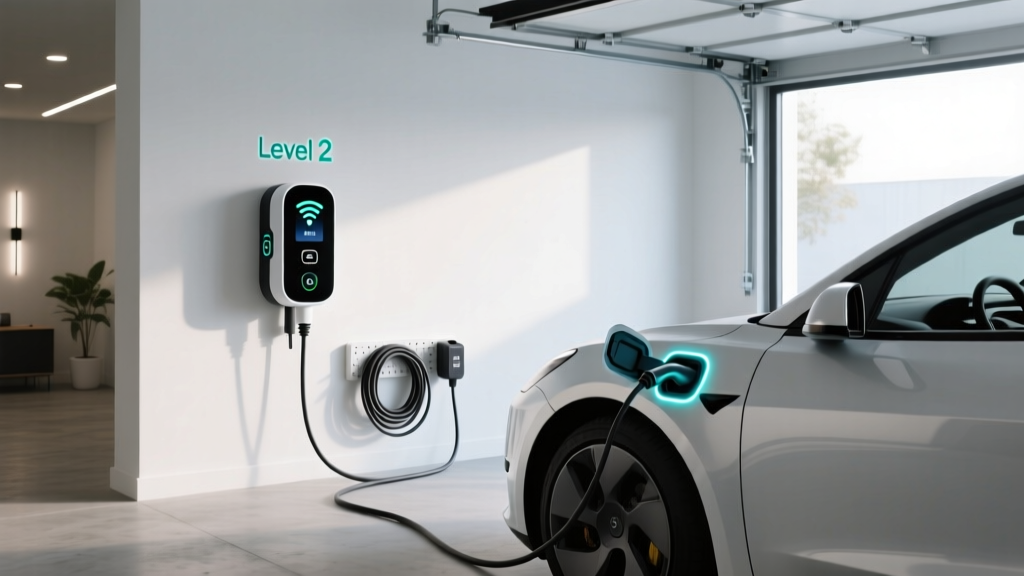
| Level 2 (Home) | 240V / 40A | 9.6 kW | ~28-32 miles | ~11 hours | Daily home charging |
| Level 2 (Max) | 240V / 48A | 11.5 kW | ~34-38 miles | ~9 hours | Faster home charging |
| DC Fast | 400V+ DC | 195 kW peak | ~180 miles in 10 min | 10-80% in ~34 min | Road trips, quick top-ups |
The BMW i7 supports a maximum Level 2 charge rate of 11 kW (48A at 240V) and DC fast charging up to 195 kW. That 195 kW peak is only sustained briefly — expect the charge curve to taper significantly above 50% state of charge, dropping to ~80-100 kW by 80% SoC. This is why manufacturers quote 10-80% times rather than 0-100%.
Home Charger Installation: Costs, Electrical Requirements & Permits
Charging your i7 at home is the most convenient and cost-effective approach. Here's what a Level 2 installation actually involves and what you'll pay.
Electrical Requirements for BMW i7 Home Charging
To achieve the i7's maximum 11 kW Level 2 rate, you need a dedicated 240V circuit with a 60A breaker (which allows continuous 48A draw per electrical code). Many homes have 40A circuits, which still deliver a solid 9.6 kW — sufficient for overnight charging.
| Component | Cost Range | Notes |
|---|---|---|
| Level 2 Charger (Equipment) | $400 - $700 | Smart chargers with WiFi/app control |
| Electrician Labor | $500 - $1,500 | Varies by region, complexity |
| Permit & Inspection | $100 - $300 | Required by most jurisdictions |
| Electrical Panel Upgrade | $1,500 - $3,000 | Only if panel is at capacity or <150A |
| Total (No Panel Upgrade) | $1,000 - $2,500 | Most common scenario |
| Total (With Panel Upgrade) | $2,500 - $5,500 | Older homes, high-load panels |
Do You Need a Panel Upgrade?
Your electrical panel has a maximum amperage rating (typically 100A, 150A, or 200A in residential homes). Adding a 60A EV circuit to a 100A panel that's already near capacity will trip the main breaker. A licensed electrician will perform a load calculation considering your HVAC, water heater, dryer, and other major appliances.
Red flags suggesting a panel upgrade:
- Panel is rated below 150A
- Multiple high-draw appliances (electric heat, tankless water heater, EVSE already installed)
- Panel is at or near 80% capacity without the EV charger
- Older fuse box rather than circuit breaker panel
Don't skip the permit. Unpermitted electrical work can void your home insurance, cause safety hazards, and create problems when you sell the house. Most jurisdictions require permits for any new 240V circuit.
Recommended Level 2 Chargers for BMW i7
The i7 uses a CCS1 connector for AC Level 2 charging. Here are three proven options that match the car's 11 kW onboard charger capability:
ChargePoint Home Flex
- Power Output: Up to 12 kW (50A) — adjustable
- Connector: CCS1 (J1772 with CCS combo)
- Cable Length: 23 feet
- Smart Features: WiFi, app scheduling, energy tracking, Alexa integration
- Price: ~$699
- Why it works: Flexible amperage lets you match your circuit; robust app; proven reliability
Emporia Vue Level 2 Charger
- Power Output: Up to 11.5 kW (48A)
- Connector: CCS1
- Cable Length: 24 feet
- Smart Features: WiFi, real-time energy monitoring, solar integration, load management
- Price: ~$549
- Why it works: Excellent value; integrates with Emporia home energy monitor; load balancing prevents panel overload
Wallbox Pulsar Plus
- Power Output: Up to 11.5 kW (48A)
- Connector: CCS1
- Cable Length: 20 feet
- Smart Features: WiFi, Bluetooth, app control, power sharing between units
- Price: ~$649
- Why it works: Compact design; outdoor-rated (NEMA 4); good for tight garage spaces
Pro tip: The i7's onboard charger maxes out at 11 kW, so buying a 19.2 kW charger won't charge your car any faster. Match the charger to your car's capability and your electrical circuit.
Public DC Fast Charging: Networks, Connectors & Real Charge Times
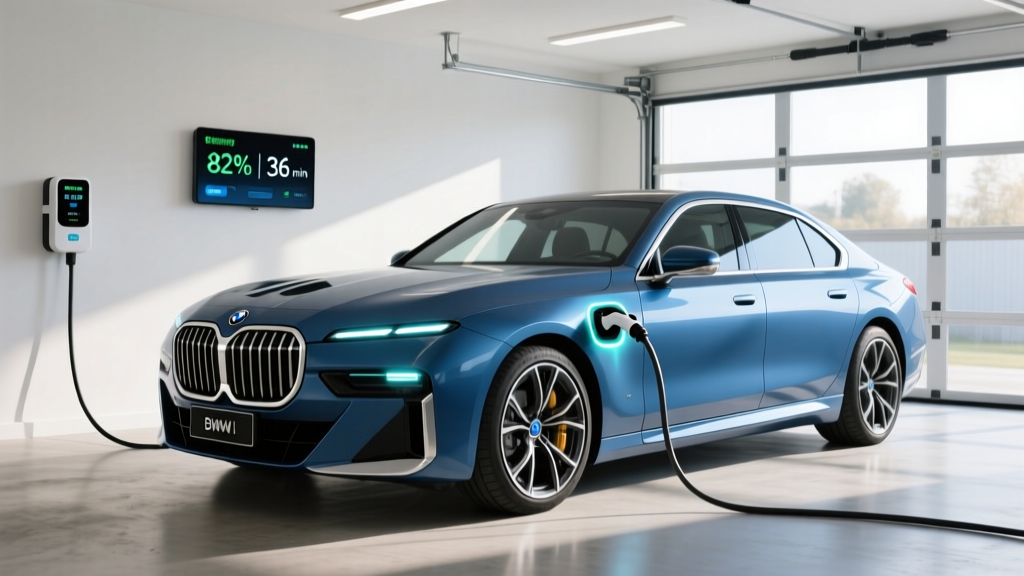
For road trips, the i7's 195 kW peak DC fast-charging capability means you can add ~180 miles of range in about 10 minutes, or charge from 10-80% in roughly 34 minutes under ideal conditions (warm battery, low state of charge).
Connector Compatibility
The 2026 BMW i7 comes equipped with a CCS1 (Combined Charging System) port, the standard for most non-Tesla EVs in North America. However, Tesla's Supercharger network — the largest and most reliable DC fast-charging network — uses the NACS (North American Charging Standard) connector.
| Connector Type | Network | Native Compatibility | Adapter Required? |
|---|---|---|---|
| CCS1 | Electrify America, EVgo, ChargePoint | ✅ Yes (native) | No |
| NACS (Tesla) | Tesla Supercharger | ❌ No | Yes — CCS-to-NACS adapter (~$200-250) |
| CHAdeMO | Limited legacy stations | ❌ No | Not available (obsolete standard) |
BMW has announced that future model years may adopt NACS natively, but for 2026, you'll need an adapter to access Tesla Superchargers. The official BMW adapter or third-party options like the Lectron CCS-to-NACS adapter enable access to Tesla's 20,000+ Supercharger stalls.
Real-World DC Fast Charging Times
The 195 kW peak rate only applies when the battery is warm (preconditioned) and at a low state of charge (10-20%). Here's what to expect:
- 10-80%: ~34 minutes (under ideal conditions)
- 10-50%: ~15 minutes (fastest charging window)
- 50-80%: ~19 minutes (charge rate tapers)
- 80-100%: ~40+ minutes (very slow — avoid unless necessary)
Battery preconditioning matters. If you navigate to a DC fast charger using the i7's built-in navigation, the car will automatically warm the battery to optimize charge speed. Without preconditioning (e.g., arriving at a charger with a cold battery), expect 10-80% times to stretch to 45-50 minutes.
Charging Cost Analysis: Home vs Public vs Gas
Electricity costs vary dramatically by location, time of day, and charging method. Let's break down real costs for the i7's 101.7 kWh battery and compare to gas equivalents.
| Charging Scenario | Cost per kWh | Cost for Full Charge (0-100%) | Cost per Mile | Annual Cost (12,000 mi) |
|---|---|---|---|---|
| Home (Off-Peak) | $0.12 | $12.20 | $0.038 | $456 |
| Home (Peak) | $0.22 | $22.37 | $0.070 | $840 |
| Public Level 2 | $0.30 | $30.51 | $0.096 | $1,152 |
| DC Fast (Electrify America) | $0.48 | $48.82 | $0.154 | $1,848 |
| Gas Equivalent (25 MPG, $3.50/gal) | — | $44.52 | $0.140 | $1,680 |
Key takeaways:
- Home off-peak charging saves ~$1,200/year vs gas
- Exclusive DC fast charging actually costs more than gas — home charging is essential for cost savings
- Time-of-use electricity plans can cut home charging costs by 40-50%
- The i7's efficiency (2.8-3.2 kWh/mile) is typical for a large luxury EV sedan
Safety, Electrical Code & Best Practices
EV charging involves high currents over extended periods. Cutting corners on safety creates fire risk and insurance liability.
Code Requirements
- Dedicated circuit: Your EV charger must have its own dedicated breaker — no sharing with other outlets or appliances
- GFCI protection: Required for outdoor installations and some jurisdictions require it indoors
- Outdoor rating: If mounted outside, charger must be NEMA 3R or NEMA 4 rated for weather resistance
- Wire gauge: 6 AWG copper for 60A circuits, 8 AWG for 40A circuits (electrician will specify)
- Disconnect switch: Some jurisdictions require a visible disconnect within sight of the charger
Best Practices
- Schedule charging during off-peak hours (typically 10 PM - 6 AM) for lower electricity rates
- Set charge limit to 80-90% for daily use to extend battery longevity (the i7's battery management system handles this automatically)
- Use the BMW app or charger app to monitor charging status and receive completion alerts
- Inspect charging cable and connector monthly for damage, corrosion, or overheating
- Never use extension cords — they create voltage drop and fire risk at these power levels
BMW i7 Ownership: Battery Warranty, Degradation & Long-Term Costs
The i7's high-voltage battery is covered by BMW's 8-year/100,000-mile warranty, which guarantees the battery will retain at least 70% of its original capacity. Real-world data from similar BMW iX and i4 models suggests degradation of 5-8% over the first 100,000 miles under normal use.
The 101.7 kWh battery uses NMC (nickel-manganese-cobalt) chemistry, which offers high energy density but is more sensitive to extreme heat and frequent DC fast charging than LFP (lithium iron phosphate) batteries. To maximize longevity:
- Avoid frequent DC fast charging (use Level 2 at home as your primary method)
- Don't regularly charge to 100% unless needed for long trips
- Minimize extended parking at very low (<10%) or very high (>95%) state of charge
- Use preconditioning in extreme temperatures
Battery replacement cost (if out of warranty) is estimated at $20,000-$25,000 based on current BMW pricing, though this is rare within the first 10 years of ownership.
Frequently Asked Questions
How much does it cost to install a home EV charger for the BMW i7?
Expect $1,000-$2,500 for a standard installation (equipment + electrician + permit) if your electrical panel has sufficient capacity. If you need a panel upgrade (common in older homes), add $1,500-$3,000, bringing the total to $2,500-$5,500. Get 2-3 quotes from licensed electricians and always pull a permit.
How fast will each charging level add range to my i7?
Level 1 (120V): ~4-5 miles per hour. Level 2 (240V, 48A): ~34-38 miles per hour. DC fast charging: ~180 miles in 10 minutes (10-80% in ~34 minutes). For daily use, Level 2 home charging adds 250-300 miles overnight — more than enough for most drivers.
Which charger connector is compatible with the BMW i7?
The i7 uses CCS1 natively, which works with Electrify America, EVgo, and ChargePoint DC fast chargers. To use Tesla Superchargers, you'll need a CCS-to-NACS adapter (~$200-250). CHAdeMO is not supported and is largely obsolete.
How much does charging the i7 cost per mile compared to gas?
Home off-peak charging: ~$0.038/mile. DC fast charging: ~$0.154/mile. Gas equivalent (25 MPG sedan): ~$0.140/mile. Home charging saves 70-75% vs gas, but exclusive DC fast charging costs more than gas. Install a home charger to realize EV cost savings.
What electrical upgrades might I need for a home charger?
If your electrical panel is below 150A or near 80% capacity, you'll likely need a panel upgrade ($1,500-$3,000). Older homes with fuse boxes, 100A service, or multiple high-draw appliances (electric heat, tankless water heater) are most likely to require upgrades. A licensed electrician will perform a load calculation to determine your exact needs.
Does the BMW i7 qualify for the federal EV tax credit?
The 2026 i7 xDrive60 (MSRP ~$120,000) exceeds the IRS §30D sedan price cap of $55,000, making it ineligible for the $7,500 federal tax credit. Check current IRS rules as sourcing requirements and eligibility change annually.
How long does the BMW i7 battery last?
BMW warranties the battery for 8 years/100,000 miles with guaranteed 70% capacity retention. Real-world data suggests 85-95% capacity at 100,000 miles with proper care (primarily Level 2 charging, avoiding extreme SoC). Most EV batteries outlast the vehicle's useful life.
Bottom Line: Charging the BMW i7 at Home Is Essential
The i7's 318-mile EPA range is sufficient for most daily driving and moderate road trips, but maximizing convenience and cost savings requires home Level 2 charging. Budget $1,000-$2,500 for installation (more if you need a panel upgrade), choose a smart charger like the ChargePoint Home Flex or Emporia Vue, and charge during off-peak hours for the lowest per-mile cost.
For road trips, the 195 kW DC fast-charging capability and CCS1 connector give you access to most major networks, with a NACS adapter opening up Tesla Superchargers. Just remember: home charging is where EVs deliver their economic advantage. Rely exclusively on DC fast charging, and you'll pay more per mile than gas.