BMW i5 Range and Charging: What You Need to Know
The BMW i5 (G60 generation) delivers an EPA-estimated range of up to 295 miles in eDrive40 trim, with the dual-motor M60 variant rated at 256 miles. But achieving that range—and replenishing it efficiently—depends entirely on your charging setup. Whether you're charging overnight at home or topping up on a road trip, understanding the i5's charging architecture is essential for ownership satisfaction.
The 2026 BMW i5 eDrive40 starts at $66,800 (MSRP), while the xDrive40 and M60 variants climb to $72,800 and $84,100 respectively. All trims use an 81.2 kWh (usable) lithium-ion battery with NMC chemistry. The i5 supports DC fast charging at up to 205 kW peak, which BMW claims can add 10-80% state of charge in approximately 30 minutes under ideal conditions.
Real-World Range Expectations: BMW i5 eDrive40
EPA Estimate: 295 miles
Highway (70+ mph, moderate temps): ~250-270 miles
Cold Weather (below 32°F): ~210-240 miles
Combined real-world average: ~260-280 miles
The i5's heat pump (standard on all trims) mitigates cold-weather range loss compared to EVs without thermal management, but expect 15-25% reduction in freezing temperatures. Highway driving at sustained speeds above 70 mph also reduces efficiency due to aerodynamic drag.
Understanding EV Charging Levels: kW vs kWh
Before diving into equipment, let's clarify the most common EV terminology confusion:
- kWh (kilowatt-hour): Energy capacity—how much electricity your battery holds. The i5 has an 81.2 kWh usable battery.
- kW (kilowatt): Power—how fast energy flows into your battery. A 11.5 kW Level 2 charger delivers energy faster than a 1.4 kW Level 1 outlet.
Think of it like filling a bucket: kWh is the bucket size, kW is the hose flow rate. Now let's break down what each charging level actually delivers.
| Charging Level | Voltage | Power (kW) | Miles of Range Added Per Hour | Typical Use Case |
|---|---|---|---|---|
| Level 1 | 120V AC | 1.2-1.9 kW | 3-5 miles | Overnight trickle, emergencies, PHEVs |
| Level 2 (Home/Public) | 240V AC | 3.3-19.2 kW | 12-75 miles | Daily home charging, workplace, shopping centers |
| DC Fast Charging | 400-800V DC | 50-350 kW | 150-1,000+ miles (peak) | Road trips, rapid top-ups, commercial fleets |
BMW i5 Charging Times by Level
Level 1 (120V, 12A): 1.4 kW — Adds ~4 miles per hour. A full 0-100% charge takes 58+ hours. Not practical for daily use unless you drive less than 30 miles per day.
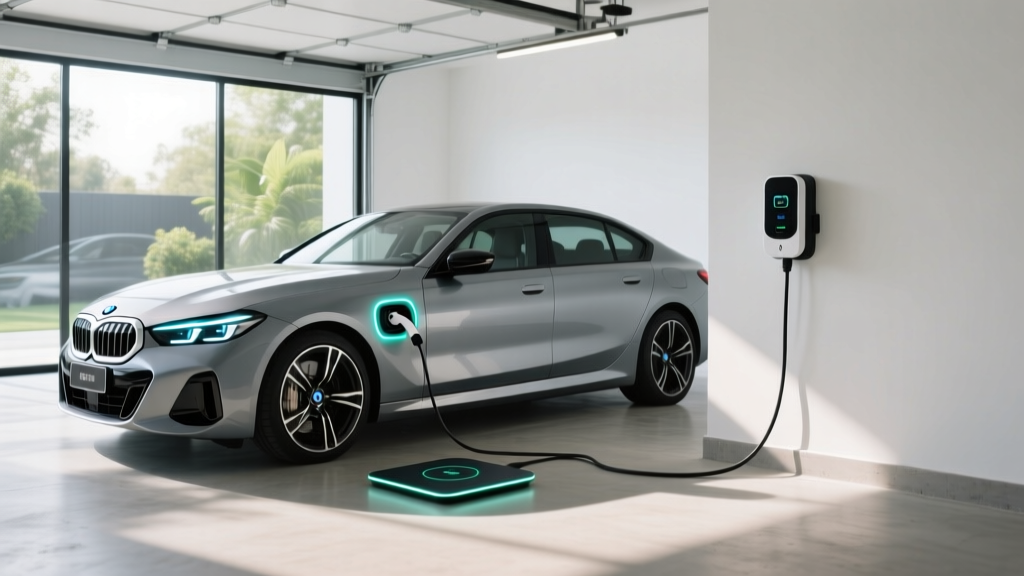
Level 2 (240V, 48A): 11.5 kW (i5's onboard charger limit) — Adds ~35 miles per hour. A 10-80% charge takes approximately 5.5 hours. This is the sweet spot for overnight home charging.
DC Fast Charging (205 kW peak): 10-80% in ~30 minutes under optimal conditions (battery preconditioned, charger at 50% or lower state of charge). Above 80% SoC, charging speed tapers significantly to protect battery health—expect 80-100% to take an additional 20-25 minutes.
Charge Curve Reality Check
The i5's 205 kW peak rate only applies between roughly 10-50% state of charge. From 50-80%, the rate drops to 100-150 kW, and above 80% it falls below 50 kW. This is normal lithium-ion battery behavior to prevent lithium plating and thermal stress. Never plan a road trip assuming sustained peak charging speeds.
Home Level 2 Charger Installation: Costs and Requirements
Installing a Level 2 home charger is the single most impactful upgrade for EV ownership. For the BMW i5, a 48-amp, 240V circuit delivers the maximum 11.5 kW the car can accept. But installation costs vary widely based on your home's electrical infrastructure.
Electrical Requirements for BMW i5 Home Charging
- Circuit: Dedicated 60-amp breaker (provides 48 amps continuous, per NEC 80% rule)
- Voltage: 240V (same as an electric dryer or oven)
- Wire gauge: 6 AWG copper (or 4 AWG aluminum) for runs up to 100 feet
- Outlet type: NEMA 14-50 (if using a plug-in charger) or hardwired connection (preferred for reliability)
- Panel capacity: Minimum 100-amp service, though 200-amp is standard in most homes built after 1990
Do You Need a Panel Upgrade?
If your home has a 100-amp electrical panel and you're already running high-draw appliances (electric oven, dryer, HVAC), adding a 60-amp EV circuit may exceed your panel's capacity. An electrician will perform a load calculation to determine if you need a panel upgrade to 200 amps.
Panel upgrade cost: $2,500-$5,000+ depending on your utility, local permitting, and whether a new service drop is required. This is the single largest variable in home charger installation.
| Component | Cost Range | Notes |
|---|---|---|
| Level 2 Charger (48A, 240V) | $500-$800 | Smart WiFi-enabled models (ChargePoint, Emporia, Wallbox) |
| Electrician Labor (standard install) | $600-$1,500 | Run 6 AWG wire, install breaker, mount charger, 2-6 hours |
| Permit Fees | $50-$300 | Varies by municipality; some utilities cover this |
| Panel Upgrade (if needed) | $2,500-$5,000 | 100A to 200A service upgrade; not required in most modern homes |
| Additional Materials | $100-$300 | Conduit, junction boxes, grounding rod (if required) |
| Total (no panel upgrade) | $1,250-$2,900 | Most common scenario for homes built after 1990 |
| Total (with panel upgrade) | $3,750-$7,900 | Older homes with 100A service or high existing loads |
Many utilities offer rebates of $250-$1,000 for Level 2 charger installation, and some states provide additional incentives. Check with your local utility and state energy office. The federal Residential Clean Energy Credit (IRS §25D) covers 30% of charger equipment and installation costs up to $1,000 through 2032.
Connector Compatibility: NACS, CCS1, and the BMW i5
The 2026 BMW i5 uses the NACS (North American Charging Standard) connector, which BMW adopted starting with the 2025 model year. This means the i5 can charge natively at Tesla Superchargers (V3 and V4) without an adapter—a significant advantage for road-trip charging access.
| Connector | Brands Using It (2026) | DC Fast Charge Networks | Adapter Needed for i5? |
|---|---|---|---|
| NACS (Tesla) | Tesla, BMW, Ford, GM, Rivian, Volvo, Polestar, Mercedes, Hyundai, Kia | Tesla Supercharger, Electrify America (select), EVgo | No—native connector |
| CCS1 | Legacy models (pre-2025), some commercial vehicles | Electrify America, EVgo, ChargePoint | Yes—CCS-to-NACS adapter ($200-$300) |
| CHAdeMO | Nissan Leaf (discontinued), Mitsubishi Outlander PHEV | Limited public availability | Not compatible; network nearly obsolete |
If you purchased a used 2024 or earlier BMW i5 (which used CCS1), you'll need a CCS-to-NACS adapter (~$250) to access Tesla Superchargers. BMW provides a CCS-to-NACS adapter with new 2025+ models for backward compatibility with legacy Electrify America stations.
Charging Cost: Home vs Public vs Gas
One of the strongest arguments for EV ownership is lower fueling costs, but the savings depend heavily on where you charge. Let's compare real-world scenarios for the BMW i5 eDrive40 (295-mile range, 81.2 kWh battery).
| Charging Scenario | Cost per kWh | Cost for 0-100% Charge | Cost per Mile | Annual Cost (12,000 miles) |
|---|---|---|---|---|
| Home (off-peak, utility rate) | $0.13 | $10.56 | $0.036 | $432 |
| Home (peak, utility rate) | $0.22 | $17.86 | $0.061 | $732 |
| Public Level 2 (ChargePoint, EVgo) | $0.30-$0.45 | $24-$37 | $0.08-$0.13 | $960-$1,560 |
| DC Fast Charging (Tesla Supercharger) | $0.28-$0.40 | $23-$32 | $0.08-$0.11 | $960-$1,320 |
| Gas Car (28 MPG combined, $3.50/gal) | N/A | $37 per 295 miles | $0.125 | $1,500 |
Key takeaway: If you charge primarily at home on off-peak rates, the i5 costs 70% less to "fuel" than a comparable gas car (BMW 530i, 28 MPG combined). But if you rely exclusively on public DC fast charging, your costs approach or exceed gas-car fueling—especially in high-cost states like California or New York.
For maximum savings, install a home Level 2 charger and take advantage of time-of-use (TOU) rates, charging overnight when electricity costs $0.08-$0.15/kWh in most markets.
Recommended Level 2 Chargers for BMW i5
Not all Level 2 chargers are created equal. For the BMW i5, you want a 48-amp charger (to match the car's 11.5 kW onboard charger limit) with a NACS connector, WiFi connectivity for scheduling, and a cable length that reaches your parking spot.
ChargePoint Home Flex (NACS)
- Power Output: Up to 11.5 kW (48A, 240V)
- Connector: NACS (native, no adapter)
- Cable Length: 23 feet
- Smart Features: WiFi, app scheduling, Alexa integration, energy reports
- Price: $699 (charger only)
- Best For: Reliable daily charging, excellent app, UL-listed
Emporia Vue Smart Home EV Charger
- Power Output: Up to 11.5 kW (48A, 240V)
- Connector: NACS (native) or J1772 (with adapter)
- Cable Length: 24 feet
- Smart Features: WiFi, solar integration, load balancing with home energy monitor
- Price: $599 (charger only)
- Best For: Homes with solar panels, budget-conscious buyers
Wallbox Pulsar Plus (NACS)
- Power Output: Up to 11.5 kW (48A, 240V)
- Connector: NACS (native)
- Cable Length: 25 feet
- Smart Features: WiFi, Bluetooth, Power Sharing (daisy-chain two chargers on one circuit)
- Price: $649 (charger only)
- Best For: Two-EV households, compact design
All three chargers are UL-listed (critical for insurance and code compliance), support hardwired or NEMA 14-50 plug installation, and include a 3-year warranty. Avoid non-UL-listed chargers from Amazon or AliExpress—they may not pass inspection and could void your homeowner's insurance in the event of an electrical fire.
Safety and Electrical Code Considerations
EV charger installation must comply with the National Electrical Code (NEC) and local building codes. Key requirements include:
- Dedicated circuit: Your Level 2 charger must have its own breaker—no sharing with other appliances.
- GFCI protection: NEC 2020 and later require ground-fault circuit interrupter protection for all EV charging outlets (not required for hardwired installations).
- Outdoor rating: If your charger is installed outside (garage exterior, carport, driveway), it must be rated for wet locations (NEMA 4 or IP65).
- Cable management: NEC requires strain relief and protection from physical damage—don't let the cable drape across a driveway where cars can run over it.
- Permit and inspection: Most jurisdictions require an electrical permit and final inspection. Skipping this can void your homeowner's insurance and create liability issues.
Hire a licensed electrician with EV charger installation experience. Ask if they've installed Level 2 chargers before and whether they'll pull the required permits. A reputable electrician will perform a load calculation and advise you honestly on whether a panel upgrade is needed.
Frequently Asked Questions
How much does it cost to install a home EV charger for the BMW i5?
A standard Level 2 installation (48A, 240V) costs $1,250-$2,900 if your electrical panel has sufficient capacity. If you need a panel upgrade from 100A to 200A service, total costs range from $3,750-$7,900. Most homes built after 1990 have 200A panels and don't require an upgrade.
How fast will each charging level add range to my BMW i5?
Level 1 (120V) adds 3-5 miles per hour—too slow for daily use. Level 2 (240V, 48A) adds ~35 miles per hour, replenishing 10-80% in about 5.5 hours. DC fast charging (205 kW peak) adds 10-80% in ~30 minutes under optimal conditions, making it suitable for road trips.
Which connector does the 2026 BMW i5 use?
The 2026 BMW i5 uses the NACS (North American Charging Standard) connector, which is compatible with Tesla Superchargers natively. If you own a 2024 or earlier i5 (CCS1 connector), you'll need a CCS-to-NACS adapter (~$250) to access Tesla's network.
How much does charging cost per mile compared to gas?
Charging at home on off-peak rates ($0.13/kWh) costs ~$0.036 per mile—about 70% less than a 28 MPG gas car at $3.50/gallon ($0.125/mile). However, public DC fast charging ($0.28-$0.40/kWh) costs $0.08-$0.11 per mile, approaching gas-car costs. Home charging is essential for maximizing EV savings.
What electrical upgrades might I need for a Level 2 charger?
If your home has a 200-amp electrical panel (standard in most post-1990 homes), you likely need no upgrades—just a dedicated 60-amp breaker and 6 AWG wire. Homes with 100-amp panels or high existing electrical loads (electric heat, oven, dryer) may require a panel upgrade to 200 amps, costing $2,500-$5,000.
Can I use a Tesla Wall Connector with my BMW i5?
Yes. The Tesla Wall Connector (Gen 3) now ships with a NACS connector and works with any NACS-equipped EV, including the BMW i5. It delivers up to 11.5 kW (48A) and costs $475, making it one of the most affordable premium chargers. However, it lacks the advanced scheduling features of ChargePoint or Emporia.
The BMW i5's 295-mile EPA range and 205 kW DC fast charging capability make it a practical luxury EV for both daily commuting and road trips—but only if you have the right charging infrastructure. A home Level 2 installation is the single most important investment you can make as an i5 owner, delivering convenience, cost savings, and battery longevity.